


An LLC, or Limited Liability Company, is a business structure that separates personal finances from business responsibilities. This means your personal assets – like your home or savings – are protected if your business faces lawsuits or debts. It’s a popular choice for small business owners because it combines liability protection with simpler rules compared to corporations.
Why Choose an LLC?
- Liability Protection: Shields your personal assets from business debts or legal issues.
- Tax Flexibility: By default, profits are taxed on your personal return, avoiding corporate taxes.
- Simpler Setup: Fewer administrative requirements than corporations.
- Credibility: Adding "LLC" to your business name signals legitimacy.
Key Facts:
- Over 21.6 million LLCs exist in the U.S.
- State filing fees range from $30 to $500.
- LLCs are taxed as "pass-through entities" by default, meaning the business itself doesn’t pay federal income tax.
Is It Right for You?
LLCs work well for freelancers, small business owners, real estate investors, and e-commerce sellers. They’re ideal if you want liability protection without the complexity of running a corporation.
Quick Tip:
To maintain liability protection, keep business and personal finances separate, use a business bank account, and follow state compliance rules.
For more details on setting up and maintaining an LLC, including tax options and state-specific fees, keep reading.
How an LLC Protects You and How It Works
Liability Protection Explained
When it comes to lawsuits or debts, an LLC (Limited Liability Company) creates a shield around your personal property. In these cases, only the LLC’s assets are at risk, keeping your personal belongings safe.
But there are limits to this protection. Courts can "pierce the corporate veil" and hold you personally responsible if you commit fraud, mix personal and business funds, or fail to meet state compliance rules. Additionally, signing a personal guarantee for a business loan or lease means you’ve voluntarily given up this protection for that particular obligation.
"Limited liability means that the assets and debts of the business remain separate from the personal assets and debts of the LLC’s owners." – Investopedia
Another crucial step often overlooked is getting business liability insurance. While an LLC protects your personal assets, it doesn’t safeguard the company’s assets from claims. Liability insurance can help fill that gap, offering extra coverage for business-related risks.
The key to maintaining this protection is treating the LLC as a separate legal entity, which is more than just a legal formality – it’s a practical necessity.
LLC as a Separate Legal Entity
An LLC is recognized in all U.S. states as its own legal "person." It can own property, sign contracts, take on debt, and even face lawsuits – all independently of its owner(s).
This separation is what creates the liability shield, but it only works if you respect the boundaries. For instance, when signing contracts, always use the format: "Your Name, Manager of [LLC Name]." Signing in your personal capacity could leave you exposed to personal liability.
Corporate attorney Omaima Poonawala emphasizes the importance of an operating agreement:
"A well-drafted operating agreement will clearly lay out the LLC’s rules for key issues… If the LLC has no operating agreement, I may have to work with the client to comb through emails and other documents to piece together agreements. The result is less certainty and higher legal fees."
Even though not all states require an operating agreement, having one strengthens the LLC’s independence. It helps establish clear rules and reinforces the separation between your personal and business finances.
LLC vs Other Business Structures: A Side-by-Side Look
Here’s how an LLC stacks up against other common business structures: Feature Sole Proprietorship Partnership LLC Corporation (C Corp)
Corporations offer the strongest liability protection but come with a lot of red tape. You’ll need a board of directors, formal meetings, and detailed record-keeping. For most new entrepreneurs, an LLC strikes the perfect balance – offering solid liability protection and tax flexibility without the added complexity.
How LLCs Are Taxed: What Founders Need to Know
LLCs combine liability protection with operational ease, but understanding how they’re taxed is just as important. Tax strategy can be a powerful tool for managing your LLC’s finances. One of the standout features of an LLC is its tax flexibility – it offers several tax election options that cater to different business needs.
Pass-Through Taxation Basics
The IRS automatically treats LLCs as pass-through entities. This means that profits and losses are reported on the owners’ personal tax returns, and the LLC itself doesn’t pay federal income tax.
Here’s how it works:
- Single-Member LLCs: Treated as disregarded entities, income and expenses are reported on Schedule C of the owner’s Form 1040.
- Multi-Member LLCs: Treated as partnerships, requiring the filing of an informational return (Form 1065) and issuing Schedule K-1 forms to members, detailing their share of profits.
One thing that often catches founders off guard is that taxes are owed on your share of the LLC’s net profit, even if you leave the money in the business. For example, if your LLC earns $80,000 and you don’t withdraw a penny, you’re still taxed on the full amount.
LLC owners are also responsible for a 15.3% self-employment tax, which covers Social Security and Medicare. However, pass-through owners can deduct up to 20% of their net business income under the Qualified Business Income (QBI) deduction, a benefit solidified by the One Big Beautiful Bill Act signed on July 4, 2025. Additionally, if you expect to owe $1,000 or more in taxes for the year, the IRS requires quarterly estimated tax payments in April, June, September, and January to avoid penalties.
For LLCs with higher earnings, there’s another option that could lead to tax savings.
S Corporation Election for LLCs
If your LLC’s net profit falls between $50,000 and $75,000 annually, electing S corporation (S Corp) status might be worth exploring. This is done by filing IRS Form 2553. While your LLC remains the same legally, its tax treatment changes.
The major advantage of an S Corp election is income splitting. You pay yourself a “reasonable salary” (taxed at the 15.3% self-employment rate) and take the remaining profits as distributions, which aren’t subject to that tax. This can result in substantial tax savings.
"The S corporation is the only business form that makes it possible for its owners to save on Social Security and Medicare taxes." – Christine Mathias, Attorney, Penn State Dickinson School of Law
However, this option comes with added responsibilities. You’ll need to manage payroll, file Form 1120-S, and issue W-2s and K-1s. These compliance requirements can cost between $3,500 and $5,000 annually, including payroll processing and CPA fees. Additionally, the IRS closely monitors what constitutes a “reasonable salary,” so it’s essential to align with industry standards to avoid audits.
"There is no single choice that is always better for a business owner – the owner’s current needs and future plans should be evaluated by working with a professional." – April Walker, Lead Manager for Tax Practice & Ethics, American Institute of CPAs
State-Level Taxes and Fees
Federal taxes are just one part of the equation. Each state has its own rules for LLCs, and the costs can vary dramatically based on where your business is formed and operates.
Here’s a look at typical state fees and taxes:
| State | Filing Fee | Annual/Biennial Fee | Notable Tax or Note |
|---|---|---|---|
| Arizona | $50 | $0 | No annual report required |
| California | $70 | $20 (biennial) | $800 minimum annual franchise tax |
| Delaware | $110 | $400 | Flat annual franchise tax |
| Florida | $125 | $138.75 | No state income tax |
| Massachusetts | $500 | $500 | Highest fees in the U.S. |
| New York | $200 | $9 (biennial) | Requires newspaper publication ($500–$1,500+) |
| Texas | $300 | $0 | Franchise tax applies only above $2.65M revenue |
| Wyoming | $100 | Minimum $60 | No state income tax |
California stands out as the priciest state for LLCs, with an $800 annual franchise tax, no matter your revenue. Meanwhile, states like Wyoming and Florida offer low fees and no state income tax, making them appealing to many business owners.
Still, forming an LLC in a state like Delaware or Wyoming doesn’t mean you can sidestep taxes if your business operates elsewhere. You’ll need to register as a foreign LLC in your home state and pay its fees on top of those in Delaware or Wyoming. For most small businesses, forming an LLC in the state where you operate is usually the simplest and most cost-effective choice.
Is an LLC the Right Choice for Your Business?
Beyond tax considerations, it’s crucial to decide if an LLC fits your specific business needs.
Common Situations Where an LLC Makes Sense
LLCs work well for many business types, but they’re particularly useful in certain scenarios.
For freelancers and independent contractors – like consultants, writers, or designers – LLCs provide a liability shield. This means that if a client sues over a contract issue, your personal assets stay off-limits. Real estate investors often turn to Series LLCs (available in roughly 20 states), which allow them to separate each property into its own legal entity. This setup ensures that a lawsuit tied to one property doesn’t jeopardize the others.
E-commerce sellers handling high transaction volumes often benefit from an LLC. It simplifies opening a business bank account, managing vendor relationships, and keeping personal finances distinct from business activities. Meanwhile, licensed professionals – such as doctors, lawyers, and accountants – frequently establish Professional LLCs (PLLCs). This structure helps them manage costs while maintaining their individual credentials.
Here’s an eye-catching stat: LLCs represented 72.7% of all partnerships filed for the 2023 tax year. That figure underscores just how widely this structure is embraced by businesses of all sizes.
"An LLC is an excellent choice if you want more liability protection than in a sole proprietorship but aren’t positioned to register as a C corp or an S corp." – LegalZoom
The tax benefits discussed earlier make LLCs even more appealing for many business owners. Now, let’s dive into how LLCs compare to corporations to help you decide which structure suits your goals.
LLC vs Corporation: Key Differences for Founders
While LLCs are ideal for many, understanding how they differ from corporations can clarify your decision. The choice often hinges on your tax preferences, willingness to handle administrative tasks, and plans for seeking outside investments.
| Feature LLC C Corporation | ||
|---|---|---|
| Liability Protection | Yes; personal assets protected | Yes; personal assets protected |
| Taxation | Pass-through by default; flexible elections | Double taxation (corporate profits and dividends) |
| Management | Flexible; member or manager run | Structured; requires board, officers, and shareholders |
| Formalities | Low; minimal meeting and record requirements | High; annual meetings, formal minutes, and resolutions |
| VC Attractiveness | Low; less appealing to institutional investors | High; preferred for issuing stock |
One major difference is taxation. Corporations face double taxation on profits and dividends, while LLCs avoid this with pass-through taxation. However, if you’re planning to raise venture capital or aim for an IPO, a C corporation is usually the better choice. Investors favor C corporations because they make stock issuance straightforward. In fact, 81.4% of U.S. IPOs in 2024 were filed in Delaware, a state known for its corporation-friendly laws.
For most new business owners – whether you’re a solo entrepreneur, part of a small team, running a local service, or selling online – an LLC offers a great mix of liability protection, ease of management, and tax efficiency, all without the heavier administrative load of a corporation.
sbb-itb-ba0a4be
How to Form an LLC in the United States: Step by Step
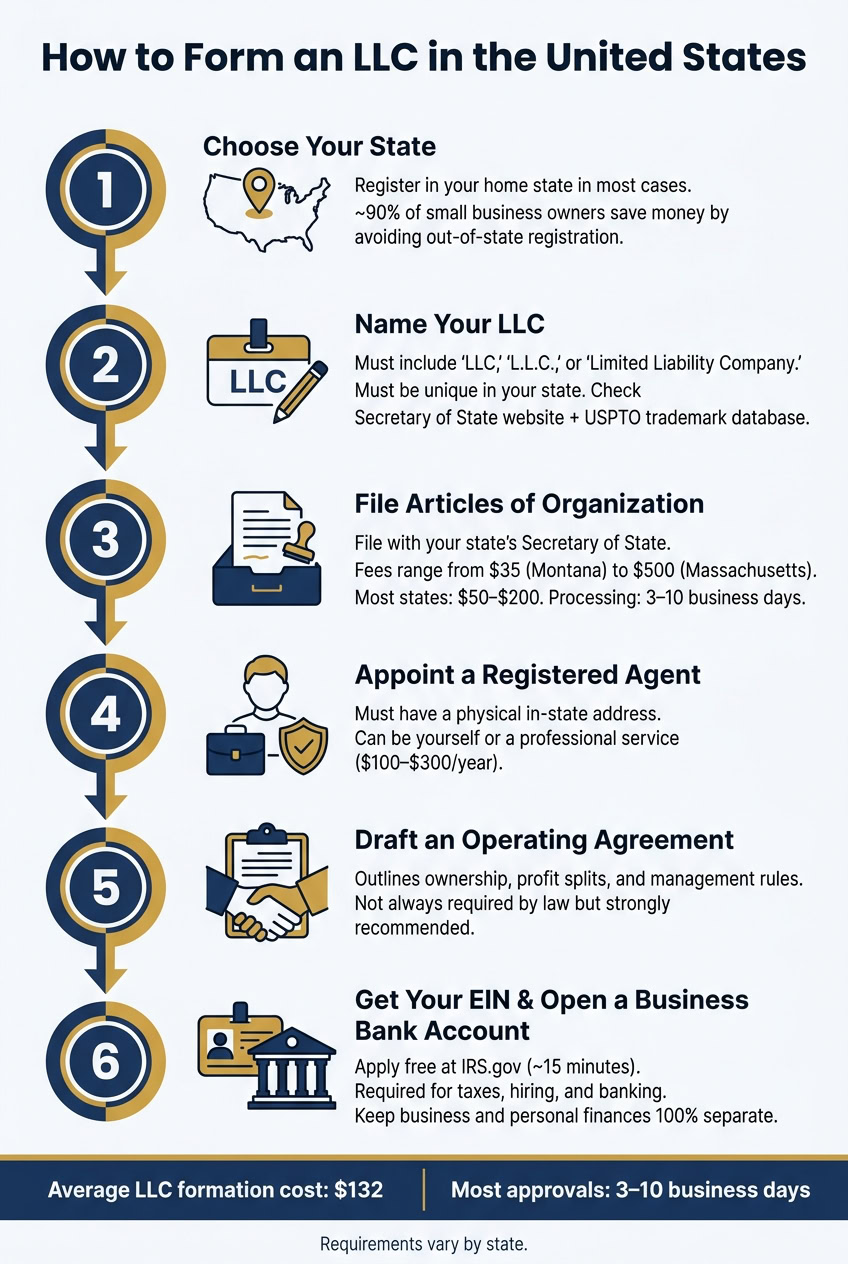
Ready to set up your LLC? Follow these simple steps to make it happen. On average, forming an LLC costs $132. Most states process approvals within 3 to 10 business days. Here’s how you can get started.
Choosing a State and a Name for Your LLC
For most business owners, the best place to register your LLC is your home state. While states like Delaware or Wyoming may sound appealing, if you live and operate in Texas, for example, you’ll need to register as a foreign LLC there – adding extra fees and paperwork. About 90% of small business owners find it easier and more cost-effective to stick with their local state.
When picking a name for your LLC, every state requires it to include an identifier like “LLC,” “L.L.C.,” or “Limited Liability Company.” The name must also be unique – it can’t match another business already registered in your state. To avoid issues, check your Secretary of State’s website to confirm the name’s availability. At the same time, confirm that the name is available both legally and online.
"While it may be tempting to register your new LLC with a name that’s catchy and distinctive, I often advise my clients to stick with something simple and basic. Use a dba [doing business as] to register business names that reflect your current or planned operations." – Omaima Poonawala, Corporate & Trademark Attorney
Don’t forget to check the USPTO trademark database as well. A name might pass at the state level but still conflict with a federal trademark, which could lead to expensive legal troubles.
Once you’ve finalized your name, it’s time to officially file your LLC.
Filing the Required Documents
With your name locked in, the next step is filing the Articles of Organization (sometimes called a Certificate of Formation) with your state’s Secretary of State office. This document officially establishes your LLC. Filing fees vary widely, from $35 in Montana to $500 in Massachusetts, but most states charge between $50 and $200.
You’ll also need to appoint a registered agent. This is a person or business with a physical address in your state who can receive legal and tax documents on behalf of your LLC during regular business hours. You can act as your own registered agent, or you can hire a professional service for $100 to $300 annually.
Next, draft an Operating Agreement. While this internal document isn’t filed with the state, it’s incredibly important. It outlines ownership stakes, how profits are divided, and how the LLC will be managed. Even though only a few states require it, having an operating agreement can save you from disputes down the road.
"Whenever a client comes to me about an internal business dispute, my first question is always the same: ‘What does your operating agreement say?’" – Omaima Poonawala, Corporate & Trademark Attorney
If you’re forming your LLC in New York, Arizona, or Nebraska, there’s one additional step: publishing a notice of your LLC formation in a local newspaper. This requirement can add $300 to $1,500 to your startup costs, so be sure to budget accordingly.
After filing, the next step is to set up your EIN and financial framework.
Setting Up Your EIN, Bank Account, and Tax Registrations
Once your LLC is officially approved, apply for an Employer Identification Number (EIN) through the IRS. This number is required for opening a business bank account, hiring employees, and filing taxes. The process is free and takes about 15 minutes when done online at IRS.gov.
The moment you receive your EIN, open a separate business bank account. This step is critical for maintaining your LLC’s liability protection. Mixing personal and business finances is a common reason courts “pierce the corporate veil,” which could make you personally responsible for business debts.
Finally, check if your business needs any specific licenses or tax registrations. Requirements vary by state and industry. For instance, a retail store might need a sales tax permit, while a contractor may need a state license. A quick visit to your state’s business portal will help you identify what’s necessary.
How to Run and Maintain Your LLC
Getting your LLC approved is just the first step. The way you handle its day-to-day operations determines whether your liability protection will actually hold up when it matters.
Keeping Business and Personal Finances Separate
One of the most important rules for running an LLC is keeping your business and personal finances completely separate. Open a dedicated business bank account and use a business credit card for company-related expenses only. Any transfers between personal and business accounts should be clearly documented as draws or distributions.
"Every entity needs its own QuickBooks file, its own business bank account. You need to be very intentional about how you move money in between them." – Casey Wojtalewicz, Cofounder, Canyon Coffee
When signing contracts, always use your official business title, like "Jane Smith, Member of XYZ LLC." This reinforces the LLC’s separate legal identity, which is critical in protecting your personal assets. Courts look at this separation closely when deciding whether to pierce the corporate veil. Keeping clear financial boundaries not only protects your assets but also makes compliance much easier.
Ongoing Compliance Requirements
Managing finances is just one part of running an LLC. Staying on top of compliance is equally important to maintain your liability protection. Most states require LLCs to file an annual or biennial report to update information about your business, such as its address, members, and managers. The filing fees can vary significantly – from $0 in Arizona to $800 annually in California, which imposes a minimum franchise tax regardless of revenue. Missing these deadlines can result in administrative dissolution, which immediately eliminates your liability protection.
Another critical requirement is maintaining a registered agent. The registered agent must always be available to receive legal documents, as failing to do so could result in a default judgment against your LLC without your knowledge. To avoid these risks, make it a habit to mark compliance deadlines on your calendar as soon as you form your LLC.
| State | Annual/Biennial Fee | Notable Requirement |
|---|---|---|
| California | $800/year | Minimum franchise tax, due even with no revenue |
| Delaware | $400/year | Annual franchise tax |
| Massachusetts | $500/year | Highest annual report fee in the U.S. |
| Texas | $0 | Franchise Tax Report still required |
| Arizona | $0 | No annual report required |
| New York | $9/biennial | Strict two-newspaper publication requirement |
Staying compliant not only protects your LLC but also makes day-to-day operations smoother. Tools designed for compliance management can help simplify this process.
How BusinessAnywhere Can Help You Stay Compliant
Tracking deadlines and managing documents can be overwhelming, but BusinessAnywhere offers tools to help keep your LLC compliant.
The platform provides compliance alerts, so you never miss a critical filing or renewal deadline. Their registered agent service, starting at just $147 per year, ensures a reliable point of contact is always available to handle legal and government notices on your behalf. Plus, all your key documents – like formation papers, EIN confirmation, and operating agreements – are stored in a centralized document management dashboard, making them easily accessible for banking, licensing, or legal needs.
For tax-related tasks, BusinessAnywhere offers S-Corp tax election filing for $97 and U.S. LLC tax filing for $700, services that can help you navigate common tax challenges faced by new LLC owners. If you already have an LLC and just need help with ongoing management, their existing company maintenance service ensures your registered agent and annual filings stay on track, so you don’t have to handle it all manually.
Conclusion: Key Takeaways for New Founders
Starting a business is a thrilling journey, but picking the right structure can make everything smoother. An LLC offers three big advantages: personal asset protection, tax flexibility, and operational simplicity – all crucial when you’re just starting out. With over 21.6 million LLCs currently running in the U.S., it’s easy to see why so many entrepreneurs lean toward this option.
But here’s the thing: the benefits of an LLC only stick if you keep things separate. That means setting up a dedicated bank account, drafting a clear operating agreement, and ensuring you have a dependable registered agent.
On top of asset protection, LLCs come with tax perks. By default, LLCs use pass-through taxation, which simplifies things for most small businesses. However, if your net profit hits around $60,000–$80,000 or more, switching to an S-Corp election could significantly cut down your self-employment taxes. Having a quick chat with a tax expert early on can save you money in the long haul.
Setting up an LLC isn’t expensive. State filing fees range from $35 to $500, depending on where you register, and many states let you complete the process entirely online. Once your LLC is formed, the ongoing tasks – like filing annual reports, maintaining a registered agent, and meeting compliance deadlines – are manageable with the right tools and systems in place.
FAQs
What doesn’t an LLC protect me from?
An LLC can help safeguard your personal assets – like your home and savings – against business debts and lawsuits. But this protection has its limits. You could still face personal liability if you commit fraud, engage in illegal activities, ignore governance rules, or blur the lines between personal and business finances. Plus, an LLC won’t exempt you from personal tax responsibilities, including self-employment taxes.
When should I elect S-Corp tax status for my LLC?
Electing S-Corp status for your LLC makes sense when your net income consistently surpasses $50,000 to $60,000 per year. This approach can lower your tax burden by dividing your income into two parts: a salary (which is subject to payroll taxes) and distributions (which are not subject to self-employment tax). To make this election, you’ll need to file IRS Form 2553. However, keep in mind that this decision comes with added responsibilities, such as managing payroll and filing separate tax returns. For the 2026 tax year, the deadline to file for S-Corp status is March 17, 2026.
Do I need to form my LLC in my home state or can I choose another state?
When setting up your LLC, you have the option to register in any state. However, most small businesses choose to register in the state where they operate. While forming an LLC in another state might seem appealing, it often requires you to register as a foreign entity in your home state. This process can lead to extra fees and additional compliance requirements, which may offset any potential savings. It’s important to weigh your business needs and goals carefully before deciding where to file.