

DBA, trade name, and fictitious name all refer to using a business name different from your legal name. These terms are interchangeable but vary by state. For example, California uses "fictitious business name", while Texas calls it an "assumed name." Here’s what you need to know:
- DBA (Doing Business As): A flexible option for branding under a name other than your legal name. It’s useful for sole proprietors or businesses managing multiple brands.
- Trade Name: A public-facing name for branding that doesn’t provide legal or liability protection. Often used for marketing purposes.
- Fictitious Name: Similar to a DBA, it’s required when operating under a name different from your legal one. Some states mandate publication in local newspapers.
Key Takeaways:
- These names don’t create a new legal entity or provide liability protection.
- Registration is required to open bank accounts, sign contracts, or avoid penalties.
- Costs and requirements vary by state, with fees ranging from $10 to $300 depending on location and publication rules.
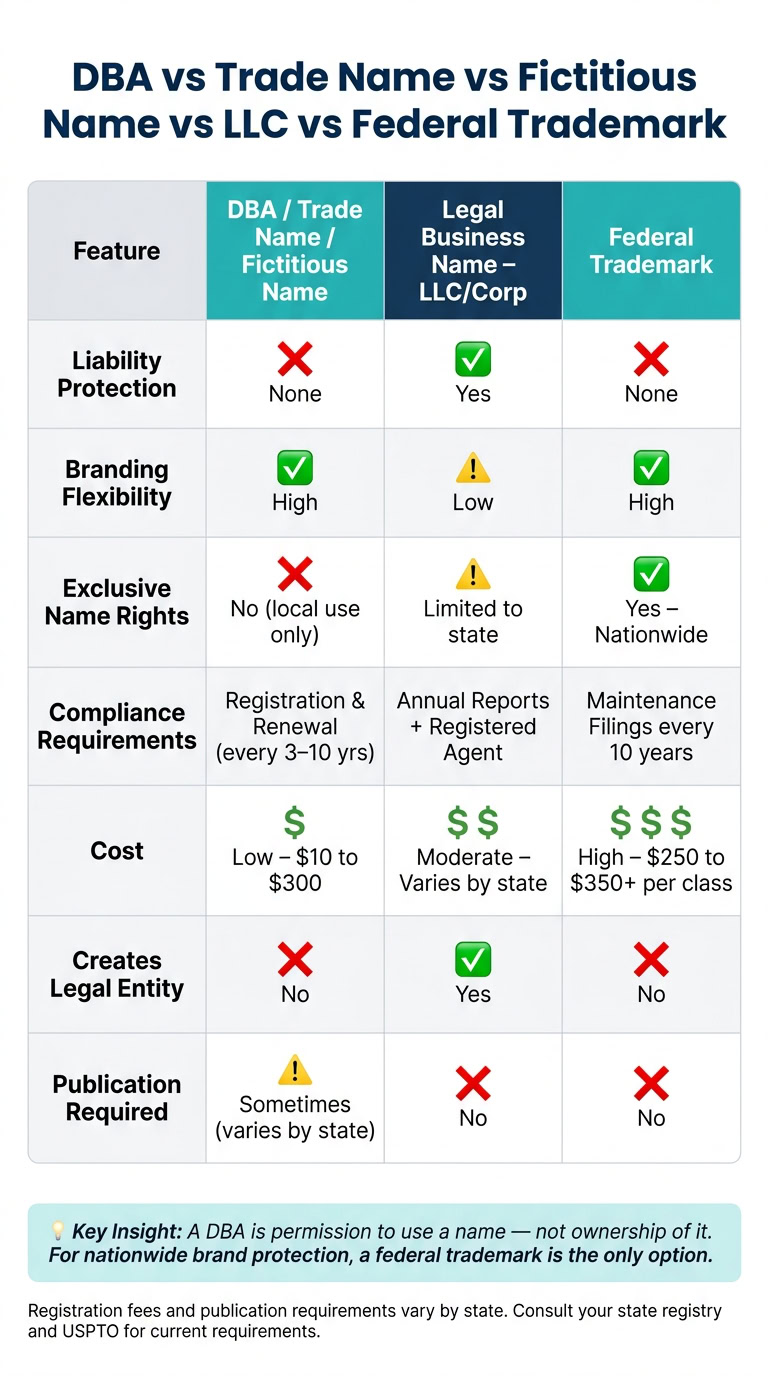
Quick Comparison Table:
| Feature | DBA / Trade Name / Fictitious Name | LLC vs Corporation | Federal Trademark |
|---|---|---|---|
| Liability Protection | None | Yes | None |
| Branding Flexibility | High | Low | High |
| Exclusive Name Rights | No | Limited | Yes (Nationwide) |
| Compliance Requirements | Registration & Renewal | Annual Reports | Maintenance Filings |
| Cost | Low ($10–$300) | Moderate (Varies by State) | High ($250–$350+) |
Before registering, confirm name availability through state databases and the USPTO trademark search. While these options offer branding flexibility, they don’t grant exclusivity – consider trademarks for nationwide protection.
1. DBA (Doing Business As)
Definition
A DBA, or "Doing Business As", is a name a business can use for operations that’s different from its legal name. For sole proprietors, the legal name is usually the owner’s personal name, while for LLCs or corporations, it’s the name listed on their formation documents. A DBA allows businesses to operate under a name that’s more aligned with branding, product differentiation, or marketing goals.
Legal Implications
A DBA doesn’t create a separate legal entity or offer liability protection. It also doesn’t change tax obligations. For sole proprietors, income is still reported on a personal tax return. However, registering a DBA is critical for tasks like opening bank accounts or signing contracts under the assumed name. It’s important to note that a DBA is distinct from other naming options, as discussed later in this guide.
Use Cases
DBAs can be helpful in several scenarios. For instance, a sole proprietor might use a DBA to adopt a more professional or marketable name without setting up an LLC, weighing the sole proprietorship pros and cons first. Similarly, an LLC or corporation might register a DBA to remove "LLC" or "Inc." from its branding for a cleaner look. Additionally, a single legal entity can manage multiple brands under different DBAs, although this approach means shared liability across all operations.
State-Specific Considerations
The process for registering a DBA varies by state. Some states handle filings at the state level, while others require county-level registration – or both, depending on the type of business. In some states, businesses must also publish a notice in a local newspaper. For example, California requires a four-week publication of a DBA notice, while Florida mandates publication before filing.
Here’s a quick look at key state filing requirements:
| State | Filing Level | Publication Required? | Renewal Period | Estimated Total Cost |
|---|---|---|---|---|
| California | County | Yes (4 weeks) | 5 years | $100–$225 |
| Texas | State (LLC/Corp) / County (Sole Prop) | No (usually) | 10 years | $15–$25 |
| Florida | State | Yes (once, pre-filing) | 5 years | $75–$200 |
| New York | State (LLC/Corp) / County (Sole Prop) | Yes (in some counties) | Indefinite | $25–$200+ |
| Delaware | State (as of Feb. 2, 2026) | No | Not specified | $25 |
In Delaware, starting February 2, 2026, all DBA filings will be centralized through the Delaware One Stop portal, eliminating the need for county-level notarization. Before registering a DBA, it’s a good idea to search your state’s business database and the USPTO trademark database. Keep in mind, a DBA doesn’t prevent others from using the same name in different areas and doesn’t protect against trademark infringement. If you need stronger protection, you should learn how to trademark a business name.
sbb-itb-ba0a4be
2. Trade Name
Definition
A trade name is essentially the public-facing name a business uses for branding and interaction with customers, differing from its official legal name used for tax and government records.
The terminology for trade names can vary by state. For example, Washington uses the term "trade name", while New York and Oregon use "assumed name", and Pennsylvania and California refer to it as a "fictitious name." Understanding these terms helps clarify the legal framework surrounding trade names.
Legal Implications
Registering a trade name does not create a separate legal entity or offer liability protection – it simply acts as an alias for the business. Attorney Andrew Sherman of Brown Rudnick contrasts it with trademarks, noting:
"It is a soft exclusivity compared to the benefits of a federally registered trademark, which is hardcore."
Unlike federally registered trademarks, trade name registration does not prevent others from using the same name in different states or regions. For true exclusivity, businesses should consider registering their name as a federal trademark. Additionally, failing to register a trade name can lead to penalties. For instance, in Connecticut, businesses may face fines or even imprisonment under Connecticut General Statutes Section 35-1.
These distinctions highlight why trade names are often used to build a brand presence rather than for legal protection.
Use Cases
Trade names are particularly effective for creating a recognizable brand identity. A good example is Gap Inc., which operates under its legal name but uses trade names like Old Navy, Athleta, and Banana Republic for its customer-facing brands. Sole proprietors also benefit from trade names, as they can project a professional image and simplify banking by allowing a single account to accept checks made out to either the legal name or the trade name.
State-Specific Considerations
The process for registering a trade name varies widely by state. In states such as Maryland and Colorado, registration is handled at the state level, while in places like California, Texas, and Virginia, it is managed by county or city offices. If your business operates in multiple states, you’ll need to register the trade name in each state separately, as registration in one state doesn’t provide legal protection in another.
Some states, including California and Illinois, require businesses to publish a notice in a local newspaper following registration. Registration fees range from $10 to $50 at the county level and can go up to $100 when state fees are included. Renewal periods also vary, typically ranging from 3 to 10 years, although in New York, trade name registrations do not expire.
3. Fictitious Name
Definition
A fictitious name refers to any name a business uses that isn’t the same as its legal name. As explained by the Florida Department of State:
"A fictitious name (also known as a ‘doing business as’ or ‘dba’) is: Different from your personal name, if doing business as a sole proprietor [or] Different from your entity’s legal name, if you have incorporated."
Similarly, the Virginia State Corporation Commission defines it as "a name that a person or business uses instead of their legal name." While states like Florida and Virginia use the term "fictitious name", others, such as Delaware, call it a "trade name", and some refer to it as an "assumed name." Regardless of the term, the concept remains the same, and it comes with specific legal requirements.
Legal Implications
Registering a fictitious name isn’t just procedural – it serves as a public notice tool, letting others know who’s behind the business. Skipping this step can lead to serious consequences. For instance, in Virginia, failing to register a fictitious name could result in a misdemeanor, a fine of up to $2,500, and even jail time. Florida treats this as a second-degree misdemeanor, and in many states, unregistered businesses may lose the ability to file or defend lawsuits.
Florida law underscores the purpose of registration:
"Registration under this section is for public notice only, and does not give rise to a presumption of the registrant’s rights to own or use the name registered."
Fictitious names also come with restrictions. For example, you can’t include terms like "Inc.", "Corp.", or "LLC" unless your business is officially registered as one of those entity types. When signing contracts, it’s crucial to use your legal name followed by "d/b/a" and your fictitious name (e.g., "John Smith, d/b/a Superior Plumbing") to ensure the contract is enforceable.
Use Cases
Fictitious names are often used by sole proprietors who want to avoid using their personal last name in their business title. For example, "O’Toole’s Classic Cars" might not require registration if it includes the proprietor’s last name. However, adding phrases like "and Sons" or "& Associates" typically means you’ll need to register the name.
Established businesses also use fictitious names to launch new product lines or services under separate branding without creating a new legal entity. Additionally, many banks require proof of fictitious name registration before allowing businesses to open accounts.
State-Specific Considerations
While the legal framework for fictitious names is consistent across states, the rules and costs for filing can vary. For instance, Virginia charges $10 for registration through the State Corporation Commission, and there’s no requirement for the name to be unique. In Florida, the fee is $50, and businesses must advertise the fictitious name in a local newspaper at least once. California requires publication in a newspaper for four consecutive weeks at the county level. Renewal timelines also differ: Florida registrations expire every 5 years on December 31, while Texas registrations last for 10 years.
Here’s a quick comparison of filing requirements across major states:
| State | Filing Level | Publication Required | Renewal Term | Filing Fee |
|---|---|---|---|---|
| Virginia | State (SCC) | No | N/A | $10 |
| Florida | State (Div. of Corp.) | Yes (once) | 5 years | $50 |
| California | County | Yes (4 consecutive weeks) | ~5 years | Varies |
| Texas | State or County | No | 10 years | Varies |
| New York | County | No | Varies | Varies |
Before filing, it’s wise to search state and county databases to confirm the name’s availability. A federal trademark search can also help you avoid potential legal issues down the road. This is a critical step in protecting your business name and brand from infringement.
Pros and Cons of Each Naming Option
This section breaks down the pros and cons of each naming option, helping you choose the best fit for your business needs.
DBA, trade name, and fictitious name all refer to the same concept. Their main advantage lies in branding flexibility. With a single LLC, you can register multiple alternate names to manage different product lines or niche brands. This approach keeps your personal or formal business name separate from customer-facing materials. For example, Gap Inc. uses trade names like "Old Navy", "Athleta", and "Banana Republic" under one corporate structure. This strategy avoids the cost and administrative hassle of forming multiple legal entities.
However, these naming options have significant drawbacks. They do not provide liability protection – you’ll need an LLC or corporation for that. Additionally, registering a DBA does not grant exclusive rights to the name. Unlike federal trademarks, a DBA filing won’t prevent others in different states or counties from using the same name. The table below highlights the key features, benefits, and limitations of each option:
| Feature | DBA / Trade Name / Fictitious Name | Legal Business Name (LLC/Corp) | Federal Trademark |
|---|---|---|---|
| Liability Protection | None – depends on the underlying entity | Provided if formed as LLC/Corp | None |
| Branding Flexibility | High; enables multiple brand identities | Low; must include "LLC" or "Inc." | High; protects logos and slogans |
| Exclusive Name Rights | No; local use only | Limited to state of formation | Yes; nationwide protection |
| Compliance | Requires initial registration and periodic renewal | Annual reports, registered agent | Maintenance filings every 10 years |
| Cost | Low ($10–$150 + publication fees) | Moderate (formation fees vary) | High ($250–$350+ per class) |
It’s worth noting that while DBA registration costs are generally low, publication requirements in certain states can significantly increase expenses. For instance, in Florida, a $50 filing fee can rise to $200 or more due to mandatory newspaper notices. Similarly, California’s four-week publication requirement can push costs to $300 in some counties.
Conclusion
DBA, trade name, and fictitious name are different terms for alternate business names, with usage varying by state.
The right choice depends on your business structure. Sole proprietors and general partnerships often adopt a DBA to operate under a professional name instead of a personal one. On the other hand, LLCs and corporations may use a DBA to manage multiple brands or simplify a lengthy legal name for marketing purposes. However, it’s crucial to note that a DBA or trade name doesn’t offer liability protection – only an LLC or corporation can provide that.
One key point to remember is that a DBA allows local use but doesn’t grant exclusive ownership.
If protecting your brand nationwide is a priority, registering a federal trademark is the only way to secure exclusive rights. Andrew Sherman, Corporate Partner at Brown Rudnick, explains:
"It is a soft exclusivity compared to the benefits of a federally registered trademark, which is hardcore."
This highlights the need to align your naming choice with your business’s branding and legal requirements.
Before registering, check name availability through your state registry, county clerk records, and the USPTO trademark database. Be sure to track renewal dates (usually every 5–10 years) and update your business bank account once your certification is finalized. Taking these steps helps protect your brand’s local presence and ensures your business name remains secure.
FAQs
Do I need a DBA if I already have an LLC?
If you have an LLC, you typically don’t need a DBA unless you want to operate under a name that’s different from your LLC’s registered legal name. The legal name is the one you filed with the state when forming your LLC. However, if you’re looking to use a different name for branding or marketing purposes, registering a DBA lets your LLC use that name without altering its official legal name.
Will registering a DBA stop others from using my business name?
Registering a DBA serves as a public declaration that your business is operating under a specific name, but it doesn’t grant you exclusive rights to that name. In other words, it won’t stop others from using the same or a similar name. If you want exclusive rights and legal protection for your business name, you’ll need to take it a step further by registering it as a trademark. A trademark provides stronger legal safeguards and ensures others can’t use your name without permission.
Do I have to publish my DBA in a newspaper?
Whether you’re required to publish your "Doing Business As" (DBA) name in a newspaper depends entirely on your state or local regulations. In some states, publication is a mandatory step in the DBA registration process. Others, however, don’t have this requirement at all.
To avoid any missteps, it’s crucial to check the specific rules for your jurisdiction. This will ensure you’re fully compliant with any legal obligations tied to your DBA registration.