


A Series LLC is a business structure where a single “master” LLC contains multiple divisions, each with its own assets, liabilities, and operations. This setup offers liability protection, ensuring financial or legal issues in one division don’t affect others. However, state laws vary significantly, impacting how Series LLCs operate across borders.
Key points:
- State Laws Vary: Only 21 states, Puerto Rico, and D.C. allow Series LLCs. Some states, like California, recognize foreign Series LLCs but impose high fees.
- Liability Risks: In states without Series LLC laws, courts may treat all divisions as one entity, exposing all assets to shared liability.
- Compliance Is Critical: Each division must maintain separate bank accounts, records, and contracts to preserve liability protections.
- Formation Costs Differ: Delaware charges $110 for setup and a $400 annual fee, while Texas has no annual report fees but calculates taxes based on revenue.
Understanding state-specific rules is essential to ensure compliance and protect your personal assets when operating a Series LLC.
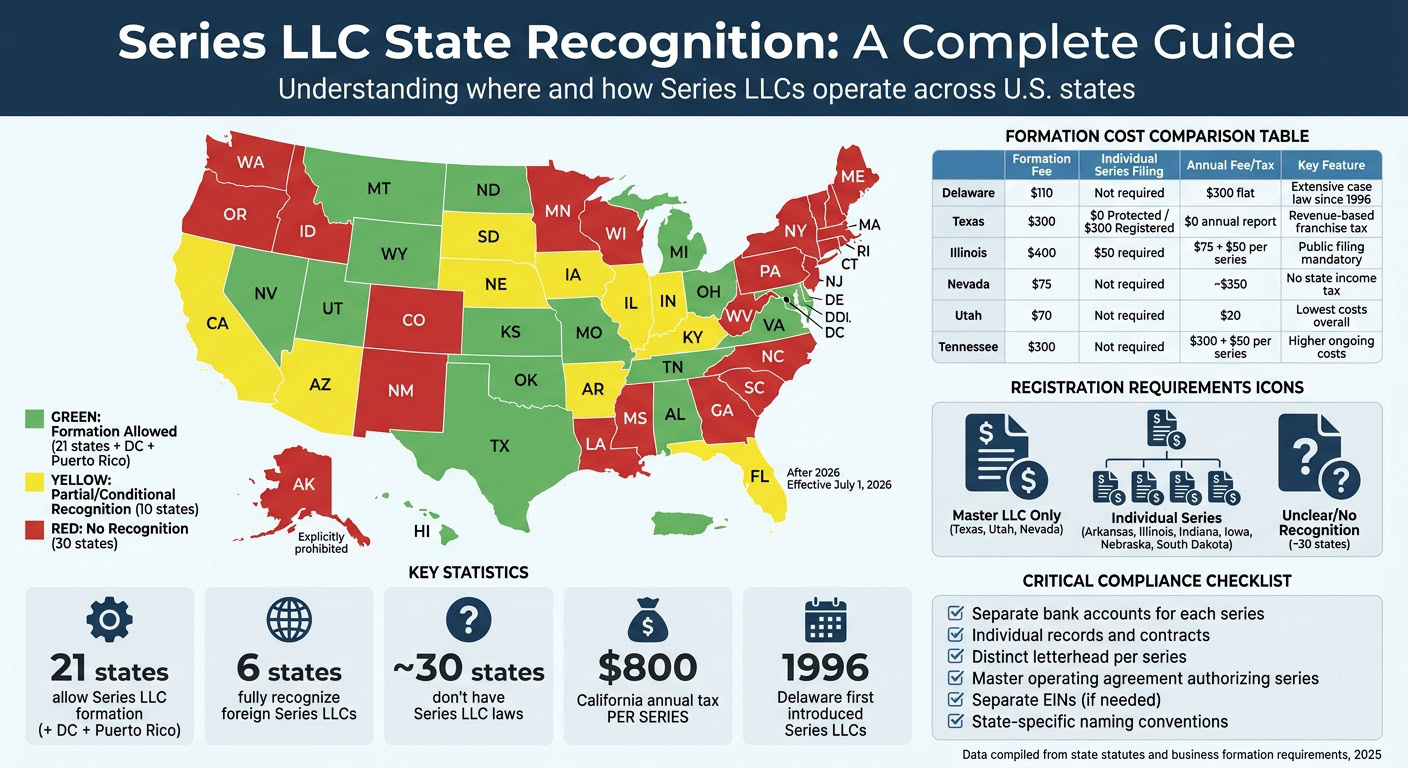
States That Allow Series LLC Formation
States with Series LLC Legislation
Currently, twenty-one states, along with the District of Columbia and Puerto Rico, permit the formation of Series LLCs [1]. The states include Alabama, Arkansas, Delaware, the District of Columbia, Illinois, Indiana, Iowa, Kansas, Missouri, Montana, Nebraska, Nevada, North Dakota, Oklahoma, Puerto Rico, South Dakota, Tennessee, Texas, Utah, Virginia, and Wyoming.
Delaware led the way in 1996, introducing the Series LLC structure primarily to simplify SEC filings for mutual funds. Its long-standing legislation has resulted in a wealth of case law, making it a trusted jurisdiction. Texas, which adopted Series LLCs in 2009, provides a budget-friendly option with no annual report fees. On the other hand, Illinois, which enacted its legislation in 2005, requires public filings for each series, adding an extra layer of administrative work.
Florida is the most recent state to join this list. With the signing of Senate Bill 316 in June 2026, Series LLCs will be permitted starting July 1, 2026 [3]. Similar to Illinois, Florida mandates a “Protected Series Designation” filing for each individual series.
“Delaware remains the gold standard for Series LLCs, with its legislation serving as a model for many other states.”
– LegalGPS [4]
Next, let’s take a closer look at how states differ in their requirements for registering and filing individual series.
Formation Requirements by State
Formation rules for Series LLCs vary widely depending on the state. For example, Delaware and Texas allow “protected series” to be created internally through the operating agreement without requiring additional state filings. In contrast, states like Illinois and Florida require public filings for each series. Illinois charges a $50 fee for a Certificate of Designation, while Florida requires a Protected Series Designation.
Montana takes a unique approach by requiring the operating agreement for each series to be included in the state filing. Naming conventions also differ; in Illinois and Florida, the name of each series must include the full name of the master LLC, along with terms like “Protected Series” or “P.S.”
Here’s a quick comparison of key requirements across selected states:
| State | Formation Fee | Individual Series Filing | Annual Fee/Tax | Key Feature |
|---|---|---|---|---|
| Delaware | $110 | Not required (via operating agreement) | $400 | Extensive case law, optional Registered Series |
| Texas | $300 | $0 for Protected / $300 for Registered | $0 | No annual report fee, revenue-based franchise tax |
| Illinois | $400 | $50 (Certificate of Designation required) | $75 + $50 per series | Public filing mandatory per series |
| Nevada | $75 | Not required | Approximately $350 | No state income tax, strong privacy protections |
| Utah | $70 | Not required | $20 | Lowest formation and annual costs |
| Tennessee | $300 | Not required | $300 + $50 per series | Higher ongoing costs |
The costs and requirements for forming and maintaining a Series LLC can vary dramatically from state to state. For instance, all states require that the master LLC’s Articles of Organization explicitly allow the creation of series. Additionally, each series must maintain separate financial records to preserve its liability shield. Understanding the specific rules in your chosen state is crucial to ensuring compliance and protecting the liability protections of your Series LLC.
sbb-itb-ba0a4be
States That Recognize Foreign Series LLCs
States with Full or Partial Recognition
When it comes to operating a Series LLC in a different state, recognition of the structure varies widely. This variability directly affects the liability protections you might expect. Here’s a breakdown of how different states handle foreign Series LLCs and their registration requirements, which you can manage through business formation services.
Currently, six states fully recognize foreign Series LLCs: Arkansas, Illinois, Indiana, Iowa, Nebraska, and South Dakota. These states allow either the master LLC or individual series to register independently [6].
Starting July 1, 2026, Florida will also fully recognize foreign Series LLCs under the Uniform Protected Series Act (UPSA). This law introduces “horizontal” liability shields, ensuring that each series is insulated from the debts and obligations of the others:
“The legislation introduces ‘horizontal’ liability shields that insulate each series from the debts and obligations of the series LLC and all other protected series.” – Holland & Knight Alert [7]
Some states, however, only partially or conditionally recognize Series LLCs. For instance:
- Virginia requires the master LLC to qualify before any series can register [6].
- California, while not allowing domestic Series LLC formation, recognizes foreign ones. However, each series operating in California must register and pay an $800 annual franchise tax [3][6].
- Arizona allows registration of the master LLC or its individual series but eliminates the internal liability shield [6].
Foreign Series LLC Registration Requirements
The registration requirements for foreign Series LLCs differ significantly from state to state. Below is a summary of how some states manage foreign Series LLC registration: State Recognition Type Registration Requirement Key Compliance Note Arkansas Full Master LLC and/or individual series can qualify independently Allows independent qualification for individual series [6] Illinois Full Requires a Certificate of Designation for each series ($50) Master LLC has a $75 annual report fee, plus $50 per series [4][6] Indiana Full Individual series can qualify independently of the master LLC Allows separate registration for individual series [6] Iowa Full Individual series can qualify independently of the master LLC Allows separate registration for individual series [6] Nebraska Full Individual series can qualify independently of the master LLC Allows separate registration for individual series [6] South Dakota Full Individual series can qualify independently of the master LLC Allows separate registration for individual series [6] Florida Full (Effective July 1, 2026) Will require separate authorization for each series Requires strict, contemporaneous recordkeeping [7] Virginia Partial/Conditional Series cannot qualify without the master LLC qualifying first Master LLC must register before any series can register [6] California Partial (Tax-based) Master LLC registers and each series files Form 568 $800 annual tax per series, regardless of formation state [4][3] Arizona Partial Master LLC or individual series may qualify Eliminates internal liability shield by statute [6]
Some states, like Montana, take an extra step by requiring each series’ operating agreement to be attached to the authority filing [6]. This adds a layer of complexity and could potentially expose sensitive business details.
To maintain liability protection, it’s critical to follow state-specific registration rules. In states with uncertain recognition, keeping separate bank accounts, financial records, and EINs for each series is a smart way to safeguard your structure. Without clear Series LLC statutes, courts might not uphold the liability shield, putting all assets in the Series LLC at risk [6].
States That Don’t Recognize Series LLCs
Non-Recognizing States
Roughly 30 states don’t have laws addressing Series LLCs, which creates uncertainty about their legal standing[6]. For example, Alaska explicitly prohibits Series LLCs[4]. Other states, including Colorado, South Carolina, Pennsylvania, Louisiana, Washington, New York, Oregon, and Massachusetts, don’t allow their domestic formation[2][4][5][8].
The reasons behind this non-recognition differ. Some states see Series LLCs as a way to sidestep traditional liability rules. As Brian T. Bradley, Esq., an Asset Protection Attorney, explains:
“Judges there view Series LLCs as statutory creations that ‘evade traditional liability rules'”[5].
For instance, Louisiana courts have dismissed the liability protections that the series structure claims to offer[4]. Similarly, Washington’s existing LLC laws reflect a clear reluctance to adopt the series model[4].
This lack of recognition creates a host of operational and legal risks for businesses.
Risks of Operating Without Recognition
Operating a Series LLC in states that don’t recognize them comes with considerable risks, particularly the potential loss of liability protection. Courts in these states might disregard the internal divisions between series, allowing creditors to target assets across all series to satisfy a single debt[4][6][8].
In some cases, state laws explicitly remove the protections meant to isolate liabilities within individual series. This could leave all assets vulnerable to creditor claims.
Other complications include the risk of bankruptcy consolidation. If funds are mixed between series, bankruptcy trustees might combine all series into one estate[5]. There’s also the danger of reverse veil piercing, where poor recordkeeping can lead courts to grant creditors access to assets across multiple series[5].
Practical challenges also arise. Many banks and lenders in these states are unfamiliar with the Series LLC structure, making it difficult to open separate accounts or secure independent financing for each series[2][4]. Additionally, some states only allow the master LLC to register, refusing to recognize individual series as separate legal entities[6].
For business owners looking for a reliable alternative, a parent-subsidiary holding company structure is an option. This model is recognized in all 50 states and provides well-established liability protections[1][2][4].
How to Operate Series LLCs Across State Lines
Master LLC vs. Individual Series Registration
When expanding a Series LLC into new states, the decision to register the master LLC, individual series, or both depends heavily on state-specific laws. States generally fall into three categories for foreign qualification. For instance, states like Texas, Utah, and Nevada only allow the master LLC to register, meaning individual series cannot file separately. On the other hand, states such as Arkansas, Illinois, Indiana, Iowa, Nebraska, and South Dakota either permit or require each series to register independently. In about 30 other states, the rules are unclear, leading to legal uncertainties.
The choice of registration has practical implications. In Virginia and Montana, for example, the master LLC must qualify first. Montana even requires attaching the operating agreements for each series. Arizona’s law (AZ Rev Stat § 29-3901(D)) explicitly states that a foreign series is liable for the debts of the master LLC and other series, effectively removing the liability shield. It’s essential to research each state’s rules carefully before filing.
Understanding these nuances can help you select the best state for forming and expanding your Series LLC.
Choosing Your Formation State
Delaware and Texas are the most popular states for Series LLCs, each offering distinct advantages. Delaware, which introduced the first Series LLC statute in 1996, has a well-established legal framework supported by its Chancery Court. Texas, which adopted its Series LLC statute in 2009, provides strong statutory protections, though it has fewer court precedents to guide decisions.
The costs associated with forming and maintaining a Series LLC vary significantly between these states:
| Feature | Delaware Series LLC | Texas Series LLC |
|---|---|---|
| Year Enacted | 1996 | 2009 |
| Individual Series Filing | Not required for “protected” series; required for “registered” series | No separate filing required for individual series |
| Annual Fees | $400 flat franchise tax for the master LLC | Based on combined revenue of all series |
| Naming Rules | Flexible – allows distinct members and asset allocation | Must include the master LLC name |
| Legal Precedent | Most established legal framework | Strong statutory protections, fewer court cases |
Delaware imposes a flat $400 annual franchise tax for the master LLC, regardless of how many series are created. Texas, however, calculates its franchise tax based on the total revenue of all series. For businesses managing multiple series with high revenue, Delaware’s flat fee can offer significant cost savings.
California poses unique challenges. While it doesn’t allow the formation of domestic Series LLCs, it recognizes foreign Series LLCs. However, it charges an $800 annual franchise tax for each series doing business in the state. For example, a Series LLC with five active series in California would face $4,000 in annual franchise taxes.
Documentation and Compliance
Once you’ve decided on a registration strategy and formation state, proper documentation is critical to maintaining liability protection. Each series must have its own bank account, records, contracts, and letterhead. Mixing funds between series is a common reason courts “pierce the veil”, which can eliminate liability protection.
The master operating agreement should clearly authorize the creation of series and outline how assets and liabilities are separated. In some states, like Illinois, you may need to file a Certificate of Designation for each series, which typically involves a $50 filing fee and a $50 annual fee per series. While the master LLC should obtain an EIN, individual series will need their own EINs if they have employees or choose separate tax elections. Additionally, many states require each series to include the master LLC’s full name in its designation, such as “Real Estate LLC – Series A”, and some mandate the use of the term “protected series.”
BusinessAnywhere offers tools to streamline multi-state compliance, including registered agent services, annual report filings, and compliance alerts – all accessible through a centralized dashboard. With services starting at $147 per year, this platform helps ensure you meet filing deadlines and maintain proper documentation when managing Series LLCs across various states.
Conclusion
Series LLCs offer a streamlined way to separate assets and liabilities under one overarching legal entity. However, the lack of uniform state recognition creates legal uncertainties. By 2025, only about 22 states allow the formation of Series LLCs [3]. In states without specific Series LLC laws, the liability shield between series may not be fully upheld [2][4].
Your choice of formation state plays a big role in determining both tax obligations and liability protections. For example, Delaware charges a flat $400 annual tax, while Texas offers fee-free registration. On the other hand, states like California impose an $800 annual franchise tax on each series conducting business, and Arizona limits liability protections for foreign Series LLCs – both of which can reduce the cost advantages of this structure [4][6].
To maintain liability protections, operational compliance is key. Each series must have its own bank accounts, contracts, and records [4]. The limited legal precedent surrounding Series LLCs adds another layer of complexity, especially in states that don’t recognize them or in federal bankruptcy cases [4]. Careful planning and meticulous recordkeeping are essential to safeguard the integrity of your Series LLC across various jurisdictions.
Before opting for a Series LLC, it’s critical to verify the recognition and filing requirements in your target states. Some states require only the master LLC to register, while others mandate separate filings for each series [6]. If the legal landscape seems uncertain, a traditional holding company structure with separate subsidiary LLCs might provide more clarity, though it often comes with higher administrative costs [2].
Platforms like BusinessAnywhere can simplify multi-state compliance by offering registered agent services for multiple states, annual report filings, and compliance tracking in one place. Starting at $147 per year, their transparent pricing helps ensure you meet important deadlines and maintain liability protections for your Series LLC across state lines.
FAQs
Will my Series LLC liability shields hold up in a state that doesn’t recognize Series LLCs?
The liability protections offered by a Series LLC might not hold up in states that don’t officially recognize this type of structure unless the Series LLC is registered to operate there. Registering in such states can serve as a form of legal acknowledgment, but the degree of protection varies based on that state’s specific laws. It’s crucial to examine the local regulations to fully grasp any potential risks.
Do I need to register the master LLC, each series, or both when operating in another state?
When running a business in another state, it’s typically necessary to register the master LLC. On top of that, some states might also require individual series under the LLC to be registered if they are conducting business there. It’s crucial to review the specific regulations of the state where you intend to operate, as these requirements can differ from one state to another.
Should each series get its own EIN and separate bank account?
Yes, each series within a Series LLC generally needs its own bank account and separate records. This practice is essential for maintaining liability protection and ensuring smooth operations.
While the IRS doesn’t specifically mandate a separate EIN for each series, many business owners opt to get one. Why? It simplifies handling independent operations, hiring employees, or managing tax-related matters. Keeping financial accounts and records distinct is a smart way to safeguard the legal and financial independence of each series.