

Most LLC owners pay federal tax on the business profit on their own return, not at the LLC level. That means you can owe tax even if the money stays in the business bank account.
If I were new to LLC taxes, here’s what I’d want to know first:
- A single-member LLC usually reports income on Form 1040 with Schedule C
- A multi-member LLC usually files Form 1065 and gives each owner a Schedule K-1
- Active owners often owe self-employment tax
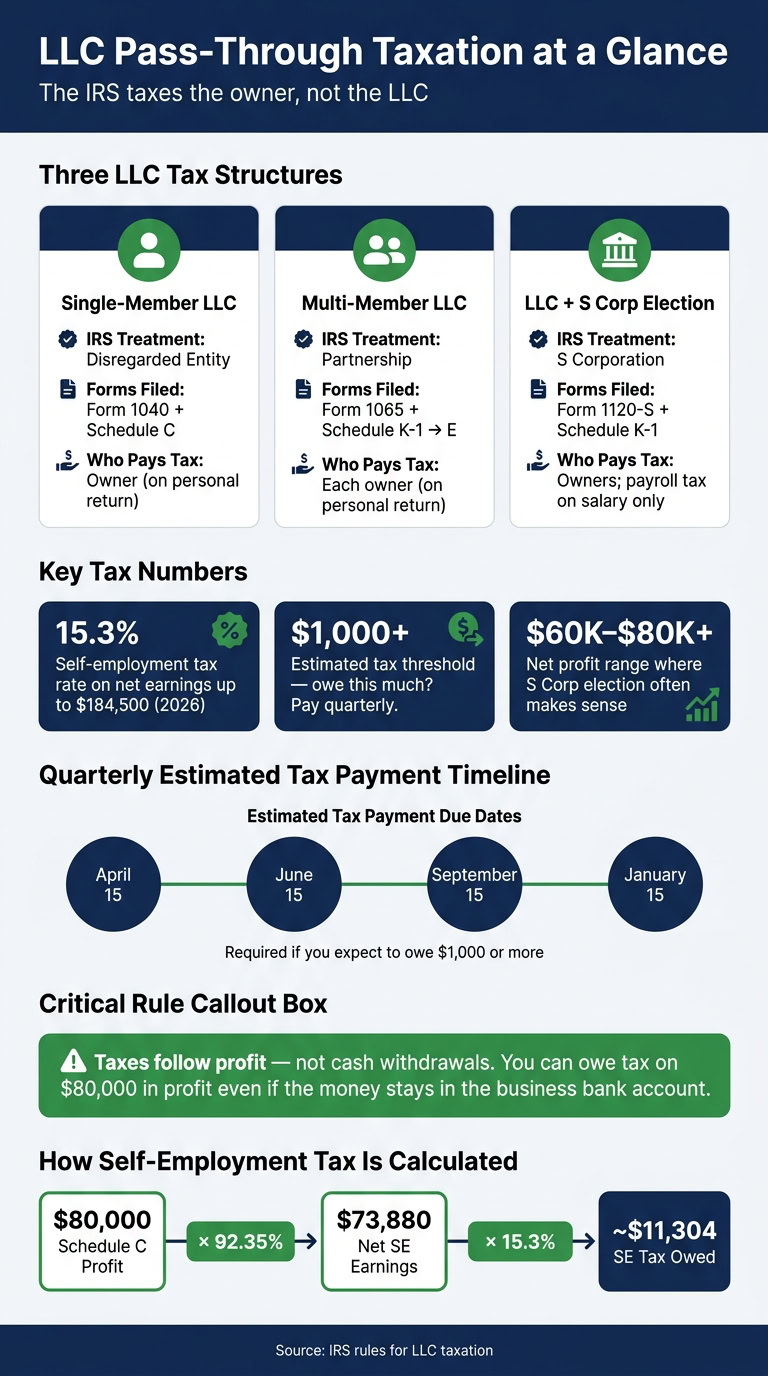
- For 2026, self-employment tax is 15.3% on net earnings up to $184,500
- If I expect to owe at least $1,000, I may need estimated tax payments in April, June, September, and January
- An S corporation election can cut payroll tax on part of the income, but it adds payroll and filing work
Here’s the simple version: LLC pass-through taxation means the IRS taxes me as the owner on my share of profit. Losses can help too, but only if I meet IRS limits. And if I work in the business, taxes often include both income tax and self-employment tax.
Quick Comparison
| LLC setup | Default federal tax treatment | Main forms | Who pays the tax |
|---|---|---|---|
| Single-member LLC | Disregarded entity | Form 1040 + Schedule C | Owner |
| Multi-member LLC | Partnership | Form 1065 + Schedule K-1 | Each owner |
| LLC with S corp election | S corporation tax treatment | Form 1120-S + K-1 | Owners, plus owner-employee payroll tax on salary |
One point stands out: taxes follow profit, not cash withdrawals. This is a key factor in LLC profit distribution planning. So if my LLC earns $80,000 and keeps the money in the business, I may still owe tax on my share. That’s the rule new owners need to plan for from day one.
LLC pass-through taxation basics
What pass-through taxation means
Here’s the core idea: for an LLC, pass-through taxation means the IRS taxes the owner or owners, not the LLC itself by default. Tax is due on each owner’s share of the profit, even if that money stays in the business and isn’t paid out as cash.
That point trips people up. A business can leave earnings in its bank account, but the owners may still owe tax on the profit allocated to them. And if an owner is active in the business, they’ll often owe self-employment tax on their share of business income, on top of regular income tax. This differs from how owners compare LLC and S-corp tax benefits for home offices.
Single-member vs. multi-member LLC: default IRS treatment

By default, the IRS classifies an LLC based on how many owners it has. You don’t need to file a tax election just to get this default treatment.
A single-member LLC is a disregarded entity. In plain English, the IRS treats the owner, not the LLC, as the federal tax filer. The owner reports the business’s income and expenses on Form 1040, usually with Schedule C. The LLC does not file its own separate federal income tax return.
A multi-member LLC is treated as a partnership by default. The LLC files Form 1065, and each member gets a Schedule K-1 that shows their share of income, deductions, and credits. Each member then reports that amount on their own personal tax return.
So the short version is simple:
- Single-member LLCs are reported like sole proprietorships
- Multi-member LLCs are reported like partnerships
That default tax classification decides which federal return gets filed, which the next section covers.
Tax forms new LLC owners need to file
Now that default LLC taxation is clear, the next step is simple: which forms do you file?
The answer depends on whether your LLC has one owner or more than one.
Single-member LLC: Form 1040 and Schedule C
A single-member LLC usually reports business income and tax deductions on Form 1040 with Schedule C attached.
Schedule C is formally titled "Profit or Loss From Business (Sole Proprietorship)." This is where you list your revenue, subtract ordinary and necessary business expenses, and report the net profit or loss on your Form 1040.
In plain English, the LLC does not file a separate federal income tax return for default tax treatment. The owner reports the business activity on their personal return.
Some business activities use other schedules, but for an operating LLC, Schedule C is the standard form.
Multi-member LLC: Form 1065, Schedule K-1, and Schedule E
A multi-member LLC taxed as a partnership files Form 1065. Then each member receives a Schedule K-1 and reports their share on Form 1040, usually on Schedule E.
Here’s how that works in practice. If two co-founders split an LLC 60/40 and the business earns $80,000 in net profit, the LLC files Form 1065 showing the full $80,000. One member gets a K-1 for $48,000. The other gets $32,000. Each person then reports that amount on their own tax return.
Here’s a quick reference:
| LLC type | Default IRS treatment | Forms filed | Who reports income |
|---|---|---|---|
| Single-member LLC | Disregarded entity | Form 1040 + Schedule C | Owner, on personal return |
| Multi-member LLC | Partnership | Form 1065 + Schedule K-1 | Each member, via Schedule E on Form 1040 |
These forms report the income. The next piece is how that income changes each owner’s tax bill.
One mistake trips up a lot of new owners: filing Schedule C for a multi-member LLC. That’s incorrect. A multi-member LLC must file Form 1065 and issue K-1s.
Filing deadlines, extensions, and basic recordkeeping
Once you know the right forms, deadlines matter.
Form 1065 is due March 15 for calendar-year LLCs. Form 1040 with Schedule C or Schedule E is due April 15. If the due date lands on a weekend or federal holiday, it shifts to the next business day. If you file an extension, the Form 1065 deadline moves to September 15 for calendar-year LLCs.
Good records make all of this much less painful. Keep:
- Income records
- Receipts
- Bank statements
- Capital contributions
- Distributions
- Ownership percentages
Those records support Schedule C reporting, K-1 amounts, and ownership allocations.
sbb-itb-ba0a4be
How profits, losses, self-employment tax, and estimated taxes affect owners
Once the return is filed, the next thing to deal with is how that profit changes the owner’s tax bill.
How profits and losses flow to the owner’s return
Tax is based on net profit, not on how much cash you take out.
So if the income shows up on Schedule C or on a K-1, the basic tax result is the same: the owner reports their share on their personal return.
Here’s the key point. If your LLC earns $80,000 and deducts $30,000, you report the $50,000 net profit even if that money stays in the business account.
Losses can lower taxable income, but only up to the IRS limits for basis, at-risk, and passive-activity rules. A loss is deductible only after it passes basis, at-risk, and passive-activity limits. Those rules decide whether the loss helps you this year or gets carried forward.
Reported profit can also lead to self-employment tax for owners who take an active role in the business.
Self-employment tax for active LLC owners
Active owners usually owe self-employment tax on net earnings. This covers Social Security and Medicare, and the owner pays the full amount. The IRS applies this tax to 92.35% of net profit on Schedule SE.
For example, an $80,000 Schedule C profit creates about $73,880 of net self-employment earnings and about $11,304 of self-employment tax. You can also deduct half of that self-employment tax as an above-the-line deduction on Form 1040, which lowers adjusted gross income.
The table below shows how this usually works depending on the owner’s role:
| Owner Situation | SE Tax Treatment |
|---|---|
| Active single-member owner | Generally pays SE tax on net business profits |
| Active multi-member owner | Generally pays SE tax on their distributive share of profits |
| Member who does not materially participate | Generally does not owe SE tax |
You report self-employment tax on Schedule SE, filed with Form 1040.
Quarterly estimated tax payments
Because no employer is withholding taxes from LLC income, owners have to pay taxes during the year themselves. If you expect to owe $1,000 or more, the IRS generally requires quarterly estimated tax payments.
To avoid penalties, pay at least 100% of last year’s tax, or 110% if your adjusted gross income was more than $150,000.
For some owners, that tax load is one reason it may make sense to talk with a tax professional about S corporation taxation.
When an LLC should consider S corporation taxation
S corporation taxation is a tax election, not a new business type. That part matters. When you file Form 2553, your LLC stays an LLC under state law, but the IRS starts taxing it under S corporation rules. For owners who now pay self-employment tax on all LLC profit, that shift can change the way taxes hit the business.
How S corporation taxation changes the setup
After the election takes effect, the LLC files Form 1120-S each year instead of using Schedule C or Form 1065. The income still passes through to the owner or owners. You report that income on your personal return through Schedule K-1 (Form 1120-S) and then on Form 1040, often through Schedule E.
So the pass-through piece stays the same. What changes is how much of the business income gets hit with payroll tax.
A working owner must take a reasonable salary through payroll. After that, any remaining profit may be paid out as distributions, which are generally not subject to self-employment tax. The IRS doesn’t give one fixed salary number. Pay should match the work the owner does, market pay for that role, and the profit the business brings in.
When the tax savings may outweigh the extra admin
This election can save money, but it also adds work. You’ll need payroll setup, quarterly payroll filings, W-2s, and a separate annual tax return. That’s why many owners look at the S corporation election when annual net profit is around $60,000 to $80,000 or more and the owner actively works in the business.
Here’s the basic tradeoff: less payroll tax on part of the income, but more filing and payroll work.
| Aspect | Default LLC Taxation | LLC with S Corp Election |
|---|---|---|
| Federal tax return | Schedule C (single-member) or Form 1065 (multi-member) | Form 1120-S |
| Owner’s pass-through form | Schedule C or Schedule K-1 (Form 1065) | Schedule K-1 (Form 1120-S) |
| How owners are paid | Owner draws; no payroll required | Reasonable salary via payroll + distributions |
| Employment tax on profits | Self-employment tax on all net earnings | Payroll tax on salary only; distributions generally exempt |
| Payroll requirement | Only for non-owner employees | Required for working owners |
| Administrative load | Lower | Higher: payroll, Form 1120-S, separate payroll and distribution records |
In many cases, the election doesn’t make sense if profits are still new or uneven, if the owner works only part-time in the business, or if the company plans to bring in owners who can’t hold S corporation stock.
How BusinessAnywhere can support ongoing compliance

Once the election is in place, the main job is staying on top of compliance. BusinessAnywhere can help with Form 2553 filing, registered agent service, bookkeeping, and compliance tracking.
Key tax rules new LLC owners should remember
Once you’ve handled the filing rules above, a few tax basics can save you a lot of stress.
Your tax filing method usually comes down to how many owners the LLC has. A single-member LLC will often report business income on Schedule C. A multi-member LLC will often file Form 1065 and send Schedule K-1s to each owner.
After profit is reported, the next thing to watch is what the IRS expects you to pay during the year. Here’s the part that catches many new owners off guard: you can owe tax on profit even if the LLC leaves the cash in the business. That’s why it helps to set money aside for taxes as the year moves along, not at the last minute.
Active owners may also owe self-employment tax. In many cases, that’s 15.3% on net earnings up to the Social Security wage base. On top of that, you may need to make quarterly estimated tax payments in April, June, September, and January if withholding from other income won’t cover what you owe.
You may hear people talk about an S corporation election as a way to cut self-employment tax on part of the profit. That can work, but there’s a catch. It also brings payroll work and separate filings. For many owners, this is the point where talking with a tax professional makes sense.
From day one, keep your books, receipts, owner records, and tax payment records in order. Good records help back up deductible expenses and make your filings more accurate.
FAQs
Do I owe tax if I leave money in my LLC?
Yes. You owe taxes on your share of the LLC’s net profit even if you leave the money in the business.
An LLC is a pass-through entity. That means the income is taxed in the year the business earns it, whether you withdraw the cash or leave it sitting in the company bank account.
How do I know if I owe self-employment tax?
If you actively work in your LLC, you’ll usually owe self-employment tax once your net earnings from self-employment go over $400 for the year.
Under the default pass-through tax setup, the IRS treats you as self-employed. That means you pay 15.3% on your share of net profits for Social Security and Medicare.
If you choose S corporation status, the rules shift a bit. Your reasonable salary is subject to payroll taxes, but distributions above that salary are not subject to self-employment tax.
When should I consider an S corporation election?
Consider an S corporation election when net business profits stay above $60,000 to $80,000 per year. At that level, the savings on self-employment tax can start to outweigh the extra cost of payroll, bookkeeping, and added tax filings.
Here’s the basic idea: you pay yourself a reasonable salary, and that salary is subject to payroll taxes. Then you can take the rest of the profit as distributions, which are not subject to self-employment tax.
This setup tends to make the most sense when your business income is steady enough to support both your salary and those distributions on a regular basis.