

Yes, I can trademark a logo in the U.S. – but only if it works as a source identifier, clears conflict checks, and is filed the right way. If I skip the search or file the wrong details, I can lose the filing fee, face delays, or end up changing the brand later.
Here’s the short version:
- A logo is filed as a design mark
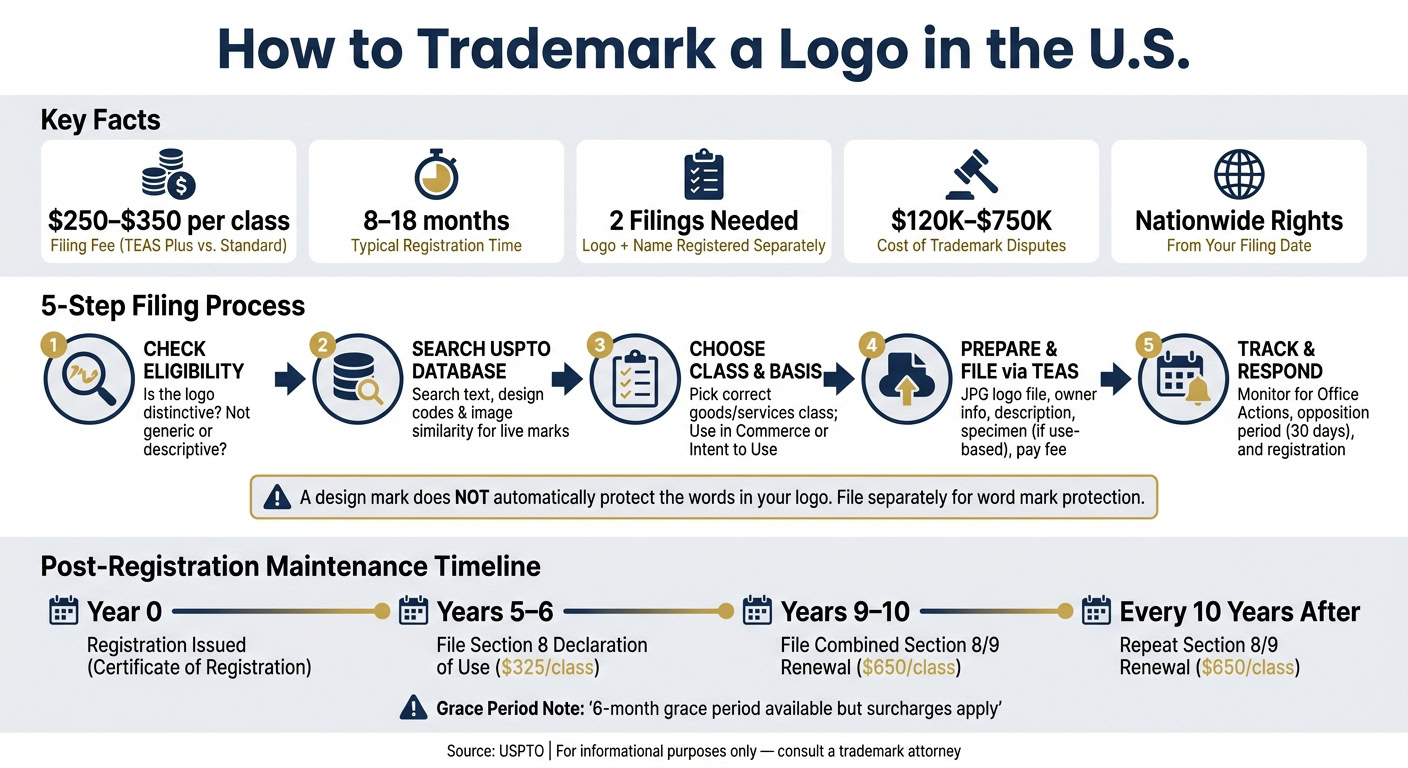
- Federal filing fees usually run $250 to $350 per class
- Registration often takes about 8 to 18 months
- Without federal registration, rights are often tied to where I use the logo
- A design mark does not automatically protect the words in the logo
- Many businesses file the logo and the brand name separately
- If I haven’t launched yet, I can file based on intent to use
- If I already use the logo in commerce, I need a specimen
- After registration, I still need maintenance filings to keep it active
- Trademark disputes can cost from $120,000 to $750,000, and rebranding can cost much more
What I’d focus on first is simple:
- Check whether the logo can function as a trademark
- Search the USPTO for similar live marks
- Pick the right classes and filing basis
- Prepare the logo file, owner details, description, and specimen if needed
- File through TEAS and track deadlines after filing and after registration
A quick point that trips people up: registering a logo is not the same as registering a name. If I want rights in both, I usually need two filings.
This guide breaks down the process in plain English so I can see what to search, what to file, what mistakes to avoid, and what the registration does – and does not – cover.
What Makes a Logo Eligible for Trademark Protection
To qualify for trademark protection, a logo needs to be distinctive and not too close to an existing mark. That rule shapes both sides of the process: what the USPTO will register and how it checks your logo against marks already on file.
Simple shapes and common design features usually don’t carry much weight unless they’re styled in a way that stands out. A plain coffee cup outline for a coffee brand, or a basic star with no special treatment, usually won’t do much on its own.
Fanciful or arbitrary logos are usually the easiest to register. Suggestive logos can qualify too. Descriptive or generic designs are tougher. In most cases, they need proof that buyers already connect the design with one source.
Design Mark vs. Word Mark: What Is the Difference
A design mark protects how your logo looks – the shapes, stylization, layout, and graphic elements shown in the application. A word mark protects the words in your name or slogan in any font or format, without tying that protection to one visual style. Put simply, logo protection covers the visual side of your brand, not the business name by itself.
That distinction matters more than many people think. The USPTO compares the logo as filed, not just the business name standing alone. If you register a stylized logo that includes your business name, that does not automatically give you rights in the words themselves.
So if another company uses your business name in a different font or style, a design mark registration may not be enough to stop them. That’s why many businesses file one application for the logo and another for the name.
How the USPTO Judges Logo Strength and Conflicts
Even if a logo is distinctive, the USPTO can still refuse it if the overall appearance is too close to an existing design. The office looks at the logo’s overall look and feel, not exact image matching. For example, two logos that show a stylized tree inside a circle for outdoor apparel could still be seen as confusingly similar, even if the trees aren’t drawn the same way. If the general impression feels too close, that’s a problem.
Logo strength comes down to how distinctive and non-generic the design is within its industry. A new geometric symbol or a heavily stylized mascot can leave a clearer commercial impression. By contrast, small tweaks – like thicker lines or a new color scheme – often won’t fix a conflict if the overall look still resembles an existing mark.
Once you know what gives a logo strength, the next step is checking whether similar logos already appear in the USPTO database.
How to Search the USPTO for Similar Logos
Once your logo stands out, the next step is simple: check for live marks that could get in the way of registration. Before you file, run a clearance search in USPTO Trademark Search.
How to Search Word Elements, Image Matches, and Design Codes
A solid logo search usually comes down to three moves.
Start with any text in your logo. Use the text search field and look up the exact wording, then test close spellings, plural forms, and phonetic versions. A small change in spelling doesn’t always change how the USPTO sees the mark.
Next, search design search codes from the USPTO Design Search Code Manual. These codes help you find logos with similar visual parts. Search each code on its own first, then combine them to narrow the results. That extra step can save you from missing a mark that looks close enough to cause trouble.
Then use the image search feature. Log into your USPTO.gov account, open Trademark Search, and choose Image search from the dropdown near the search bar. Upload a clear version of your logo. The system returns visually similar marks based on shapes, composition, and layout. That helps you catch lookalikes that don’t share the same design codes or text.
This can be especially helpful for logos used across websites, app icons, packaging, and digital assets, where visual similarity often matters most. After the results load, filter for live marks and narrow the list by the international class that fits your goods or services, such as Class 35 for retail services or Class 42 for software services.
What matters most in the results is overlap in both appearance and market use.
How to Spot Real Conflicts
Similarity becomes a bigger issue when the goods, services, and sales channels overlap. Two logos that use a shopping cart icon are a much bigger concern when both are tied to online retail than when one is for retail and the other is for financial planning.
If you run an ecommerce brand, look closely at Class 35. If you offer software services, Class 42 deserves close attention. And if your main symbol is common, the key question is whether your exact version looks different enough to sit in the same space without causing confusion.
Small-size testing also matters more than many people expect. App icons and favicons strip away fine details fast. If two logos look almost the same at that size and reach the same kind of customer through the same channels, that’s a real conflict risk, even if the full-size versions look a bit different.
Use what you find in the search results to decide whether the logo needs changes or whether you’re ready to file.
What to Prepare Before Filing
Once you’ve ruled out similar marks, the next step is simple: get your filing info in order. The USPTO asks for a pretty specific set of details, and having them ready upfront makes the process much smoother.
Application Details the USPTO Will Ask For
Gather these items before you file.
Owner information: Provide the legal owner’s full name, entity type, U.S. mailing or domicile address, and email address.
Logo image: Upload a clean JPG under 5 MB on a plain background. It shouldn’t include watermarks, borders, or ™/® symbols.
Design description: Add a short written description of the logo’s visual elements.
Color claim: If color is part of what you want to protect, include a color claim that names each color and where it appears. Many applicants file in black and white if they want more room to use the logo in different color versions later.
Literal wording: If the logo includes words, list them separately. Non-English words need an English translation, and non-Latin characters need a transliteration.
Goods and services: Use specific terms people commonly understand from the USPTO’s Acceptable Identification of Goods and Services Manual. For example, "T-shirts; hooded sweatshirts" works. "Apparel brand" does not. The wording also needs to match the goods or services connected to the logo.
Filing fees: TEAS Plus costs $250 per class, and TEAS Standard costs $350 per class. If your goods and services fit the pre-approved wording in the USPTO ID Manual, TEAS Plus can save you $100 per class.
Use in Commerce vs. Intent to Use: Key Differences
Your filing basis affects when you need to show proof of use and when the registration can issue.
| Aspect | Use in Commerce (Section 1(a)) | Intent to Use (Section 1(b)) |
|---|---|---|
| Filing timing | Logo is already used in interstate U.S. commerce | Logo is planned but not yet in use |
| Specimen at initial filing | Required: one per class showing actual use | Not required at initial filing |
| Later specimen requirement | Usually only in maintenance filings after registration | Required later in an Amendment to Allege Use or Statement of Use before registration |
| Extra filing steps | Application → examination → publication → registration | Application → examination → publication → AAU/SOU with specimen → registration |
| Likely added costs | Initial per-class filing fee; later maintenance fees | Initial per-class filing fee plus later use-filing fees; later maintenance fees |
Intent to use can be a smart move if you haven’t launched yet. It lets you lock in a filing date before the logo goes live. The tradeoff is that you’ll have one more filing step and extra fees before the registration issues.
Specimen Examples That Work for Logo Trademarks
A specimen needs to show the logo in actual use, not just as a draft or idea. That’s the whole point. The USPTO wants proof that the mark is being used in the market, so mockups, proofs, and edited images that don’t show real use can get rejected.
For goods, good specimens include photos showing the logo on:
- product packaging
- labels or tags attached to the product
- the product itself, such as a bottle, device casing, or clothing label
The image must connect the logo to the product listed in the application.
For services, a website screenshot often works well if the logo appears near a description of the services and there’s a clear way for customers to contact the business or buy something. App screens can also qualify when they show the logo being used as part of the service. A promo page with no contact option or purchase function will usually miss the mark.
When you submit specimen files, use JPG under 5 MB or PDF under 25 MB. And one detail matters a lot: the logo in the specimen must match the logo in your drawing without material differences.
sbb-itb-ba0a4be
How to File the Logo Trademark Application
How to Submit the Application and Pay the Filing Fee
Once your search and prep work are done, file through TEAS. Before you open the form, get everything in one place. That small step can save a lot of back-and-forth.
| Filing Material | What to Have Ready |
|---|---|
| Logo image | A clear JPG drawing file, under 5 MB |
| Owner information | Legal name, entity type, U.S. domicile address, and email address |
| Goods/services class | The specific goods or services and the correct class numbers |
| Filing basis | Use in Commerce (Section 1(a)) or Intent to Use (Section 1(b)) |
| Specimen (if use-based) | A real specimen showing actual use |
| Payment method | A way to pay the USPTO filing fee |
Inside TEAS, you’ll upload the logo image, enter the mark description and any literal elements, choose the right goods or services class, select the filing basis, attach a specimen if you’re filing based on use in commerce, and sign the declaration. That declaration confirms the application is true and complete.
Then you’ll pay the filing fee. TEAS Plus costs less, but it requires wording from the ID Manual. TEAS Standard costs more and gives you more room in how you describe your goods or services. Filing fees are nonrefundable, so it’s smart to check every field before you hit submit.
What Happens After You File: Review, Publication, and Registration
After you submit, the USPTO reviews the application in stages. First comes examination. Then, if the application clears review, it gets published for opposition. After that, the USPTO issues either a registration or a Notice of Allowance.
If the examining attorney spots a problem, you may get an Office Action asking for a correction or more detail. Publication opens a 30-day opposition period for third parties. If someone files an opposition, the matter can move to the Trademark Trial and Appeal Board (TTAB), which can add a lot of time to the process.
If no one opposes the application, a use-based filing moves to registration and the USPTO issues a Certificate of Registration. An intent-to-use filing works a little differently. In that case, the USPTO sends a Notice of Allowance, and you later file a Statement of Use with a specimen before registration can issue.
Common Logo Filing Mistakes to Avoid
Most delays come from filing mistakes that could have been avoided.
Wrong owner is one of the biggest ones. If the business owns the logo, list the legal entity as the owner, not yourself as an individual.
Vague mark descriptions can slow examination and make the registration weaker. Be specific about the logo’s shapes, text, placement, and colors.
Overly narrow color claims can box you in. If you claim a specific color set, your protection may be limited to that exact mix. Filing in black and white, with no color claim, gives you more room if your branding shifts later.
Mismatched goods and services can cause trouble down the road. Only list goods or services you already use or realistically plan to use.
Wrong TEAS choice can also trip people up. If you pick TEAS Plus, your goods and services must match the USPTO’s pre-approved ID Manual wording. If they don’t, the USPTO may switch the application to TEAS Standard and charge an extra per-class processing fee.
How to Keep Your Logo Trademark Active
After registration, your job isn’t over. You need to keep using the logo and file the right USPTO forms on time.
Maintenance Filings and Continued Use
Once the USPTO registers your logo, the focus shifts from getting approval to keeping that registration in force.
Between the 5th and 6th year after registration, file a Section 8 Declaration of Use or Excusable Nonuse. This filing needs at least one current specimen and a sworn statement that the logo is still in use. If use has stopped, the USPTO allows that only in narrow situations.
Then, between the 9th and 10th year after registration, file a combined Section 8/9 filing. After that, you need to file again every 10 years. Section 8 confirms that you’re still using the logo. Section 9 renews the registration for another 10-year term. Miss those deadlines, and the registration can be canceled.
The filing fees are straightforward:
- $325 per class for a timely Section 8 filing
- $325 per class for a timely Section 9 renewal
- $650 per class for the combined filing
If you miss a deadline, the USPTO gives you a six-month grace period, but you’ll pay extra surcharges for each class. Put both deadlines on your calendar now. It’s one of those small admin tasks that can save a big headache later.
Each time you file, submit one current specimen per class that shows the logo in current use. For e-commerce, that usually means a website or product page with the logo next to a shopping cart or "Buy Now" button. For goods, use packaging, labels, or product photos that show the logo.
These filings keep the registration alive. The next piece is knowing what that registration actually gives you.
What Logo Trademark Registration Covers and What It Does Not
A logo registration protects only the specific design and the goods or services listed in the filing. That limit matters. Many businesses use the same logo on websites, packaging, ads, and digital assets, but registration doesn’t stretch beyond the design and classes you filed.
Use the chart below to see where the line is.
| What Registration Covers | What It Does Not Cover |
|---|---|
| The specific logo design as filed with the USPTO | Unregistered redesigns or heavily updated logo versions |
| Exclusive use on the listed goods and services | Unrelated industries where no likelihood of confusion exists |
| Nationwide rights across the U.S. as of your filing date | Automatic control of domain names or social handles |
| Right to sue in federal court and use the ® symbol vs the TM mark | Your business name as a word mark (requires a separate registration) |
The ® symbol shows that your registration is official, and it can make copycats think twice. But the USPTO won’t police the market for you. You have to watch for problems yourself by checking marketplaces, social media, domain names, and competitor branding on a regular basis.
Minor logo changes may still fall within the same registration if the core design stays the same. A major redesign usually means filing a new application.
FAQs
Should I trademark my logo and name separately?
Yes. It’s smart to protect them separately.
Registering your name and logo on their own gives you broader legal coverage. That’s because each trademark protects a specific brand element tied to certain goods or services.
Separate registrations also put you in a stronger position if someone copies your business name, your logo, or both.
Can I trademark a logo before I start selling?
Yes. You can file an intent-to-use application with the USPTO before you start selling.
That means you can get the process started while your brand, product, or launch is still in the works. But there’s one catch: you won’t get the final registration until you file a Statement of Use that shows the logo is being used in commerce.
Filing early can help secure your rights during the development phase. Until registration is approved, you can use the TM symbol. Once the registration goes through, you can use the ® symbol.
What if I change my logo after filing?
If you change your logo after filing with the USPTO, you usually can’t just update the current application to show the new design. Trademark protection applies to the exact mark you submitted.
If the new logo is meaningfully different, you’ll likely need to file a new application. That’s why it’s smart to finalize your logo before you apply. It can help you avoid problems and an extra filing cost.