
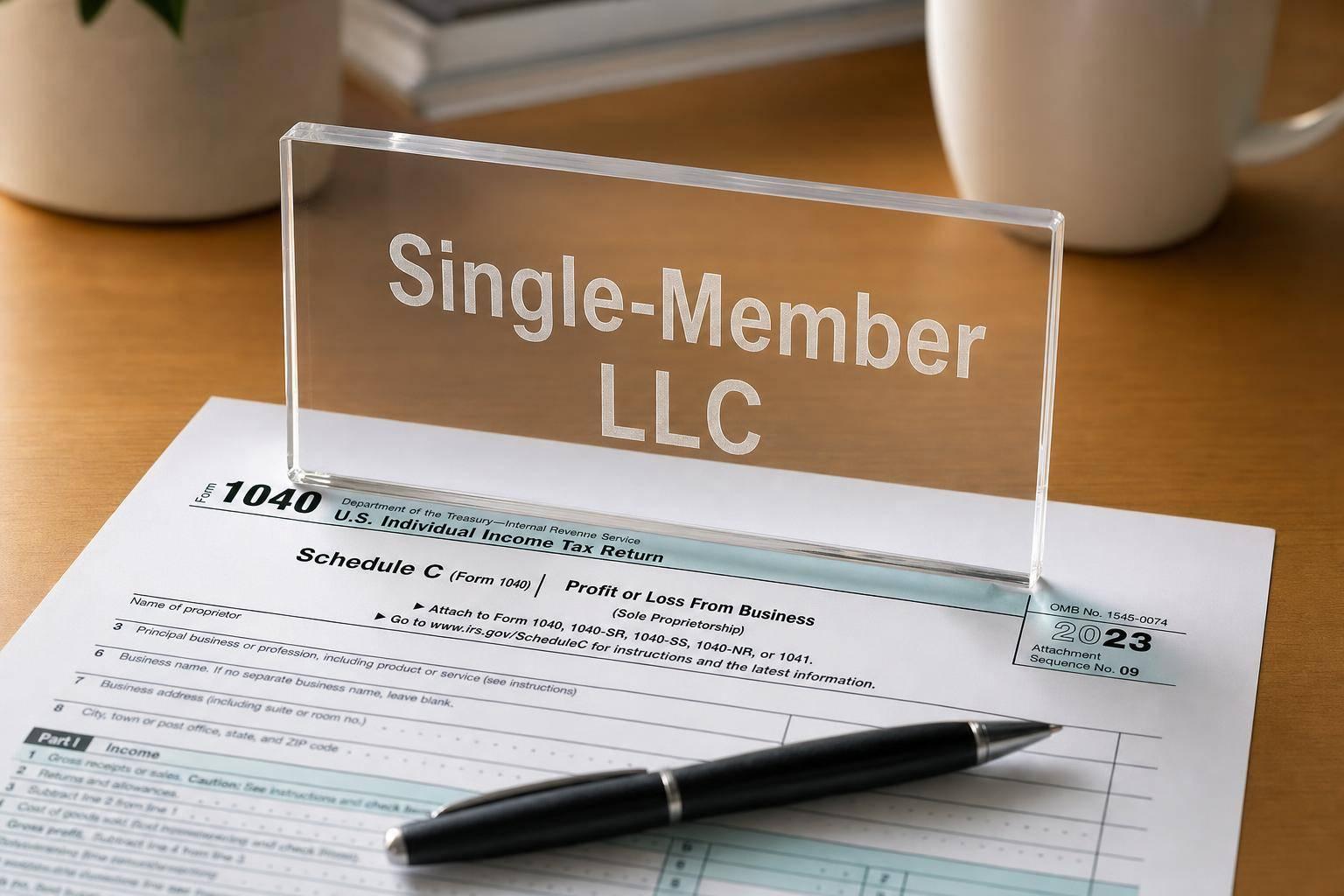
If you own 100% of an LLC and made no tax election, the IRS will usually ignore the LLC for federal income tax. That means I report the business on my own return, often on Schedule C, instead of filing a separate business income tax return.
Here’s the short version:
- A disregarded entity is not a separate federal income tax filer
- The most common case is a single-member LLC
- The LLC still exists under state law
- I may still need separate filings for payroll or excise tax
- I can change tax status with Form 8832 or Form 2553
- Some edge cases apply, like community property ownership and foreign-owned single-member LLCs (which may trigger Form 5472 filing requirements)
A few tax facts matter here:
- 1 owner is the usual trigger for default disregarded treatment
- Business profit on Schedule C or Schedule F will often lead to self-employment tax
- A tax classification change can limit another change for 5 years
The big idea: the IRS may ignore the LLC for income tax, but I still have to run it like a separate business for legal and recordkeeping purposes.
Quick comparison
| Setup Federal income tax treatment Separate legal entity under state law Typical federal filing | |||
|---|---|---|---|
| Sole proprietorship vs. LLC | Reported on owner’s return | No | Form 1040 with Schedule C |
| Single-member LLC, default | Disregarded | Yes | Form 1040 with Schedule C, E, or F |
| Multi-member LLC, default | Partnership | Yes | Form 1065 with K-1s |
| LLC taxed as S corp | Pass-through after election | Yes | Form 1120-S with K-1 |
| LLC taxed as C corp | Separate taxpayer after election | Yes | Form 1120 |
If I want the plain-English answer, it’s this: “disregarded” changes how the IRS taxes the LLC, not whether the LLC exists.
sbb-itb-ba0a4be
Which Businesses Are Treated as Disregarded Entities
Single-Member LLCs by Default
The most common disregarded entity for federal income tax is a single-member LLC.
If you own 100% of the LLC and haven’t filed anything to change how it’s taxed, the IRS treats that LLC as disregarded by default.
You can change that by filing Form 8832 to choose C corporation tax treatment or Form 2553 to choose S corporation status. If you don’t make one of those elections, the one-owner LLC stays disregarded.
A sole proprietorship can look similar at tax time, but it’s not the same legal setup.
Sole Proprietorship vs. Single-Member LLC
A sole proprietorship is not a separate legal entity. Under state law, the owner and the business are the same thing.
A single-member LLC is different. It is a separate legal entity under state law. That means it can own property, sign contracts, and operate in its own name, even though the IRS looks through it for federal income tax.
| Feature | Sole Proprietorship | Single-Member LLC (Default) |
|---|---|---|
| Legal entity under state law | No | Yes |
| Federal income tax reporting | Schedule C, Form 1040 | Schedule C, Form 1040 |
| Liability protection | None | Limited liability |
Here’s the practical point: by default, both setups usually report income the same way on a federal tax return. But only the LLC puts a legal wall between your personal assets and business debts.
Special Cases and Exceptions
A few ownership setups can change the default rule.
- Membership drops to one. If a multi-member LLC goes down to one owner, it becomes disregarded by default. If a second owner joins, the LLC becomes a partnership by default.
- Married couples in community property states. Under Revenue Procedure 2002-69, if both spouses own the LLC as community property and no one else has an ownership interest, the IRS can treat it as a disregarded entity instead of a partnership. Married owners in a community property state should check the rule before filing.
- Foreign-owned single-member LLCs. These LLCs are still disregarded for income tax, but they may need to file Form 5472 with a pro forma Form 1120 to report information about the foreign owner.
Next, see how the IRS handles income, expenses, and filings for a disregarded entity.
How Taxes Work When Your Business Is a Disregarded Entity
Where Business Income and Expenses Are Reported
If your LLC is a disregarded entity, you report the business income and expenses on your personal tax return, not on a separate business income tax return. That means the income goes on Form 1040.
The schedule depends on what the business does:
- An active business usually uses Schedule C (Profit or Loss From Business)
- A single-member LLC that owns rental property and does not provide major services to tenants usually uses Schedule E (Supplemental Income and Loss)
- A farming business run through a single-member LLC uses Schedule F (Profit or Loss From Farming)
There’s an extra tax point here that matters. Profit from Schedule C and Schedule F usually triggers self-employment tax on Schedule SE. Schedule E rental income usually does not.
That’s the default rule for federal income tax. But it doesn’t mean the LLC is off the hook for every other filing.
When the LLC Does and Does Not File Its Own Tax Return
A disregarded single-member LLC does not file its own separate federal income tax return. In plain English, there’s no Form 1065 or Form 1120 unless the LLC has chosen a different tax classification.
That said, the LLC may still need its own EIN. And if it has employees or owes excise tax, it may also need to file separate payroll or excise tax forms.
| Tax Type | Does the LLC File Separately? | Key Form |
|---|---|---|
| Federal income tax | No – reported on owner’s Form 1040 | Schedule C, E, or F |
| Employment (payroll) tax | Yes, if the LLC has employees | Form 941, Form 940 |
| Federal excise tax | Yes, if applicable to the business | Form 720 |
So while income tax passes through to the owner, other federal tax filings can still land on the LLC.
How a Business Can Change Its Tax Status
If you want your LLC taxed in a different way, you can file Form 8832 to choose corporate tax treatment. If the LLC later qualifies, it can then elect S corporation status with Form 2553. Once that happens, the business files Form 1120-S, and the income passes through to you on Schedule K-1.
This kind of change isn’t something to do on a whim. A classification change can block more changes for five years, so it makes sense to run the numbers with a CPA before filing Form 8832 or Form 2553.
A tax-status change can also affect filing work and liability issues, so it’s not just about how the income shows up on a return.
Why This Classification Matters: Taxes, Liability, and Compliance
Tax Treatment Does Not Change Legal Status
Once you know how a disregarded entity files, the next step is figuring out what that label changes in day-to-day use. Tax status does not change legal status. If the IRS disregards your LLC for federal income tax, that does not wipe out the LLC under state law. It still exists as a separate legal entity under state law.
That line matters more than people think. You should still treat the LLC like its own business. If you mix personal and business money, you can weaken liability protection. And even if the LLC is disregarded for income tax, it may still need separate payroll or excise tax filings.
Where Classification Affects Compliance Decisions
Federal tax status is only one piece of the puzzle. State annual reports, LLC fees, franchise taxes, and local licenses usually still apply no matter how the LLC is treated for federal tax purposes.
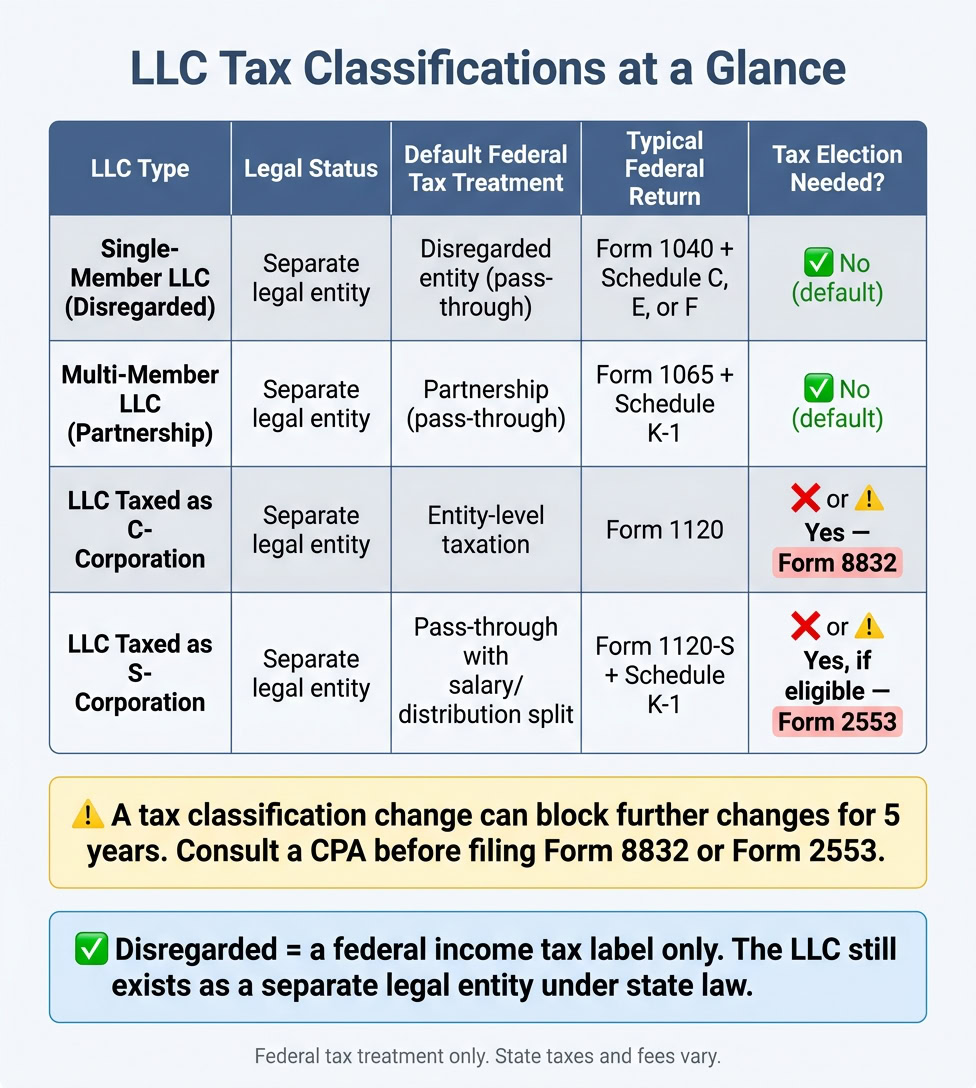
Here’s a quick side-by-side look at the main LLC tax treatments:
| LLC Type | Legal Status | Default Federal Tax Treatment | Typical Federal Return | Tax Election Needed? |
|---|---|---|---|---|
| Single-Member LLC (Disregarded) | Separate legal entity | Disregarded entity (pass-through) | Form 1040, Schedule C, E, or F | No (default) |
| Multi-Member LLC (Partnership) | Separate legal entity | Partnership (pass-through) | Form 1065 & Schedule K-1 | No (default) |
| LLC taxed as C-Corporation | Separate legal entity | Entity-level taxation | Form 1120 | Yes (Form 8832) |
| LLC taxed as S-Corporation | Separate legal entity | Pass-through with salary/distribution split | Form 1120-S & Schedule K-1 | Yes, if eligible (Form 2553) |
This chart can save you from filing the wrong return. That’s also why separate books matter, even when the IRS ignores the entity for income tax. Keep separate books and a business bank account so your Schedule C, E, or F reporting holds up.
How to Check Your Status and Choose the Right Next Step
A Quick Self-Check for Business Owners
Use the rules above to confirm how the IRS will treat your LLC. Go through these three questions in order:
- Did you form an LLC under state law? If you filed Articles of Organization with your state and got approval, you have an LLC under state law.
- Are you the only owner? If yes, you have a single-member LLC.
- Did you file Form 8832 or Form 2553? If not, the default tax treatment applies.
If you answered yes, yes, and no, your LLC will likely be treated as a disregarded entity for federal income tax. The IRS applies this treatment automatically. It does not send a separate approval letter.
If this checklist points to disregarded treatment, the next move is to confirm the right filing path.
Conclusion: The Main Points to Remember
For most one-owner LLCs, a disregarded entity is a single-member LLC that has not elected corporate tax treatment. The owner reports business income and expenses directly on their personal tax return, and for federal income tax, the business is treated as part of that return.
"Disregarded" is a federal income tax label, not a legal one. The LLC still exists as a separate legal entity under state law, and the right filing and compliance setup still matters, no matter how the IRS treats the business for income tax.
FAQs
How do I know if my LLC is disregarded?
Usually, your LLC is a disregarded entity if you’re the only owner and you haven’t chosen corporate tax treatment.
For federal income tax purposes, the IRS doesn’t treat the LLC as separate from you. That means the business usually doesn’t file its own income tax return. Instead, you report the LLC’s income and expenses on your personal Form 1040, most often on Schedule C.
Do I need an EIN for a disregarded LLC?
For a single-member LLC, an EIN is technically optional if you have no employees, owe no excise taxes, and don’t offer retirement plans. In that situation, you can use your Social Security Number for tax reporting.
That said, getting an EIN is still a smart move. Banks often ask for one when you open a business bank account. It can also help you build business credit and draw a clean line between your personal and business finances.
You must get an EIN if you:
- Hire employees
- Offer retirement plans
- File excise tax forms
When should I elect S corp or C corp status?
Consider electing S corp or C corp status if your business has changed shape or your profit level points to a different tax setup.
S corp status can make sense once annual net profit lands around $60,000 to $80,000. In most cases, you elect it within 75 days of the start of your tax year.
C corp status may be a better fit if you plan to raise capital, offer stock options, or keep earnings in the business. The tradeoff is that it can lead to double taxation and more complicated filing.