
A US LLC can help you run your business. It does not give you residency, a visa, or tax-free income.
If I had to boil this guide down to a few points, it would be these:
- A US LLC is just a business entity
- Your tax bill still depends on your citizenship, tax residency, and where you do the work
- State choice affects fees and filings, not your personal residency
- Foreign-owned single-member LLCs can owe no US income tax and still face a $25,000 Form 5472 penalty if they miss the filing
- Multi-member LLCs can face penalties starting at $210 per member, per month for late Form 1065 filings
- Delaware and Wyoming serve different use cases, but neither erases tax or registration duties where you actually work
Put another way: if you live abroad and run an online business, a US LLC may help with contracts, invoicing, Stripe, PayPal Business, ACH, and US banking access. But you still need to sort out residency, federal filings, state reports, recordkeeping, and local tax rules.
Here’s the short version of what matters most:
- Best fit: US citizens abroad, green-card holders, and non-US founders selling online services
- Big risk: confusing company formation with personal tax residency
- Main state choice: Wyoming for many simple owner-run setups, Delaware for investor-focused setups
- Admin stack: registered agent, EIN, business address plan, bookkeeping, filing calendar, and clean records
- BOI point: as of 09/25/2026, US-created entities are generally exempt from federal BOI reporting under current FinCEN guidance, but some foreign entities registered in the US may still need to file
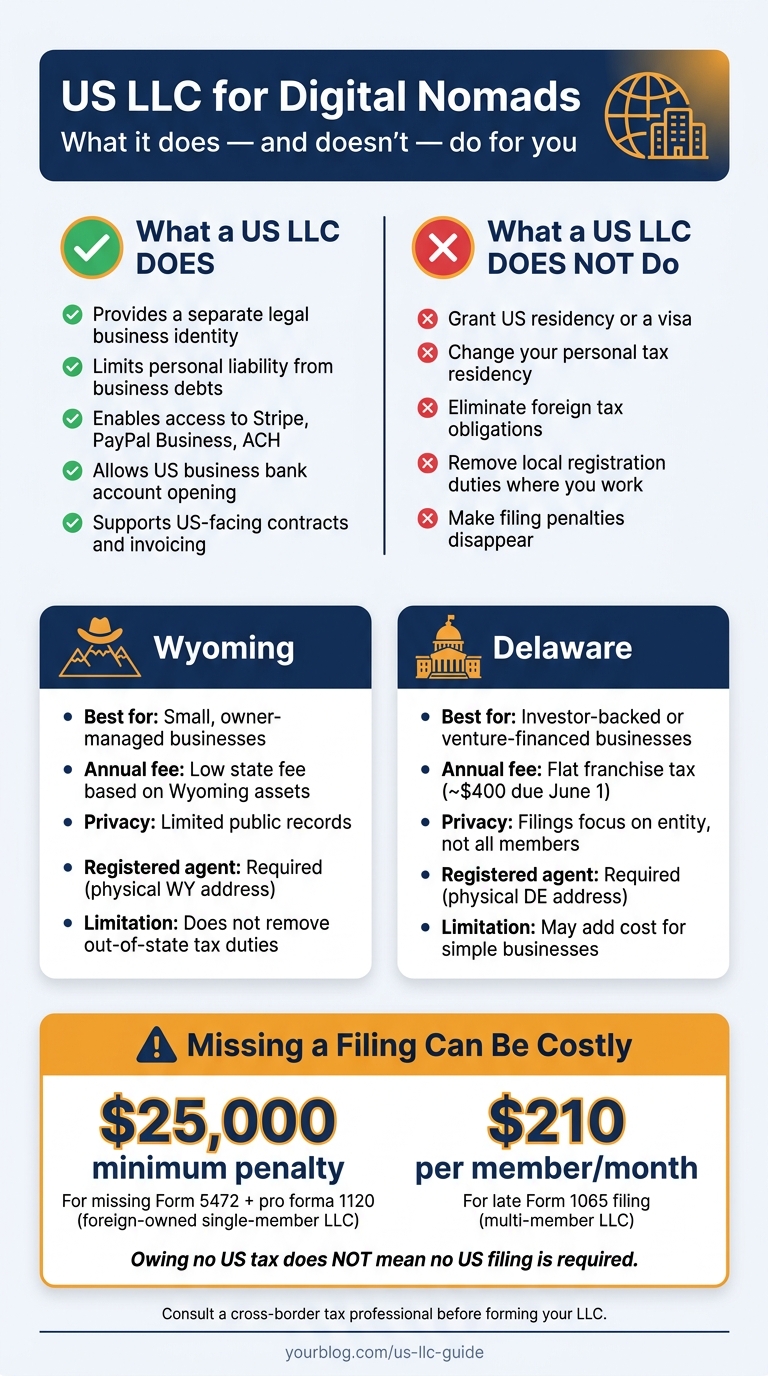
US LLC for Digital Nomads: Wyoming vs Delaware vs Federal Filing Penalties
Quick Comparison
| Topic | What you need to know |
|---|---|
| LLC and residency | Owning a US LLC does not make you a US resident |
| LLC and taxes | The LLC does not by itself remove US or foreign tax duties |
| Where tax often turns | Citizenship, green-card status, tax residency, and where services are performed |
| Wyoming | Often lower-cost and simpler for small owner-run businesses |
| Delaware | Often used when investors or more layered ownership are part of the plan (see our Delaware vs Wyoming LLC comparison) |
| Foreign-owned single-member LLC | May owe no US income tax, but can still need Form 5472 + pro forma 1120 |
| If you work from another place | You may need local registration or may create tax exposure there |
If you’re thinking about forming a US LLC as a digital nomad, I’d treat it as a business tool with filing duties attached – not as a residency plan or tax shortcut.
sbb-itb-ba0a4be
What a US LLC offers digital nomads
A US LLC gives your business its own legal identity. That matters because it can help separate your personal life from your business life. If the LLC gets sued, your personal assets are generally kept apart from business debts and legal claims.
There’s also a practical side to it. With a US LLC and an EIN, you can often open a business bank account without traveling to the US. You may also get access to tools like Stripe, PayPal Business, US bank accounts, and ACH transfers. If your clients are in the US, that can make getting paid a lot smoother.
| Feature | What It Means for You |
|---|---|
| Liability protection | Personal assets stay separate from business debts and lawsuits |
| Contracts & invoicing | A US entity name can help with trust among enterprise and US-based clients |
| Payment processing | Access to Stripe, PayPal Business, ACH transfers, and US bank accounts |
| Compliance load | No board meetings or formal minutes. |
Still, those upsides only matter if the LLC matches your residency and tax situation. That’s the part many people miss.
Who benefits most from this structure
Three groups often get the most from a US LLC:
- US citizens living abroad
- Green-card holders working remotely
- Non-US nationals running online service businesses
For non-US owners, this setup can work well when the services are performed outside the US, especially if they need US payment rails or want a US-facing company name for clients.
On the other hand, a US LLC may not do much for you if you don’t need US banking or that extra layer of trust with US clients.
Owning a US company versus being a US resident
Owning a US LLC does not make you a US resident. It also does not change your tax residency. The LLC is a business entity. You are a person. The IRS and foreign tax authorities look at those separately.
Here’s the plain-English version: setting up the LLC doesn’t wipe out your personal tax duties in the country where you live and work. Company ownership is one piece of the puzzle. Your own tax residency is a different issue entirely.
That’s why it makes sense to get tax advice before assuming the LLC fixes everything. Residency and state choice come next for a reason.
Residency, location, and state selection
The state where you form your LLC affects registration and state filings. It does not decide your personal tax residency. Once you know where you’re a resident for tax purposes, the next step is picking the state where the LLC should be formed.
US tax residency, foreign tax residency, and dual-residency risk
For non-citizens, U.S. tax residency usually depends on either the green card test or the substantial presence test. Owning an LLC doesn’t change that result.
Other countries use their own residency rules. If you spend long stretches in another country, that country may also treat you as a tax resident based on things like:
- Days spent there
- A permanent home
- Family ties
- Where you regularly run the business
If two countries both say you’re a resident, a treaty may include tie-breaker rules. But that doesn’t wipe out filing duties. You may still need to file in one or both places. That’s why it’s smart to have a tax professional look at your facts before assuming a treaty fixes everything.
Wyoming vs. Delaware: How to choose a formation state
Once residency is sorted out, the practical issue is simpler: which state gives you the least hassle on an ongoing basis?
Neither Wyoming nor Delaware is automatically the right pick. The better fit depends on your setup, whether you plan to bring in investors, and where the business actually operates.
| Factor | Wyoming | Delaware |
|---|---|---|
| Typical fit | Small, owner-managed businesses that want a simple setup and lower recurring state costs | Businesses expecting investors, more layered governance, or venture financing |
| Annual state obligation | Annual report and a state fee based on Wyoming assets, subject to the state’s minimum | Annual flat franchise tax |
| Registered agent | Required, with a physical Wyoming address | Required, with a physical Delaware address |
| Privacy | Public records are limited, but privacy is not anonymity | Public filings focus on the entity and registered agent rather than listing all members |
| Main limitation | Does not remove taxes or registration duties where you actually operate | May add extra cost for simple businesses |
Here’s the key point: formation state and operating state are not the same thing.
If you form in Wyoming but later work full-time from California or another U.S. state, the LLC may need to register there as a foreign LLC and pay that state’s taxes and fees. The same idea applies to Delaware. A lot of owners miss this and assume the formation state controls everything. It doesn’t.
Registered agent, business address, and mail handling
Your state choice also affects your registered agent and mail setup. Every LLC needs a registered agent with a physical street address in the formation state. That address has one job: receiving legal papers and official state notices during business hours.
For remote owners, this can get messy fast. It’s common to juggle four different addresses at once, and mixing them up can cause problems with banks, tax agencies, and licensing offices.
| Address Type | Purpose | Notes |
|---|---|---|
| Registered agent address | Receives legal service of process and state notices | Must be a physical address in the formation state |
| Principal business address | Where the company’s main activity or management happens | May be outside the formation state; often requested for banking and EIN applications |
| Mailing address | Receives routine correspondence | Can differ from the operating address |
| Virtual mailbox | Scans, stores, and forwards mail remotely | Useful for nomads; does not qualify as a registered agent address |
A virtual mailbox works well for day-to-day mail. But it can’t stand in for a registered agent. If someone files a lawsuit or the state sends an urgent compliance notice, that goes to the registered agent, not your mailbox service.
So when you pick a registered agent, check the basics:
- How fast they notify you
- Whether they scan and forward documents securely
- How they handle time-sensitive notices
Missed notices can turn into very real problems. Think unanswered lawsuits, missed annual reports, or state penalties that were avoidable.
Keep a day-by-day travel log to support your residency position.
Federal tax treatment for US and non-US owners
For digital nomads, LLC tax treatment turns on two things: who owns the company and where the work happens.
Default LLC tax treatment and pass-through rules
By default, a single-member LLC is treated as a disregarded entity, and a multi-member LLC is taxed as a partnership. In most cases, the LLC itself does not pay federal income tax. Instead, the owners pay tax on the income at the owner level. That setup helps avoid corporate-style double taxation.
US citizens and green-card holders living abroad
If you’re a US citizen or green-card holder, the IRS taxes your worldwide income no matter where you live. So even if you’re based abroad, your federal filing duty doesn’t go away. You may still qualify for the Foreign Earned Income Exclusion or Foreign Tax Credits.
That applies to US citizens and green-card holders. Foreign owners usually deal with a different set of filing rules.
Foreign owners and Form 5472 filing obligations
For non-US owners, US tax usually applies only when the LLC has US-connected income. If you do all of the work outside the US and the LLC has no US presence, it may owe no federal income tax.
But here’s the part people often miss: owing no tax doesn’t mean no filing. A foreign-owned single-member LLC must still file Form 5472 with a pro forma Form 1120 each year. Tax treatment and filing duties are separate issues, and the table below shows that split.
| Filing | Applies to | Due date | Penalty |
|---|---|---|---|
| Form 1065 | Multi-member LLC | March 15 | $210 per member/month |
| Form 5472 + pro forma 1120 | Foreign-owned single-member LLC | April 15 | $25,000 minimum |
Budget for annual CPA help even when no tax is due.
The cost of compliance is usually far lower than the cost of missing a filing.
EIN, filings, and ongoing compliance from abroad
Forming the LLC is just the first move. If you want the company to stay usable for banking, contracts, and payment processors, you have to keep it in good standing. That’s where the day-to-day admin comes in: federal filings, state deadlines, and clean ownership records.
EIN, annual reports, and federal filing deadlines
Your Employer Identification Number (EIN) is the LLC’s federal tax ID. You’ll commonly use it for federal tax filings, opening business or financial accounts, applying for payment-processing services, and handling employment tax reporting when needed. One small mismatch can cause a headache, so use the same legal name, address, and responsible-party details across filings and accounts.
Beyond the EIN, there are three separate compliance layers, and each one runs on its own schedule. Missing one doesn’t excuse the others.
| Compliance layer | What it covers | Example deadline |
|---|---|---|
| State annual report | Updates managers, address, registered agent | Wyoming: anniversary month of formation |
| State franchise tax | State charge for maintaining the entity | Delaware LLCs: $400 due June 1 |
| Federal information return | IRS filings based on LLC classification and ownership | Foreign-owned single-member LLCs may need Form 5472 with a pro forma Form 1120 when applicable |
Set up a compliance calendar on day one. Add 60-day and 30-day reminders for annual reports, registered-agent renewals, local licenses, and home-country filings. That simple habit can save you from late fees and avoidable messes.
Beneficial ownership rules and recordkeeping
Under current FinCEN guidance, U.S.-created companies are exempt from federal BOI reporting, while certain foreign entities registered in the United States may still have filing duties. For applicable foreign entities, the initial BOI report is generally due within 30 calendar days after the effective registration date . Don’t rely on old checklists floating around online. Check the current FinCEN position directly, or confirm it with qualified counsel, before you file or claim an exemption.
Even when a BOI filing doesn’t apply, the ownership records behind it still matter. Banks and payment processors may still ask for ownership and control details as part of their compliance checks. So even if FinCEN doesn’t need a report, you still need your records in order.
Keep one digital compliance folder with your articles of organization, operating agreement, EIN confirmation letter, state certificates, annual reports, tax returns, registered-agent notices, and payment confirmations. Also track every contribution, distribution, loan, reimbursement, and related-party payment with the date, amount, counterparty, purpose, and supporting documents. And yes, keep business and personal funds fully separate. Run business expenses through the LLC’s own account, not your personal one.
Tools that help nomads manage the LLC remotely
If you’re running the LLC from abroad, a small remote-compliance stack goes a long way. At a minimum, you need:
- a registered agent
- a virtual mailbox
- bookkeeping software
- a compliance calendar with automated alerts
It also helps to use one system for formation, registered-agent service, virtual mailbox, EIN support, annual reports, and document storage. That keeps everything in one place instead of scattered across inboxes and portals. Still, these tools only handle the admin side. They don’t replace a CPA or tax attorney when it’s time to make filing decisions.
Conclusion: How to decide if a US LLC fits your nomad business
A US LLC can give a digital nomad a legal business entity, limited liability, and access to US banking and payment rails. But it does not change your residency, tax status, or filing duties.
Those results depend on three things: your citizenship, where you physically do the work, and where you are tax resident. That’s the lens this guide has used all along: residency, taxes, and compliance.
So the main decision is pretty simple: is the LLC worth the admin work that comes with it?
Before you form one, check four things:
- There’s a real business reason for the LLC
- You understand your residency and tax exposure
- You know the full yearly cost
- You can handle filings and records while living abroad
If any of those points feels fuzzy, bring in a cross-border tax professional before formation, not after. That can save you a lot of pain later.
Choosing the best state to form an LLC often comes down to your specific needs: Wyoming works well for small owner-run businesses with lower recurring costs, while Delaware tends to fit businesses with investors or more involved equity setups. Either way, your state choice does not change your personal tax residency or your local registration duties.
Use the checklist below to pressure-test your setup.
| Question | Green light | Pause and get advice |
|---|---|---|
| Owner classification | You understand US-person or foreign-owner tax rules | Citizenship, green-card status, or tax residence may create worldwide-income reporting complexity |
| Work location | You can clearly state where services are performed | You move frequently or may create local business-tax exposure |
| Business purpose | The LLC solves a real contracting, payment, or liability need | The entity is mainly for obtaining residency or avoiding taxes |
| Federal compliance | You have a calendar and understand possible Form 5472 exposure if applicable | You assume no US tax due means no US filing required |
| Ongoing admin | You can fund a registered agent, maintain records, and file on time | You lack a stable mail process, bookkeeping system, or professional support budget |
Form the LLC only if the upside is bigger than the compliance burden. Tie the entity to where you actually work and pay tax, verify the filing rules with qualified professionals in both the US and your country of residence, and then decide whether to move ahead.
FAQs
Can a US LLC help me get a visa or residency?
Forming a U.S. LLC does not automatically give you a visa or residency. That part trips up a lot of people.
What it can do is help support some immigration applications by showing that you have a real U.S. business presence.
Possible categories include E-2, L-1A, O-1A, and International Entrepreneur Parole. A B-1 visa may allow short business visits, but it does not permit active business operations.
The key issue is eligibility. Each category has strict rules, and the standards can be tough. That’s why it makes sense to speak with an immigration professional before you make plans around an LLC.
When does a non-US owner owe US tax on an LLC?
A non-US owner usually owes U.S. federal income tax when the LLC earns Effectively Connected Income (ECI) from a U.S. trade or business. That often means the business has a clear link to the United States, such as U.S.-based employees, offices, or inventory.
There’s another bucket to watch: U.S.-source passive income. This can include dividends, interest, or royalties. That income may be taxed at a flat 30% rate unless a tax treaty lowers it.
On the flip side, you generally avoid U.S. federal tax if the LLC has no U.S.-source income, no U.S. employees, and no physical presence in the U.S.
Do I need to register my LLC where I actually work?
No. You can form your LLC in any U.S. state that fits your business needs, including Wyoming or Delaware, no matter where you live or work.
That said, there’s one key catch: you need a registered agent with a physical address in the state where you form the LLC.
And if your business is active in another state, say you have employees, an office, or inventory there, you may also need to register that LLC in that state as a foreign entity.