

Yes – nonresident owners generally get the same US LLC liability protection as other owners. My starting advice: keep company money separate, sign contracts in the LLC’s name, and check for personal guarantees before signing.
The key distinction is <u>company obligations versus your personal obligations</u>:
- Company debts generally stay with the LLC. Personal guarantees, your own wrongdoing, certain tax duties, and misuse of the company can still put your assets at risk.
- State law sets the limits. Keep records, state filings, and registered-agent details current, and arrange to receive lawsuit notices while abroad.
- Tax reporting is a separate issue. A foreign-owned single-member LLC with reportable related-party transactions generally must file Form 5472 with a pro forma Form 1120. Filing failures can trigger a $25,000 penalty.
- Cross-border rules still matter. Another country may treat your LLC differently. Check local registration, tax rules, and insurance coverage.
I treat an LLC as a boundary between business and personal liability – not protection from every claim.
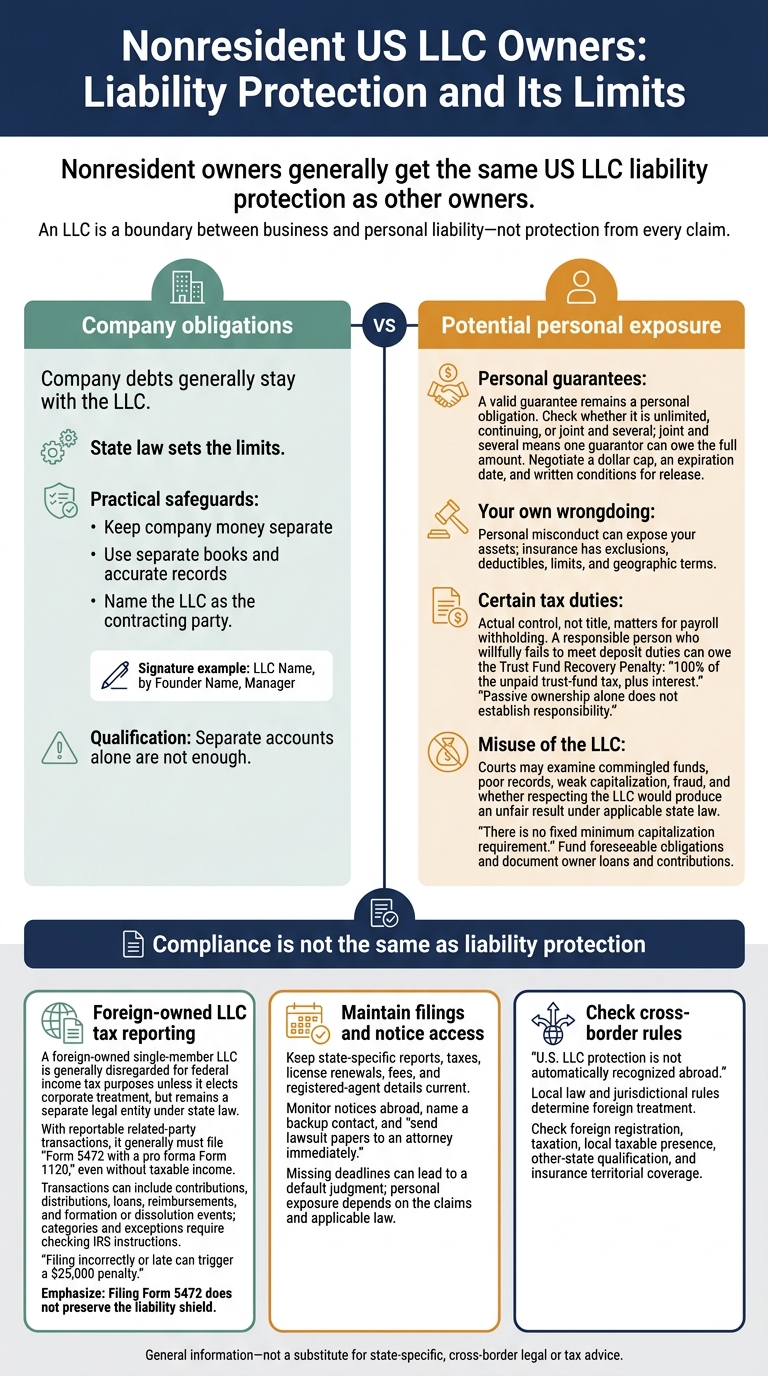
Nonresident US LLC Owners: Liability Protection and Its Limits
When Founders Can Be Personally Liable
An LLC does not shield founders from every personal obligation. Separate promises, personal misconduct, tax-control duties, and misuse of the LLC can still leave you personally liable.
Personal Guarantees, Wrongdoing, and Tax Debts
A guarantee is a separate personal promise. Before signing, check whether it is unlimited, continuing, or joint and several – meaning one guarantor can owe the full amount. Negotiate a dollar cap, an expiration date, and written conditions for release.
For payroll withholding, the IRS looks at actual control, not your title. A responsible person who willfully fails to meet deposit duties can owe the Trust Fund Recovery Penalty: 100% of the unpaid trust-fund tax, plus interest. Passive ownership alone does not establish responsibility. If you control payments, track payroll-tax deposits and keep payment confirmations.
Insurance can reduce risks tied to personal misconduct. But coverage depends on exclusions, deductibles, limits, and geographic terms, especially if you deliver services from abroad.
Mixing Funds and Misusing the LLC
Another major risk is treating the LLC as your personal property. Courts may disregard the LLC when owners use company money as personal money or otherwise misuse the entity.
Under applicable state law, courts examine commingled funds, poor records, weak capitalization, fraud, and whether respecting the LLC would produce an unfair result. There is no fixed minimum capitalization requirement. The business needs reasonable resources to cover its foreseeable obligations. Document owner loans and contributions rather than moving money without records.
| Risk | Practical prevention | Limit of protection |
|---|---|---|
| Personal guarantees | Negotiate caps, expiration dates, and release terms. | A valid guarantee remains a personal obligation. |
| Commingled funds | Keep separate accounts; document reimbursements and distributions. | Separate accounts alone are not enough. |
| Undercapitalization | Fund foreseeable obligations; document decisions. | Adequacy depends on the business and state law. |
| Negligence | Use insurance, procedures, and risk controls. | Coverage has exclusions and limits. |
| Fraud or misuse | Use truthful disclosures and accurate records. | LLC documents cannot authorize fraud. |
sbb-itb-ba0a4be
Compliance Steps for Founders Living Abroad
Once you understand the liability limits, focus on keeping the LLC’s records, filings, and notices in order while you’re abroad.
Keep Money, Records, and Contracts Separate
Use a dedicated LLC bank account and separate books. Store receipts, invoices, signed contracts, and bank statements in a secure digital archive you can access abroad. Reconcile the account monthly, and record every owner transfer by date, amount, and purpose: contribution, loan, reimbursement, or distribution. These records also support foreign-owned disregarded-entity reporting.
Adopt and follow an operating agreement that sets out ownership, management authority, and approval rules. Name the LLC as the contracting party. When authorized, sign in the LLC’s name and state your role:
LLC Name, by Founder Name, Manager
That signature does not override a separate personal guarantee. Keeping records in order also makes state filings and registered-agent upkeep easier.
Keep State Filings and Registered Agent Details Current
To maintain the LLC’s separate legal status, create a state-specific calendar for initial, annual, or biennial reports, state taxes, license renewals, and required fees. Check company details before filing, and save the confirmations.
Keep registered-agent coverage continuous. A mailing address alone does not automatically meet registered-office or physical-business-address requirements.
Get an EIN using the LLC’s exact legal name, and save the IRS confirmation. Foreign-owned U.S. disregarded entities need an EIN for Form 5472 reporting.
Track Legal Notices, Mail, and Deadlines Abroad
Once filings and agent details are current, watch for legal notices and response deadlines. Set up separate workflows for lawsuit notices and ordinary mail. Monitor alerts, name a backup contact, and send lawsuit papers to an attorney immediately.
Missing a notice or deadline while abroad can lead to a default judgment. Personal exposure depends on the claims and applicable law. Mail and maintenance services do not extend response deadlines.
Tax Reporting and Cross-Border Liability
Liability protection and tax compliance are separate issues. Meeting tax filing requirements doesn’t determine whether your personal assets are protected.
Tax Reporting for Foreign-Owned LLCs
A foreign-owned single-member LLC is generally disregarded for federal income tax purposes unless it elects corporate treatment. Under state law, it remains a separate legal entity.
If the LLC has reportable related-party transactions, it must file Form 5472 with a pro forma Form 1120, even without taxable income. These transactions can include contributions, distributions, loans, reimbursements, and formation or dissolution events. Check the IRS Form 5472 instructions for the applicable categories and exceptions.
The filing deadline generally follows the Form 1120 deadline, including extensions. Filing incorrectly or late can trigger a $25,000 penalty. You also need to check federal, state, payroll, and home-country filing rules. These duties affect compliance – not the LLC’s basic liability shield.
How Tax Compliance Differs From Liability Protection
Filing Form 5472 does not preserve the liability shield, and federal tax classification does not control state-law liability. Reporting penalties and personal tax obligations are separate from creditor claims against your personal assets.
Tax reporting, state filings, and payroll taxes affect compliance and penalties. They do not, by themselves, determine personal liability. This distinction matters most when your LLC operates outside the United States or in another state.
Doing Business Abroad or in Another US State
Cross-border operations add another layer of rules. Local law may affect both compliance and enforcement.
U.S. LLC protection is not automatically recognized abroad. Local law and jurisdictional rules determine how a foreign court treats the LLC. Check requirements for foreign registration, taxation, and local taxable presence. Before setting up regular operations in another U.S. state, review foreign qualification requirements and applicable liability rules.
Banks, landlords, and other counterparties can still require personal guarantees. Match your insurance to your activities and locations, and check territorial coverage – not just U.S. policy terms.
Conclusion: LLC Protection Generally Applies to Nonresident Owners
Living outside the United States does not remove LLC liability protection. Business debts generally stay with the company. This is a core benefit of running a U.S. LLC from overseas. But personal guarantees, personal misconduct, liabilities imposed by law, and misuse of the LLC can expose a founder’s personal assets.
That protection depends on keeping the LLC separate from your personal activity in banking, records, and contracts. Keep records accurate, update registered-agent details, and submit required state reports and tax filings on time.
BusinessAnywhere can bring registered-agent services, mail handling, and compliance support into one place. It does not replace legal or tax advice for your formation state, any other state where you operate, or relevant foreign jurisdictions.
FAQs
Can a US LLC creditor reach my assets abroad?
A U.S. LLC generally protects your personal assets from business lawsuits or debts, no matter where you live.
That protection has limits. Creditors may still reach your assets if you sign personal guarantees, commit fraud or engage in criminal activity, or mix business and personal finances. In many states, creditors can also use a charging order to reach your LLC membership interests.
Which state’s LLC laws best protect me?
For non-residents, the “best” state usually comes down to privacy and yearly compliance costs.
Wyoming is the top pick. When you use a registered agent, member names aren’t required in public filings. The state also offers strong charging-order protection, no state income tax, and annual fees of around $60.
Delaware may be a better fit if you plan to seek venture capital, though yearly franchise costs are higher – about $300–$400. New Mexico is the most budget-friendly option, with no annual report fee.
Can I pay LLC expenses from my personal account?
No. Keep your personal and business finances separate to help protect your LLC’s limited liability status. Mixing funds can weaken the legal shield that protects your personal assets from business debts or lawsuits. Use a dedicated business bank account for every company transaction.
If you paid the initial formation fees with personal funds, record those payments as a capital contribution. Pay all business expenses after that through your business account.