


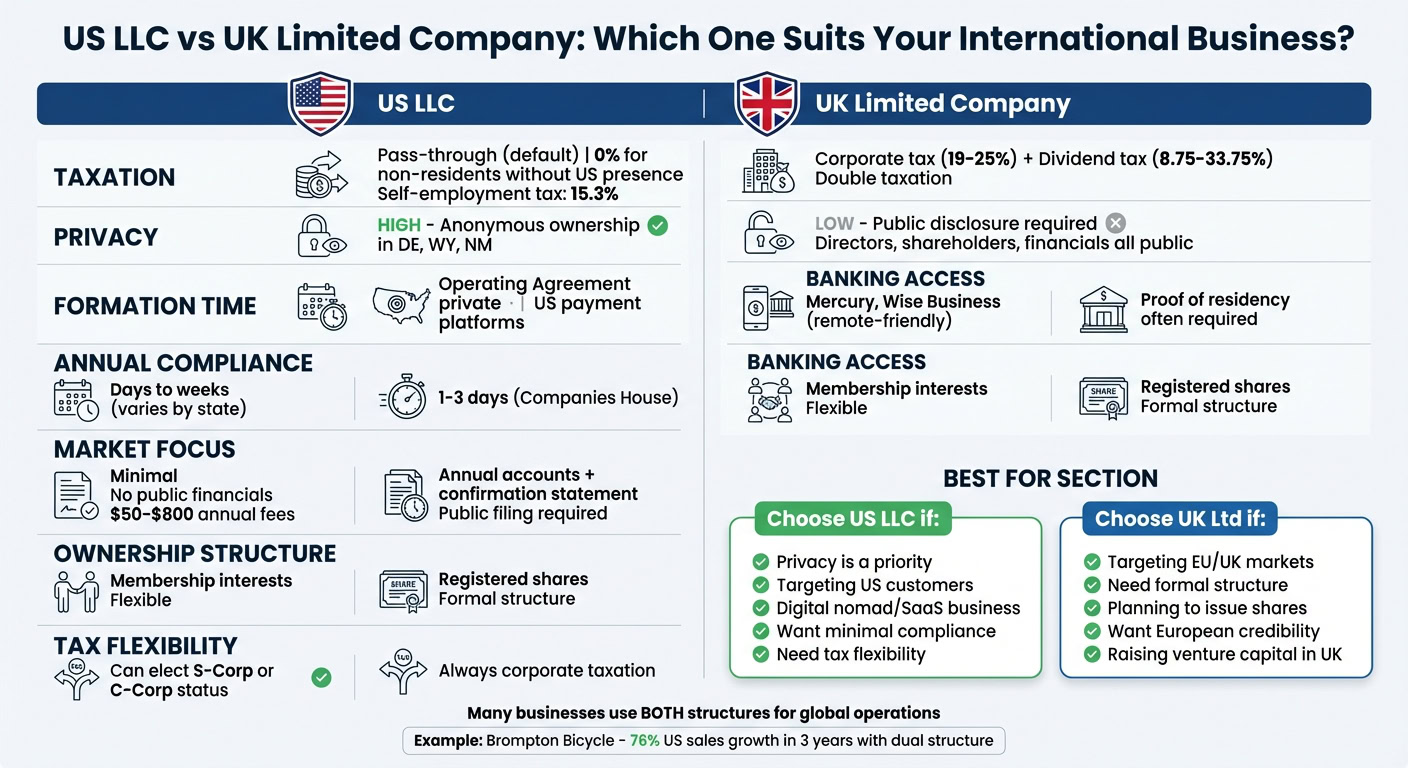
When deciding between a US LLC and a UK Limited Company for your international business, the right choice depends on your goals, tax preferences, and privacy needs. Here’s a quick breakdown:
- US LLCs: Offer flexibility with pass-through taxation, privacy in certain states (like Delaware or Wyoming), and fewer compliance requirements. They’re ideal for US-focused businesses, digital entrepreneurs, and privacy-conscious ventures.
- UK Limited Companies: Provide a formal structure, credibility in European markets, and centralized compliance through Companies House. However, they require public disclosure of financials and ownership details. Best suited for businesses targeting the UK or EU markets or those needing share issuance capabilities.
Quick Comparison
| Feature | US LLC | UK Limited Company |
|---|---|---|
| Taxation | Pass-through (default) | Corporate tax + dividend tax |
| Privacy | High (in certain states) | Low (publicly disclosed) |
| Formation Timeline | Days to weeks (varies by state) | 1–3 days |
| Compliance | Minimal | Annual accounts and filings |
| Market Focus | US | UK/EU |
| Banking | US-friendly platforms | Proof of residency often needed |
Choose a US LLC for simplicity, privacy, and US market focus. Opt for a UK Limited Company if you value formal structure and credibility in Europe. Both options can work together for businesses with global ambitions.
US LLC vs UK Limited Company: Complete Comparison Guide for International Business
Legal Structure and Liability Protection
How Each Entity Protects Owners
Both US LLCs and UK Limited Companies offer a protective barrier – often called a "corporate veil" – that shields personal assets from business liabilities and legal troubles.
In the US, an LLC combines the liability protection of a corporation with the operational flexibility of a partnership. This structure is defined by state law, and Wyoming was the first to introduce it in 1977. By 1996, all 50 states had their own LLC statutes.
The UK Limited Company operates as a separate legal entity under the UK Companies Act. Its shareholders are only responsible for the unpaid portion of their shares’ nominal value, which is typically minimal. On the other hand, members of US LLCs are generally not personally liable for the company’s debts. However, Single-Member LLCs often face closer scrutiny because they are more vulnerable to poor record-keeping and are frequently treated as disregarded entities for tax purposes.
"One surefire way to lose limited liability legal protections is to mingle personal and business funds." – Jake Flanagin, Shopify UK
In both the US and UK, failing to follow proper formalities – like mixing personal and business finances or committing fraud – can lead to the corporate veil being pierced. To maintain this protection, it’s crucial to take steps like using a dedicated business bank account to avoid commingling funds, drafting an Operating Agreement for US LLCs, and keeping statutory registers and filing annual reports for UK Limited Companies.
Next, let’s look at how formation timelines and compliance requirements differentiate these two entities.
Comparison Table: Liability Protection
| Feature | US LLC | UK Limited Company |
|---|---|---|
| Legal Personality | Separate legal entity | Separate legal personality |
| Liability Limit | Members not personally liable for debts | Shareholders liable up to unpaid share value |
| Governance Requirements | Flexible; no boards or annual meetings | Rigid; requires directors with fiduciary duties |
| Formalities | Minimal; private Operating Agreement | Extensive; statutory registers and annual filings |
| Ownership Structure | Membership Interests | Registered Shares |
| Veil Piercing Risks | Commingling funds, fraud, poor records | Fraud, director breaches, insolvent trading |
sbb-itb-ba0a4be
Formation Timeline and Compliance Requirements
Formation Steps and Timelines
Forming a US LLC can take anywhere from a few days to several weeks, depending on the state and filing method. Online filings are typically quicker, while mail submissions can stretch the process out. Here’s a breakdown of the key steps:
- Choose a state: Delaware is popular for investor-backed ventures, while Wyoming is often chosen for lower costs.
- Select a business name: The name must be unique and include "LLC" or a similar designation.
- Appoint a registered agent: This agent must have a physical address in the state of formation.
- File Articles of Organization: Submit this to the Secretary of State, with fees ranging from $50 to $500.
- Draft an Operating Agreement: Though not always required, it’s highly recommended.
- Obtain an EIN: The IRS issues this Employer Identification Number. U.S. Social Security Number holders can get it immediately by phone, while international applicants may need 4 business days by fax or up to 4 weeks by mail.
On the other hand, forming a UK Limited Company is much simpler, thanks to a centralized system. Registration through Companies House usually takes just 1–3 days. A tax identification number is automatically issued at the time of incorporation. This streamlined process eliminates the state-by-state variations that U.S. entrepreneurs often deal with.
Ongoing Compliance: US vs. UK
Once the business is formed, compliance requirements differ greatly between the two countries.
In the U.S., there’s no central business registry, as each state governs its own LLCs and corporations. Most states require annual or biennial reports listing officers and directors, but they don’t mandate the filing of financial accounts. This allows for greater privacy. However, businesses must maintain a registered agent in their formation state, which typically costs $50–$300 annually. Annual fees also vary widely – Wyoming charges as little as $50–$60, while California imposes a minimum annual tax of $800.
For UK Limited Companies, compliance is centralized. Companies must file annual accounts with Companies House, making their financial data publicly accessible. They’re also required to submit an annual confirmation statement to keep their records up to date. While this national system simplifies compliance, it comes at the cost of privacy, as anyone can view the company’s financial performance.
"The US-UK tax treaty is crucial for British entrepreneurs setting up businesses in America. It can significantly reduce your overall tax burden when structured correctly." – James Harrison, International Tax Specialist
Comparison Table: Formation and Compliance
| Feature | US LLC | UK Limited Company |
|---|---|---|
| Formation Timeline | A few days to weeks (varies by state) | 1–3 days |
| Tax ID Timeline | Immediate (phone) to 4 weeks (mail) | Issued upon incorporation |
| Primary Authority | Secretary of State (state level) | Companies House (national level) |
| Registered Agent | Required in state of formation | Not required (registered office instead) |
| Public Financial Accounts | No (private) | Yes (filed annually) |
| Annual State Fees | $50–$800+ (varies by state) | Standardized via Companies House |
| Annual Reports | Reports listing officers/directors | Confirmation statement + annual accounts |
Tax Structures and Financial Implications
How US LLCs Are Taxed
US LLCs operate under a pass-through taxation system by default. This means that any profits or losses are directly reported on the owners’ personal tax returns, effectively bypassing corporate-level taxation. For single-member LLCs, the IRS treats them as "disregarded entities", while multi-member LLCs are taxed as partnerships.
However, there’s a notable self-employment tax obligation for LLC members. They must pay a 15.3% self-employment tax on all net earnings, which includes Social Security (12.4% on earnings up to $176,100) and Medicare (2.9%), with no cap on the latter. This tax applies regardless of whether profits are distributed.
One of the standout features of US LLCs is their tax classification flexibility. Using the IRS’s "check-the-box" rules, owners can opt for S-Corporation or C-Corporation taxation without altering the LLC’s legal structure. The S-Corporation election is especially beneficial for LLC owners with profits exceeding $60,000–$80,000. For example, with $150,000 in profit, an LLC electing S-Corp status and paying a $70,000 salary could save about $6,100 annually in self-employment taxes by taking the remaining profit as distributions.
"The tax flexibility afforded to the US LLC is the primary differentiating factor and the main reason for its popularity." – LegalClarity Team
On the other hand, the taxation system for UK Limited Companies follows a different approach.
How UK Limited Companies Are Taxed
UK Limited Companies are taxed as separate legal entities, which means they pay Corporation Tax on their profits before any distributions to shareholders. Current rates are set at 25% for profits exceeding £250,000 and 19% for profits under £50,000. After this, shareholders are taxed on dividends, introducing a layer of double taxation.
Dividend taxation in the UK comes with limited allowances. Starting in 2026, only £500 of dividends will be tax-free annually. Beyond that, dividends are taxed at 8.75% for basic rate taxpayers and 33.75% for higher rate taxpayers. To minimize their tax liability, many UK Ltd owners opt to take a small salary within the personal allowance and withdraw additional profits as dividends, which are exempt from National Insurance contributions.
UK Limited Companies can also benefit from schemes like R&D tax credits and the Enterprise Investment Scheme (EIS). Additionally, any business losses generally remain within the company and can be used to offset future profits.
The following table highlights the key differences between these tax structures.
Comparison Table: Tax Structures
| Feature | US LLC (Default) | UK Limited Company |
|---|---|---|
| Primary Tax Level | Individual (Members) | Corporate (The Company) |
| Double Taxation | No (unless C-Corp election) | Yes (Corporation Tax + Dividend Tax) |
| Tax on Retained Earnings | Taxed at individual rates even if not distributed | Taxed at corporate rate; no individual tax until distributed |
| Social Security/Payroll | 15.3% self-employment tax on all net income | National Insurance on salaries only; no NI on dividends |
| Tax Elections | Highly flexible (C-Corp, S-Corp, Partnership) | None (Always taxed as a corporation) |
| Loss Treatment | Can offset owner’s other personal income | Generally offset against future company profits |
| Effective Tax Burden | ~25–45% (varies by state/income) | ~25–42% (combined corp + dividend) |
Privacy and Public Disclosure Requirements
Privacy in US LLCs
US LLCs generally provide more privacy than UK Limited Companies. In many states, the names of members or managers aren’t required on public formation documents. Initial filings typically only need the name and address of the organizer or registered agent, keeping ownership details confidential.
States like Delaware, New Mexico, and Wyoming are known for supporting anonymous LLC formation. For example, Delaware allows owner and manager information to remain off public records.
"Delaware allows for no owner or manager information to be supplied on the face of the Certificate of Formation, and has no annual report, so your identity can remain off the public record forever." – VALIS Group, Inc.
New Mexico offers similar benefits, as it doesn’t require annual reports or public disclosure of ownership details. Wyoming also supports anonymity at formation but requires annual reports, which may reduce long-term privacy compared to Delaware or New Mexico.
The Operating Agreement of a US LLC, which outlines its internal rules and management structure, remains a private document and isn’t filed with any government agency. This ensures that ownership percentages and management structures stay confidential. However, anonymous LLC owners are still required to disclose their identities to the IRS and banking institutions.
In comparison, UK Limited Companies operate under stricter public disclosure standards.
Disclosure Requirements in UK Limited Companies
UK Limited Companies are subject to mandatory transparency rules. These companies must register with Companies House, which maintains a public record of directors, shareholders, and financial information.
"The LTD prioritizes public transparency, making the identity of those controlling the company and its basic financial health a matter of public record." – LegalClarity Team
Directors’ names, service addresses, initial shareholders, and individuals holding over 25% of shares or voting rights must be disclosed through the PSC (Persons with Significant Control) register.
Financial transparency is also required. UK Limited Companies must file annual accounts that are accessible to the public, unlike US LLCs, which generally don’t file internal financial statements with state or federal governments. Additionally, the Articles of Association, which govern a company’s internal rules, are public documents in the UK. This differs from the private Operating Agreement used by US LLCs.
While UK business owners can use service addresses for directors to keep residential addresses off public records at Companies House, they are still required to disclose their names and roles.
These differences in privacy and disclosure are key considerations when deciding on the right entity for international business.
Comparison Table: Privacy and Disclosure
| Feature | US LLC (Privacy-Friendly States) | UK Limited Company |
|---|---|---|
| Public Disclosure of Owners | Optional/state-dependent (Anonymous in DE, NM, WY) | Mandatory (Shareholders and PSCs >25%) |
| Director/Manager Names | Generally private | Publicly disclosed |
| Service Addresses | Remain private (via a registered agent) | Publicly disclosed |
| Financial Statements | Not publicly filed | Annual accounts are filed publicly |
| Governance Documents | Operating Agreement remains private | Articles of Association are public |
| Beneficial Ownership | Often private (state-dependent) | Publicly disclosed through the PSC register |
| Anonymity Level | High (in specific states like DE and NM) | Low (transparency is a legal requirement) |
Choosing the Right Entity for Your International Business
When deciding on the best entity for your international business, it’s essential to weigh legal, compliance, and tax factors against your specific operational needs. Let’s break down the key considerations and scenarios to help you make the right choice.
What to Consider When Deciding
Start with your primary market location. If your business focuses on US customers and processes payments in USD, a US LLC might be your best bet. It grants direct access to American payment platforms like Stripe and PayPal. On the other hand, for businesses serving European or Commonwealth markets and operating in GBP or EUR, a UK Limited Company can provide stronger local credibility and trust with customers and partners.
Tax efficiency is another critical factor. US LLCs offer a pass-through taxation model, which can mean paying 0% US tax for non-residents without a permanent US presence. In contrast, UK Limited Companies are subject to a 25% corporate tax rate, plus additional taxes on dividends.
Your privacy requirements also play a role. For example, US LLCs formed in privacy-friendly states allow for confidential ownership and low annual fees. In contrast, UK Limited Companies require public disclosure of directors and shareholders. If maintaining confidentiality is a priority, this is worth considering.
Banking accessibility is another practical concern. US LLCs can access digital-first banking platforms like Mercury and Wise Business, which allow non-residents to open accounts remotely. UK banks, however, often require proof of residency, making it more challenging for non-UK residents to establish banking relationships.
By carefully weighing these factors, you can choose a structure that aligns with your business goals and operational needs.
Business Scenarios and Recommendations
Here are some common business scenarios to illustrate how these entities align with different objectives:
- SaaS companies targeting US customers: A US LLC is ideal for these businesses. It integrates seamlessly with American payment systems and USD banking. The pass-through tax model is especially advantageous for digital businesses without a physical US presence.
- Privacy-focused ventures: A Wyoming LLC is a strong option. It provides maximum anonymity, with no public listing of members or managers, and boasts the lowest annual fees in the US. This setup is particularly appealing to consultants, digital nomads, and service providers who value confidentiality.
- Startups seeking US venture capital: In this case, a Delaware C-Corporation is often the better choice. With over 67% of Fortune 500 companies incorporated in Delaware, its specialized business court system and established legal precedents make it the preferred structure for institutional investors.
- European e-commerce businesses: A UK Limited Company offers credibility with European customers and facilitates VAT compliance. The LTD designation is well-recognized, and its formal governance structure appeals to EU partners and suppliers.
- Digital nomads without US citizenship: US LLCs are a flexible option, offering potential 0% tax on foreign-sourced income and remote banking features. These benefits make it a favorite among location-independent entrepreneurs. However, it’s important to comply with tax obligations in your country of residence.
Some businesses even combine both entity types. For instance, Brompton Bicycle set up Brompton USA LLC in 2017 to manage its US operations while maintaining its UK parent company. This dual-entity approach allowed the company to leverage the LLC structure for tax efficiency and direct-to-consumer sales, leading to a 76% growth in US sales within three years.
Decision Framework: US LLC vs. UK Limited Company
| Business Need | Recommended Entity | Primary Reason |
|---|---|---|
| Privacy Priority | US LLC (Wyoming/Delaware) | No public member registry |
| US VC Funding | US C-Corporation (Delaware) | Preferred by institutional investors |
| Digital Nomad | US LLC | Pass-through tax and remote banking |
| UK Local Presence | UK Limited Company | Necessary for local employees and contracts |
| Low Maintenance | US LLC | Fewer formal meetings and filings |
| European E-commerce | UK Limited Company | EU customer credibility and VAT compliance |
| SaaS targeting US customers | US LLC | Access to US payment stacks and USD banking |
Ultimately, the right choice depends on where your customers are, your tax preferences, and how much privacy you need. Align your decision with your operational goals to set your business up for success.
Conclusion
Choosing between a US LLC and a UK Limited Company comes down to your business goals, market focus, and operational priorities. If you’re a digital entrepreneur targeting American customers, prioritizing privacy, and seeking minimal administrative hassle, a US LLC for non-residents – especially in states like Wyoming or Delaware – might be your best option. These entities offer pass-through taxation and options for maintaining ownership anonymity. On the other hand, if your focus is on European markets, raising capital through share issuance, or leveraging the formal structure of a corporation, a UK Limited Company provides a solid framework.
The decision largely hinges on three key factors: tax treatment, privacy, and banking integration. US LLCs can potentially offer a 0% US tax rate for non-residents without a permanent establishment, while UK Limited Companies face a 25% corporate tax plus dividend taxes. Privacy is another differentiator – some US states allow anonymous ownership, whereas the UK mandates public disclosure of company details. Banking integration also varies, with US LLCs seamlessly connecting to digital platforms, while UK banks often require proof of residency, which can complicate things for international entrepreneurs. However, UK entities excel when it comes to issuing shares, making them attractive for venture-backed startups.
Interestingly, many global businesses use both structures to their advantage. For example, Brompton Bicycle created Brompton USA LLC in 2017 to complement its UK parent company, leading to a 76% growth in US sales within three years. Ultimately, your choice should align with your market focus, tax strategy, privacy preferences, and growth ambitions. Select the entity that best supports your business objectives.
FAQs
Do I owe U.S. tax if I’m not a U.S. resident and my LLC sells internationally?
If you’re not a U.S. resident, simply selling internationally through your LLC doesn’t automatically mean you owe U.S. taxes. However, things get more complicated if you earn income from U.S. sources or if your LLC is classified as a disregarded entity or partnership for tax purposes. To navigate these specifics, it’s a good idea to consult a tax professional who can provide guidance tailored to your situation.
Which structure is easier for non-residents to open a business bank account?
For non-residents, setting up a business bank account is typically simpler with an LLC compared to a UK Limited Company. Many U.S. banks and online banking platforms allow remote account creation for LLCs, often without the need for you to be physically present. On the other hand, UK Limited Companies often encounter more complicated processes, making LLCs a more convenient option for international entrepreneurs who value straightforward banking solutions.
Can I run a UK Ltd and a US LLC at the same time?
Yes, it’s possible to run both a UK Limited Company (Ltd) and a US LLC at the same time. Entrepreneurs often choose this setup to take advantage of benefits offered by each jurisdiction, like broader market access, potential tax perks, or specific legal protections. That said, managing both entities means adhering to the legal and tax obligations of each country, including registration, reporting, and filings. While this can be complex, careful planning makes it entirely manageable.