

If I had to boil it down to one rule, it’s this: form your entity before risk, profit, or growth outgrow a sole proprietorship. If I’m still testing a low-risk solo business, staying a sole proprietor can be fine. But once I’m signing bigger contracts, hiring, selling physical products, buying rentals, planning to seek outside money, or clearing about $40,000 to $80,000+ in net profit, I’d take a hard look at an LLC, an S corp tax election, or a C corporation.
Here’s the short version:
- Stay a sole proprietor if I’m early, low-risk, and keeping costs low.
- Form an LLC if I want personal liability protection for client work, product sales, or property ownership.
- Look at an S corp election when profit is steady enough that payroll costs may be worth the tax split.
- Use a C corp if I plan to issue equity, bring in co-founders, or seek angel or VC money.
- File before a big contract, first employee, funding event, or the start of a new tax year.
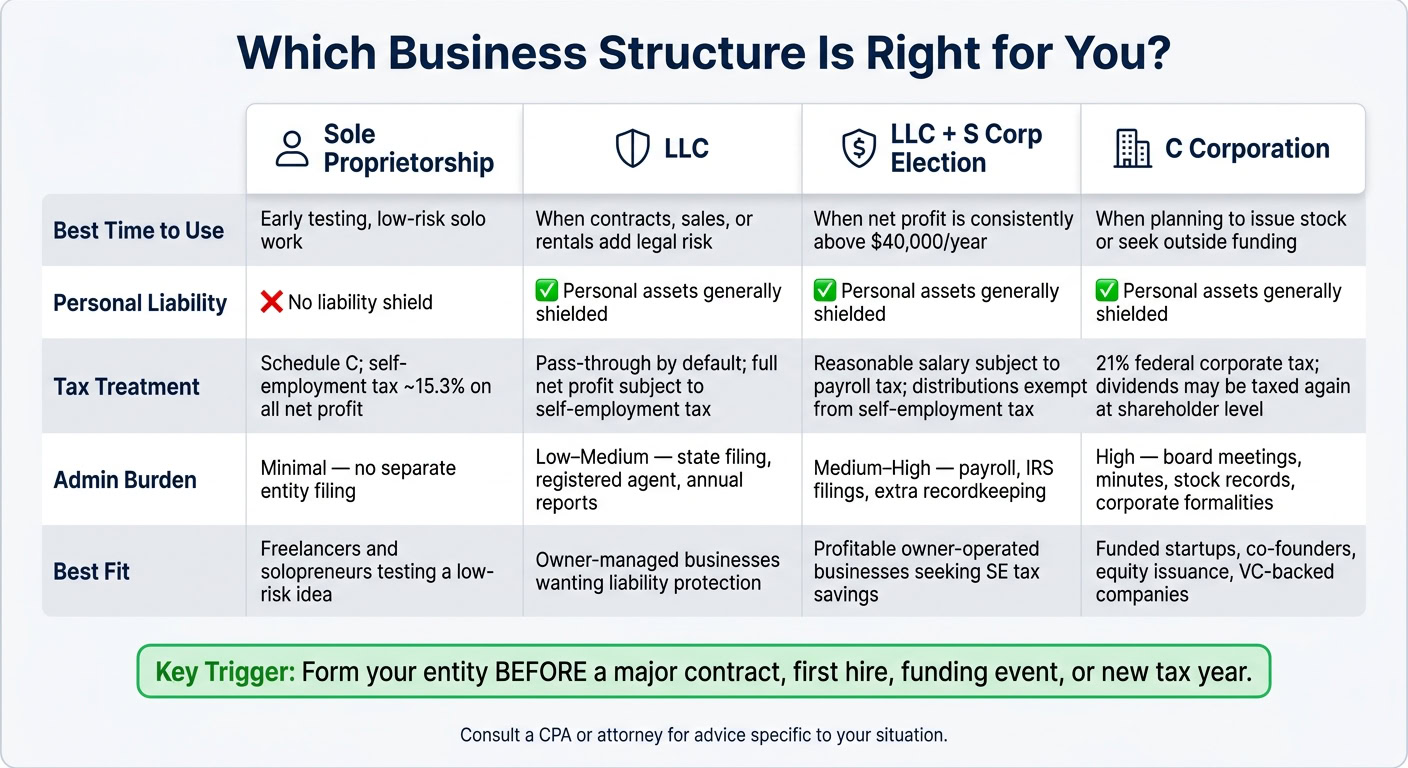
Quick comparison
| Structure | Best time to use it | Main tax point | Main tradeoff |
|---|---|---|---|
| Sole proprietorship | Early testing, low-risk solo work | Profit goes on Schedule C; self-employment tax can hit 15.3% | No personal liability shield |
| LLC | When contracts, sales, or rentals add legal risk | Pass-through by default | State fees, reports, and recordkeeping |
| LLC + S corp election | When profit is often above $40,000/year | Part of income may avoid self-employment tax | Payroll, filings, and more admin |
| C corporation | When I plan to issue stock or seek outside money | 21% federal corporate tax, plus possible tax on dividends | More rules, records, and formal steps |
My takeaway: I’d pick the structure that fits the business I have now, not the one I might have later. The article comes down to five things: liability, taxes, funding, growth, and paperwork.
sbb-itb-ba0a4be
Sole proprietor, LLC, or corporation: what each path means in practice
Each structure changes three big things: personal liability, taxes, and access to investors.
| Structure | Personal liability | Tax treatment | Best fit | Ongoing compliance |
|---|---|---|---|---|
| Sole proprietorship | No liability shield | Schedule C; self-employment tax of 15.3% on net earnings | Low-risk solo work or early-stage testing | Minimal – no separate entity filing |
| LLC | Personal assets generally shielded | Pass-through by default; can elect corporate taxation | Owner-managed businesses that want liability protection without corporate formalities | Moderate – state filing, registered agent, annual reports in many states |
| C corporation | Personal assets generally shielded | Corporate profits are taxed at 21%, and dividends can be taxed again at the shareholder level | Funded startups, equity issuance, institutional investors | High – board meetings, minutes, and stock records |
| S corporation (tax election) | Personal assets generally shielded | Pass-through if eligible | Owner-operated businesses wanting pass-through treatment with a corporate structure | High – corporate formalities plus IRS eligibility rules |
An S corporation is a tax election, not a separate state-law entity.
Once you lay the options side by side, the next question is pretty simple: which one fits your risk, tax, and growth goals right now?
When staying a sole proprietor still makes sense
If you’re testing demand with low-risk solo work, a sole proprietorship is the cheapest way to get started. There’s nothing to file at the state level, no registered agent fee, and no annual report hanging over your head.
That said, this setup works best as a starting point, not a forever plan. If your revenue grows, your contracts get bigger, or your work brings more legal risk, the lack of a liability shield becomes hard to ignore. At that point, many owners move to an LLC or a corporation.
When an LLC is the right next step
For most owner-managed businesses, an LLC hits the sweet spot. You get a legal line between your personal assets and business liabilities, but you don’t have to deal with the full stack of corporate paperwork.
That matters once your business starts operating in ways that carry more exposure. A marketing consultant signing larger client agreements, a software developer working with enterprise customers, or an e-commerce seller shipping physical products all take on risk that a sole proprietorship leaves sitting on the owner’s shoulders.
Real estate is a good example. Many investors put each property into a separate LLC to box in risk. If a tenant sues over an injury at one property, assets in another LLC are usually kept out of that claim. That’s why LLCs are often the default choice for businesses that want protection but don’t need outside investors.
When incorporation is the better move
A C corporation usually makes more sense when outside funding is part of the plan. It supports stock issuance, multiple classes of stock, and employee stock options. That’s a big reason funded startups often use it when they plan to raise capital or aim for an acquisition.
The tradeoff is tax complexity. Corporate profits are taxed at 21%, and dividends can be taxed again at the shareholder level. If you don’t need outside capital, an LLC is often the simpler path. The difference shows up fast when growth depends on equity, not just profit.
Five triggers that tell you it is time to formalize your business
Most owners don’t plan to stay sole proprietors forever. Usually, they’re waiting for a clear sign that it’s time to make the switch. These triggers can help you figure out whether your current setup still matches your risk, tax, and growth goals.
Liability risk and contracts: form before the stakes get real
Set up an LLC or corporation before your work creates meaningful personal risk. This part matters more than many owners think.
Entity protection usually applies to obligations you take on after the entity is formed, not before. So if a dispute comes from a contract you signed as a sole proprietor, forming an LLC the next day won’t protect you from that claim.
The practical move is simple: form first, then sign contracts in the entity’s name.
Taxes and profit levels: when added structure can start paying off
If liability risk still feels manageable, profit is often the next signal to watch.
As a sole proprietor or default LLC, your net profit is generally subject to self-employment tax – about 15.3% up to the Social Security wage base, plus Medicare above that. At lower profit levels, that may not change much. But as profit grows, the gap can start to matter.
Once your net business profit is consistently in the $50,000 to $80,000+ range, it’s worth running the numbers with a CPA to see whether an LLC with an S corporation election makes sense. With an S corp election, you pay yourself a reasonable salary that is subject to payroll taxes, while the remaining profit can be taken as distributions that are not subject to self-employment tax.
Below about $40,000 in net profit, an S corp is often tough to justify. The tax angle may sound appealing, but payroll, filings, and extra recordkeeping can eat into the upside.
| Structure | Self-employment tax exposure | Admin burden |
|---|---|---|
| LLC (default taxation) | Full net profit generally subject to self-employment tax | Low–medium |
| LLC with S corp election | Payroll taxes on reasonable salary only; distributions exempt | Medium–high |
Funding, growth, and compliance: match the structure to the business you are building
If the tax math doesn’t support a switch, growth plans often do.
If you plan to raise outside capital – especially angel or venture funding – a LLC or C corporation is usually the better place to start, often a Delaware C corp. Changing from an LLC in the middle of a fundraise can bring legal fees and extra complexity that you may avoid by choosing the right entity at the start.
For a freelancer, consultant, or small agency with no plan to raise equity, an LLC – with or without an S corporation election – usually covers the basics well. The compliance load is lighter than with a corporation. Think separate finances, annual or biennial reports, and the records needed to keep the entity in good standing.
Once you add outside capital, equity for employees, or formal governance needs, incorporation starts to make more sense. Pick the structure that fits the business you have right now, not the one you might build someday.
How the decision plays out across common business types
Those signals can look pretty different once you map them to actual business models.
Freelancers, consultants, and online business owners
For many freelancers, the first clear sign shows up when income becomes steady and the work starts to carry more risk. A designer making $1,500–$2,000 per month from low-risk, one-off projects can often stay a sole proprietor. In that setup, the main reason to form an LLC is liability protection.
That changes when the same designer starts landing steady retainers, longer contracts, and agreements with IP or indemnity clauses. Now the case for an LLC gets stronger. It puts a clearer legal line between personal assets and contract disputes. And when revenue is steady, annual fees tend to feel a lot more manageable.
Online store owners usually hit this decision point because of scale. A seller going from a few orders here and there to a higher-volume store takes on more product, payment, and shipping risk. At that stage, an LLC can also make it easier to open a business bank account and keep personal and business money separate.
Consultants working with enterprise clients need to look closely at the contract terms. Master service agreements often include indemnification, limitation-of-liability, confidentiality, and data-protection language. If you’re giving financial, HR, cybersecurity, or similar advice, signing in your own name can leave more on the line than signing through an LLC. In that case, the entity choice tends to work best alongside the right insurance, like professional liability or cyber coverage.
Startup founders and real estate investors
For co-founders and equity issuance, a C corp keeps vesting, cap tables, stock options, and SAFEs lined up cleanly. Venture capital funds and many institutional investors usually expect a C corporation, often a Delaware C corp. Forming the company early can also help make IP ownership and founder agreements clear from day one.
Real estate investors face a different set of trade-offs. One property may not be enough to justify an LLC. But once you have multiple properties or more equity at stake, liability separation starts to matter more. Put simply, the more equity and properties you add, the more the structure counts.
A short checklist to help you decide today
Use this as a quick gut-check before talking to a CPA or attorney:
| Question | If yes → | If no → |
|---|---|---|
| Is your net profit consistently above $40,000/year? | Consider LLC or S corp election | Sole proprietor is likely fine for now |
| Are you signing contracts with indemnity or IP clauses? | Form an LLC before signing | Review contracts and add insurance |
| Do you plan to raise outside capital or issue equity? | Incorporate as a C corp | LLC is likely sufficient |
| Do you own or plan to own multiple rental properties? | Consider one or more LLCs | One LLC plus insurance may be enough |
| Are you comfortable with annual filings and recordkeeping? | Move forward with entity formation | Factor compliance costs into your decision |
If the checklist points toward formation, the next step is figuring out where to file, what it will cost, and how long approval takes.
Filing your entity: state choice, costs, timelines, and next steps
How state filing differences affect your timing and cost
Once you’ve picked the right structure, the next step is simple on paper: choose the state, set up an LLC, and wait for approval. For an LLC, you file Articles of Organization. For a corporation, you file Articles of Incorporation. In most cases, that goes through the Secretary of State.
For most small businesses, the best move is to file in the state where you actually do business. Filing in another state can sound smart at first, but it often means you still have to register in your home state as an out-of-state entity. That can leave you paying fees in two states and dealing with extra compliance work. In plain English: file where you operate unless another state clearly cuts your total cost and paperwork.
Here’s a quick look at how state costs can vary:
| State | LLC filing fee | Annual state cost | Why it matters |
|---|---|---|---|
| Kentucky | $40 | $15/year | A low-cost option when cash flow is tight. |
| Florida | $125 | $138.75/year | Budget for the recurring report, not just the filing. |
| California | $70 | $800/year minimum franchise tax + $20 Statement of Information fee | The minimum tax applies even if profit is still low. |
The upfront filing fee is only one piece of the bill. Annual reports, franchise taxes, and registered agent fees can add up to more over time. That’s why the cheapest filing fee doesn’t always mean the cheapest setup overall. What matters more is the total cost and how fast you can get the entity ready to use.
Timing matters too. Standard processing can take anywhere from a few business days to several weeks, depending on the state and whether you file online or by mail. If you pay for expedited service, approval often drops to 24–72 hours, and some states even offer same-day online filing. If you need the entity ready before signing a big contract or bringing on an employee, give yourself at least 2–4 weeks. That buffer helps if the state rejects something or asks for a correction.
Some states add another wrinkle: publication rules. Arizona and New York, for example, require new entities to publish formation notices in local newspapers. That can add both cost and several more weeks to the process. If your state has that rule, build it into your plan from day one.
What to do right after your entity is approved
Approval doesn’t mean you’re done. It means the setup work shifts into compliance work. Right after approval, take care of these items:
- Get an EIN. Apply with the IRS for an Employer Identification Number. You’ll need it to open a business bank account, run payroll, and file taxes. Even a single-member LLC should usually get one to keep business and personal information separate. BusinessAnywhere offers an EIN application service for $97 if you don’t want to handle the IRS process on your own.
- Create your governing documents. An LLC should have an operating agreement. A corporation should adopt bylaws and, if needed, a shareholders’ agreement. These papers lay out ownership, profit sharing, decision-making, share structure, and what happens if an owner leaves. Banks and investors often ask to see them.
- Open a dedicated business bank account. Put all business income into that account and pay business expenses from it. Mixing business and personal money is one of the fastest ways to make bookkeeping messy and weaken liability protection.
- Register for any needed state or local tax accounts and licenses. That may include sales tax, payroll tax, or local business licenses, depending on what you do and where you operate.
- Calendar your compliance deadlines. Annual reports, franchise taxes, and registered agent renewals all come with due dates. Miss them and you could face late fees, loss of good standing, or even administrative dissolution. BusinessAnywhere’s registered agent service includes compliance alerts, which can help you keep track.
Conclusion: the right time to formalize is before risk or growth outpaces your current setup
Pick your structure based on where the business stands today. Stay a sole proprietor when the business is still small, low-risk, and bringing in modest income. Move to an LLC when liability risk, steady revenue, or contract demands start to grow. Go with a corporation when you’re adding co-founders, issuing equity, or getting ready to seek outside funding.
Timing matters as much as structure. In most cases, the right time to file is before a major contract, before your first hire, before a funding event, or at the start of a new tax year. The goal is to get the entity in place before risk or growth gets ahead of your current setup.
FAQs
Can I switch from a sole proprietorship to an LLC later?
Yes. You can switch from a sole proprietorship to an LLC at any point as your business grows and you want liability protection or a more formal setup.
To make the change, you’ll need to:
- Pick a name that’s available in your state
- File Articles of Organization
- Get a new EIN
- Update your licenses, permits, and bank accounts
You’ll also need to stay on top of state filing rules and keep your business and personal money separate.
Does forming an LLC automatically lower my taxes?
No. Forming an LLC does not automatically lower your taxes.
By default, a single-member LLC is taxed like a sole proprietorship. That means you report the income on your personal tax return and pay self-employment tax on the full net profit.
Where people sometimes save money is through tax treatment choices. For example, you can elect S-Corp status if the tax savings outweigh the added payroll work and compliance costs.
Should I form my business before signing my first big contract?
Often, yes – mainly when the contract brings major legal risk or involves sensitive data.
As a sole proprietor, you are personally on the hook for business debts and legal claims. An LLC, on the other hand, creates a separate legal entity that can help shield your personal assets.
If the contract is high-value, an LLC can also make your business look more established. That said, it comes with extra admin work too, like state filings, possible annual fees, and keeping your personal and business finances separate.