

If you use a business name in Florida that does not match your legal name or your company’s exact state-filed name, you usually need a fictitious name registration before using it.
Here’s the short version: I’d check the name on Sunbiz, publish a newspaper notice in the county of the main business location, file the registration with the Florida Division of Corporations, and pay $50.00. After that, I’d track the 5-year term, because the filing expires on December 31 of the fifth calendar year unless renewed.
What matters most:
- A Florida DBA is called a fictitious name
- It does not form an LLC or corporation
- It does not protect personal assets
- The newspaper notice must run before filing
- The state filing fee is $50.00
- Renewal is due every 5 years
- Missing the deadline means filing again
A few common cases:
- If I’m a sole proprietor using a brand name instead of my full legal name, I’d usually need to file.
- If my LLC drops “LLC” from its public name, I’d usually need to file.
- If my corporation uses a different brand name, I’d usually need to file.
Quick facts:
| Item | Florida rule |
|---|---|
| Official term | Fictitious name |
| State fee | $50.00 |
| Notice rule | Publish once before filing |
| Renewal cycle | 5 years |
| Expiration point | December 31 of the fifth calendar year |
| Late renewal grace period | None |
Bottom line: I’d treat this as a name-registration step, not a business-formation step, and I’d keep proof of publication, the filing confirmation, and the renewal date in one place.
When You Need a Fictitious Name in Florida
You need to register a fictitious name in Florida if you plan to use a business name that is not your legal name or your entity’s exact registered name. That filing goes with the Division of Corporations before you use the name in public.
Sole Proprietors, LLCs, and Corporations That Must File
For a sole proprietor, your legal name is your full personal legal name. So if your name is Jane Doe and you do business as Jane’s Cupcakes, you’ll usually need to file a fictitious name. The same goes if you leave out part of your name or swap in a brand name.
For LLCs and corporations, the rule is pretty strict. The legal name is the exact name on file with the state, including the required designator. That means even a small change can trigger a filing. For example, if your LLC is Sunshine Services LLC but your public-facing name is Sunshine Services, Florida generally treats that as a different name. A corporation works the same way: Atlantic Builders, Inc. would need a fictitious name to operate as Atlantic Home Services.
Here’s how that looks in common cases:
| Business Type | Legal Name | Operating Name | DBA Required? | Florida Basis |
|---|---|---|---|---|
| Sole Proprietor | Jane Doe | Jane Doe | No | Using the owner’s exact legal name |
| Sole Proprietor | Jane Doe | Jane’s Cupcakes | Yes | Brand name differs from the owner’s legal name |
| LLC | Sunshine Services LLC | Sunshine Services | Yes | Dropping LLC creates a different customer-facing name |
| LLC | Suncoast Design Studio, LLC | Suncoast Interiors | Yes | Separate brand name differs from the registered entity name |
| Corporation | Atlantic Builders, Inc. | Atlantic Home Services | Yes | Operating name differs from the exact corporate name |
When a DBA Is Not Required
If your contracts, invoices, bank accounts, and signs all use the exact registered name, you usually do not need a fictitious name filing.
Once you know the name has to be filed, the next step is to check whether it’s available and publish the required notice.
sbb-itb-ba0a4be
Check Name Availability and Meet Florida’s Newspaper Requirement
If your business needs a fictitious name, begin with two required tasks: make sure the name is open, then publish the newspaper notice in the right county.
Search Sunbiz and Check Florida Naming Rules
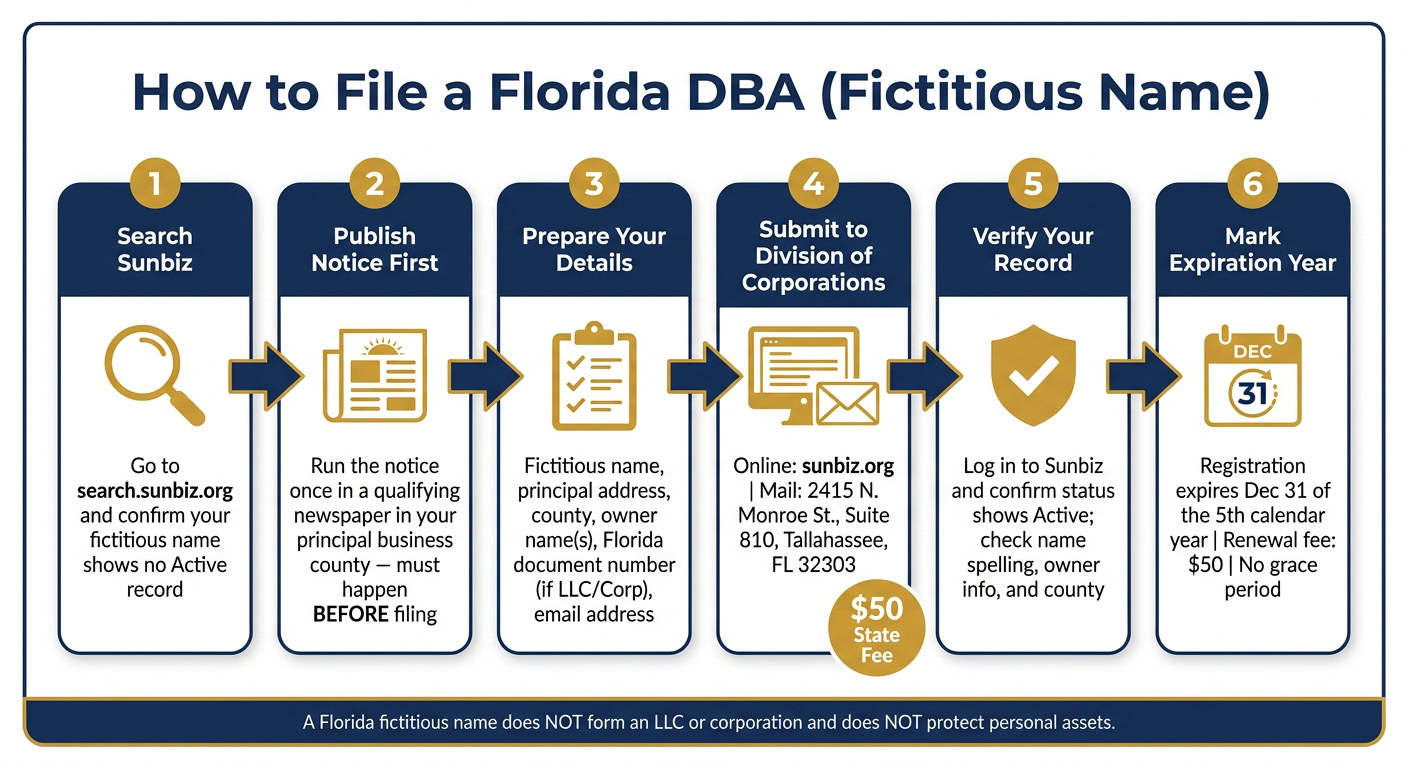
Go to the Florida Division of Corporations’ official search portal at search.sunbiz.org and search the fictitious name records there. Type the name exactly as you plan to register it. Spelling, punctuation, and wording all matter.
When you review the results, look closely at the "Status" column. If a record shows "Active," that name is already taken. If the name is "Inactive" and linked to a voluntarily dissolved entity, it opens up after 120 days. If it is linked to an administratively dissolved entity, it opens up after one year.
You also need to watch for naming rules beyond simple availability. Stay away from names that suggest a government link, hint at a regulated field like banking, insurance, or law, or use restricted words such as "Olympic" without authorization. If your DBA is tied to an existing Florida LLC or corporation, check that the main entity also shows "Active" status on Sunbiz and write down its Florida document number. You’ll need that number on the filing.
Once the name checks out, handle the newspaper notice before you file.
Publish the Fictitious Name Notice in the Correct County
Florida law says the fictitious name must be advertised at least once in a qualifying newspaper in the county where your main place of business is located. That publication has to happen before you submit the registration. The filing includes a certification that the notice was published, and the state does not require you to upload proof.
A standard notice usually includes:
- The fictitious name
- The legal owner’s name or entity name
- A statement that you plan to do business under that name
- The principal county of business
The newspaper charges a separate fee for running the notice.
After publication, keep the newspaper affidavit, tear sheet, or invoice with your business records.
How to File a Florida DBA: Step by Step
Information You Need Before You Start
Once the name is cleared and the newspaper notice is done, get your filing details together. To register a fictitious name the right way, you’ll need the fictitious name, principal business address, county, mailing address, and each owner’s name and address before you file.
For a sole proprietor, use the individual’s full legal name, home or business address, any separate mailing address, and a statement that the business is a sole proprietorship.
For an LLC or corporation, use the entity’s legal name exactly as it appears in Division of Corporations records, along with its principal office address and Florida document number so Sunbiz can match the fictitious name to the right record. If the business has a FEIN, include that with the Florida entity number.
You should also have a working email address ready. Sunbiz uses it to send confirmations and notices. And don’t skip the newspaper step. The application asks you to certify that the notice was completed before filing.
File Online or by Mail and Pay the State Fee
When your information is ready, you can file through Sunbiz online or send the form by mail.
If you file online, go to the Florida Fictitious Name Registration e-file page on sunbiz.org, enter the required information, review everything closely, certify the filing electronically, and pay the $50 state registration fee by credit card or another accepted online payment method.
If you’d rather file by mail, download the "Application for Registration of Fictitious Name" PDF from Sunbiz, fill it out, sign it, and mail it with a check or money order for $50 to:
Division of Corporations
2415 N. Monroe Street, Suite 810
Tallahassee, FL 32303
Mail filings are processed in the order received. If you want extra documents, a certified copy costs $30, and a certificate of status costs $10.
After Filing: Confirm the Record and Organize Your Documents
After you file, check the record and make sure it shows "Active." Then compare the details line by line. The business name spelling, owner information, and county should match what you submitted exactly.
Online filers get an email confirmation that can be downloaded as a PDF. Mail filers receive a paper acknowledgment with the registration number and filing date.
If the record doesn’t show up or something is wrong, contact the Division of Corporations directly. Fixing an error may mean filing an amendment or canceling and registering again, which adds cost and time.
Keep the filing, publication proof, and confirmation together in one place, whether that’s a folder on your desk or a digital file. A digital file or mailbox service can also help you store notices and keep an eye on renewal dates.
After the filing posts, track the renewal deadline and keep your records current. Next, review the renewal, update, and cancellation rules to keep the filing active.
How to Renew, Update, or Cancel Your Florida Fictitious Name
Florida Renewal Rules and Deadlines
Once your fictitious name is on record, don’t just file it and move on. You need to keep an eye on the renewal year and update the record when business details change.
A Florida fictitious name stays active for 5 years and expires on December 31 of the fifth calendar year after registration. That part trips people up. The date that matters is the expiration year, not the exact day you filed.
The renewal fee is $50. You can renew through Sunbiz or by mail for $50. The Division of Corporations sends a renewal notice by September 1 of the expiration year, but don’t count on that notice showing up or catching your attention at the right time.
Miss the December 31 deadline, and the registration expires right away. Florida does not give you a grace period. If you still want to use the name, you’ll need to file a new fictitious name registration and pay the fee again.
Changing Business Details or Ending the DBA
For routine account changes, Sunbiz makes things pretty simple. But if the business name or ownership changes, the process is different.
You can update details like your mailing address, email, owner address, or FEIN through Sunbiz’s update tools. That’s the easy part.
Some changes, though, call for a fresh filing:
- The fictitious name changes: cancel the old filing and re-register for $50.
- Ownership changes: file a cancellation and re-registration within 30 days of the change, and mail it instead of filing online.
If the business stops using the fictitious name for good, Florida law says you must file a cancellation within 30 days after you stop using it. To do that, complete Section 4 of the Fictitious Name Registration form and mail it with payment.
Florida DBA Filing Checklist
Use this checklist to keep the registration active and current.
| Step | Action |
|---|---|
| Determine need | Confirm whether your business still needs a fictitious name |
| Name search | Search Sunbiz before filing a new or re-registered DBA |
| Newspaper notice | Publish the notice in the correct county if you’re filing a new DBA |
| Renew with Sunbiz | Submit your renewal online or by mail |
| Save proof | Store the filing, renewal, or cancellation confirmation with your records |
| Mark the expiration year | Note the expiration year and set reminders well ahead of time |
| Update promptly | File address changes through Sunbiz; cancel and re-register for ownership or name changes |
| Cancel when done | File cancellation after you stop using the fictitious name |
A simple habit helps here: save every confirmation you get and add the expiration year to your calendar the same day you file. That small step can save you from having to start over later.
FAQs
Do I need a fictitious name if I drop “LLC” from my business name?
Yes. If you leave “LLC” off your business name, you’re using a name that’s different from your legal business name. That means you need to register a fictitious name.
Think of it this way: your LLC keeps its legal name on paper, but the shorter version can be the name you use in public. That gives you room to use the simpler name in branding, marketing, and day-to-day operations without changing the business entity itself.
What happens if I miss the Florida fictitious name renewal deadline?
If you miss the renewal deadline, you can lose the legal right to use your Florida fictitious name. In that case, you may have to reapply from scratch, which usually means another name check and another filing fee.
That slip-up can also create problems with your brand, bank accounts, and compliance records. And if someone else registers the name before you renew, things can get messy fast.
Can I change the owner or business name on an existing Florida DBA?
No. A Florida fictitious name registration stays with the exact legal entity that filed it.
A DBA is only a brand name for an existing business. It isn’t a separate business on its own. Because of that, you can’t switch the owner or move the registration to a different legal entity.
If the owner changes, or you want to use the same name under another entity, you’ll need to file a new fictitious name registration.