

A holding company LLC for real estate is a legal structure designed to own and manage property assets, offering benefits like liability protection, tax advantages, and streamlined management for investors choosing between an LLC or sole proprietorship. Here’s what you need to know:
- Liability Protection: Separates personal assets from business risks. Each property can be placed in its own LLC under a parent company to isolate liabilities.
- Tax Benefits: Avoid double taxation with pass-through taxation and qualify for deductions like mortgage interest, repairs, and depreciation.
- Simplified Financing: Lenders prefer this structure as it allows loans to be underwritten for individual properties.
- Privacy Options: States like Wyoming and New Mexico offer anonymous ownership for enhanced privacy.
When to Form One:
- You own or plan to own multiple properties.
- You want to protect personal assets from property-related liabilities.
- You’re seeking tax efficiency and easier management of a growing portfolio.
While this structure offers strong advantages, it may not be cost-effective for single-property owners or those with minimal risk exposure. Forming the LLC before buying properties ensures liability protection from the start.
What Is a Holding Company LLC for Real Estate?
Definition and Structure
A real estate holding company LLC is a legal entity created specifically to own and manage property assets. Unlike standard operating LLCs, which handle everyday tasks like leasing and tenant relations, a holding company focuses solely on owning deeds and titles.
This setup often includes a “parent” company that owns one or more “child” LLCs. This parent-child structure creates a protective barrier, often referred to as a corporate veil, which separates your personal assets from business liabilities. If a lawsuit targets one property, only the subsidiary LLC that owns that property is at risk, leaving other properties and your personal assets protected.
“A real estate holding company is a legal entity designed to protect business owners from the risks that come with owning investment properties.” – Than Merrill, CEO, FortuneBuilders
Setting up a holding company typically involves LLC filing fees by state, which average around state filing fees, which average around $40-$500, and additional costs for establishing multi-entity structures, starting at approximately $1,000. This structure is a cornerstone of risk management in real estate.
How It Works for Real Estate
While operating LLCs handle the day-to-day responsibilities like leases, tenant interactions, and property maintenance, a holding company operates behind the scenes. It doesn’t sign contracts or interact with tenants. Instead, it owns the assets, while the subsidiary LLCs manage the daily operations. This division of roles minimizes risk exposure.
For example, if a tenant files a lawsuit related to one property, only the subsidiary LLC that manages that property is affected. The other properties, along with the parent company, remain shielded. This separation is a key reason many real estate investors choose this structure. It also appeals to lenders, as they can underwrite loans against individual properties rather than a combined portfolio.
A holding company generates income through rental payments, interest, or dividends collected from its subsidiaries, rather than through active business operations. This distinction is crucial for tax purposes and liability protection. In states like Wyoming and New Mexico, holding companies can be set up with anonymous ownership, ensuring your name does not appear on public property records.
Benefits of a Holding Company LLC for Real Estate
Using a holding company LLC offers several advantages for real estate investors, especially those managing multiple properties.
Asset Protection
One of the biggest perks of a holding company LLC is its ability to protect personal wealth from property-related liabilities. By placing each property in its own subsidiary LLC under a parent holding company, any legal issues tied to one property remain isolated. This prevents liabilities from spilling over to other assets. In fact, over 80% of professional investors with 10 or more properties use this type of structure.
“Most new investors treat their entity structure like an afterthought… But the right holding company setup can protect assets, simplify taxes, and actually make financing faster and cleaner.” – Zach Cohen, Founder, Ridge Street Capital
Tax Advantages
LLCs offer pass-through taxation, which means profits are taxed only once at the individual level, avoiding the double taxation typically associated with corporations. This setup also allows for a variety of deductions, including mortgage interest, property taxes, repairs, maintenance, insurance, and depreciation. In a parent-subsidiary structure, losses from one property can offset gains from another, effectively lowering the overall tax burden. Additionally, the flexibility to choose S-corp or C-corp taxation can provide further tax savings.
Risk Isolation for Properties
Real estate comes with its fair share of risks, such as tenant injuries, environmental claims, contractor disputes, or creditor actions. If all properties are held under a single LLC, a lawsuit involving one property could jeopardize the entire portfolio. A holding company structure solves this by placing each property in its own LLC, isolating risks. Moreover, separating asset holding from property management through distinct LLCs adds another layer of protection, keeping operational liabilities confined.
Easier Property Management
A holding company simplifies the management of multiple properties by centralizing control. This streamlines financial tracking, tax reporting, and compliance. Lenders also prefer this structure because loans are often underwritten at the individual LLC level, speeding up the approval process. Additionally, transferring property ownership through the holding company can help reduce gift and estate taxes.
These benefits – ranging from asset protection to operational efficiency – make the holding company LLC a smart choice for real estate investors managing multiple properties.
Common Structures for Real Estate Holding Company LLCs
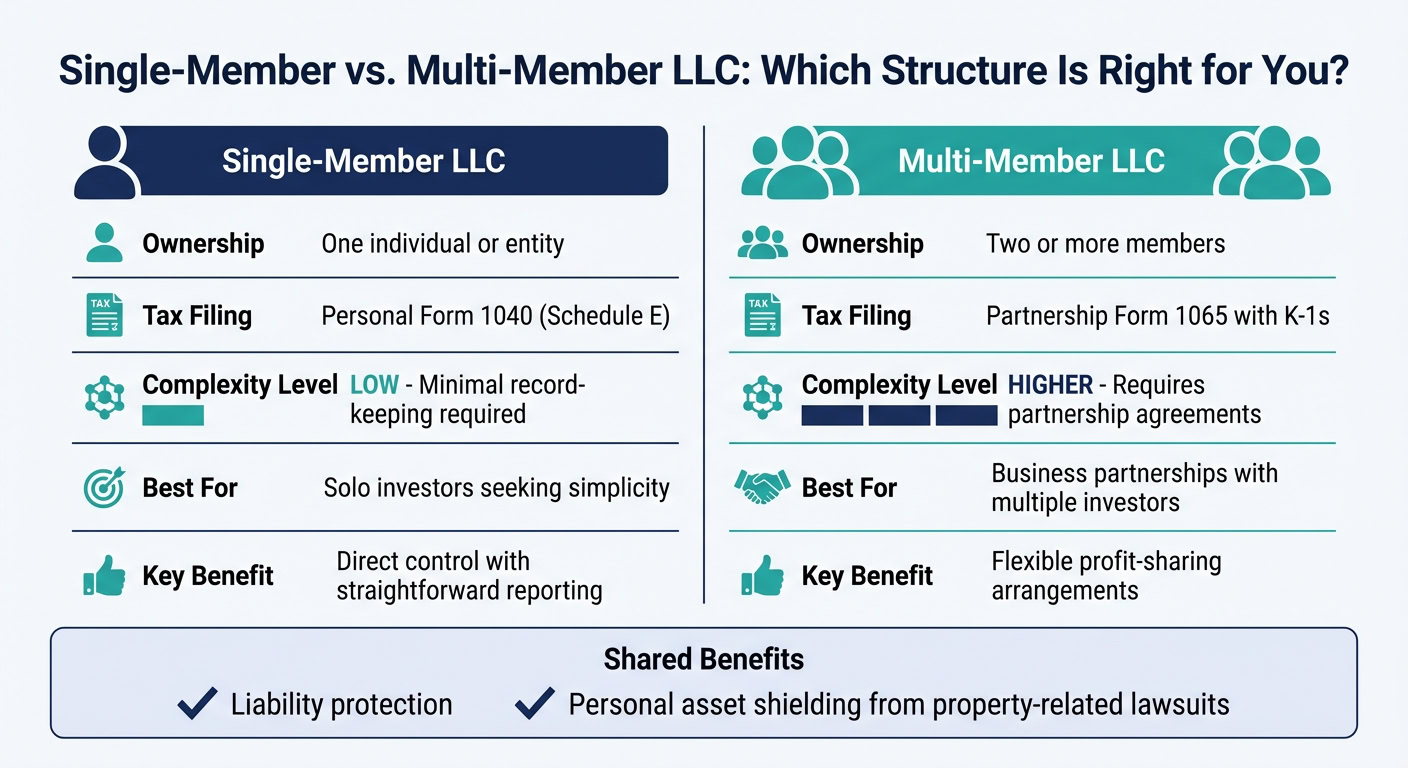
Real estate investors typically choose between two main structures: the parent-child model and single-member vs. multi-member ownership. Deciding on the right setup depends on the size of your portfolio and your investment goals.
Parent-Child LLC Structure
In the parent-child structure, a primary “parent” LLC owns one or more “child” LLCs, with each child LLC holding a specific property. This setup helps isolate liability. For instance, if a tenant files a lawsuit, the liability is limited to the child LLC that owns the property, leaving other assets untouched.
You can also divide responsibilities by assigning one child LLC to own the property and another to handle property management. This arrangement is often preferred by lenders, as they usually require each financed property to have its own borrowing entity, which can simplify loan approvals.
Many investors establish the parent LLC in states like Wyoming, known for strong privacy and asset protection laws, while creating child LLCs in the states where their properties are located or starting a Wyoming LLC. To maintain legal separation, each child LLC must have its own EIN and bank account.
Single-Member vs. Multi-Member LLCs
Once you’ve decided on a structural framework, the next step is choosing between a single-member or multi-member LLC, depending on your investment needs.
A single-member LLC is owned by one individual or entity and is classified as a “disregarded entity” by the IRS. This means its income and expenses are reported on your personal tax return using Schedule E. This option is straightforward, with minimal paperwork, making it a good fit for solo investors.
On the other hand, a multi-member LLC has two or more owners and is generally treated as a partnership for tax purposes. This requires filing a separate partnership tax return (Form 1065) and issuing K-1 forms to members. While more administrative work is involved, this structure offers flexibility in profit-sharing, allowing members to allocate earnings in ways that don’t necessarily align with ownership percentages. It’s particularly useful for rewarding contributions like “sweat equity”.
| Feature | Single-Member LLC | Multi-Member LLC |
|---|---|---|
| Ownership | One individual or entity | Two or more members |
| Tax Filing | Personal Form 1040 (Schedule E) | Partnership Form 1065 with K-1s |
| Complexity | Low; minimal record-keeping | Higher; requires partnership agreements |
| Best For | Solo investors | Business partnerships |
Both structures offer liability protection, shielding personal assets from property-related lawsuits. The primary differences lie in tax reporting and management complexity. A single-member LLC is ideal for simplicity and direct control, whereas a multi-member LLC suits partnerships where flexible profit-sharing is a priority.
sbb-itb-ba0a4be
When Should You Form a Holding Company LLC for Real Estate?
Situations Where Formation Makes Sense
Forming a holding company LLC becomes particularly useful when you’re managing multiple properties or planning to grow your real estate portfolio. Experts often recommend a parent-child LLC structure once you own 10 or more properties.
For high-risk properties, creating separate subsidiary LLCs is a smart way to shield your portfolio. Properties like office buildings, construction sites, or those with environmental risks should be isolated. Why? A lawsuit tied to one property – like a slip-and-fall at a commercial site – will stay contained within that specific LLC, protecting your other investments from exposure.
Financing requirements also play a big role. Lenders offering Debt Service Coverage Ratio (DSCR) loans often insist that each financed property be held by its own LLC instead of being owned directly by the holding company. Keeping the structure simple, with each property in its own LLC, can lead to quicker loan approvals.
If you’re partnering with other investors or planning for estate succession, a holding company simplifies the process. Instead of dealing with new deeds for every property, you can transfer membership interests within the LLC. This makes it easier to bring in partners or pass assets to heirs without unnecessary paperwork.
These scenarios highlight when forming a holding company LLC might make sense. But before jumping in, there are a few key factors to weigh.
Factors to Consider Before Forming
Before setting up a holding company, take a closer look at your portfolio and the costs involved.
Assess the size of your portfolio and property equity. If you own just one or two properties with low equity, the added complexity and expenses of a holding company structure might not be worth it.
Pick the right state for formation. The state you choose matters. Forming in your home state simplifies banking, but states like Wyoming offer strong privacy protections, no state income tax, and low annual fees. New Mexico is another option, offering anonymity and no annual fees, making it an affordable choice for long-term holdings. On the other hand, California imposes an $800 annual franchise tax, even if the LLC isn’t active.
Factor in setup and maintenance costs. Filing fees and attorney costs vary by state. Make sure these expenses align with your investment returns and long-term goals.
Check with your lender about existing mortgages. Transferring a property with a mortgage into an LLC could trigger a due-on-sale clause, so it’s critical to consult your lender first.
Form your LLC before buying properties. Setting up the LLC before making your first purchase ensures liability protection from day one. Retrofitting an existing portfolio into an LLC can be tricky and may involve tax consequences of transferring property or complications with existing mortgages.
How to Form a Holding Company LLC for Real Estate with BusinessAnywhere

If you’re considering setting up a real estate holding company LLC, BusinessAnywhere simplifies the process. Here’s a step-by-step guide to get started.
Step 1: Register Your LLC
BusinessAnywhere acts as your LLC organizer, handling the preparation, signing, and filing of your Articles of Organization (or Certificate of Formation) with the state government. This service is designed to protect your privacy by listing the organizer’s name on public records instead of yours.
The platform offers same-day filing and even enables instant bank account setup, making it easy to get your holding company up and running quickly. For real estate investors, BusinessAnywhere supports “Parent-Child” or “Sister-Sister” LLC structures, which help separate risks associated with different properties. The best part? You only pay state filing fees – no additional service fees. Filing costs vary by state, ranging from $50 in New Mexico to $125 in Florida.
When choosing your state of incorporation, consider these costs:
- Wyoming: $100 filing fee, $60 annual fee
- New Mexico: $50 filing fee, no annual fee
- Delaware: $110 filing fee, $400 annual franchise tax
Step 2: Designate a Registered Agent
Every LLC must have a registered agent with a physical address in the state of incorporation to handle legal correspondence. BusinessAnywhere provides this service, helping you maintain compliance while shielding your personal details.
As an added benefit, BusinessAnywhere includes one year of registered agent service for free when you register your LLC. After the first year, the service costs $147 annually.
Step 3: Set Up a Virtual Mailbox
A virtual mailbox not only keeps your home address private but also provides a professional business address for opening bank accounts and establishing credibility with lenders. This is especially useful for investors managing multiple LLCs, as it consolidates all correspondence into a single, easy-to-access digital dashboard.
BusinessAnywhere offers virtual mailbox services in states like Florida, Arizona, New Mexico, and Wyoming. Plans include:
- $20/month for 2 recipients
- $30/month for 5 recipients
- $65/month for 20 recipients
All plans are billed annually and include unlimited mail scanning. This setup allows you to manage your real estate business from anywhere.
Step 4: Maintain Compliance
Once your LLC is established, staying compliant is crucial. BusinessAnywhere assists with tasks like annual filings, BOIR reporting, and tax elections. They even provide free Beneficial Ownership Information (BOI) reporting to meet federal requirements under the Corporate Transparency Act, helping you avoid penalties.
If you plan to elect S-Corp tax status for your LLC, BusinessAnywhere can file IRS Form 2553 for $97. Need an EIN? They’ll handle that too for $97. To ensure you never miss an important deadline, the platform sends compliance alerts, and all your records are accessible via an online dashboard 24/7. To maintain your LLC’s legal protections, remember to keep business finances separate by using dedicated accounts.
Conclusion: Is a Holding Company LLC Right for You?
A holding company LLC can be a smart choice for real estate investors managing multiple properties or planning to grow their portfolios. This structure provides strong asset protection by clearly separating personal and business liabilities. Its parent-subsidiary setup also helps contain risks – meaning a legal issue with one property won’t threaten your entire portfolio. On top of that, pass-through taxation and potential deductions for expenses like mortgage interest, repairs, and management fees can streamline your tax strategy while keeping operations flexible.
That said, this setup isn’t ideal for everyone. If you own just one rental property with minimal risk, the added administrative costs and complexity may not be worth it. But for those juggling several properties, planning future acquisitions, or seeking privacy in states like Wyoming or New Mexico, a holding company LLC can be a game-changer. These benefits explain why so many real estate investors eventually adopt a multi-entity structure.
Zach Cohen, Founder of Ridge Street Capital, emphasized earlier that the right holding company structure can safeguard assets, simplify taxes, and make the financing process smoother.
If you’re considering this route, it’s wise to establish your LLC before purchasing your first property to lock in liability protection from day one. Also, remember to keep your personal and business finances separate – this step is key to protecting your assets effectively.
FAQs
What’s the difference between a holding company LLC and a regular LLC in real estate?
A holding company LLC is designed to own and oversee other LLCs, with each subsidiary LLC typically managing a single property. This setup helps provide liability protection by keeping risks separate – if one property encounters legal trouble, the others, along with the holding company itself, are generally protected. Additionally, it offers tax advantages, such as the ability to offset losses from one property with gains from another. It also allows for a clear distinction between ownership and management, adding layers of privacy and operational efficiency.
In contrast, a regular LLC functions as a standalone entity that directly owns and manages properties. It’s a simpler and more cost-effective option, making it a great choice for single-property investments or smaller portfolios. However, all the assets and liabilities are housed within the same entity. This means if one property faces a lawsuit, the entire portfolio could be at risk. Deciding between the two structures depends on your investment strategy, the size of your portfolio, and your need to separate assets.
How can a holding company LLC protect the privacy of real estate investors?
A holding company LLC offers real estate investors an effective way to maintain privacy by keeping personal information out of public records. When an LLC owns a property, public filings, like those with the county recorder, usually show only the LLC’s name, registered agent, and EIN – leaving out the owner’s personal details.
In certain states, such as Wyoming, investors can establish anonymous LLCs, which don’t require member or manager names to appear in formation documents. For even greater privacy, investors can use a parent holding company to manage multiple subsidiary LLCs, with each subsidiary owning a separate property. This setup ensures that public records for any given property point only to the subsidiary LLC, not the individual owner or the parent company. Beyond enhancing privacy, this approach also helps shield personal assets from potential liability.
What are the downsides of setting up a holding company LLC for a small real estate portfolio?
While a holding company LLC offers certain advantages, it can also present challenges, particularly for smaller real estate portfolios. One of the main concerns is higher costs. These include state filing fees, which can range from $100 to $800, along with attorney or formation fees and ongoing maintenance expenses. For investors managing just a handful of properties, these expenses can take a noticeable bite out of profits.
Another hurdle is the administrative complexity that comes with operating an LLC. This includes filing separate tax returns, keeping meticulous accounting records, and staying on top of compliance requirements. Financing can also become trickier – lenders might impose higher interest rates, stricter underwriting standards, or even require personal guarantees when properties are held under an LLC.
For smaller portfolios, these costs and added layers of complexity might outweigh the benefits, especially if rental income is modest. It’s crucial to weigh these factors carefully and consider whether this structure aligns with your financial goals and overall investment strategy.