
Yes, your personal home address can still be found even if you own property through an LLC. Many real estate investors assume LLCs automatically protect their privacy, but this is a common misconception. Public records, state filings, and property transactions often expose your personal information, especially if you use your home address as the LLC’s registered agent or during property transfers. Here’s what you need to know:
- Public Records: Property deeds, tax assessments, and county filings can link your name to the LLC.
- State Requirements: Most states require LLCs to disclose member or manager details, which may include addresses.
- Registered Agent Risks: Using your home address for the registered agent makes it public.
- Federal Filings: IRS and other federal filings may also reveal your address.
Key Steps to Protect Your Privacy:
- Use a professional registered agent to keep your home address off public records.
- Consider forming an anonymous LLC in privacy-friendly states like Wyoming or New Mexico.
- Combine an LLC with a land trust for added privacy.
- Use a virtual mailbox for business correspondence instead of your home address.
While LLCs offer asset protection and tax benefits, maintaining privacy requires additional steps. By addressing these vulnerabilities, you can better safeguard your personal information.
Privacy Myths Real Estate Investors Believe About LLC Ownership
Many real estate investors rely on LLCs to protect their privacy, but common misconceptions can leave personal details exposed. Let’s break down three myths that often lead to misunderstandings about privacy and LLC ownership.
Myth 1: LLCs Hide Your Personal Address
Some investors believe that moving a property into an LLC automatically erases their personal address from public records. Unfortunately, this isn’t the case. If you use your home address as the registered agent in state and county filings, your personal information becomes publicly accessible through Secretary of State websites.
Even worse, third-party directories often collect and share this information, making it easier to link your address across multiple platforms.
"Once information goes onto the public record, there’s no way to completely erase it."
Every time you file documents, this trail grows, further exposing your personal details.
Myth 2: Every State Keeps LLC Member Information Private
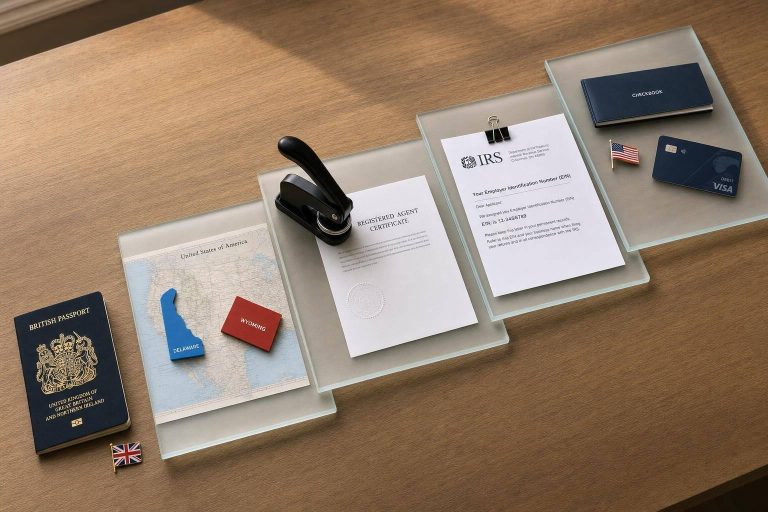
The idea that all states protect LLC member information is another misconception. Only a handful of states – Delaware, Wyoming, New Mexico, and Nevada – allow you to create anonymous LLCs. In most other states, you’re required to disclose details about LLC members or managers in public filings.
For example, California mandates filing a Statement of Information (Form LLC-12), which includes the names and addresses of managers or members. Texas doesn’t allow anonymous entities at all. As noted by Hancock, McGill & Bleau, "Texas does not allow the creation of anonymous entities. The document filed to create an entity requires the names of the managers or directors, or… the names of the members or shareholders".
Additionally, many states require annual or biennial reports that include ownership details, which are then added to searchable public databases. Holden W. Stein, Partner at Fathom Law PC, points out: "If the LLC owners list themselves in items 5 or 6 of this public document [Statement of Information], the opportunity for anonymity could be compromised".
These requirements make it easy for ownership information to be traced back to you.
Myth 3: No One Can Trace Property Records Back to You
Even with privacy measures in place, public records can still reveal the individuals behind an LLC. Real estate tools and databases can connect property records to identify the owners and their contact information.
Here’s how it works: County property records list the LLC name on the deed, while state business filings reveal the managers or members of the LLC. If you transfer property from your personal name to the LLC, that transaction also creates additional public records.
Moreover, when applying for an EIN with the IRS, you must provide a physical mailing address for the LLC’s principal place of business. P.O. Boxes and third-party registered agent addresses are generally not allowed, which increases the chances of your personal address appearing in federal records.
These interconnected data points make it difficult to maintain complete privacy, even when using an LLC.
How Your Personal Address Gets Exposed Through Public Records
Despite what some may believe about maintaining complete anonymity, public records often make your personal address accessible. Understanding how and where your address appears in these records can help you identify potential privacy risks. From property deeds to state filings, several public systems routinely reveal home addresses through common transactions. Let’s break down how this happens.
Property Deeds and County Records
When you purchase property, the grant deed is filed with the County Clerk or Recorder of Deeds. These records are public and searchable using the property address or parcel identification number.
A significant privacy issue arises when individuals buy property in their personal name – often required by residential lenders – before transferring it to an LLC. This process leaves a paper trail that directly links your name to the LLC. The title transfer from your name to the LLC becomes a permanent record, making it easy to trace ownership.
County tax assessor offices also maintain detailed ownership records and assessment rolls. Even tax-exempt properties are listed, ensuring this information remains accessible. In cities like New York, systems like ACRIS link deeds to mortgages and debt statements, which often reveal more personal details than the deed itself. These records create a lasting exposure of your information.
Signatures on recorded documents – such as deeds of trust, mortgages, and other agreements – further expose who manages the LLC. These signatures make it simple to identify the individuals behind the entity.
| Record Type | Information Exposed | Where to Find It |
|---|---|---|
| Grant Deed | Owner name (LLC), purchase price, transfer date | County Recorder/Registrar |
| Tax Assessment | Owner name, assessed value, tax billing address | County Tax Assessor |
| Mortgage/Deed of Trust | Lender info, loan amount, representative signatures | County Recorder |
| DBA Certificate | Individual names behind business aliases | County Clerk |
State LLC Filings and Registered Agent Information
State-level filings add another layer of risk. Articles of Organization often require the names and physical addresses of organizers or initial members. Additionally, many states mandate periodic reports – such as Texas Public Information Reports or California Statements of Information – that disclose the names and addresses of officers, directors, members, or managers.
Using your home address as your registered agent can expose your personal information. Every LLC must provide a physical street address (P.O. Boxes aren’t permitted) where someone is available during business hours to accept legal documents.
"When you use your home address as a registered agent, it becomes public record – anyone can search and find your personal address online".
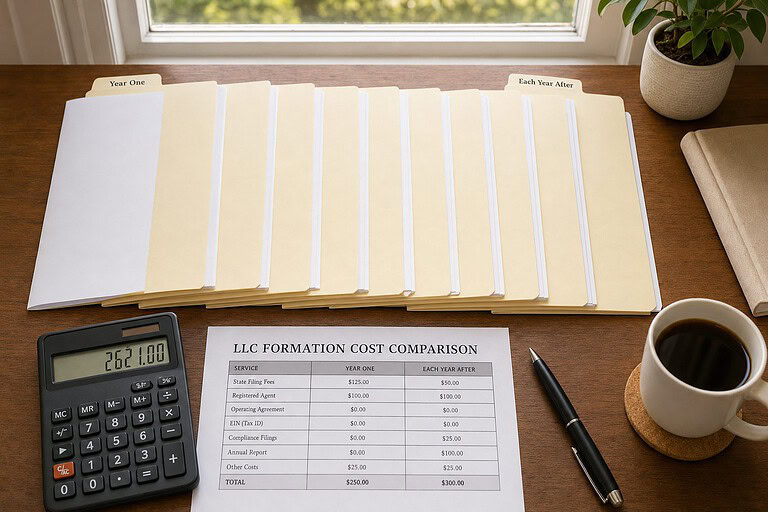
Even after updating your records, third-party data brokers often archive old information, keeping outdated addresses available on private websites. To avoid this, many people turn to professional registered agent services, which cost between $50 and $300 annually, with an average of $125. This small investment can help protect your privacy.
FinCEN Beneficial Ownership Information Reports
Initially, the Corporate Transparency Act required LLCs to report beneficial ownership information to the Financial Crimes Enforcement Network (FinCEN), including each owner’s current residential street address. However, as of March 26, 2025, entities created in the United States and their beneficial owners are exempt from this reporting requirement.
Now, the reporting applies primarily to foreign entities registered to do business in the U.S., reflecting increased scrutiny of foreign investments in U.S. real estate.
Although the FinCEN database isn’t public, its information is accessible to federal, state, local, and tribal law enforcement for investigations. Financial institutions can also access this data with your consent, often required when opening bank accounts or applying for real estate loans.
"FinCEN will release information only to certain limited entities upon request, such as certain federal agencies; state, local, or tribal law enforcement agencies; and, with consent from the Reporting Company, certain financial institutions".
For entities still required to report, failing to update a beneficial owner’s address within 30 days can result in civil penalties of up to $500 per day, along with potential criminal fines of up to $10,000 and imprisonment for up to two years. These risks highlight the importance of understanding how your personal information can be exposed and taking steps to safeguard it.
sbb-itb-ba0a4be
How to Protect Your Privacy as a Real Estate Investor
When you’re a real estate investor, public records can easily expose your personal address. To safeguard your privacy, here are some practical steps tailored to address specific vulnerabilities.
Use a Professional Registered Agent Service
Every LLC is required to have a registered agent to receive legal documents. If you use your home address for this purpose, it becomes part of state public records. A professional registered agent service, which typically costs between $50 and $300 annually (with an average of around $125), provides a commercial address for your LLC’s official paperwork.
These services also meet the legal requirement of being available during standard business hours (9 AM to 5 PM, Monday through Friday). If your home address is already listed, you can file a Change of Registered Agent form with your Secretary of State. Filing fees for this process generally range from $25 to $100.
Pro tip: It’s best to designate a professional registered agent when you first form your LLC. Once your home address is in public records, removing it entirely can be challenging.
Form Your LLC in Privacy-Friendly States
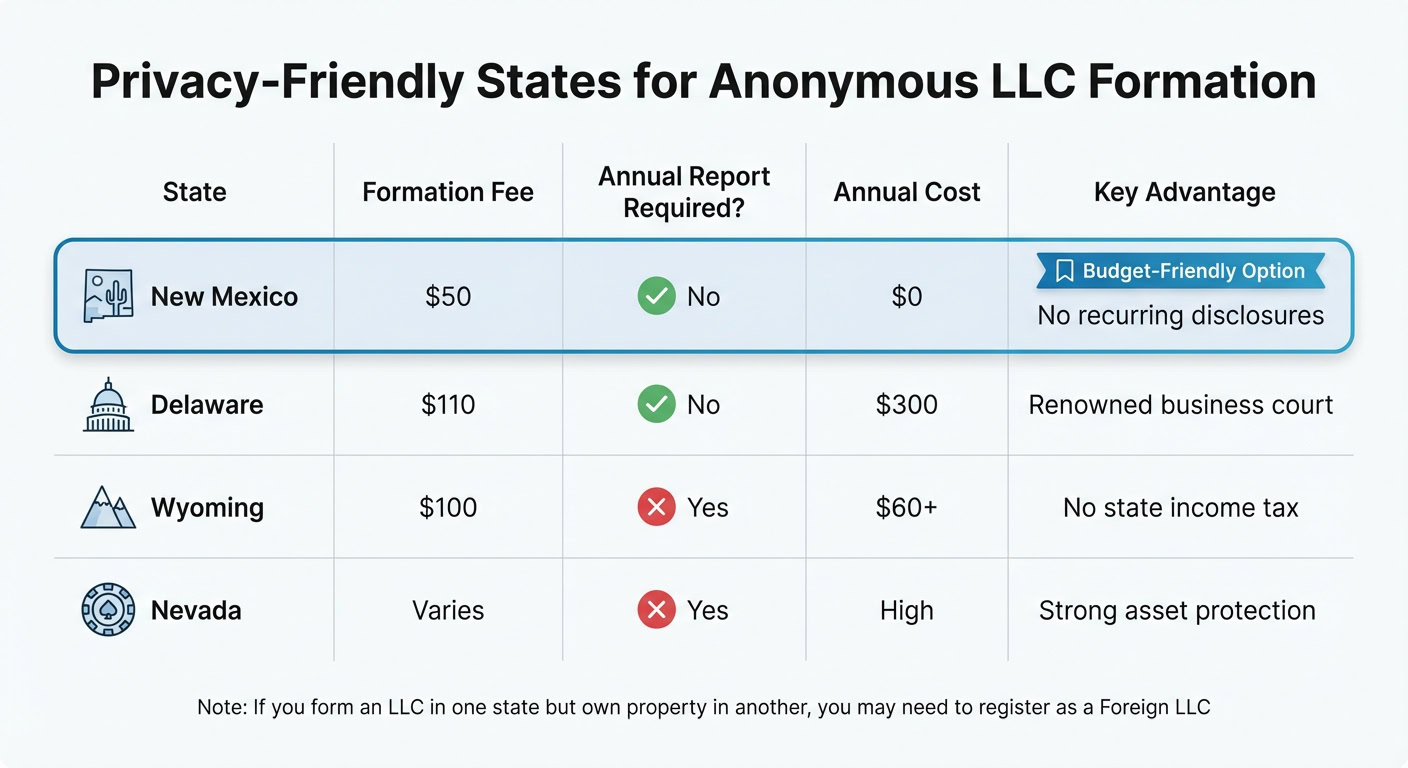
Certain states – Delaware, Wyoming, New Mexico, and Nevada – allow the creation of "Anonymous LLCs", which keep owner details out of public records.
Among these, New Mexico is the most budget-friendly, with a $50 formation fee and no annual reporting requirements. Wyoming charges $100 to form an LLC and requires annual reports starting at $60. Delaware, while more expensive with a $110 formation fee and a $400 annual franchise tax, offers the benefit of its well-regarded Court of Chancery for resolving business disputes.
| State | Formation Fee | Annual Report Required? | Annual Cost | Key Advantage |
|---|---|---|---|---|
| New Mexico | $50 | No | $0 | No recurring disclosures |
| Delaware | $110 | No | $400 | Renowned business court |
| Wyoming | $100 | Yes | $60+ | No state income tax |
| Nevada | Varies | Yes | High | Strong asset protection |
Important note: If you form an anonymous LLC in one state (e.g., Wyoming) but own property in another (e.g., Florida), you may need to register as a "Foreign LLC" in the property’s state. This could subject you to that state’s disclosure rules.
"An anonymous LLC can be a fast and easy way to own things privately… perhaps you want to protect your privacy by keeping your name and address off the internet."
- Wyoming LLC Attorney
Combine LLCs with Land Trusts for Extra Privacy
For even greater privacy, consider combining an LLC with a land trust. In this setup, the land trust holds the property title, while your LLC acts as the beneficiary. This ensures that only the trust’s name appears on public records, keeping your personal details hidden. If your LLC is registered in a state that supports anonymous ownership, your privacy is even more secure.
While forming an LLC costs between $75 and $500 in most states, creating a land trust involves additional legal fees for drafting the necessary documents. For investors managing multiple properties, this dual-layered approach can be worth the investment.
Use a Virtual Mailbox Instead of Your Home Address
A virtual mailbox provides a physical street address for your business correspondence, separate from the address your registered agent uses for legal documents. These services cost between $20 and $100 per month and can handle mail by receiving packages, scanning envelopes for online viewing, and forwarding items to any location.
Using a virtual mailbox alongside a professional registered agent ensures your home address stays off business cards, websites, and other public-facing materials. Together, these services can maintain your privacy for around $35–$60 per month.
Action step: Transition to a virtual mailbox and update your official address by filing IRS Form 8822-B. Don’t forget to notify banks, vendors, and state agencies where your LLC is registered.
For example, BusinessAnywhere’s Virtual Mailbox Services offer privacy-focused options in states known for supporting confidential business structures, helping you keep your personal address private.
Conclusion
Forming an LLC won’t fully protect your home address from ending up in public records. State filing requirements, county property records, and registered agent details all create ways for someone to link your name to your residence. As Northwest Registered Agent puts it, "Once information goes onto the public record, there’s no way to completely erase it".
That said, you can take steps to reduce your visibility. By layering privacy tools, you can significantly limit your exposure. Using a registered agent service along with a virtual mailbox builds a strong privacy barrier. For those managing multiple properties, creating an anonymous LLC in states like Wyoming or New Mexico – possibly paired with a land trust – offers even more protection.
New regulations, such as the Corporate Transparency Act effective January 1, 2024, highlight the importance of keeping detailed records. While the federal database it creates isn’t publicly accessible, it reflects how regulatory oversight is evolving. Jonathan Kessler, Head of Credit and Cash Management Solutions at PNC Private Bank, reminds us: "Creating an LLC and then walking away is not a substitute for good planning or recordkeeping".
The cost of privacy protection is small compared to the risks of exposure. For about $35–$60 a month, you can secure a professional registered agent and a virtual mailbox. This investment keeps process servers from showing up at your door, prevents competitors from tracking your assets, and stops strangers from finding your home.
Take action now by reviewing your current LLC filings. If your home address is already in public records, file an amendment and switch to professional services. While you can’t erase past records, you can stop further exposure. For real estate investors serious about privacy, these steps are essential to protecting both your investments and your personal life.
FAQs
How can I keep my home address private when owning property through an LLC?
To keep your home address off public records when setting up an LLC, avoid listing it on official paperwork. Instead, opt for a registered agent service that offers a commercial address for your LLC’s registration. This way, only the agent’s address appears in state records, safeguarding your personal address.
If privacy is a top concern, think about forming your LLC in states like Wyoming, Delaware, or New Mexico. These states allow anonymous filings, meaning you can register without disclosing your name or home address. For those who’ve already registered in a state with stricter rules, you can amend your filing to replace your address with the registered agent’s address or even create a new LLC in a state that prioritizes privacy.
To further protect your information, consider using a virtual office address for correspondence. Additionally, where permitted, you can title properties under a trust or LLC name instead of your own. Combining these approaches can provide a stronger shield for your personal details.
What are the advantages of setting up an anonymous LLC in privacy-focused states?
Setting up an anonymous LLC in states like Wyoming, Delaware, New Mexico, or Utah can provide strong privacy and protection for your assets. These states allow LLC owners to keep their names and personal addresses off public records. Instead, only the LLC’s name and the registered agent’s address appear, which helps protect your identity and home address from unwanted attention. This can be particularly useful in avoiding risks from scammers, competitors, or potential lawsuits.
On top of privacy, anonymous LLCs offer solid asset protection by creating a clear separation between your personal wealth and the property owned by the LLC. This separation makes it more challenging for creditors or litigants to track your assets or file unnecessary claims against you. Plus, many of these states have minimal reporting requirements, which means less paperwork, lower costs, and more peace of mind when it comes to safeguarding your confidentiality.
Can using an LLC and a land trust together improve my privacy as a real estate investor?
Combining an LLC with a land trust can be a smart way to increase your privacy by making it more difficult to link your personal name to a property. When a land trust holds the property deed, the trustee – often your LLC – is the name that appears in public records. Meanwhile, the LLC members (you) stay out of the spotlight, especially if you’re operating in a state like Wyoming that allows anonymous ownership. This setup can help keep your identity and home address out of easy reach during casual searches.
That said, this strategy has its limits. Courts can still require LLC member disclosure in lawsuits, particularly in states that don’t uphold anonymous ownership or if the trust appears to be just a formality. To further protect your privacy, you might want to take extra steps such as using a professional registered-agent address, choosing states with strong anonymity protections, and keeping your personal finances completely separate from the trust and LLC. While this approach can boost your privacy, it works best when integrated into a larger asset-protection strategy rather than being your only line of defense.