

If you work from home as a W-2 employee, you usually do not need a home occupation permit. If you run your own business from home, you might.
I’d break it down like this:
- A home occupation permit is a zoning approval
- A business license is a local tax or registration item
- Client visits, deliveries, signs, and on-site workers often trigger permit rules
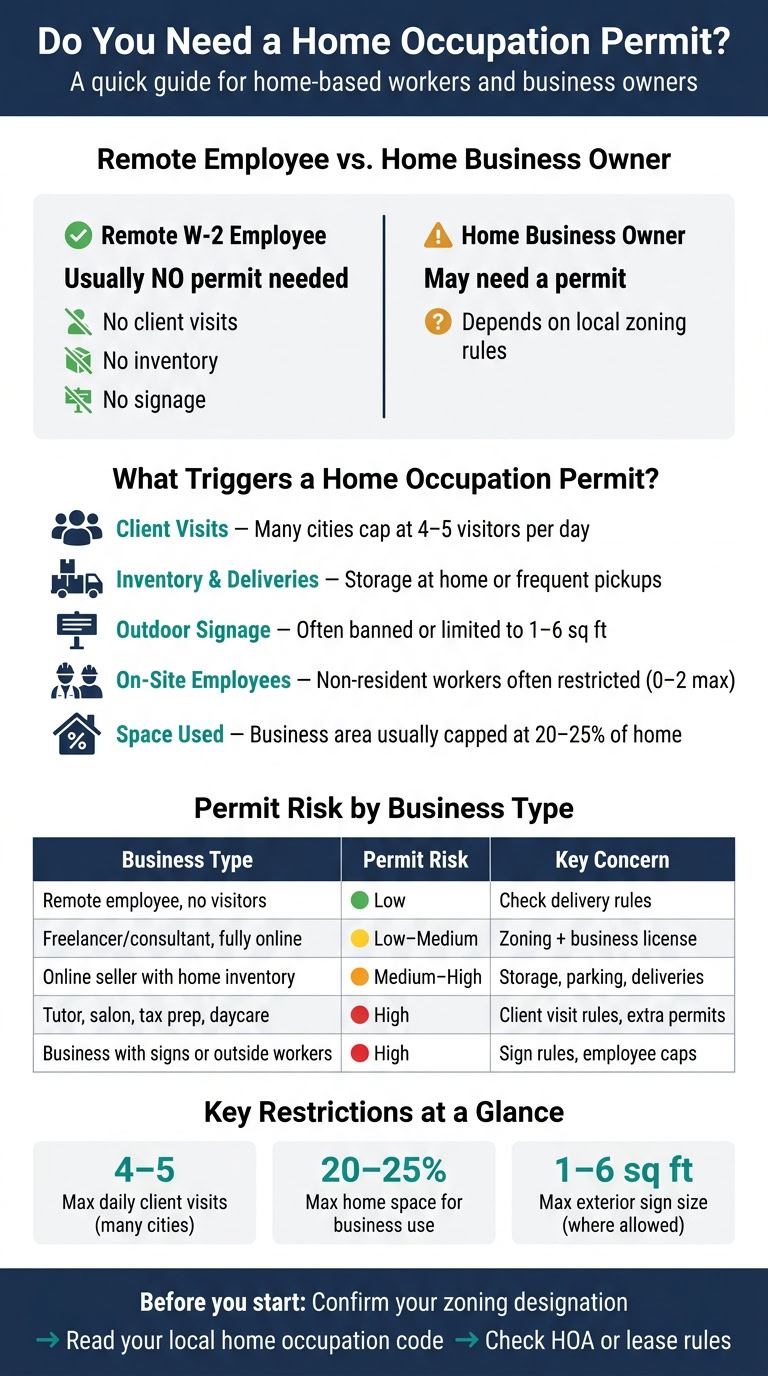
- Many cities limit visitors to about 4–5 per day
- Many places cap business space at about 20%–25% of the home
- Signs are often banned or limited to about 1–6 square feet
- Skipping a required permit can lead to fines, shutdown orders, or insurance trouble
The short version: if your home still works like a normal residence, you may not need extra approval. But if your business adds traffic, storage, parking issues, or public visibility, I’d check city or county zoning rules before you start.
Quick comparison
| Situation | Usual permit risk | What to check |
|---|---|---|
| Remote employee, no visitors | Low | Local rules if deliveries or clients show up |
| Freelancer or consultant, fully online | Low to medium | Zoning code, business license rules |
| Online seller with inventory at home , such as when you start a craft business | Medium to high | Storage, pickup, parking, delivery limits |
| Tutor, salon, tax prep, massage, daycare | High | Client visit rules, zoning, extra agency permits |
| Business with signs or non-resident workers | High | Sign rules, employee caps, parking limits |
So if I were starting a home-based business, I’d first confirm whether the property is in a city or unincorporated county, then read the local code for that exact address, and then check any HOA rules or lease terms.
How home occupation permits fit with zoning, licenses, and other approvals
Once zoning checks out, there’s still another layer to deal with: local licenses and any permits tied to the work you do. These approvals do different jobs, and one does not replace another. That’s the key point here. A business can be fine under zoning rules and still need a local license or a permit tied to child care, food, fire safety, or something else.
Some businesses also need separate approvals, such as child-care, health, or fire permits.
| Approval | Purpose | Issued By | When It Applies |
|---|---|---|---|
| Home occupation permit | Confirms business use is allowed at a residential address under zoning rules | City/county planning or zoning department | Before opening, especially for client-facing or publicly listed home businesses |
| Local business license | Registers the business for local tax compliance | City/county finance or licensing office | Required for most businesses in a jurisdiction, regardless of location |
| Activity-specific permits | Address safety or regulatory concerns specific to the business type | Fire, health, building, or child-care agencies | Triggered by specific activities: daycare, food prep, structural changes, etc. |
Home occupation permit vs. local business license
A home occupation permit deals with land use. It tells you whether the business can operate from that home under local zoning rules.
A local business license handles local registration and tax compliance. It’s less about where you work and more about whether the business is properly registered with the city or county.
So even though people often lump them together, they’re not the same thing. The set of approvals you need depends on the kind of business you run.
Common restrictions on home-based businesses
Client visits are one of the biggest sticking points. Many ordinances limit daily visitors, often to no more than 4–5 per day, and set allowed hours such as 7:00 a.m. to 8:00 p.m. In some cases, customer visits aren’t allowed at all for certain business types.
On-site employees are another common limit. Many ordinances either do not allow non-resident employees to work at the home or allow only one, and sometimes two, with limits on hours. Remote employees who work somewhere else usually don’t trigger this rule.
Space, storage, and equipment rules are also common. A business often has to stay within part of the home, usually no more than 20–25% of total floor area, and inventory or equipment usually has to stay indoors with no outdoor display. Equipment that creates noise, fumes, or heavy utility use is often not allowed.
Signage and parking come up a lot too. Many ordinances either ban exterior signs or limit them to 1–6 square feet. Parking rules often bar visible commercial vehicles at the curb and limit daily vehicle trips from clients or deliveries.
These are the rules that separate a low-impact home business from one that gets extra local review.
sbb-itb-ba0a4be
Do you need a home occupation permit for your business?
Whether you need a home occupation permit comes down to local zoning rules and how you use your home. A remote employee with no visitors is usually treated very differently from a home-based business that brings clients, workers, or delivery activity to the property.
The main test is pretty simple: Does your business change how the property is used or how visible that use becomes?
Situations that often trigger permit requirements
The clearest trigger is client visits. If clients, students, or customers come to your home on a regular basis – for tutoring, massage therapy, or tax prep – many cities or counties require a home occupation permit to deal with added traffic and parking. Having employees on-site can also lead to a review.
Inventory and deliveries are another common trigger. An online seller using dropshipping with no stock at home is much less likely to draw attention than someone storing boxes in a garage and getting frequent UPS, FedEx, or USPS pickups. And if you want to put up an outdoor sign, that often needs separate approval.
Other uses that often get local attention include a state-licensed home daycare or a home salon or barbershop. Those are the kinds of activities zoning rules often limit.
If none of those factors apply, many home businesses fall into a lighter review category – or don’t need a permit at all.
Businesses that often face fewer home permit issues
Freelancers, consultants, writers, designers, and software developers who work fully online usually run into the fewest home permit issues. Why? Because they usually don’t add visible traffic, storage, or signage.
Operating with or without a permit: risk comparison
Skipping a required permit is not just a paperwork problem. It can lead to real trouble. Some ordinances allow a permit to be automatically revoked after a confirmed violation, which can force an immediate shutdown.
There’s also the insurance angle. Homeowner’s insurance often excludes business-related claims. If a client trips on your property and your insurer finds out you were running an unpermitted business, that could complicate coverage or lead to a denial.
| Factor | With a Required Permit | Without a Required Permit |
|---|---|---|
| Legal standing | Compliant with local zoning rules | Risk of code enforcement, fines, or forced closure |
| Enforcement risk | Low, with defined operating conditions | High if neighbors complain or inspectors investigate |
| Home address use | Can publicly list home as business location | Advertising your home address increases enforcement risk |
| Insurance | Easier to secure business coverage or riders | Claims may be denied if unpermitted activity is discovered |
| Growth flexibility | Can expand within permitted conditions | Growth in clients, deliveries, or staff raises exposure |
| Upfront cost | Application fees, possible inspection | None upfront, but fines can add up quickly if caught |
Before you open, check the local code for your exact address.
How to check local rules and stay compliant
How to verify city or county requirements
If your business might trigger local review, you need to check the exact rules for your address.
Start by confirming whether your property sits inside a city or in an unincorporated county area. That part matters more than many people think. A city address follows city zoning rules. An unincorporated address follows county zoning rules. You can usually confirm this with your property tax bill or through the county assessor’s website.
Once you know which jurisdiction controls the property, contact the local planning or zoning department. Ask them to confirm your zoning designation, such as R-1, R-2, or R-3. Then look up that designation in the local municipal code.
Many cities post their full code on sites like Municode or Code of Ordinances. Search terms like "home occupation", "home-based business," or "accessory use" usually get you to the right section. That section should spell out what is allowed, what is limited, and whether you need a permit. Check the code for the exact rules on visits, hours, fees, and renewals.
You should also check private restrictions. HOA covenants (CC&Rs), condo bylaws, and residential leases can limit or ban home businesses even when the city says yes. In plain English: zoning approval does not overrule private rules. If your lease or CC&Rs are vague, ask the property manager or an attorney before you apply.
Tools that help separate business activity from your home address
If local rules allow a home business, the next issue is how your address shows up in public.
A virtual mailbox, registered agent, and business address can help keep your home address off public filings and client-facing materials. That can lower privacy and enforcement exposure. But these tools do not replace the need to follow home occupation and zoning rules where the work actually happens.
A compliance checklist before you start
Use this checklist before you apply or open.
| Step | Action |
|---|---|
| Confirm jurisdiction and zoning designation | Use your address to determine city vs. county authority, then identify your zoning designation using the local parcel lookup or zoning map |
| Read the home occupation code | Search Municode or the local code for "home occupation" or "accessory use" to find applicable rules |
| Gather application materials | Prepare any required floor plan, site plan, or affidavit confirming HOA, lease, or owner approval before you apply |
| Review lease and HOA rules | Read CC&Rs, condo bylaws, or your rental agreement for any restrictions on commercial activity |
| Check operating limits | Note any caps on client visits, signage, on-site employees, inventory, and parking |
| Use a registered agent and business address | Keep your home off public records if needed, without replacing local zoning compliance |
| Update permits if operations change | Revisit your permit if you add employees, expand services, or increase delivery frequency |
Conclusion: How to decide before running a business from home
Working from home as a remote employee and running a business from home are not the same thing under local zoning law.
If you’re on a company’s payroll as an employee, you usually don’t need a home occupation permit. But if you own and run a business from your home address – even as a solo freelancer or consultant – local zoning rules may treat that use as a home occupation, which can mean a permit is needed.
From there, most local rules come down to a few practical issues: traffic, visibility, and what happens on-site. Zoning looks at how the home is being used, not just the type of work you do. Common triggers include client visits, inventory stored at the home, regular deliveries, and employees working there.
Getting a permit is often much easier than dealing with a code issue after a violation. That’s why the safest move is to check your local code before you open.
If privacy matters, keep your business address and public filings separate from your home address. Just don’t treat that as a stand-in for zoning compliance.
The bottom line is simple: check your city or county rules before you start, not after. Confirm your zoning designation, read the home occupation section of your local code, review your lease or HOA rules, and contact your planning department if anything is unclear. Start with the rules tied to your exact address.
FAQs
How do I find my local zoning rules?
Start with your city or county planning or zoning office. That’s usually the place that handles home occupation permits and address-based land-use rules.
If your area has an online new-business checklist or permit portal, use it. It can help you check what applies to your specific address without a lot of guesswork.
You can also call your city or county clerk and ask where to start. And don’t stop with local government rules. Check your HOA rules and your lease terms too, because private rules can limit what you’re allowed to do from home even if zoning says yes.
Can I run a business from a rental home?
Yes, you may be able to run a business from your home. But in most cases, it’s not automatic.
Many home-based businesses need a home occupation permit or similar approval. Local zoning rules often limit things like:
- Signs
- Client visits
- Parking
- Noise
You should also check your lease and any HOA covenants. Either one may ban business activity, even if the city says yes.
The exact rules depend on your business type and what takes place at the property. So before you get started, verify the local rules that apply to your address.
What happens if I skip a required permit?
Skipping a required permit for a home-based business can trigger legal and financial problems fast. You might get hit with fines, daily penalties, or a stop-work order that forces you to shut things down until the issue is fixed.
It can also make contracts hard to enforce, cancel insurance coverage, put your personal assets at risk, and lead to permit revocation, legal action, or even criminal charges.