
Yes – forming an LLC is not the same as getting permission to do business. If I form an LLC, I may still need a state license, a city or county business license, a sales tax permit, a home-occupation permit, or a board license for my field.
Here’s the short answer:
- An LLC filing creates the business
- A tax registration sets up tax accounts
- A license or permit lets the business lawfully start work
- Rules change by state, city, county, and industry
- Costs vary a lot, from $15 local fees in some Florida areas to $200 per year for Nevada’s state business license
- Wyoming has no general state business license, but a $60 sales tax license may apply for taxable sales
If I want to know what my LLC needs, I’d check in this order:
- State agency for tax and license rules
- County office if the business is in an unincorporated area
- City office if the business is inside city limits
- Industry board or department for trade-specific permits
The big mistake is assuming LLC approval covers all of this. It doesn’t. A formed LLC can still face fines or shutdown risk if it starts work without the right license or permit.
Quick Comparison
| State | Statewide General Business License | Local License | Sales Tax Registration |
|---|---|---|---|
| Nevada | Yes – $200/year | Yes | Yes, for taxable sales |
| Florida | No | Usually yes | Yes, for taxable sales |
| Wyoming | No | Sometimes | Yes – $60 one-time |
I’d use this article and an LLC formation checklist as a plain guide to sort out what comes after LLC formation: state rules, local permits, sales tax setup, home-based limits, online selling, and board licenses for regulated work.
How to find out what licenses your LLC needs
Start by separating formation, tax registration, and licensing.
Step 1: Separate LLC formation from licensing and tax registration
Use this three-step check to figure out what your LLC still needs after formation.
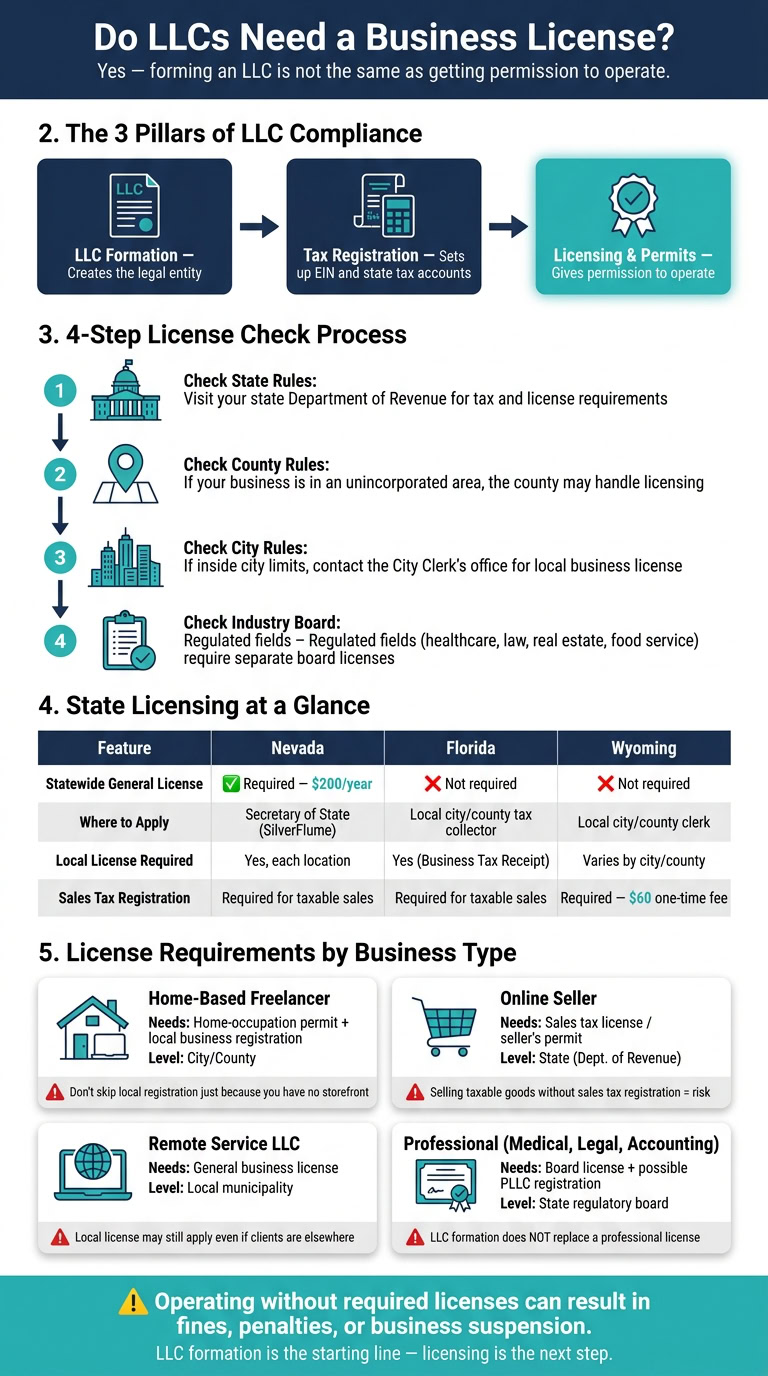
Think of LLC setup as three separate parts. Formation filing, usually the Articles of Organization, creates the legal entity. Tax registration covers things like your EIN and state tax accounts, which set up how you pay taxes. Licensing is different. That’s the part that gives you permission to operate.
A lot of people lump these together. That’s where trouble starts. You can form an LLC and still not be cleared to do business.
These are the main license types you’ll run into:
| License Type | Issued By | What It Covers |
|---|---|---|
| Sales Tax License | State Dept. of Revenue | Selling taxable goods or services |
| Business Tax Receipt | City or County | Permission to operate locally |
| Professional License | State Regulatory Board | Specialized fields like healthcare, law, or real estate |
| Home Occupation Permit | Local Zoning Dept. | Running a business from a residential address |
Step 2: Check state, county, and city rules in that order
Start with your state Department of Revenue. That’s usually the first place to check for a sales tax license or state tax registration. Next, look at the county level. If your business is in an unincorporated area, the county may be the office that handles licensing. After that, check with the City Clerk’s office if you operate inside city limits.
This order matters. Many general business licenses are local, not state-level. So if you only search state rules, you can miss city or county requirements.
Once you know which level of government applies, the next step is simple: match the search to the way your business actually works.
Step 3: Match your license search to your business model
What you sell, where you work, and how you serve customers all affect what you may need.
Here’s a practical breakdown:
- Freelancers: Check your city or county for a local business license or occupational license.
- Online sellers: If you sell taxable goods or services, you may need a state sales tax license or seller’s permit.
- Home-based LLCs: Contact your local zoning or planning department before you start operating. Many places require a home-occupation permit.
- Licensed professions (doctors, architects, CPAs, real estate agents): Your field may still require a separate state license. Forming an LLC does not replace that.
- Regulated industries (food service, alcohol, childcare, construction): Expect permits from health departments, state boards, or both.
sbb-itb-ba0a4be
State-by-state guide: where LLCs need state licenses and where local licensing applies
After you check state, county, and city rules, these examples help show how licensing works on the ground.
Where statewide general licenses apply
Nevada requires every LLC doing business in the state to get a state business license through the Secretary of State’s SilverFlume portal. The fee is $200 per year for LLCs, and the license renews every year.
States where LLCs rely mainly on city or county licenses
Florida and Wyoming work a bit differently. In these states, LLCs usually deal more with local licensing than a statewide general license.
Florida has no statewide general business license. Instead, most LLCs need a local business tax receipt from the city or county where they operate. The cost can be as low as $15 or go above $2,500 per year, depending on the local area and the kind of business.
Wyoming also has no general statewide business license. If your Wyoming LLC sells taxable goods, you need to register for a $60 sales tax license.
| Feature | Nevada | Florida | Wyoming |
|---|---|---|---|
| Statewide General License | Required ($200/year) | Not required | Not required |
| Where to apply | Secretary of State (SilverFlume) | Local city/county tax collector | Local city/county clerk |
| Local License Required | Yes, each location | Yes (Business Tax Receipt) | Varies by city/county |
| Sales Tax Registration | Required for taxable sales | Required for taxable sales | Required ($60 one-time fee) |
These examples show the pattern, not the full checklist.
How to use this state overview without missing local permit requirements
Use this as a starting point, not the last word. Before you open, hire staff, or sign a lease, verify the rules at the state, county, and city level. You should also check zoning rules and any license rules tied to your industry.
Next, check the rules that apply to home-based, online, freelance, and licensed professional LLCs.
License requirements for home-based, online, freelance, and professional LLCs
Your LLC’s license requirements depend on what you do and where you do it.
Home-based LLCs: zoning, home-occupation permits, and city registrations
Business model matters just as much as location.
Running your LLC from home doesn’t mean you’re off the hook for local licenses. Many cities and counties still require a home-occupation permit or local registration. Zoning rules may also limit things like signage, parking, and employees. Check with the local office that handles business registration and zoning.
Online sellers and remote service businesses: seller’s permits and multi-state issues
If your LLC sells taxable goods, you’ll usually need to register for a sales tax permit with your state’s Department of Revenue. In Wyoming, the sales tax license has a one-time $60 fee. Other states have different fees, and some ask you to renew each year.
Service-only freelancers often don’t need a sales tax permit. But they may still need a local business license in the city or county where the business is managed. For service-only businesses, the bigger issue is often professional licensing.
Professional and regulated LLCs: board licenses still apply
If your business works in a regulated field, you may still need a separate board or occupational license. Forming an LLC does not replace a professional license. State board or occupational license rules still apply. In some states, certain licensed professions must choose between a PLLC vs LLC instead.
| Business Type | Typical Licenses/Permits | Government Level | Common Mistake |
|---|---|---|---|
| Home-based freelancer | Home-occupation permit, local business registration | City/County | Skipping local registration because there’s no storefront |
| Online seller | Sales tax license/seller’s permit | State (Dept. of Revenue) | Selling taxable goods without registering for sales tax |
| Remote service LLC | General business license | Local municipality | Assuming no local license is needed because clients are elsewhere |
| Professional (medical, legal, accounting) | Board license, PLLC registration | State regulatory board | Assuming LLC formation covers professional licensing |
Use this checklist before you open, sign a lease, or start taking clients. Then verify local, zoning, and industry-specific rules before you begin operating.
Conclusion: what to do after forming your LLC
An LLC gives you a legal business entity. But it does not give you permission to start operating.
After your LLC is formed, finish your compliance work before you open. The simplest way to handle it is to go in order: federal and tax first, then state, then local, then any industry rules that apply to your business.
- Get your EIN first. Apply for an EIN from the IRS as early as you can. Many license applications ask for it.
- Check state licensing and tax registration rules. Some states require a business license, tax registration, or both.
- Check local licensing. If you operate inside city limits, contact the city clerk. If you’re in an unincorporated area, check with the county.
- Check industry-specific licensing. Construction, food service, healthcare, alcohol, and other regulated fields often need permits beyond a general business license.
- Build a renewal calendar and track every expiration date.
LLC formation is the starting line. Licensing is the next step.
If you operate without the licenses your business needs, you could face fines, penalties, or suspension of your business registration.
FAQs
Does an LLC need both state and local licenses?
Yes, in many cases.
Forming an LLC creates your legal business entity. But that step alone doesn’t give you the licenses or permits you may need to run the business.
What you need depends on your industry and where you operate. You may need separate approval from:
- City agencies
- County agencies
- State agencies
- Local business licensing offices
- Industry regulators
That can include a local business license, along with permits tied to your line of work.
For your exact requirements, check with your city or county clerk’s office.
How do I know which permits my LLC needs?
Forming an LLC sets up your legal business entity. But it does not automatically give you the licenses or permits you need to run the business.
What you need depends on your industry, the work your business does, and where you operate.
A good place to start is your city or county clerk’s office. They can point you to local business licenses and zoning permits. Then check your state’s Secretary of State website or department of revenue, along with the U.S. Small Business Administration, to see if any state or federal rules apply.
Can I run my LLC from home without a permit?
No. Forming an LLC does not automatically give you the right to run a business from your home.
You still need to follow local city or county rules, including zoning laws. In many places, you may also need a home occupation permit. That permit helps the local government make sure your business doesn’t create too much noise, traffic, or other disruption in the neighborhood.
The bottom line: check with your local government office to find out what rules apply in your area.