
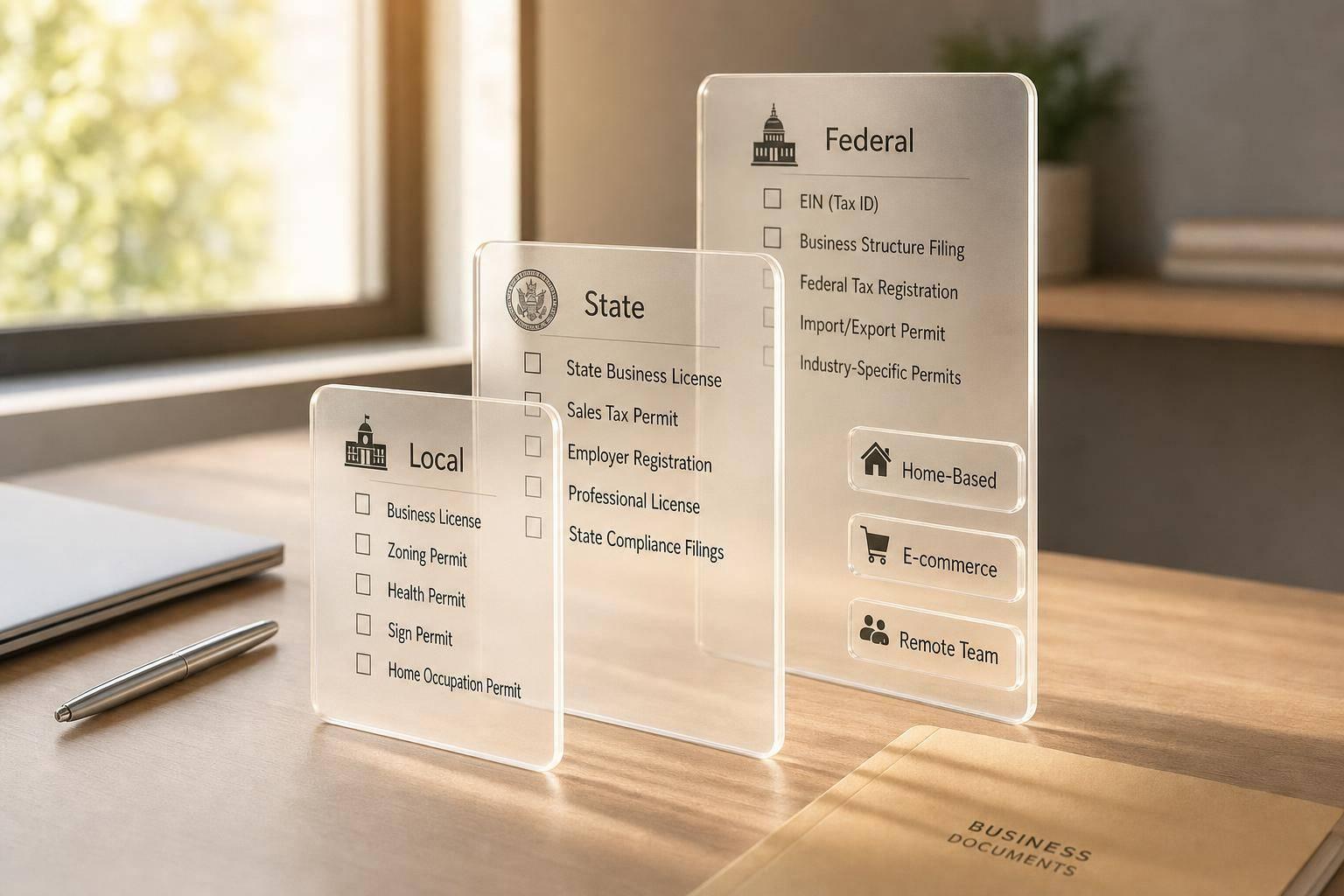
Filing an LLC does not mean you can start operating. In most cases, I’d check 3 to 5 separate items right away: a local business license, a seller’s permit if I sell taxable goods or services, a DBA if I use a different business name, zoning or home-based approval, and any job-specific state license.
Here’s the short version:
- Your legal entity and your licenses are different filings
- City, county, state, and federal offices each handle different rules
- Most small businesses don’t need every permit
- Remote teams, home-based sellers, and licensed fields often trigger extra filings
- Hiring in another state or selling into another state can create tax duties there
If I wanted a simple way to handle this, I’d do it in two passes:
- Match the filings to what the business does
- Match each filing to the place where the business operates
A few points stand out:
- A general business license is often local
- A seller’s permit is usually state-issued for sales tax
- A DBA applies when the public-facing name doesn’t match the legal name
- A home occupation permit may apply even if the business is online
- An EIN is a tax ID, not permission to operate
- Federal licenses are less common and usually tied to regulated industries
For example, if I run a home-based online store, I might need:
- A city or county business license
- A home occupation or zoning approval
- A seller’s permit
- A DBA
- Product-specific permits if I sell food, supplements, cosmetics, or alcohol
If I run a remote-first company with staff in 2 or more states, I may also need:
- Foreign qualification
- State payroll tax accounts
- State unemployment registrations
- Sales tax registration where nexus rules apply
The main point: I would file only what fits the business activity, product, and location, then confirm each item with the right agency before paying fees or submitting forms.
This article is best used as a short checklist to help narrow down what to verify first.
The Core Licenses and Permits Most Small Businesses Should Check First
General Business License, Seller’s Permit, and DBA Registration
Most small businesses should start with three basic filings: a general business license, a seller’s permit, and a DBA registration if they use a name that doesn’t match the legal entity name.
A general business license – sometimes called a business tax certificate – is usually a local filing issued by your city or county. Forming your business with the state does not take the place of local licensing. A seller’s permit, also called a sales tax permit, allows you to collect sales tax on taxable sales. And if you do business under a different name, you may need a DBA.
Professional Licenses, Home Occupation Permits, and Zoning Approval
If you work in a licensed field, such as law, medicine, or real estate, you may need a state professional or occupational license. If your business doesn’t fall into a licensed field, the next thing to check is whether your location needs local approval.
Home-based businesses often need a home occupation permit or another land-use approval from the city or county. This is how local officials confirm that your business follows land-use rules, including limits on signs, traffic, and noise. Also check your lease and HOA rules. Local approval doesn’t cancel private restrictions.
| Requirement | Who Needs It | Issuing Level |
|---|---|---|
| Professional License | Licensed professions such as law, medicine, and real estate | State (professional board) |
| Home Occupation Permit / Zoning Approval | Home-based businesses and locations with land-use restrictions | City or county |
Next, it helps to separate operating permits from tax filings, because people mix them up all the time.
State and Local Tax Registrations Beyond the Basic License
Licenses and tax registrations are not the same thing. If you sell taxable goods or services, you may need state sales and use tax registration. If you have employees, you may also need state withholding and unemployment insurance registrations. Some cities and counties add their own business taxes or gross receipts taxes too.
Remote businesses and distributed teams need to pay close attention to tax nexus. Why? Because hiring employees or doing business in more than one state can create new filing duties. Track where your employees work and where your sales are concentrated. An EIN (Employer Identification Number) is often required for state tax registrations, and any business with employees or more than one member must have one. Applying through the IRS is free.
sbb-itb-ba0a4be
Licenses That Only Apply to Certain Business Activities
Not every business needs every permit. The licenses in this section apply only when your business involves regulated activities, property changes, or an industry with federal oversight.
If none of those fit your setup, you may not need the licenses below. Use this section to narrow down what matters before you move to the business-type checklist.
Health, Food, Childcare, and Personal Service Permits
Food, beverage, childcare, and personal-service businesses may need local health or safety permits, even when they run from home.
The key point is simple: these permits attach to the activity, not the LLC itself. So even if your business is small or home-based, the work you do may still trigger local rules.
Licensed professions may also need state occupational licenses.
Building, Signage, and Location-Based Permits
If your business involves building changes, local permit rules may apply before work begins.
That can include changing a property, remodeling part of a space, or adding signage. In those cases, local building or sign permits may be required before any work starts.
If you have a storefront or office, zoning permits help confirm that your business activity is allowed at that location. And online businesses aren’t off the hook. You still need to check the rules tied to your home address, office, or warehouse.
Federal Licenses for Regulated Industries
An EIN is a tax ID, not a license to operate.
Federal licenses are uncommon and usually apply only to regulated industries, such as alcohol.
Next, match these rules to your business model.
Checklist by Business Type: What You Likely Need to File First
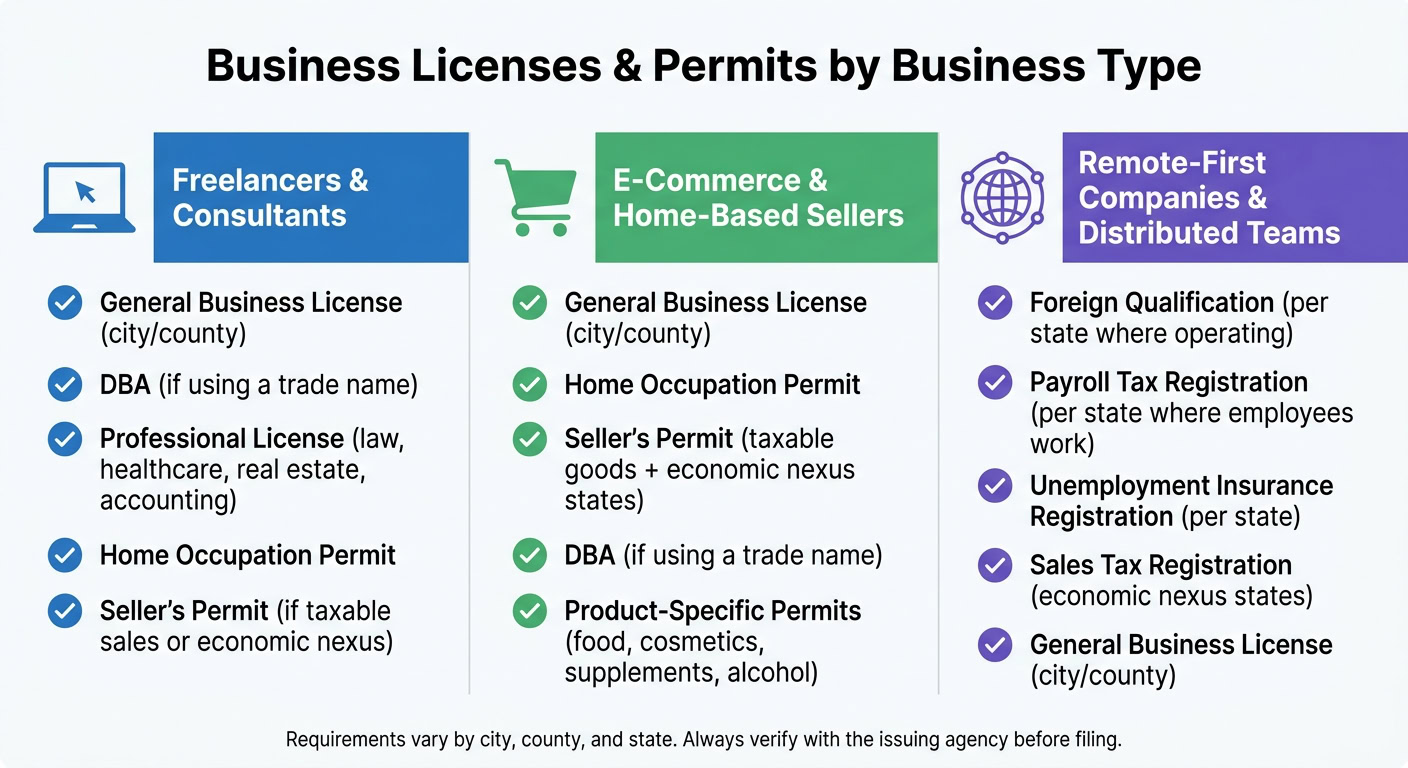
The rules above narrow down the options. The checklists below show which filings often apply based on your business model. Treat them as a starting point – your city, county, or state may still ask for more.
Freelancers and Consultants
Start with the simplest setup, then add filings only when your work, location, or tax setup calls for them.
For freelancers and consultants, the first things to check are your business name, where you work, and whether your field needs a license:
- General business license: Check your city and county first. Some states, including Alaska and Nevada, also require a state-level license.
- DBA: File a DBA if you use a name that differs from your legal entity name.
- Professional license: Fields like law, healthcare, real estate, accounting, and financial services may require a state professional license. You may also need to register state by state.
- Home occupation permit: Check whether your home address needs a home occupation permit.
- Seller’s permit: If you sell taxable goods or services and meet economic nexus rules in another state, you may need to register there.
A registered agent service can help protect your privacy and keep legal mail in order when you run the business from home.
E-Commerce and Home-Based Sellers
Start with your city or county business license, then move through the filings that most often apply.
If you sell online or run the business from home, these are usually the first items to review:
- Product-specific permits: Selling food, cosmetics, supplements, or alcohol may trigger FDA registration, state health department permits, or a separate alcohol license, depending on the product.
- Home occupation permit: Check whether your home address needs one before you begin operating.
- Seller’s permit: If you sell taxable goods, register for a seller’s permit. If you meet economic nexus rules in another state, register there too.
- DBA: File a DBA if you use a name that differs from your legal entity name.
If you haven’t formed an entity yet, starting with an LLC before applying for licenses is often the practical order. A virtual mailbox gives you a business address that can help keep your home address off public filings.
Remote-First Companies and Distributed Teams
Remote teams often end up with filing duties in more than one state because the rules usually follow where people work. That’s where things can get tricky fast.
If you operate in another state, register there when foreign qualification, payroll, or sales tax rules apply:
- Foreign qualification: Required if your LLC does business in a state where it wasn’t formed. Foreign qualification is separate from your original formation filing.
- Payroll registrations: Register for employer withholding and unemployment accounts in each state where employees physically work.
- Sales tax registration: If you meet economic nexus thresholds in a state, register for a seller’s permit there.
A registered agent can help make sure legal documents reach the right place in each state where you’re registered.
How to Verify Your Requirements and Stay Compliant
Which Office to Contact at the City, County, State, and Federal Level
Use this map to check the filings listed in the checklist above. The main goal is simple: match each filing to the office that issues it.
- City or County Business License Office – usually your first stop for a general operating permit
- Local Zoning or Planning Department – handles zoning and home occupation permits
- State Department of Revenue – handles sales and use tax registration, seller’s permits, and in many states employer tax registration
- Secretary of State – handles entity formation, annual reports, and sometimes DBA filings
- State Professional Licensing Boards – check whether your line of work needs a state-issued license
- IRS (IRS.gov) – issues EINs and handles federal tax matters; use Form 8822-B for address or responsible-party changes
- Federal agencies – some heavily regulated industries may need extra federal permits
Here’s the simple match-up:
| License/Permit Type | Primary Issuer | Where to Verify |
|---|---|---|
| General Business License | City or County | City Clerk or County Business License Office |
| Seller’s Permit | State Dept. of Revenue | State Department of Revenue or Taxation |
| DBA (Doing Business As) | State or County | Secretary of State or County Clerk |
| Professional License | State Licensing Board | State Professional Licensing Board |
| Home Occupation Permit | Local Zoning Dept. | Local Planning or Zoning Department |
What to Track After Approval: Renewals, Address Changes, New Products, and New States
Once you’re approved, the job changes. It’s less about filing and more about keeping everything up to date.
Keep a compliance calendar with each license, its renewal date, and the agency that issued it. That makes it much easier to stay on top of deadlines and avoid last-minute scrambles.
A few things matter most:
- Renewals: Most general business licenses need annual renewal, and many states require annual or biennial reports to keep your entity in good standing.
- Address changes: Update local permits and IRS records after any address change.
- New states or new products: If you hire employees in a new state, you need payroll tax registration there. If you launch a taxable or regulated product line, check whether you need a new seller’s permit or a product-specific permit before sales begin.
Conclusion: File Only What Applies, and Always Verify with the Right Agency
Do not file everything. File only what applies to your business activity, location, and industry, and check each item with the city, county, state, or federal agency that handles it.
FAQs
How do I know which permits apply to my business?
Check three things: location, industry, and your day-to-day business activities. Those three details usually decide which permits and licenses you need.
A good starting point is the SBA. It can help you find federal, state, and local rules based on your business type and address.
Then confirm the details with the right offices:
- Federal agencies if you work in a regulated industry
- Your state Secretary of State or Department of Revenue for licenses and seller’s permits
- Your city or county clerk for general business licenses, zoning rules, and home occupation permits
That way, you’re not guessing – you’re checking with the offices that actually handle the paperwork.
Do I need a license if I run my business from home?
Yes, often. Forming an LLC doesn’t mean you can skip local rules.
A lot of home-based businesses still need a home occupation permit. In many cities or counties, you may also need a general business license.
It’s also smart to check local zoning rules and any HOA restrictions. Some residential addresses limit business activity, and some don’t allow it at all.
What changes if I hire or sell in another state?
Expanding into another state often means foreign qualification. That simply means registering your business entity in that state.
In most cases, you’ll need to do this if you:
- hire remote employees
- lease office or retail space
- store inventory
- do business there on a regular basis
You’ll also need a registered agent with a physical address in that state.
And there’s one more thing to watch for: economic nexus. In some cases, those rules can trigger sales tax duties, which means you may need to register for a seller’s permit.