

Most LLC owners do not need to turn their LLC into a corporation. In most cases, you keep the LLC and file an IRS election so the business is taxed as an S corporation starting on the date you choose, such as January 1, 2027.
If I were explaining this in one minute, I’d say this:
- Your legal entity can stay an LLC
- Your tax status can change to S-corp
- You usually file Form 2553
- You must meet IRS rules, including owner eligibility and the one-class-of-stock rule
- For a calendar-year business, the deadline is usually March 15 of the year the election starts
- After approval, you need payroll, a reasonable W-2 salary, clean books, and a new tax return: Form 1120-S
- Some states want a separate election or charge extra taxes, like California’s $800 minimum franchise tax
That’s the core issue: this is mostly a tax change, not a state-law entity change. And that matters because the tax savings can be real, but so are the extra filing steps, payroll work, and annual costs that can run about $2,000 to $5,000 per year.
Here’s the short version of what you need to get right:
| Topic | What to know |
|---|---|
| LLC vs. S-corp | LLC is the legal entity; S-corp is a federal tax election |
| Main IRS form | Form 2553 |
| Common deadline | 15th day of the 3rd month of the tax year |
| Payroll | Required for active owner-employees |
| Tax filing after election | Form 1120-S and Schedule K-1s |
| Common failure points | Late filing, missing owner consent, nonresident alien owner, special distribution rights |
| State issues | May need a separate state election or owe state franchise taxes |
So if you want to “convert” your LLC to an S-corp, the right question is not, “How do I become a corporation?” It’s: Do I need only a tax election, or do I also need a legal conversion under state law?
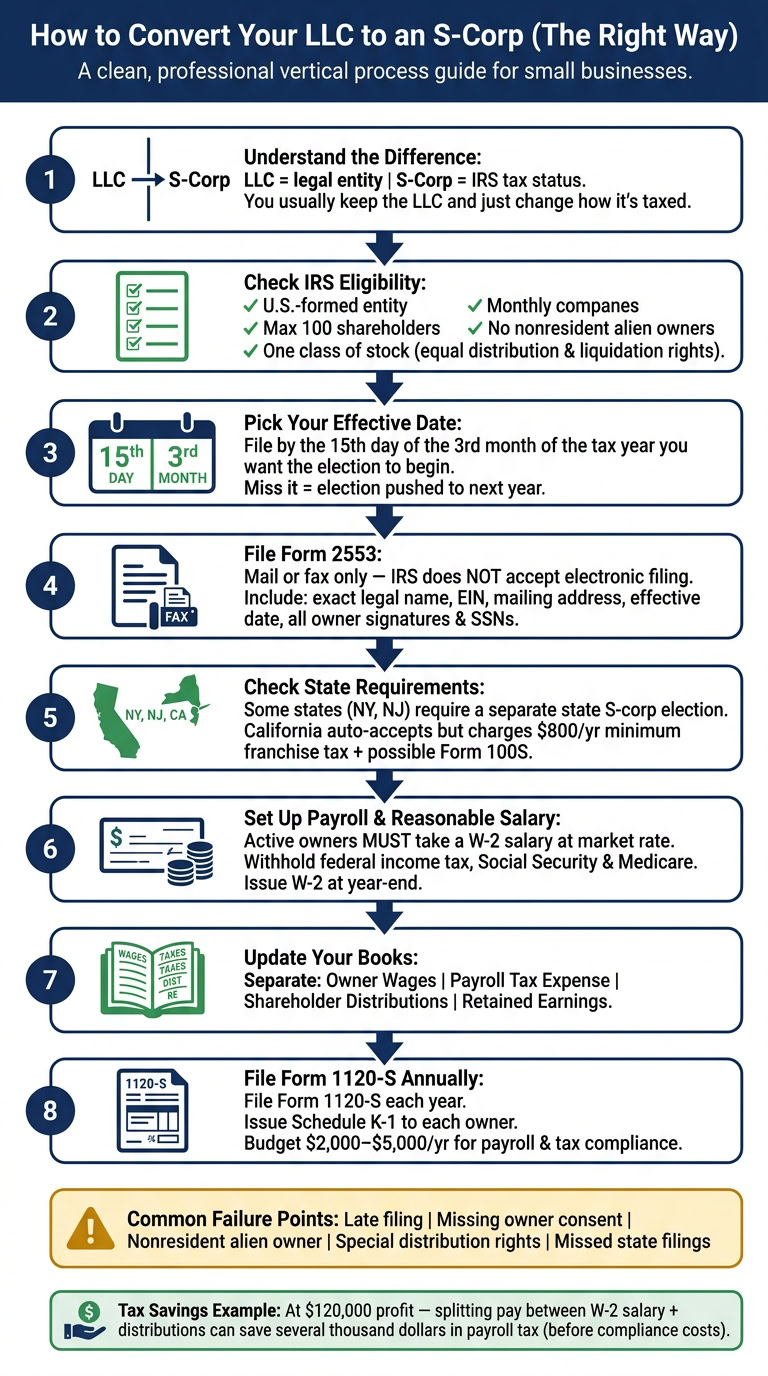
Know the Legal and Tax Difference Before You File
Before you file, separate the LLC’s state-law status from its IRS tax status.
An S-corp is a tax status, not a legal entity. The IRS recognizes it as an S-corp for tax purposes under Subchapter S of the Internal Revenue Code. That’s the key point. Your filing rules, deadlines, and what you need to do next all depend on which route you take.
When an LLC Keeps Its State Status but Elects S-Corp Taxation
After Form 2553 is approved, the LLC still exists under state law. It does not turn into a corporation just because it chose S-corp taxation. For federal tax purposes, though, it files Form 1120-S and issues Schedule K-1s.
The tax savings usually come from splitting the owner’s pay into W-2 wages and distributions. Only the wages are subject to payroll tax.
Here’s how the two setups compare in the areas that matter most:
| Feature | LLC (Default Taxation) | LLC Taxed as S-Corp |
|---|---|---|
| Federal Tax Return | Schedule C (single-member) or Form 1065 (multi-member) | Form 1120-S |
| Owner Income Reporting | Schedule C income or K-1 income | W-2 wages + Schedule K-1 (Form 1120-S) |
| Self-Employment Tax | Paid on 100% of net business profit | Paid only on the owner’s W-2 salary |
| Owner Pay Method | Owner draws or distributions | Reasonable W-2 salary, then distributions |
| Payroll Required | No for owners | Yes – formal payroll for active owner-employees |
| Ongoing Compliance | Simpler, no owner payroll requirement | Quarterly payroll filings, annual Form 1120-S, and K-1s |
With that distinction in place, the next move is to check whether you qualify and pick the right effective date.
When a State-Law Conversion Is a Different Process
Some businesses go a step further and do a state-law conversion. That means changing the legal entity from an LLC to a corporation at the state level. This is a separate process from the IRS tax election.
It may involve filing articles of conversion with the Secretary of State, adopting corporate bylaws, issuing stock, and updating state records to show that the LLC has formally become a corporation. After that, if the new corporation qualifies, it can make a separate S-corp tax election.
Most small LLCs do not need a legal conversion to get S-corp tax treatment.
Once you separate the legal change from the tax election, the next step is checking eligibility and deadlines.
Check S-Corp Eligibility and Filing Deadlines
Before you file Form 2553, make sure your LLC meets every IRS rule for S-corp status. This is the gatekeeper step. If the LLC doesn’t qualify, the tax break isn’t on the table at all.
| IRS Requirement | What It Means for Your LLC | Common Mistake |
|---|---|---|
| Domestic entity | The LLC must be formed in the United States. | Assuming a foreign-registered entity qualifies |
| 100-shareholder limit | The LLC can have no more than 100 shareholders; some family members may count as one shareholder. | Overlooking indirect ownership through other entities |
| Eligible shareholders only | Owners must be U.S. citizens, U.S. resident aliens, certain trusts, or estates. | Having even one nonresident alien owner |
| One class of stock | All owners must have the same rights to distributions and liquidation proceeds. | Operating agreements that give one member preferred distribution rights or special liquidation rights |
| Timely Form 2553 | File by the 15th day of the 3rd month of the tax year the election is meant to start. | Assuming the election is automatic or that any filing date works |
The two trouble spots that derail filings most often are shareholder eligibility and the one-class-of-stock rule.
Who Qualifies for S-Corp Status
A single nonresident alien owner makes the election fail.
The IRS focuses on distribution rights and liquidation rights – not member titles or voting power. So if your operating agreement gives one member preferred distributions while another gets only what’s left over, the IRS may treat that setup as two classes of stock.
That’s where many LLCs get tripped up. On paper, the company may look fine. But the operating agreement tells the real story. Review it closely before filing.
If your LLC clears those rules, the next move is simple: file before the deadline.
How to Pick the Effective Date and Avoid Missing the Election Year
For a calendar-year LLC, Form 2553 must be filed by the 15th day of the 3rd month of the tax year when you want the election to begin. Miss that date, and the election usually won’t start until the next tax year unless the IRS allows late-election relief.
That relief does exist, but it isn’t automatic. The LLC must have intended to be taxed as an S-corp, reported income in line with that intent, and have reasonable cause for filing late. There’s also a hard time limit: less than 3 years and 75 days can have passed since the intended effective date.
If you missed the deadline, don’t just hope for the best. Talk to a tax professional fast.
Why State Tax Rules Must Be Checked Separately
Federal approval doesn’t settle the state side.
Some states, including New York and New Jersey, ask for a separate state S-corp election. Others, like California, accept the federal election automatically but still impose their own taxes. In California, S-corps pay an $800 minimum franchise tax each year and may also need to file Form 100S.
So even after the IRS says yes, you may still have separate state filings and tax bills to deal with.
How to File the S-Corp Election Correctly
Once you know your LLC qualifies and you’ve picked the right effective date, Form 2553 is what makes the S-corp election official. You must file it by mail or fax – the IRS does not accept Form 2553 electronically. As soon as you send it, keep your fax confirmation or certified mail receipt. That proof matters.
Before you fill out the form, pull together the basics for the LLC:
- Exact legal name
- EIN
- Mailing address
- Date formed
- State of formation
- Contact details for the authorized member or manager
Have those details ready from the start so you’re not guessing halfway through the form.
Fill Out Form 2553 with the Right Entity and Owner Details
One of the most common reasons Form 2553 gets held up is simple: the details on the form don’t match what the IRS already has on file. Your LLC’s legal name, EIN, and mailing address should match IRS records exactly. Don’t use a trade name, nickname, or shortened version. Even a minor mismatch can slow things down.
A few other parts of Form 2553 also cause trouble more often than people expect:
- Effective date: Use the first day you want S-corp tax treatment to start.
- Tax year selection: Use a calendar year unless the IRS has already approved a fiscal year.
- Owner consent: Every owner must sign the consent section. The form also needs each owner’s name, address, Social Security Number or EIN, ownership percentage, and the date the owner acquired that interest.
- Authorized signature: The form must be signed by an authorized member or manager of the LLC.
When Form 8832 May Also Be Required
File Form 8832 only when the LLC first needs to change its federal tax classification. If that step isn’t needed, don’t file it.
Confirm Your Filing Status and Keep Records
Once the form is sent, keep a signed copy, your delivery proof, and the IRS approval notice in the LLC’s permanent records. If the IRS hasn’t responded within 60 days, contact the IRS to confirm the filing was received and is still being processed.
| Document to Keep |
|---|
| Signed copy of Form 2553 |
| Fax log or certified mail receipt |
| IRS acceptance letter |
| Form 8832 (if filed) |
After the IRS approves the election, update payroll, owner compensation, and bookkeeping right away.
sbb-itb-ba0a4be
Update Payroll, Owner Pay, and Bookkeeping After Approval
After IRS approval, the focus moves to payroll, bookkeeping, and year-end tax work. If you actively work in the business, you need to run payroll and take W-2 wages before you take profit distributions.
Set Up Owner Payroll and a Reasonable Salary
Start by putting the owner on payroll and setting a reasonable salary. Reasonable compensation means the market rate for the work you actually do. To back that up, keep a role description, comparable pay data, and work logs.
Paying yourself no salary – or just a token amount while taking large distributions – is a red flag. If the IRS decides your wages are too low, it can reclassify distributions as wages and assess back payroll taxes, penalties, and interest.
Once you set the salary, move to a formal payroll schedule. That includes withholding federal income tax, Social Security, and Medicare, paying employer payroll taxes, and issuing a Form W-2 at year-end. You may also need to register payroll accounts and use a payroll provider or accountant so you can pay yourself on a regular schedule.
At $120,000 in profit, splitting pay between salary and distributions can save several thousand dollars in payroll tax before compliance costs.
Once payroll is running, the books need to show a clean split between wages and distributions.
Separate Wages, Distributions, and Equity in Your Books
After the election, your bookkeeping should clearly separate owner wages, shareholder distributions, and retained earnings. When those get mixed together, tax season gets messy fast. It also gets harder to show that your salary was reasonable.
Each item should have its own spot in the chart of accounts:
- Owner wages – recorded as a payroll expense
- Payroll tax expense – tracked in a separate tax expense account
- Shareholder distributions – reduce equity and are not deductible business expenses
- Retained earnings – track profits left in the business after distributions
Keep payroll registers, Form 941 filings, W-2s, payroll tax payment confirmations, bank statements, distribution records, and any owner resolutions that support compensation. Clean records make it much easier to reconcile wages, distributions, and equity if questions come up later.
With payroll in place, the tax calendar needs to change too.
Adjust Your Annual Tax Filing Routine
The S-corp election means filing Form 1120-S each year. Each owner gets a Schedule K-1 that shows their share of income, deductions, and credits, which they then report on their personal Form 1040. During the year, the business also handles payroll tax returns and year-end wage reporting through Forms W-2 and W-3.
Plan to spend $2,000 to $5,000 per year on payroll and tax compliance. For lower-profit businesses, that cost can wipe out the tax savings.
Stay Compliant and Avoid Mistakes That Can Undo the Election
Approval is just the beginning. An S-corp election can still fall apart later if you slip on filing, ownership, payroll, or state rules.
Common Mistakes That Cause Tax or Compliance Problems
The biggest issues that put an S-corp election at risk are late or defective filings, ineligible owners, unreasonable compensation, weak records, and missed state filings.
Late or defective elections are more common than many owners think. A missing signature, the wrong effective date, or incomplete shareholder details can make Form 2553 defective. If you miss the deadline, you may need to ask the IRS for late-election relief and show reasonable cause. You also need to show that the business was treated as an S-corp from the date you intended. Relief may be available, but it is not guaranteed.
Ineligible ownership can end S-corp status without much warning. If a nonresident alien, corporation, or partnership becomes an owner, the election can terminate. Even a small ownership transfer should be checked for tax eligibility before the deal closes.
Hidden second-class stock risk is another easy miss. If your operating agreement gives one member priority distribution or liquidation rights, the IRS may treat that as a second class of stock. That can kill the election. After approval, review the agreement and make sure all economic rights stay strictly pro-rata.
State-level mismatches can also wipe out part of the tax upside. Some states require their own S-corp election on top of Form 2553. California accepts the federal election automatically, but it still charges the greater of $800 or 1.5% of net income as franchise tax. That can shrink the federal tax savings. Check your state’s filing and election rules on their own instead of assuming the federal approval covers everything.
Use the checklist below to catch the most common problem spots before they turn into tax issues.
| Risk Area | What Goes Wrong | How to Prevent It |
|---|---|---|
| Late or defective election | IRS denies the election or treats it as effective later than intended | File Form 2553 on time and verify every shareholder signature, election date, and owner detail |
| Ineligible owner | S-corp status terminates automatically | Review all ownership transfers before they close |
| Multiple classes of stock | IRS treats special distribution rights as a second class | Keep distribution and liquidation rights identical and pro-rata |
| Unreasonable compensation | IRS reclassifies distributions as wages | Document salary methodology and maintain payroll records |
| Poor recordkeeping | Hard to substantiate basis, wages, or corporate formalities in an audit | Keep books, basis schedules, minutes, and payroll records organized |
| Missed state filings | State taxes the business differently than the IRS expects | Confirm state election and filing requirements separately |
BusinessAnywhere Resources to Help You Stay on Track
If you’d rather not handle every filing and follow-up task in-house, BusinessAnywhere offers help for the main pieces.
BusinessAnywhere’s S-Corp Tax Election service files Form 2553 for $97 and has a 1–2 business day turnaround. That can cut down the odds of a late or defective submission.
For state compliance, the Registered Agent service and Existing Company Maintenance can help you stay on top of official state notices, annual reports, and renewal filings.
If you need to update ownership paperwork or lock in shareholder terms after the election, Corporate Documents templates start at $27.
FAQs
Should I keep my LLC or convert it?
You don’t need to convert or dissolve your LLC to get S-Corp tax treatment. An S-Corp is a tax election, not a different legal entity.
That means your LLC can stay exactly the same at the state level. You simply file IRS Form 2553, and the IRS changes how it taxes your business income.
In plain English: you keep the LLC’s liability protection and day-to-day flexibility, while you may also cut self-employment taxes.
When does an S-corp election save money?
An S-corp election can cut your tax bill by reducing self-employment tax.
Here’s the basic idea: with default LLC taxation, 100% of net profit is usually subject to the 15.3% self-employment tax. But with S-corp status, that income gets split in two parts:
- a reasonable W-2 salary, which is taxed
- shareholder distributions, which are not subject to self-employment tax
That split is where the savings can come from. You’re not dodging tax. You’re changing how part of the income is treated.
In most cases, this starts to make sense when annual net profit hits around $60,000 to $80,000 or more. Below that range, the extra cost of payroll, tax prep, and compliance often eats up the tax savings.
What if I miss the Form 2553 deadline?
Missing the Form 2553 deadline does not automatically knock your business out of S-Corp status.
The IRS may still allow a late election under IRS Revenue Procedure 2013-30 if you file within 3 years and 75 days of the intended effective date.
To request relief, complete Part IV of Form 2553, explain why the election was late, and confirm that all shareholders consistently filed tax returns as if the election had already taken effect.
That said, approval is still up to the IRS.