


If your LLC has steady profit, choosing the right LLC tax election can cut self-employment tax by moving part of your pay from wages to distributions. In plain terms: you still pay tax on both, but only the salary part gets hit with payroll tax.
Here’s the short version:
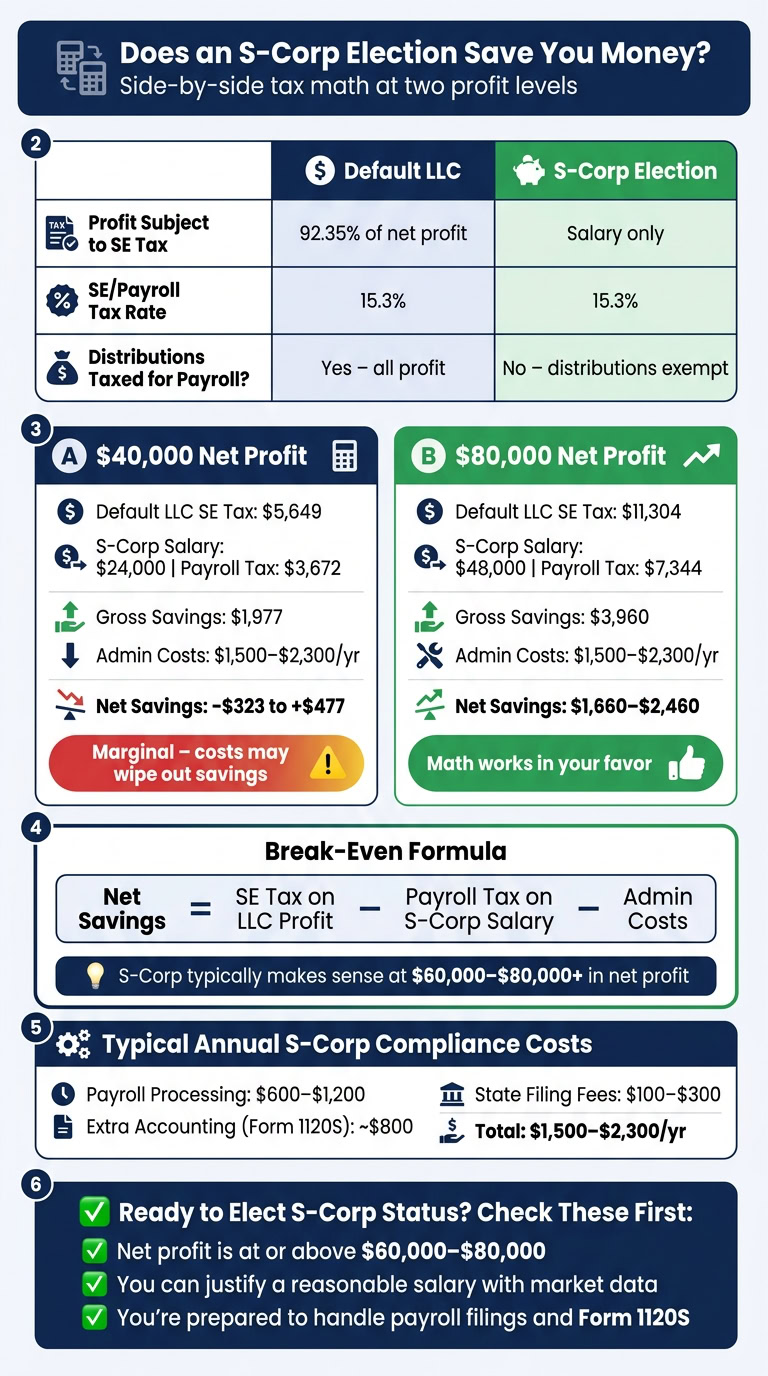
- If your business makes $40,000, the tax cut may be small after extra costs.
- If your business makes $80,000, the math often looks better.
- A common range where this starts to matter is around $60,000 to $80,000 in net profit.
- You must pay yourself a reasonable salary.
- You also need to handle payroll, tax filings, and Form 2553 on time.
The core math is simple:
- Default LLC tax: 92.35% of profit × 15.3%
- S-corp tax: 15.3% payroll tax on salary only
- Your net tax cut = baseline SE tax minus payroll tax on salary minus admin costs
For example, at $80,000 in profit:
- Default LLC SE tax: about $11,304
- S-corp payroll tax on a $48,000 salary: $7,344
- Gross tax cut: $3,960
- After added yearly costs of about $1,500 to $2,300, net tax cut is about $1,660 to $2,460
At $40,000 in profit, the gross tax cut is only $1,977, so payroll and filing costs can wipe out most of it.
| Profit | Default LLC SE Tax | S-Corp Salary | Payroll Tax on Salary | Gross Tax Cut | Net After Costs |
|---|---|---|---|---|---|
| $40,000 | $5,649 | $24,000 | $3,672 | $1,977 | -$323 to $477 |
| $80,000 | $11,304 | $48,000 | $7,344 | $3,960 | $1,660 to $2,460 |
My takeaway: this move works best when you have steady active income, can support your salary with market data, and your expected tax cut is more than the extra yearly filing and payroll costs.
If that sounds like your situation, this article shows how the numbers work and where the break-even point tends to land.
How the S-corp election works
An S-corp election is a tax status, not a new legal entity. When you file Form 2553, your LLC or corporation stays the same from a legal standpoint. What changes is how the IRS taxes the business under Subchapter S. That setup lets owner pay be split into two parts: a W-2 salary that is subject to payroll taxes, and profit distributions that are not.
That distinction is a big deal. Only the salary portion gets hit with payroll taxes. The next section walks through the default tax math this can change.
Eligibility rules and the Form 2553 filing window
To elect S-corp treatment, the business must be a domestic entity with no more than 100 shareholders. All shareholders must be U.S. citizens or residents, must consent to the election, and the business can have only one class of stock.
You also need to file Form 2553 within 2 months and 15 days after the start of the tax year for the election to take effect. Once those boxes are checked, the main issue becomes pretty simple: do the tax savings beat the extra payroll and filing costs?
Why S-corp taxation reduces self-employment tax
Under default LLC taxation, 100% of net profit is usually subject to the 15.3% self-employment tax, though S-corp tax benefits can significantly reduce this burden. That rate includes 12.4% for Social Security and 2.9% for Medicare.
With an S-corp election, you pay yourself a reasonable W-2 salary that is subject to payroll taxes. Then the rest of the profits pass through as distributions, which are generally not subject to self-employment tax.
How BusinessAnywhere can help with the Form 2553 filing
If you want help filing Form 2553, BusinessAnywhere offers an S-Corp Tax Election filing service for $97.
Next, the baseline self-employment tax formula shows what this election can reduce.
The baseline: Self-employment tax without an S-corp election
Start with self-employment (SE) tax on your net business profit. That’s the reference point for figuring out whether an S-corp tax election saves you money.
SE tax is separate from income tax. It applies only to your net earnings from self-employment after business expenses.
The basic formula: 92.35% × 15.3%
The IRS doesn’t apply the 15.3% rate to your full net profit. It applies that rate to 92.35% of net profit instead.
Here’s how that works on $80,000 of annual net profit before owner pay:
| Step | Calculation | Result |
|---|---|---|
| Net business profit | Given | $80,000 |
| Apply 92.35% factor | $80,000 × 0.9235 | $73,880 |
| SE tax rate | 12.4% Social Security + 2.9% Medicare | 15.3% |
| Self-employment tax owed | $73,880 × 0.153 | $11,303.64 |
On $80,000 of profit, SE tax comes to about $11,304. That’s the baseline to use when you compare it with the S-corp setup.
Next, you look at the salary-and-distribution split, which can shrink the amount subject to this tax.
What this baseline does and does not include
This math covers only self-employment tax. It does not include federal income tax, state income tax, or the extra 0.9% Medicare tax that can apply at higher income levels.
Social Security tax applies only up to the annual wage base, which is $176,100 for 2025. Medicare tax has no wage cap. You can usually deduct half of your SE tax on your federal return, but that deduction cuts income tax, not the SE tax itself.
This is the baseline that S-corp elections aim to lower. The next step is to compare it with an S-corp owner’s salary and distributions.
sbb-itb-ba0a4be
Salary vs. distributions: How the tax savings are created
An S-corp can cut self-employment tax by splitting owner pay into two buckets: salary and distributions.
Here’s the basic idea. Salary gets hit with payroll tax. Distributions do not. So when part of the business profit is paid out as distributions instead of wages, only the salary piece stays exposed to payroll tax. Compared with the baseline where the full profit is subject to self-employment tax, the tax savings come from shrinking the amount that gets taxed for payroll purposes.
That split is where the savings come from.
| Feature | W-2 Salary | Shareholder Distributions |
|---|---|---|
| Tax Treatment | Subject to 15.3% payroll tax plus ordinary income tax | Subject to ordinary income tax only; no self-employment tax |
| Payroll Obligations | Requires withholding, W-2 filing, and quarterly reporting | No payroll tax withholding or reporting required |
| Why It Matters | Payroll tax applies to every dollar of salary | Distributions avoid payroll tax entirely |
What counts as reasonable compensation
The IRS says owner-employees must pay themselves reasonable compensation before taking distributions. In plain English, your salary should line up with what someone would normally earn for doing that job.
To back up your salary amount, keep records that show:
- Your job duties
- Your hours worked
- Your experience
- Local market pay for similar roles
If you set your salary too low just to cut taxes, you could draw IRS attention. And if the IRS reclassifies distributions as wages, you may owe back payroll taxes, interest, and penalties.
How the salary and distribution split affects your tax bill
Every dollar paid as a distribution instead of salary avoids payroll tax. That’s the lever.
In Sarah’s example, shifting $15,000 from salary to distribution avoided payroll tax and lowered total tax by $2,295 before compliance costs.
That gross tax savings number is only the starting point. The next step is to stack it up against payroll and compliance costs.
The math: Tax savings, ongoing costs, and the break-even point
Using the salary/distribution split above, here’s how the numbers look at two profit levels.
Scenario 1: Lower profit where savings may be small
Take a freelance designer with $40,000 in net profit. With default LLC taxation, self-employment tax works out to:
$40,000 × 92.35% × 15.3% = $5,649
With an S-corp election, the owner takes a $24,000 reasonable salary, or 60% of profit. Payroll tax applies only to that salary:
$24,000 × 15.3% = $3,672
That creates gross savings of $1,977.
Then the fixed yearly admin costs show up. Those usually run about $1,500–$2,300:
| Cost Item | Annual Estimate |
|---|---|
| Payroll processing | $600–$1,200 |
| Extra accounting (Form 1120S) | ~$800 |
| State filing fees | $100–$300 |
| Total added costs | $1,500–$2,300 |
So what happens in plain English? At this income level, the S-corp can save money on paper, but the added admin costs eat up most of it. Net savings land at about -$323 to $477. That’s not much room for error.
Scenario 2: Higher profit where net savings become clearly positive
Now look at a marketing consultant with $80,000 in net profit. Under default LLC taxation, self-employment tax is:
$80,000 × 92.35% × 15.3% = $11,304
If that owner pays a $48,000 reasonable salary, again 60% of profit, payroll tax becomes:
$48,000 × 15.3% = $7,344
That means gross savings of $3,960.
After subtracting the same compliance costs of about $1,500–$2,300, net savings come to around $1,660–$2,460 per year. At this point, the math starts to work in your favor.
Break-even formula and decision checklist
The break-even formula is simple:
Net Savings = SE tax on LLC profit − payroll taxes on S-corp salary − payroll, tax prep, and state filing costs
In many cases, an S-corp election starts to make sense when annual net self-employment income reaches about $60,000 to $80,000 or more.
Before making the switch, check these three things:
- Net profit is at or above the $60,000–$80,000 range
- You can back up a reasonable salary based on your job duties and market pay data
- You’re ready to handle payroll filings and filling out Form 2553 for a separate business tax return
If those pieces aren’t there yet, default LLC taxation may be the simpler and lower-cost move for now.
FAQs
How do I choose a reasonable salary?
A reasonable salary isn’t a guess, and it isn’t a fixed percentage either. The IRS does not give you a safe-harbor formula. So the number needs to come from a simple standard: what would an unrelated employer pay someone to do the work you do?
That means you should document your role, day-to-day duties, credentials, and hours worked. Then use market salary data to back up the amount you choose. Keep a clear paper trail, and make sure the pay runs through formal W-2 payroll before you take distributions.
When does an S-corp election stop being worth it?
An S-corp election usually stops making sense when annual net profit stays under $60,000. At that level, payroll, extra tax filings, and corporate compliance costs can eat up most – or all – of the self-employment tax savings.
It may also be a poor fit if income swings a lot from year to year. The same goes if your reasonable salary needs to be high enough that there’s not much left to take as distributions.
What extra filings come with an S-corp?
Electing S-corp status comes with more IRS paperwork and more admin work.
First, you need to file Form 2553 to make the election. After that, the business must file Form 1120-S every year and send Schedule K-1s to shareholders.
There’s also payroll to deal with. If the owner takes a salary, you need to run formal W-2 payroll. That means handling quarterly Form 941 filings, the annual Form 940, and W-2s.
On top of the federal forms, you may also need to handle state filings and keep up corporate records, such as bylaws and meeting minutes.