If you run a corporation without bylaws, you leave key rules up to state default law. I’d treat bylaws as the company’s internal playbook: they set who can make decisions, how meetings work, how votes count, who can sign contracts, and how changes get approved.
In simple terms, here’s what matters most:
- Articles of Incorporation create the corporation with the state
- Bylaws set the internal rules for the board, officers, and shareholders
- Bylaws usually cover board size, officer duties, meeting notice, quorum, voting, stock rules, records, indemnification, and conflicts of interest
- Many notice periods fall in the 10 to 60 day range
- A majority quorum is common for boards and shareholders
- Bylaws are usually adopted at the first board meeting and kept in the corporate records, not filed with the state
Here’s the short version: I’d start with a template, check it against the Articles of Incorporation and state law, then edit it to match how the company will actually run. That means setting plain rules for meetings, written consent, remote participation, stock issuance, signing limits, and bylaw amendments.
A few points stand out:
- Keep the corporate purpose broad so the company can change direction later
- Set clear signing limits so officers know what they can approve
- Use written consents and remote meetings if state law allows them
- Record everything in minutes and keep signed bylaws in the minute book
- Review the bylaws when the company adds directors, changes share classes, or shifts how meetings are held
One point I’d keep front and center: bylaws do not need fancy wording. They need to match how the corporation works in practice. That helps with banks, investors, internal disputes, and keeping up corporate formalities.
What to Include in Corporate Bylaws
These clauses spell out who has power, how meetings work, how votes count, and how ownership is handled. Start with the parts that deal with authority, meetings, and stock.
Corporate Identity, Purpose, and Fiscal Year
Begin with the corporation’s exact legal name and principal office. Using the exact legal name helps prevent mismatches in records and contracts. The bylaws can also let the board move the principal office by resolution, so you don’t have to amend the bylaws every time the address changes.
For the corporate purpose, broad language usually works best, such as “to engage in any lawful business under the laws of [State].” If the purpose clause is too narrow, it can get in the way later if the company changes direction or adds new lines of business.
Set the fiscal year-end in plain terms. December 31 is the most common option because it lines up with the calendar year and common tax filing cycles. You can also let the board change the fiscal year by resolution if that makes sense down the road.
Board Structure, Officer Roles, and Committees
Start this section by stating the board’s authority. You can use a fixed number of directors or a range that the board or shareholders can adjust by resolution. For early-stage companies, a range gives you room to grow without forcing a bylaw amendment every time the board changes size.
This section should also cover director terms, qualifications, removal, and how vacancies are filled. For example, the bylaws can say whether directors serve one-year terms or staggered multi-year terms, and whether a majority of the remaining directors can fill an open seat. It should also say, in plain language, that the board manages the corporation’s business and affairs. Set the board’s quorum and voting rules here too. A common rule is a majority of directors then in office.
It also makes sense to allow virtual board meetings and unanimous written consent. That can save a lot of hassle, especially for small teams or directors in different places.
The board usually appoints and removes officers. The main roles are:
- President/CEO – runs operations and signs major contracts within board limits
- Secretary – keeps records, minutes, and notices
- Treasurer/CFO – manages funds, banking, and payments
These roles help split oversight from day-to-day management.
| Role | Core Responsibilities |
|---|---|
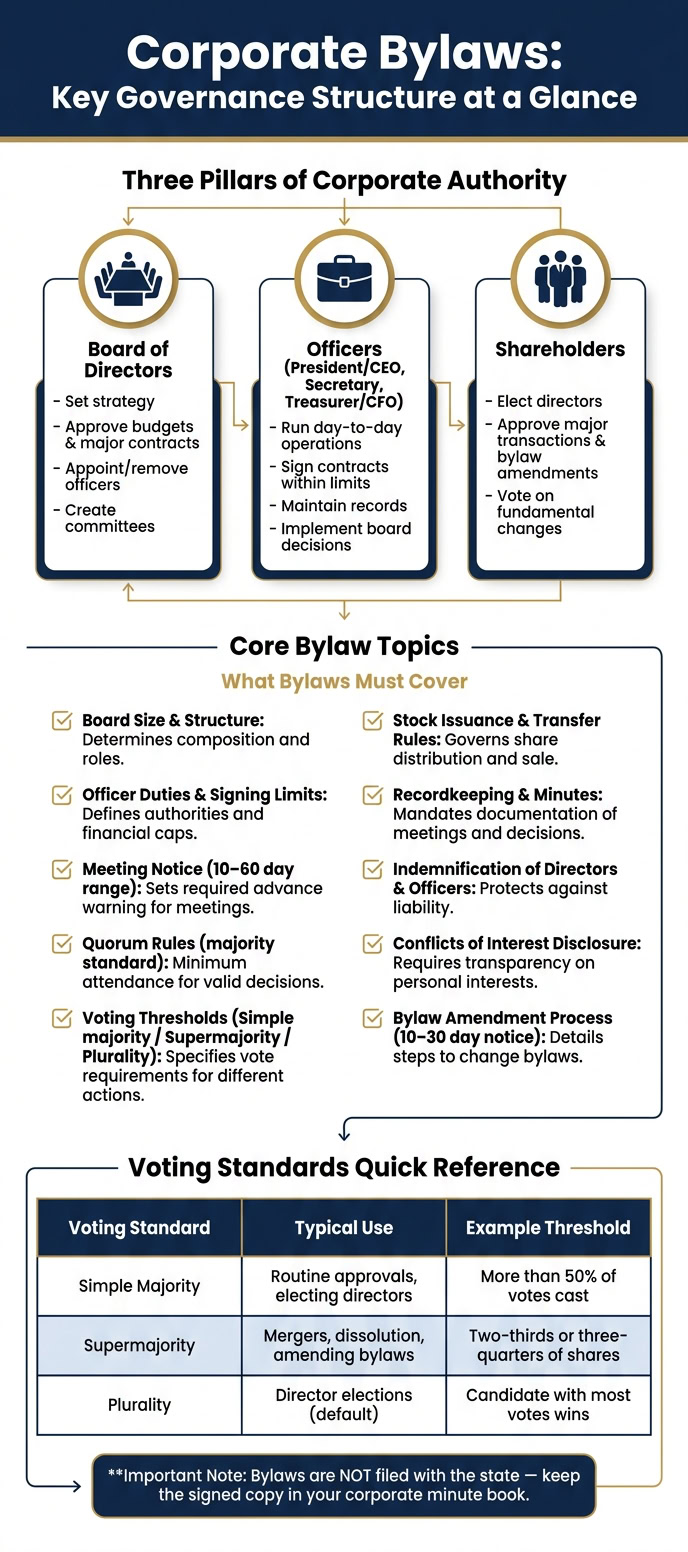
| Board of Directors | Set strategy; approve budgets and major contracts; appoint and remove officers; create committees |
| Officers | Run day-to-day operations; sign contracts within limits; maintain records; implement board decisions |
| Shareholders | Elect directors; approve major transactions and bylaw amendments; vote on fundamental changes |
Bylaws can also allow committees, such as audit or compensation committees. State law can limit what committees are allowed to do, so keep each committee’s authority narrow and clear.
Shareholder Meetings, Voting, and Stock Rules
This part should cover annual meetings, special meetings, and the rules that make those meetings valid. The annual meeting can be set for a fixed date or for a date the board chooses each year. That meeting is usually used to elect directors and handle routine business.
Special meetings are for matters that can’t wait until the next annual cycle. The bylaws should say who can call them. In many corporations, that means the board, the chair, or shareholders holding a set percentage of voting shares.
You can also cover proxy voting and shareholder action by written consent when state law allows it. For small companies, or companies with owners in different places, this can make life much easier than waiting for a formal in-person meeting. Meetings may be held at the principal office or through permitted remote communication. Notice periods often run 10 to 60 days. The notice should list the date, time, place, and agenda items.
Quorum and voting thresholds decide when a meeting can act and how much support an action needs. The bylaws should define quorum for both shareholders and directors. A majority is common for each, though state law may allow a lower shareholder threshold.
| Voting Standard | Typical Use | Example Threshold |
|---|---|---|
| Simple majority | Routine approvals, electing directors, standard resolutions | More than 50% of votes cast at a meeting with quorum |
| Supermajority | Fundamental changes such as amending bylaws, mergers, or dissolution | Two-thirds or three-quarters of outstanding shares |
| Plurality | Director elections unless the bylaws require a majority standard | Candidate with the most votes wins |
The stock section should cover share classes, how shares are issued, who approves new issuances, and any transfer limits, such as a right of first refusal. If the corporation has more than one class of stock, the bylaws should briefly explain the rights tied to each class, including voting and dividend rights. This section can also address stock certificates, signatures, and replacements.
After these core governance rules, add clauses for records, signatures, and conflicts.
sbb-itb-ba0a4be
Bylaw Clauses That Support Compliance and Daily Management
These clauses cover the nuts and bolts of running the corporation: records, signing power, money, liability, and conflicts.
Recordkeeping, Minutes, and Signing Authority
Once the bylaws spell out who runs the corporation, the next job is to make sure those decisions are put in writing and stored in one place.
The corporate secretary should prepare and keep minutes of board, shareholder, and committee meetings, along with written consents. Minutes, bylaws, the stock ledger, and key resolutions should be kept together in the minute book as part of the corporation’s records at the principal office or another U.S. location the board designates.
Signing authority also needs clear guardrails. In practice, the bylaws should set three main controls:
- The president or CEO may sign routine contracts within limits set by the board.
- The treasurer or CFO may sign checks and payment instruments within limits set by the board.
- Checks above a stated amount require two signatures, and board approval is required before anyone pledges corporate assets or guarantees a third party’s obligations.
The board may also authorize an officer or agent to execute contracts, either for all transactions or only for certain ones.
Dividends, Indemnification, and Conflicts of Interest
After records and authority are set, the bylaws should deal with distributions, liability protection, and insider deals.
Dividends are declared by the board. Before approving a distribution, the board should review current earnings, expected cash needs, debt terms, and any solvency tests that apply. Each dividend declaration should be recorded in a board resolution that states the amount, the record date, the payment date, and the class of stock that will receive the dividend.
Indemnification clauses protect directors and officers from personal liability for expenses, judgments, fines, and settlements tied to legal proceedings that come from their corporate service. The bylaws should spell out the process plainly: how someone requests indemnification, who decides, and when indemnification is not allowed, such as when a director is found liable for misconduct or took a personal benefit at the corporation’s expense. Many bylaws also provide for advancement of legal fees, which means the corporation pays defense costs upfront.
For conflicts of interest, the bylaws should require any director or officer with a financial interest in a proposed transaction to disclose that interest in writing before the board votes. That person should then step out of the discussion and abstain from the vote. The minutes should record who made the disclosure, the nature of the interest, the options the board considered, and how the disinterested directors voted. That paper trail helps show that related-party transactions were handled openly and at arm’s length.
With these rules set, the next step is to draft, approve, and store the bylaws with the corporate records.
How to Draft, Approve, and Update Your Bylaws
Draft the First Version Using a Clear Template
Start with the governance decisions your corporation has already made and use them to fill out the first draft.
Before you draft anything, pull together your Articles of Incorporation and your state’s corporate statute. Those two documents tell you what your bylaws need to address and what they can’t conflict with.
From there, list the internal choices already in place: board size, officer titles, fiscal year-end, share structure, quorum thresholds, and meeting frequency. Then plug those exact choices into the draft. For example, you might state that "the board shall consist of not fewer than three (3) and not more than seven (7) directors." That makes the draft much easier to build – and much easier to use later.
A template can save time, but it should only be the starting point. Go line by line and fix any clause that doesn’t match how your corporation works, especially rules for remote meetings, electronic notice, and signing authority.
Approve the Bylaws and Store Them With Corporate Records
Once the draft lines up with the company’s structure, the next step is approval and proper recordkeeping.
Adopt the bylaws at the organizational meeting or by written consent, and record that action in the minutes. If written consent is allowed under state law, that’s fine – but the adoption still needs to be documented.
The minutes should include:
- The date
- Who attended
- The vote outcome
- A reference to the bylaws by date or version number
A standard resolution says the bylaws were presented, reviewed, and adopted, and that a copy should be placed in the minute book. Unlike the Articles of Incorporation, bylaws are not filed with the state. The signed and dated copy should go into the corporate minute book along with the Articles, stock records, and board resolutions.
Review and Amend Bylaws as the Corporation Changes
As the corporation grows, the bylaws should keep pace with how the business actually runs.
Common reasons to amend bylaws include adding directors, issuing a new class of shares, moving from in-person meetings to remote meetings, or changing officer titles after a reorganization.
Each set of bylaws should include an amendment article that deals with three points:
- Who can propose a change
- What vote is needed
- How much advance notice must be given before the vote, often 10–30 days
When an amendment passes, record the vote in the board or shareholder minutes, update the bylaws document, and sign and date the revised version. If you’ve made several changes over time, prepare a clean consolidated copy. That way, directors and officers can work from one current document instead of piecing together scattered amendments.
Have counsel review the first version of the bylaws and any major amendments to make sure they match state law and the Articles of Incorporation.
Conclusion: The Rules That Keep a Corporation Organized
Corporate bylaws set the ground rules for how a corporation runs. They spell out how the company is governed, how decisions get made, and who handles what among directors, officers, and shareholders. Without bylaws, state default rules take over. And those defaults may not fit the way a given business actually works. That matters in day-to-day operations, in avoiding fights, and in keeping up corporate formalities, including the corporate veil that separates personal and business liability.
That’s why the final draft should reflect how the company operates in practice. Bylaws shaped for the business, instead of copied straight from a template, can give investors more confidence in the company’s governance and lower the risk of internal disputes. A business attorney can also check that the document lines up with state law and the Articles of Incorporation.
Once the bylaws are adopted, treat them like a working document. Adopt them at the organizational meeting, keep the signed copy with the corporate records, and update them as the business changes.
FAQs
Do I need bylaws for a small corporation?
Yes. In most states, corporations need bylaws to stay in good standing.
Even when the law doesn’t flat-out require them, bylaws still matter. They help protect the corporate veil and spell out the rules for board roles, voting, and recordkeeping. They also show that your company operates as a separate legal entity instead of just an extension of its owners.
That matters outside your company too. Banks, lenders, and investors may ask to see your bylaws as proof that the business is distinct and professionally managed.
Who can change corporate bylaws later?
Corporate bylaws can usually be changed by either the board of directors or the shareholders. It depends on what the corporation’s current bylaws say.
That’s why your bylaws should spell this out in plain terms. State who has the power to make changes and what vote is needed – for example, a simple majority or a supermajority.
This matters because it gives future amendments a clear, approved path instead of leaving the process open to confusion or disputes.
What happens if bylaws conflict with state law?
Corporate bylaws can’t conflict with state law or the corporation’s Articles of Incorporation. Bylaws sit lower in the stack as an internal company document, so they need to match those higher-level rules.
If a bylaw provision contradicts state law, it’s generally unenforceable. Keeping bylaws in line with the law of the state of incorporation helps support proper corporate governance and can help the company avoid legal issues.