

If your real estate LLC is already public, making it anonymous is nearly impossible. Once your personal information is in state records, it remains accessible. The better option? Start fresh in a privacy-friendly state like Wyoming, Delaware, or New Mexico. These states allow you to form LLCs without disclosing ownership details in public records, offering stronger privacy for real estate investors.
Key Takeaways:
- Existing LLCs: Public records can’t be erased. Amendments help reduce exposure, but full anonymity isn’t achievable.
- Privacy States: Wyoming, Delaware, and New Mexico provide better protection by not requiring owner names in public filings.
- Costs:
- New Mexico: $50 to form, no annual fees.
- Wyoming: $100 to form, $60 annual fee.
- Delaware: $110 to form, $400 annual tax.
- Best Approach: Form a new LLC in a privacy state or use a holding company structure to shield ownership of your properties.
Conclusion: If privacy is your priority, starting a new LLC in a privacy-focused state is the most effective solution.
Can You Make Your Current LLC Anonymous?
Making an existing real estate LLC private is a tough challenge. Once your personal information is made public, it’s there for good. As Northwest Registered Agent puts it:
“Once information goes onto the public record, there’s no way to completely erase it.”
When you filed your Articles of Organization, your name, address, and other identifying details became part of your state’s permanent public database. Even if you amend those records later, the original filings remain accessible. If you initially purchased property in your personal name and then transferred it to your LLC, the chain of title clearly links you to the property as the grantor. These permanent public records highlight why anonymizing an existing LLC is so difficult.
Why Existing LLCs Are Hard to Make Anonymous
This issue isn’t just about old filings. Many residential lenders won’t issue loans directly to an LLC for 1-to-4 unit properties. Instead, they require you to buy the property in your name first, then transfer it to the LLC. This creates a permanent public record of the transfer, connecting you to the property. As Hancock, McGill & Bleau explain:
“If you take title in your name and then transfer into the LLC, the real estate records will show the transfer and identify you as the person who made the transfer.”
Operating in multiple states adds another layer of complexity. For instance, you might establish an LLC in Wyoming, a state known for its privacy protections, but if your rental property is in California, you’ll need to register as a “foreign LLC” in California. This process often requires you to disclose member or manager information, undermining the privacy benefits of forming the LLC in Wyoming. These obstacles make it clear why achieving full anonymity for an existing LLC is near impossible. Still, there are a few steps you can take to increase privacy.
Privacy Options for Current LLCs
While no solution can erase your past records, there are ways to limit the exposure of your information moving forward. For instance, you can amend your state filings to replace yourself as the registered agent with a professional service. This removes your home address from the “Registered Office” field on public records. Another option is switching to a manager-managed vs. member-managed structure or appointing a nominee manager, which limits the public disclosure of your involvement.
Using a professional registered agent and a virtual mailbox for your business address is another step you can take. Additionally, keeping an Operating Agreement as an internal document allows you to prove ownership to banks without making that information publicly available. However, none of these steps can erase the historical trail. Anyone conducting thorough research can still trace your original filings and property transfers. As Hancock, McGill & Bleau aptly state:
“Achieving anonymity for a real estate investor is relative, not absolute.”
Best States for Anonymous Real Estate LLCs
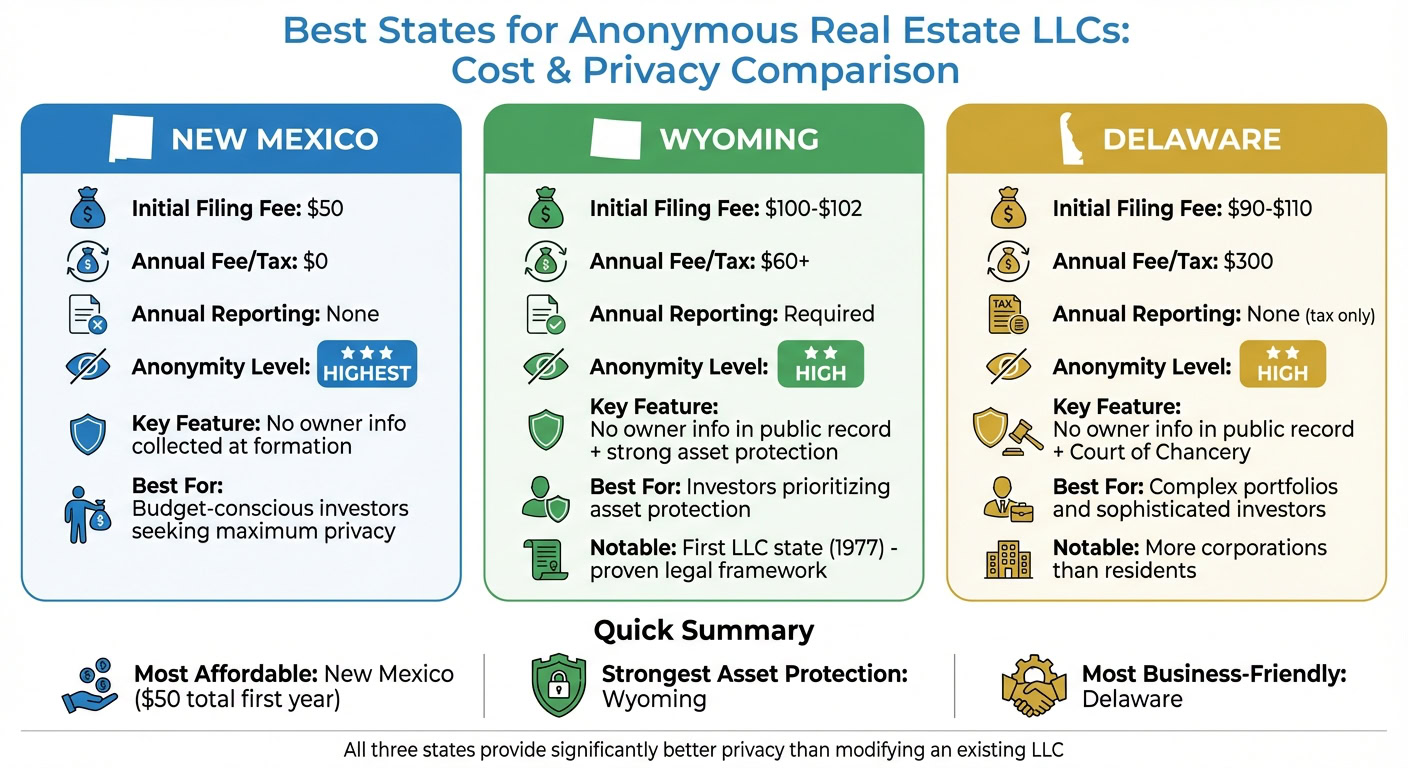
If safeguarding your privacy is a priority and modifying an existing LLC isn’t enough, starting fresh in a privacy-focused state can be the way to go. Three states stand out for their robust privacy protections: Wyoming, Delaware, and New Mexico. Each offers unique advantages tailored to different budgets and asset sizes, so selecting the right one depends on your specific needs.
Wyoming: A Leading Choice for Anonymous LLCs
Wyoming is a standout for privacy, as it doesn’t require owner or manager names to appear in public records. To enhance anonymity, nominee services are also available. Beyond privacy, Wyoming’s strong asset protection laws make it a preferred choice for many.
The state has consistently ranked high in business-friendly metrics, topping the 2024 Tax Foundation‘s Business Tax Climate Index. Additionally, Wyoming imposes no corporate income tax on LLCs. As the first state to establish LLC laws in 1977, it has a solid legal foundation to back its protections. Alex Recouso, CEO of CitizenX, highlights this legacy:
“Wyoming stands as the original LLC state, having enacted the first LLC statute in 1977. The Wyoming Limited Liability Company Act… provides comprehensive privacy protections that have served as a model for other states.”
While Wyoming does require annual reporting, its charging order protection ensures that creditors have limited remedies, even for single-member LLCs.
Delaware: Privacy with a Business-Friendly Edge
Delaware is renowned for its business-friendly environment and privacy protections. Member names are kept off public filings, and the state’s specialized Court of Chancery ensures efficient and predictable handling of disputes.
Interestingly, Delaware is home to more corporations than residents, underscoring its popularity among businesses. The initial filing fee is $110, with a $400 annual tax. Unlike Wyoming, Delaware doesn’t require an annual report for LLCs – just the tax payment – reducing opportunities for public disclosure.
Delaware is often the go-to for investors with larger or more complex real estate portfolios, thanks to its sophisticated legal framework. However, the $400 annual tax makes it the priciest option for those seeking privacy.
New Mexico: Budget-Friendly Anonymous LLCs
New Mexico offers unparalleled anonymity by default, as it does not record ownership details. Only the registered agent and organizer are listed on public filings.
Jeannine Mancini highlights this unique feature:
“New Mexico is the only state where business owners can register their businesses without disclosing their names on the forms they are submitting.”
For privacy-conscious investors on a budget, New Mexico is an excellent option. With a low $50 initial filing fee and no annual tax or reporting requirements, it’s the most affordable choice for maintaining anonymity.
| State | Initial Filing Fee | Annual Fee/Tax | Annual Reporting | Anonymity Level |
|---|---|---|---|---|
| New Mexico | $50 | $0 | None | Highest (No owner info collected) |
| Wyoming | $100–$102 | $60+ | Required | High (No owner info in public record) |
| Delaware | $110 | $400 | None (Tax only) | High (No owner info in public record) |
For most real estate investors, New Mexico combines affordability with unmatched privacy, while Wyoming offers stronger asset protection, and Delaware is ideal for handling complex business needs. Choosing the right state depends on your priorities, but all three provide far greater anonymity than attempting to modify an existing LLC. These states also pave the way for more advanced strategies, such as holding company structures or move your LLC to another state, to optimize your real estate investments.
Why Starting a New Privacy State LLC Works Better
Once your name appears in public LLC records, it’s there for good – searchable and archived indefinitely. Trying to make an existing LLC anonymous isn’t an option because the information is already public.
By forming a new LLC in a privacy-focused state, your name never enters the public record in the first place. States like Wyoming, Delaware, and New Mexico don’t require member or manager names on their formation documents, offering a strong layer of anonymity. Clint Coons, Founding Partner at Anderson Law Group, explains the advantage:
“If your name is hidden, they don’t know what you own or whether it’s even worth pursuing you. This is why anonymity is so powerful. You can’t be a target if people don’t know what you own.”
This strategy is particularly timely. On March 26, 2025, FinCEN issued an interim final rule exempting all domestic U.S. entities from the Corporate Transparency Act’s beneficial ownership reporting requirements. This rule further strengthens the privacy benefits of forming anonymous LLCs in these states.
Using a Holding Company Structure for Real Estate Privacy
Starting fresh with a privacy state LLC opens the door to even greater anonymity through a holding company structure. Here’s how it works: you create an anonymous LLC in a privacy state to serve as a holding company, which then owns your local LLC where the property is located. This setup ensures that the local LLC’s public records list the holding company – not you – as the owner.
This added layer of separation means that even if someone searches property records, they’ll only find the name of another LLC. Alex Recouso, Co-founder and CEO of CitizenX, highlights why New Mexico is particularly effective:
“New Mexico genuinely does not know who owns LLCs formed in the state. No member or manager information is collected at formation or through ongoing compliance.”
This approach also helps with asset segregation. By using separate LLCs for each property, it becomes harder for potential litigants to identify your full portfolio or connect multiple properties to you personally. To maintain this protection, it’s essential to follow corporate formalities, like keeping separate bank accounts and ensuring personal and business finances don’t overlap.
How to Transfer Your LLC to a Privacy State Structure
If you already own real estate through an LLC, transitioning to a privacy state structure involves a few key steps:
- Form the Privacy State Holding Company: Start by filing formation documents in a privacy state. Costs vary: New Mexico charges about $50, Wyoming $100–$102, and Delaware $110. Once established, update your local LLC’s records to reflect the holding company as the new owner.
- Update Ownership Records: Amend your local LLC’s operating agreement to list the privacy-state LLC as its sole member. Since this document is internal and not filed with the state, it won’t create new public records. Additionally, submit Form 8822-B to the IRS to update the responsible party information.
- Transfer Property Deeds: To move property titles under the new structure, file updated deeds with the local county. Be sure to check with your lender first, as many mortgages include a “due-on-sale” clause requiring lender approval before transferring ownership. Ada Danelo, Partner at Summit Law Group, warns:
“Transferring a mortgaged property into an LLC can present challenges. Many standard mortgages contain a ‘due-on-sale’ clause, allowing lender to demand full repayment if the property is transferred to another individual or entity.”
It’s also worth investigating whether your state offers tax exemptions for transfers where beneficial ownership doesn’t change. Additionally, confirm with your title insurance provider that your current policy remains valid under the new entity structure.
Tax and Legal Requirements for LLC Restructuring
Restructuring your LLC under a privacy state framework not only enhances privacy but also simplifies compliance and reduces public disclosures. Recent regulatory changes, such as the March 26, 2025 FinCEN interim rule, further strengthen these advantages.
However, state-level regulations vary. For instance, New York’s LLC Transparency Act, effective January 1, 2026, mandates that all LLCs operating in the state disclose beneficial ownership in a publicly accessible database. In such cases, using a holding company structure becomes even more critical, as only the holding company’s name will appear in the database.
It’s important to note that financial institutions still require beneficial ownership information under the Bank Secrecy Act and USA PATRIOT Act. While this information remains private between you and the bank, you’ll need to provide identification when opening business accounts.
Annual maintenance costs for privacy state LLCs are relatively low. New Mexico requires no annual reports or fees, Wyoming charges a minimum $60 annual report fee, and Delaware imposes a $400 annual franchise tax without requiring an annual report. To preserve liability protection, ensure you follow corporate formalities, such as signing contracts in the LLC’s name and maintaining separate, accurate records for each entity. Courts may void transfers if they determine the intent was to hinder creditors or if the transfer wasn’t for “reasonably equivalent value” while insolvent.
sbb-itb-ba0a4be
How BusinessAnywhere Helps You Create an Anonymous LLC
Setting up an anonymous LLC in a privacy-focused state requires careful attention to detail. From selecting a registered agent to ensuring a compliant business address, every step matters. BusinessAnywhere streamlines this process with its user-friendly platform, designed to help you establish and maintain a private real estate structure while keeping your personal information secure. Let’s break down how their tools simplify LLC formation and privacy management.
Form Your Privacy State LLC with BusinessAnywhere
BusinessAnywhere offers a straightforward, cost-effective way to form an LLC in privacy states like Wyoming, New Mexico, and Delaware. With their $0 LLC formation option, you only cover state filing fees, which range from $100 to $102 in Wyoming, approximately $50 in New Mexico, and $110 in Delaware. Plus, they include the first year of registered agent service for free, with an annual renewal fee of $147.
A registered agent plays a critical role in protecting your privacy. Their name and physical address appear on public records instead of yours, shielding your personal details. By choosing BusinessAnywhere as your registered agent, your information stays off public records from the start – an affordable and effective way to safeguard your real estate interests.
Protect Your Privacy with Virtual Mailbox Services
In addition to LLC formation, BusinessAnywhere offers virtual mailbox services to further protect your personal address. Privacy states like Wyoming require a physical mailing address that cannot be a P.O. Box. BusinessAnywhere’s virtual mailbox service meets this requirement while keeping your home address confidential. Plans start at $20 per month (billed annually) and include unlimited mail scanning, storage, and global forwarding.
This service provides a professional business address in states like Florida, Arizona, New Mexico, or Wyoming – locations that support anonymous LLC formation. Using this address on your LLC documents creates another layer of privacy, keeping your personal residence out of public records.
Stay Compliant with Online Notary and BOIR Filing
While the March 26, 2025 FinCEN interim rule exempts all U.S. domestic entities from beneficial ownership reporting requirements, maintaining proper documentation is still crucial for banking and legal compliance. BusinessAnywhere offers BOIR filing assistance and remote online notary services for $37 each. These tools, combined with compliance alerts, help you stay on top of state deadlines and requirements.
BusinessAnywhere’s compliance features simplify annual filing and tax obligations. For example, Wyoming requires a $60 annual report for assets under $300,000, Delaware charges a $400 annual franchise tax, and New Mexico has no annual reporting fees. The platform’s dashboard keeps all of these deadlines organized, ensuring you remain legally compliant and maintain your LLC’s privacy without missing a beat.
Conclusion: Protect Your Real Estate LLC with Privacy State Formation
Safeguard your real estate investments from public scrutiny, lawsuits, and unwanted attention. Public records often leave investors exposed to unnecessary risks, but forming an LLC in a privacy-focused state like Wyoming, New Mexico, or Delaware can shield your identity from the start. These states offer a straightforward way to maintain anonymity, ensuring your name stays off public records from day one.
“You can’t be a target if people don’t know what you own.” – Clint Coons, Founding Partner, Anderson Law Group
Here’s a quick look at the costs: New Mexico charges $50 with no annual fees, Wyoming requires $100–$102 plus a $60 annual fee, and Delaware imposes $110 with a $400 annual tax. These affordable options provide a solid foundation for protecting your privacy and assets.
BusinessAnywhere simplifies the process of forming an anonymous LLC. They offer a $0 setup fee (you only pay state fees), free registered agent services for the first year, and virtual mailbox options starting at $20 per month. Their platform takes care of everything – from filing formation documents to tracking compliance – making it easier to achieve true anonymity without adding unnecessary administrative work. Plus, with the March 26, 2025, FinCEN exemption eliminating federal beneficial ownership reporting requirements for domestic entities, privacy-focused LLCs are becoming an even more appealing choice for real estate investors.
Take control of your privacy by forming your anonymous real estate LLC in a privacy state today.
FAQs
Can I use a holding company to make my real estate LLC more private?
Yes, you can boost the privacy of your real estate LLC by incorporating a holding company, commonly known as a double-LLC structure. Here’s how it works: you establish a holding LLC in a privacy-focused state like Wyoming, Delaware, Nevada, or New Mexico. This holding LLC then acts as the sole member or manager of your operating LLC – the entity that directly owns the property. By listing the holding LLC on public records instead of your personal name, you can shield your identity and make ownership more difficult to trace.
This approach maintains the liability protection and tax perks of a traditional LLC. However, the degree of privacy can vary depending on the state where the property is located. For instance, states like Texas may require the disclosure of members or managers, which could reduce anonymity. Additionally, if you’re securing financing for the property, lenders might request personal guarantees, which could reveal your identity.
Using a holding company is a practical way to safeguard your privacy when managing a real estate LLC, provided you select the appropriate jurisdiction and adhere to the specific rules of the state where your property is situated.
What are the pros and cons of setting up an LLC in a privacy-focused state?
Forming an LLC in states like Wyoming, Delaware, Nevada, or New Mexico offers a layer of privacy that many business owners value. These states either don’t require ownership details in the Articles of Organization or allow that information to remain confidential. By doing so, they help keep your personal data off public records, reducing risks like identity theft and shielding your assets from creditors or competitors. Plus, you can take advantage of business-friendly tax laws and regulations without needing to relocate. An LLC registered in one of these privacy-focused states can still operate in others.
The primary costs to consider include state filing fees, which are usually between $100 and $200, and the annual or biennial fees for a registered agent to manage legal correspondence on your behalf. While some states require regular reports, privacy-focused states often exempt these reports from including member details. These relatively small expenses are often outweighed by the advantages you gain – greater privacy, better asset protection, and more flexibility in how you run your business.
Can I transfer my current property to an anonymous LLC?
Yes, transferring your property to an anonymous LLC involves two key steps: forming the LLC and transferring the title to it. First, you’ll need to create an LLC in a state known for privacy protections, such as Wyoming, Delaware, Nevada, or New Mexico. These states allow owners to stay off public records. To further protect your privacy, consider using a registered agent or nominee service to shield your personal information. Draft an operating agreement that names you as the beneficial owner. Then, secure an EIN (Employer Identification Number) from the IRS and open a business bank account for the LLC.
Once your LLC is set up, the next step is transferring the property title. This requires executing a deed – such as a grant deed or quitclaim deed – to transfer ownership from the current owner to the LLC. File this deed with the county recorder’s office to make the transfer official. If the property has an active mortgage, you’ll need written approval from your lender, as most mortgages include restrictions against unapproved title transfers. After recording the deed, update all relevant documents, such as title insurance, property tax accounts, and any insurance policies, to reflect the LLC as the new owner. Lastly, keep the LLC compliant by ensuring all public filings, like annual reports and registered agent details, are kept current.