


If you’re running a business in the U.S., understanding the difference between EIN, ITIN, and SSN is crucial. Each serves a specific purpose:
- SSN (Social Security Number): For U.S. citizens and residents, used for personal identification and tax filing.
- ITIN (Individual Taxpayer Identification Number): For non-U.S. residents who need to file U.S. taxes but aren’t eligible for an SSN.
- EIN (Employer Identification Number): A tax ID for businesses, required for hiring employees and filing business taxes.
Quick Overview: Which ID Fits Your Needs?
- Sole proprietors (U.S. citizens): Use an SSN or get an EIN for better privacy.
- LLCs, corporations, or partnerships: Must have an EIN.
- Foreign entrepreneurs: Need an ITIN first to apply for an EIN.
Using the wrong ID can lead to IRS delays or compliance issues. Choose the right one to protect your business and personal information.
What is a Social Security Number (SSN)?
Definition and Purpose
A Social Security Number (SSN) is a nine-digit identifier (formatted as NNN-NN-NNNN) issued by the Social Security Administration (SSA). Initially, it was designed to track workers’ earnings and determine eligibility for Social Security benefits. Over time, it has become a key personal identifier used in various aspects of life.
You’ll need your SSN for filing taxes, opening bank accounts, applying for loans, obtaining passports, and verifying employment eligibility. It serves as a unique identifier for individuals, especially in financial and government-related activities.
Who Can Get an SSN and When Businesses Can Use It
There are three primary groups eligible for an SSN:
- U.S. citizens: Automatically eligible.
- Lawful permanent residents: Green card holders qualify.
- Eligible noncitizens: This includes foreign workers, international students, and DACA recipients with work authorization or a valid non-work-related reason.
For businesses, the use of an SSN is limited but important in specific cases. For example, sole proprietors can use their SSN when filing business taxes, such as Schedule C (Profit or Loss From Business) or Schedule F (Profit or Loss From Farming) on Form 1040. However, once you hire employees or establish an LLC, corporation, or partnership, you’ll need an Employer Identification Number (EIN) instead of relying on your SSN.
Using your SSN in business contexts, like filling out a W-9 form, can increase the risk of identity theft. This is why many business owners switch to an EIN as their operations grow.
How to Apply for an SSN
If you’re eligible and need to apply for an SSN, the process is simple and free:
- Complete Form SS-5: This is the "Application for a Social Security Card", available on the SSA website or at local offices.
- Provide required documents: Submit original documents (not copies) that verify your identity, age, and U.S. citizenship or lawful immigration status.
- Submit your application in person: Visit a nearby Social Security office to hand in your documents.
Once approved, you’ll receive your Social Security card by mail within 5 to 10 business days. For assistance, you can contact the SSA at 800-772-1213.
If you’re not eligible for an SSN – such as being a foreign national without work authorization – you’ll need an Individual Taxpayer Identification Number (ITIN) to meet your tax filing obligations.
What is an Individual Taxpayer Identification Number (ITIN)?
Definition and Tax-Only Purpose
If you’re ineligible for a Social Security Number (SSN), an Individual Taxpayer Identification Number (ITIN) is what you’ll need for federal tax reporting. An ITIN is a nine-digit number issued by the IRS to individuals who cannot get an SSN. It always starts with a "9" and follows the format 9XX-XX-XXXX, making it easy to distinguish from an SSN.
Here’s the deal: ITINs are strictly for tax purposes. They don’t grant work authorization, Social Security benefits, or any changes to your immigration status. The IRS issues ITINs without regard to immigration status, focusing solely on whether you have a tax obligation in the U.S.
Who Needs an ITIN in a Business Context
For foreign nationals involved in U.S. business activities, ITINs are often a necessity. If you’re a nonresident alien earning U.S.-source income, you’ll need an ITIN to file your federal tax return. It’s also required to claim reduced withholding rates under international tax treaties.
Additionally, an ITIN is essential when applying for an Employer Identification Number (EIN) as the responsible party for your business. This allows foreign entrepreneurs to form a U.S. LLC and obtain an EIN, ensuring personal and business tax records are kept separate – an important step for proper business operations.
Foreign contractors receiving payments from U.S. companies also need an ITIN. It’s used to report income or claim a refund if taxes were withheld. If you later qualify for an SSN, you must stop using the ITIN and inform the IRS so your tax records can be consolidated.
For nonresident business owners, obtaining an ITIN is a straightforward but crucial step. The process is outlined below.
How to Get an ITIN
To apply, complete Form W-7 (Application for IRS Individual Taxpayer Identification Number) and attach a valid federal income tax return unless an IRS exception applies.
You’ll also need to prove your identity and foreign status. A valid passport is the easiest choice since it satisfies both requirements. If you don’t have a passport, you’ll need at least two other documents from the IRS’s approved list, such as a national ID card or birth certificate.
Here are your submission options:
| Method | Document Handling |
|---|---|
| Mail to IRS Austin Service Center | Send originals; returned within ~60 days |
| IRS Taxpayer Assistance Center (TAC) | Documents authenticated and returned immediately |
| Certifying Acceptance Agent (CAA) | Documents authenticated on the spot; no need to mail originals |
If you can’t be without your passport for 60 days, using a Certifying Acceptance Agent (CAA) is your best bet. Processing times are typically 7 weeks, but during peak periods (January 15 to April 30) or for applications submitted from outside the U.S., it can take 9 to 11 weeks.
Keep in mind that ITINs expire if they’re not used on a federal tax return for three consecutive years. ITINs issued before 2013 that were never renewed are also considered expired and must be renewed before filing. Once you’ve secured your ITIN, the next logical step for many business owners is obtaining an EIN for their company.
What is an Employer Identification Number (EIN)?
Definition and Business-Level Function
An Employer Identification Number (EIN) is a nine-digit number issued by the IRS (formatted as XX-XXXXXXX) that serves as your business’s financial identity. Think of it as a Social Security Number (SSN) for your business – it keeps personal and corporate finances separate and is essential for various tax and financial tasks.
"An Employer Identification Number (EIN) is also called a Federal Tax Identification Number. It identifies a business entity for tax purposes when filing tax returns or making deposits." – Taxpayer Advocate Service
An EIN is necessary for several critical business activities, including opening a business bank account, managing payroll, filing tax returns (like employment or excise taxes), applying for licenses, and handling transactions such as receiving 1099 forms from clients. Essentially, it anchors your business’s financial identity in the U.S.
Who Needs an EIN
Not every business is required to have an EIN, but many will need one at some point. The table below outlines when an EIN is mandatory:
| Business Type | EIN Requirement |
|---|---|
| Corporations | Mandatory |
| Partnerships | Mandatory |
| Multi-member LLCs | Mandatory for multi-member LLCs classified as partnerships |
| Sole Proprietors | Optional, unless hiring employees or filing excise/pension returns |
| Single-member LLCs | Optional for income tax (can use the owner’s SSN), but mandatory for employment and excise taxes |
Even if your business isn’t legally required to have an EIN, getting one can still be a smart decision. For instance, sole proprietors can use an EIN on invoices or 1099 forms instead of their personal SSN, adding an extra layer of privacy and security.
Once you determine that your business needs an EIN, the next step is to apply.
How to Get an EIN
The process to obtain an EIN is straightforward and free if you apply directly with the IRS. Before applying, ensure your business is registered with your state, as the IRS requires your entity to be legally established.
A responsible party – someone who owns or controls the business – must be listed on the application. This individual needs a valid SSN or ITIN. The method of application depends on your business’s location:
| Method | Eligibility | Processing Time |
|---|---|---|
| Online | U.S. entities with a valid SSN or ITIN | Immediate |
| Telephone | International applicants (call 267‑941‑1099, Mon–Fri) | Immediate |
| Fax | All applicants (using Form SS‑4) | 4 days |
| All applicants (using Form SS‑4) | 4 weeks |
For U.S.-based businesses, applying online is the fastest option, with the EIN issued immediately after the application is verified. International businesses, however, must use phone, fax, or mail.
Once you receive your EIN, keep the CP‑575 confirmation letter safe – it’s required for setting up payroll and business banking.
sbb-itb-ba0a4be
EIN vs ITIN vs SSN: Side-by-Side Comparison for Business Use
Key Differences and Use Cases
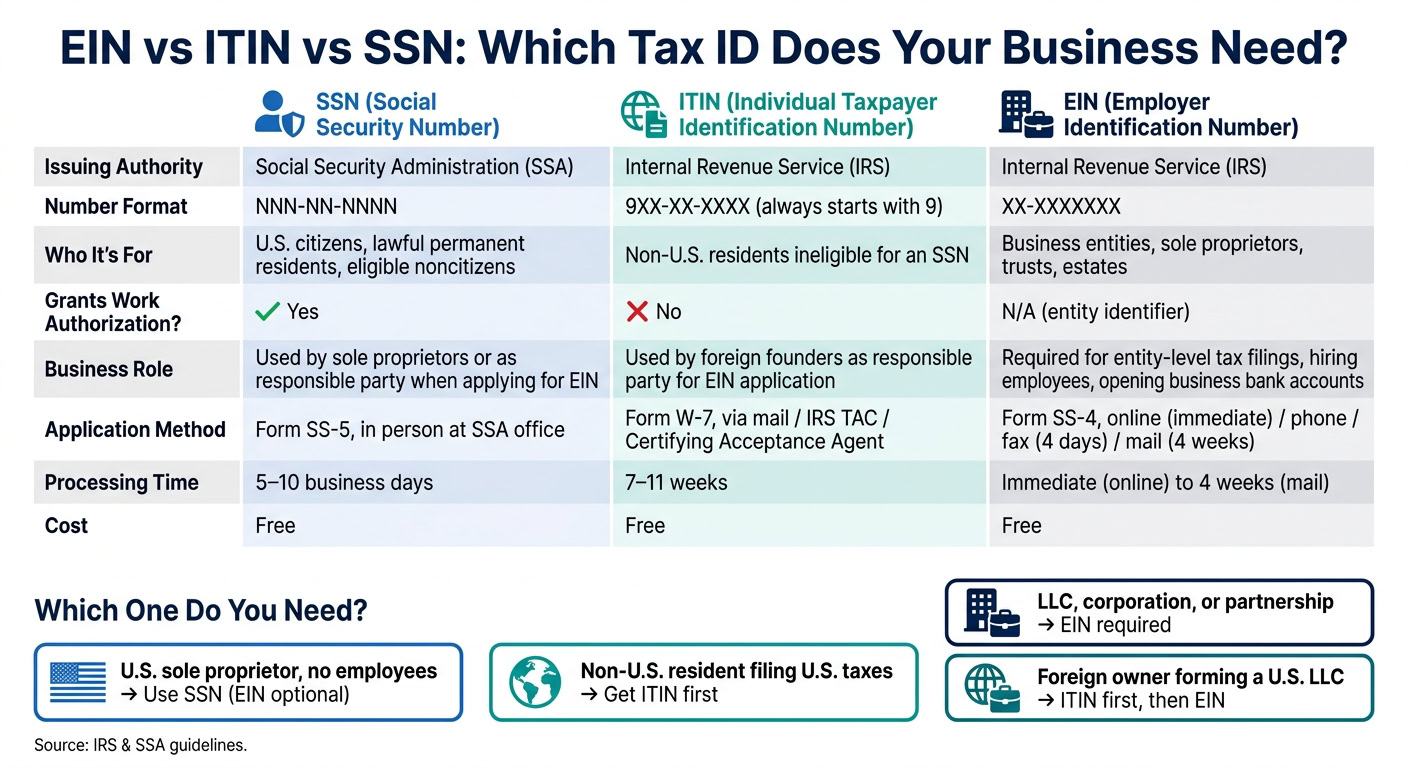
Each of these three IDs serves a specific purpose, and using them incorrectly can lead to IRS issues. Here’s a straightforward comparison to clarify their roles:
| Feature | SSN | ITIN | EIN |
|---|---|---|---|
| Issuing Authority | Social Security Administration (SSA) | Internal Revenue Service (IRS) | Internal Revenue Service (IRS) |
| Primary Holder | U.S. citizens and authorized residents | Non-residents or individuals not eligible for an SSN | Business entities, sole proprietors, trusts, and estates |
| Work Authorization | Yes | No | N/A – identifies the entity, not a person |
| Business Role | Used by sole proprietors or as the "responsible party" when applying for an EIN | Used by foreign founders as the "responsible party" for an EIN | Required for entity-level tax filings, hiring employees, and opening business bank accounts |
| Cost | Free | Free | Free |
The IRS emphasizes the importance of using these IDs correctly:
"An EIN is for use in connection with your business activities only. Don’t use your EIN in place of your social security number (SSN) or individual taxpayer identification number (ITIN)." – Internal Revenue Service
Next, let’s explore scenarios to help you identify which ID best suits your business needs.
How to Choose the Right ID for Your Business
The type of ID you need depends on your business structure and residency status. In some cases, you might even need more than one. Here are some common scenarios:
- U.S. citizen running a solo business with no employees: Sole proprietors can use their SSN, but getting an EIN can offer extra privacy.
- U.S. business owner with employees or an LLC/corporation: An EIN is mandatory. Businesses must file taxes under their EIN, separate from personal returns.
- Non-U.S. founder forming a U.S. LLC: You’ll need an ITIN to act as the "responsible party" when applying for an EIN. The ITIN handles your personal tax obligations, while the EIN is tied to the business.
The bottom line? An SSN or ITIN is tied to you personally, while an EIN is strictly for your business. Each serves a different function, and they can’t be used interchangeably.
Common Mistakes to Avoid
Misusing these IDs can lead to costly errors. Here’s what to watch out for:
- Using an SSN for entity filings: If your business is an LLC, corporation, or partnership, you must file taxes under an EIN – not your personal SSN. Using an SSN can delay processing and prompt IRS notices.
- Assuming an ITIN allows work authorization: An ITIN is purely for federal tax reporting and does not grant permission to work in the U.S.. It also doesn’t qualify the holder for Social Security benefits or the Earned Income Tax Credit (EITC).
- Opening a business bank account without an EIN: Most U.S. banks require an EIN to open a business account. Make sure your EIN is confirmed before attempting to set one up. Also, if the "responsible party" for your business changes after the EIN is issued, you must notify the IRS by filing Form 8822-B within 60 days.
Understanding these distinctions can save you from unnecessary complications and keep your business running smoothly.
How BusinessAnywhere Helps You Get Your US Tax ID
For non-US residents, getting a tax ID can feel like navigating a maze. The IRS online EIN Assistant is only accessible to applicants with an SSN or ITIN and a principal place of business in the US. If you don’t have an SSN or ITIN, your only options are to apply via phone, fax, or mail – each of which can mean long hold times or waiting up to 8 weeks for a mailed response. Luckily, there’s a way to skip the hassle.
BusinessAnywhere makes the entire process simpler. For a flat fee of $97, they handle everything: preparing and submitting Form SS-4 using your foreign identification documents, acting as your authorized IRS representative, and managing the EIN confirmation process. Plus, you don’t need an SSN or ITIN to use their service.
But BusinessAnywhere doesn’t stop at just EIN applications. They recommend forming your LLC or corporation with the state first. Why? Because the IRS requires the details on your EIN application to match your approved state filing exactly. BusinessAnywhere even uses their registered agent address on your application, ensuring all IRS correspondence – like the official confirmation letter (CP 575) – goes to a reliable US address instead of getting lost in international mail. This approach not only speeds up the process but also helps maintain a clear separation between your personal and business finances.
In addition to EIN services, BusinessAnywhere offers tools to help you build a professional presence in the US. For example, their virtual mailbox starts at $20/month (billed annually), providing your business with a legitimate US address. They also provide ongoing compliance support, including annual report filings and US LLC tax filings for $700. This service covers Form 5472 and the pro-forma Form 1120, which are mandatory for foreign-owned single-member LLCs. Missing this filing can result in a $25,000 IRS penalty, even if your LLC earns no revenue.
Everything BusinessAnywhere offers – from company registration to EIN applications and compliance services – can be done entirely online, meaning international founders can launch a fully compliant US business without ever stepping foot in the country.
Conclusion: Picking the Right Tax ID for Your Business
The tax ID you choose hinges on your business structure and personal status. If you’re a U.S. citizen or resident operating as a sole proprietor, your Social Security Number (SSN) might suffice. However, as soon as you hire employees, open a business bank account, or want to separate personal and business finances, an Employer Identification Number (EIN) becomes the smarter option. For non-U.S. residents who need to file U.S. taxes but aren’t eligible for an SSN, obtaining an Individual Taxpayer Identification Number (ITIN) is essential – often as a precursor to applying for an EIN as the responsible party on Form SS-4. Additionally, LLCs, corporations, and partnerships are required to have an EIN to operate, hire, and open bank accounts in the United States.
Using the wrong tax ID can lead to IRS processing delays, misplaced tax payments, and costly compliance problems.
Quick Reference: Which ID Fits Your Situation?
| Your Situation | ID You Need |
|---|---|
| U.S. citizen, sole proprietor, no employees | SSN (EIN optional but recommended) |
| Non-U.S. resident filing U.S. taxes | ITIN |
| Any LLC, corporation, or partnership | EIN |
| Foreign owner applying for an EIN | ITIN first, then EIN |
These guidelines simplify the process of selecting the right tax ID, ensuring compliance and clarity. An EIN helps keep personal and business finances separate, while an ITIN is crucial for foreign entrepreneurs filing U.S. taxes.
If you’re a non-U.S. resident starting a business in the United States, services like BusinessAnywhere can make the process much easier. For $97, they’ll prepare and submit Form SS-4 on your behalf, act as your IRS representative, and manage the confirmation process – eliminating the need for you to provide an SSN or ITIN. They also offer a U.S. LLC tax filing service for $700, which includes mandatory filings like Form 5472 and pro-forma Form 1120 for foreign-owned LLCs. By taking these steps, you’ll ensure your business meets IRS requirements while safeguarding your personal information.
FAQs
Can I get an EIN without an SSN or ITIN?
Yes, non-residents can get an EIN without having a Social Security Number (SSN) or an Individual Taxpayer Identification Number (ITIN). To do this, they need to file Form SS-4. The form can be submitted via phone, fax, or mail. If you don’t have a U.S. tax ID, simply write "foreign" or "N/A" in Box 7b of the form. This process makes it possible for non-residents to obtain an EIN even if they don’t have an SSN or ITIN.
Do I need both an ITIN and an EIN as a non-U.S. founder?
Non-U.S. founders might need both an EIN and an ITIN, but this depends on their circumstances. An EIN (Employer Identification Number) is essential for business-related activities like opening a bank account, filing taxes, or hiring employees. On the other hand, an ITIN (Individual Taxpayer Identification Number) is used for personal tax filings or claiming treaty benefits if you’re not eligible for a Social Security Number (SSN). If your situation involves both running a business and filing personal taxes, you’ll probably need both identifiers.
When should a sole proprietor switch from using an SSN to an EIN?
A sole proprietor should consider switching to an Employer Identification Number (EIN) when specific circumstances arise. These include hiring employees, setting up certain retirement plans, filing excise tax returns, or choosing to be taxed as a corporation. In most other cases, sole proprietors can continue using their Social Security Number (SSN) for business-related activities.