


If you’re a non-U.S. resident looking to start a business in the United States, forming an LLC (Limited Liability Company) is a straightforward way to get started. Here’s how:
- Why Form a U.S. LLC?
Gain access to U.S. payment processors, bank accounts, and a large consumer market. An LLC also offers personal asset protection and tax advantages. - Key Steps to Form an LLC Online:
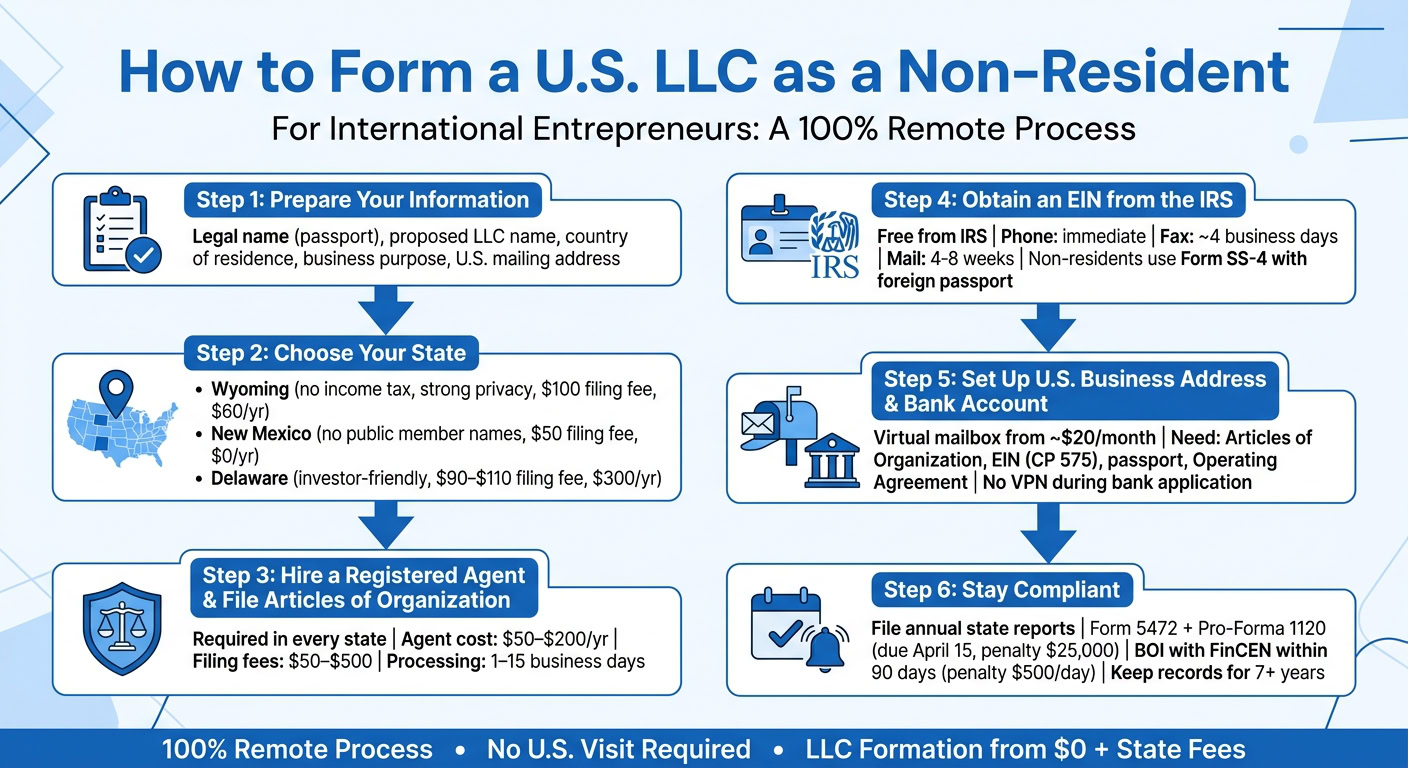
- Choose a state (Wyoming and New Mexico are popular for privacy and low fees).
- Hire a registered agent (required for receiving legal documents).
- File your LLC formation documents (Articles of Organization) and pay state fees.
- Obtain an EIN (Employer Identification Number) from the IRS.
- Set up a U.S. business address and open a bank account remotely.
- Important Compliance Requirements:
File annual reports, pay state fees, and meet federal reporting obligations like Form 5472 to avoid penalties.
Services like BusinessAnywhere can simplify the process, offering LLC formation, EIN applications, and compliance support. Starting a U.S. LLC as a foreign entrepreneur is entirely possible and can be done without stepping foot in the U.S.
How to Prepare Before Filing Your LLC
Who Can Form a U.S. LLC
You don’t need to be a U.S. citizen or resident to form an LLC. As Stripe explains:
“The flexibility and protection offered by an LLC makes it a popular choice for non-residents. There’s no requirement for members to be US citizens or residents.”
This means most foreign nationals are eligible to form an LLC. However, there are a couple of key restrictions to keep in mind. First, S-Corporations are not an option for non-resident aliens – your choices are limited to LLCs and C-Corporations. Second, a sole proprietorship is usually not feasible since it often requires the owner to physically operate within the U.S., which can clash with visa or work permit requirements.
Define Your Business Model First
Before filing, take time to clarify your business purpose and revenue model.
For non-U.S. owners, it’s crucial to determine whether your income will be sourced from the U.S. or abroad. This decision impacts your tax obligations and the overall structure of your business.
Your funding plans also play a role. For freelancers, consultants, or e-commerce sellers, an LLC is often the best choice due to its simplicity. On the other hand, if you’re launching a startup and plan to seek venture capital, forming a C-Corporation in Delaware is typically the go-to option. For most international online businesses, an LLC strikes the right balance between ease and tax efficiency.
Privacy might also influence your decision. If maintaining anonymity is important – for example, in competitive industries – states like Wyoming allow “anonymous” LLCs, where member names are kept out of public records.
Information You Need to Have Ready
Once you’ve outlined your business model, gather the following details to streamline the filing process:
- Legal name (as it appears on your passport)
- Proposed LLC name (plus a few alternatives in case your first choice is unavailable)
- Country of residence and passport information
- Business purpose (a brief description)
- A U.S. mailing address
If securing a U.S. mailing address feels daunting, don’t worry – you don’t need to lease office space. A virtual mailbox is a practical solution. Services like BusinessAnywhere’s virtual mailbox provide a real U.S. street address that can be used for state filings, IRS communication, and banking, all managed remotely.
Additionally, draft a simple Operating Agreement. Many banks and payment processors require this document when setting up accounts.
With these preparations complete, you’ll be ready to choose your state and registered agent to officially form your LLC.
Choosing a State and Registered Agent
How to Pick the Right State
When setting up an LLC in the U.S., international entrepreneurs often wonder which top states for LLC formation are the best fit. For online businesses without a physical presence in the U.S., Wyoming and New Mexico stand out. Wyoming is appealing because it has no state income tax, low annual fees, and strong privacy protections. If privacy is your top priority, New Mexico is a great choice since it doesn’t require member names to be listed publicly.
If you’re planning to attract U.S. investors, Delaware might be your best bet. Its legal framework is especially popular among venture capitalists. As Stripe explains:
“If you’re looking for investor-friendly laws and legal protections, Delaware might be the better option.”
However, some states are less favorable for LLC formation. For example, California imposes a mandatory $800 annual franchise tax on all LLCs, even if the business is inactive. Similarly, in Florida, the annual report fee is $138.75, but late filings can cost you significantly more – up to $538.74.
| State | Best For | Key Advantage |
|---|---|---|
| Wyoming | Online/lean businesses | No income tax, strong privacy |
| New Mexico | Privacy-focused owners | No public member names, low maintenance |
| Delaware | Investor-backed startups | Preferred by U.S. venture capital |
| Nevada | Privacy-focused businesses | Strong asset protection laws |
Once you’ve picked your state, the next step is to secure a reliable registered agent to handle your filings.
What a Registered Agent Does and Why You Need One
Every LLC in the U.S. is required to have a registered agent. This is an individual or company with a physical address in your state of formation who is available during regular business hours to receive legal and government documents. Their main responsibility is to accept service of process, including lawsuits, subpoenas, and official notices. Attorney Sergei Tokmakov highlights the importance of this role:
“If your company is sued in the US and you do not have a valid registered agent, you may not receive notice of the lawsuit. Courts can enter a default judgment against your company without you ever knowing about the case.”
For international entrepreneurs, hiring a commercial registered agent service is essential since they lack a U.S. address and fixed business hours. These services typically cost between $50 and $200 per year. However, it’s important to note that you shouldn’t use your registered agent’s address on bank applications, as banks may reject accounts associated with such addresses.
How BusinessAnywhere Handles State Filing and Agent Services
Once you’ve chosen your state and registered agent, BusinessAnywhere simplifies the entire process. Their integrated solution combines LLC formation with registered agent services, helping international founders navigate the complexities of U.S. business registration. When you register your LLC through BusinessAnywhere, the first year of registered agent service is included at no extra cost, with an annual renewal fee of $147 thereafter.
BusinessAnywhere ensures your LLC stays compliant from day one. They provide a physical address in your chosen state, manage incoming legal and government correspondence, and notify you promptly of any important documents. If you need to update your registered agent information with state agencies, BusinessAnywhere handles that, too, making the process as seamless as possible.
How to File Your LLC Formation Documents
Check and Reserve Your LLC Name
Before you can officially file for your LLC, you’ll need to make sure your chosen business name is available. Each state has an online database to help you check for existing registrations. For example:
- Wyoming: Visit wyobiz.wy.gov
- New Mexico: Use www.sos.nm.gov
- Delaware: Go to icis.corp.delaware.gov
Your LLC name has to be unique within the state and must include a designator like “LLC”, “L.L.C.”, or “Limited Liability Company.” Some words, like “Bank”, “Insurance”, or “University”, are restricted and require special licensing. To avoid delays, it’s a good idea to prepare three potential name options and confirm availability. Once you’ve settled on a name, don’t forget to reserve the corresponding domain for your website.
If you’re not quite ready to file your LLC paperwork, some states allow you to reserve your name for a limited time – usually 30 to 120 days – for a fee ranging from $10 to $50. This ensures no one else can claim your name while you finalize your plans.
Once your name is secured, you’re ready to move forward with filing your Articles of Organization.
Submit Your Articles of Organization
The Articles of Organization (sometimes called a Certificate of Formation) is the key document that establishes your LLC as a legal entity. This form typically requires the following information:
- Your LLC’s name
- Business address
- Details about your registered agent
- Management structure (whether it’s member-managed or manager-managed)
For the business purpose section, it’s smart to use a broad statement like “to engage in any lawful business activity.” This keeps your options open and avoids unintentionally restricting your company’s future activities.
Filing fees vary by state, ranging from $50 to $500. For example, New Mexico charges around $50, Wyoming’s fee is about $100, and Delaware’s fee is $110. Filing online is usually the quickest option, with instant confirmation once your submission is processed.
If navigating state websites feels overwhelming, services like BusinessAnywhere can handle the filing for you. Their packages start at $0 plus state fees, and they even include the first year of registered agent service for free.
After submitting your Articles of Organization, the next step is to pay the associated state fees and monitor your filing status.
Pay State Fees and Track Your Filing
Once you’ve submitted your documents online, you’ll need to pay the filing fee using a credit or debit card. After payment, you’ll receive a confirmation number, which you can use to track the status of your filing on the Secretary of State’s website.
Standard processing times range from 1 to 15 business days, depending on the state. If you’re in a rush, many states offer expedited processing – sometimes as quick as 24 hours – for an additional fee. Once your LLC is approved, you’ll receive a stamped copy of your Articles of Organization. Keep this document in a safe place; you’ll need it to apply for an EIN and to open a U.S. business bank account.
Here’s a quick comparison of filing fees, processing times, and annual fees for a few states:
| State | Initial Filing Fee | Processing Time | Annual Fee |
|---|---|---|---|
| Wyoming | ~$100 | 1–3 business days | $60 |
| New Mexico | ~$50 | 1–5 business days | $0 |
| Delaware | $110 | 1–3 business days | $400 |
| Florida | $125 | 3–5 business days | $138.75 |
sbb-itb-ba0a4be
Setting Up Your U.S. Business After Formation
Once your LLC is formed, there are a few essential steps to get your U.S. business up and running. After receiving your LLC approval, focus on these three tasks: securing an EIN, setting up a U.S. business address, and opening a bank account.
Get an EIN From the IRS
An Employer Identification Number (EIN) is a nine-digit number assigned by the IRS, acting like a Social Security Number for your business. It’s required for opening bank accounts, hiring employees, and filing taxes. The IRS provides EINs free of charge.
For non-U.S. residents, the online application is only available to those with a U.S. Social Security Number or ITIN. If that’s not an option, you can apply through phone, fax, or mail:
| Method | Timeline | Notes |
|---|---|---|
| Phone (+1 267-941-1099) | Immediate | EIN is issued during the call |
| Fax (+1 304-707-9471) | ~4 business days | A quick alternative without needing a live call |
| 4–8 weeks | Suitable only if timing isn’t a concern |
The application requires Form SS-4, which includes details like your LLC’s legal name, entity type, and the “responsible party” (the individual managing the business funds). Non-residents can use their foreign passport number as an identifier.
Once processed, the IRS sends a CP 575 confirmation letter to the address on your application. Keep this letter handy – it’s a key document for opening a bank account.
If you want to simplify the process, BusinessAnywhere’s EIN Application Service offers assistance for $97, covering form preparation, submission, and follow-up.
With your EIN in hand, the next step is securing a U.S. business address to ensure smooth operations and compliance.
Set Up a U.S. Business Address
A U.S. street address is a must for banking and payment processor requirements. P.O. Boxes won’t suffice – you’ll need a legitimate street address, which is often provided through a virtual mailbox or Commercial Mail Receiving Agency (CMRA).
It’s important to note that your registered agent address is not the same as your business address. Banks usually flag registered agent addresses on account applications.
“Banks: Need a physical street address, not a P.O. Box. Credit Cards: Will mail your physical card here. You then pay the service to forward it to your home country.” – Foreign Founder Team
To meet this requirement, consider how a virtual mailbox works to meet this requirement. BusinessAnywhere’s Virtual Mailbox provides a U.S. street address, unlimited mail scanning, and worldwide forwarding, starting at $20/month (billed annually).
Open a U.S. Business Bank Account
Traditional banks often require an SSN, utility bills, and even an in-person visit, which can be challenging for international founders. Thankfully, fintech platforms now allow non-residents to open U.S. business accounts remotely using biometric verification.
Typically, you’ll need these four documents to apply:
- Approved Articles of Organization
- EIN confirmation letter (CP 575 or 147C)
- Valid passport
- Operating Agreement
Avoid using a VPN during the application process – it could trigger fraud alerts.
“The phrase ‘opening a US bank account’ usually involved a long-haul flight, a stack of confusing paperwork, and a high chance of rejection at the bank teller’s window. But it’s 2025. You shouldn’t have to cross an ocean just to get a routing number.” – Hurupay
To streamline this process, BusinessAnywhere’s bank account setup assistance connects you with remote-friendly banking partners and ensures all required documents, including your U.S. address and EIN, are in order before you apply. Completing these steps will set your business up for seamless entry into the U.S. market.
Staying Compliant After Your LLC Is Formed
Forming an LLC is just the first step. As Vincenzo Villamena, CEO of Entity Inc., explains:
“Opening an LLC is just the start. Tax and other compliance requirements must be met to keep the company open.”
Missing deadlines can lead to penalties that might cost more than forming the LLC itself. Below, we’ll break down the key areas of compliance you need to focus on.
State Compliance Requirements
To keep your LLC in Good Standing, most states require specific actions like filing annual reports, paying franchise taxes, and maintaining a registered agent.
Annual reports are usually due on the anniversary of your LLC’s formation, not a fixed calendar date. Costs vary widely by state – for example, Wyoming charges about $60/year, while Delaware’s combined annual report and franchise tax cost at least $400/year. Interestingly, New Mexico is one of the few states with no annual report requirement.
It’s also critical to keep your registered agent active. If your agent’s address becomes invalid or you fail to maintain one, your LLC could face administrative dissolution.
For peace of mind, services like BusinessAnywhere’s Registered Agent Service handle this for you. Starting at $147/year, they also send compliance alerts to ensure you never miss a deadline.
Federal Tax and Reporting Requirements for Non-U.S. Owners
Federal reporting is a must, even if your LLC doesn’t owe income tax. This is a common pitfall for foreign founders. Your LLC might owe zero U.S. federal income tax, but you could still face mandatory reporting requirements.
“Filing obligations and tax obligations are separate questions. A non-resident-owned LLC with zero US-source income may owe $0 in federal tax but still face mandatory information reporting requirements with five-figure penalties for non-compliance.” – David Stancel
Whether you have a Single-Member or Multi-Member LLC determines your filing requirements:
| Filing Requirement | Entity Type | Deadline | Penalty for Non-Compliance |
|---|---|---|---|
| Form 5472 + Pro-Forma 1120 | Single-Member LLC | April 15 | $25,000 per form |
| Form 1065 + K-1/K-2/K-3 | Multi-Member LLC | March 15 | $260/month per partner |
Even something as simple as a capital contribution counts as a “reportable transaction” on Form 5472. To avoid penalties, you can file Form 7004 by the original deadline, giving you an automatic 6-month extension.
For hassle-free compliance, BusinessAnywhere’s U.S. LLC Tax Filing service handles Form 5472 and the pro-forma Form 1120 for $700, with an optional EIN add-on for $97.
Keep Your LLC Records Organized
Good recordkeeping is more than just staying tidy – it’s essential for maintaining your LLC’s limited liability protection and ensuring smooth operations. Make sure you keep permanent digital copies of these key documents:
| Document | Purpose |
|---|---|
| Articles of Organization | Verifies your LLC’s legal existence |
| EIN Confirmation (CP 575) | Needed for banking and tax filings |
| Operating Agreement | Details ownership and internal rules |
| Filed Annual Reports | Confirms Good Standing with the state |
| Form 5472/1120 | Federal compliance; keep for at least 7 years |
Keeping your records up-to-date also helps protect your LLC’s legal status. For instance, update your Operating Agreement whenever there are changes in ownership, management, or profit-sharing. If your LLC becomes inactive, formally dissolve it with the state and IRS to avoid unnecessary fees and penalties.
To simplify this process, BusinessAnywhere’s document management dashboard allows you to store and access all your formation documents, compliance filings, and correspondence from anywhere in the world.
Conclusion
Forming a U.S. LLC as an international founder has become a straightforward process. In 2023, U.S. business applications reached record highs, with international entrepreneurs increasingly attracted to the credibility, banking options, and legal protections that a U.S. LLC provides.
By following the steps outlined earlier – choosing a state, appointing a registered agent, filing formation documents, obtaining an EIN, setting up a U.S. address and bank account, and ensuring compliance – you can establish your LLC successfully. Skipping any of these steps could result in unnecessary and expensive complications.
Compliance is non-negotiable. New LLCs must meet strict deadlines, including filing state annual reports and federal requirements like Form 5472 and Beneficial Ownership Information (BOI) with FinCEN within 90 days of formation. Failure to file Form 5472 can result in a minimum IRS penalty of $25,000, while BOI filing delays incur fines of $500 per day.
Navigating these requirements can feel overwhelming, but services like BusinessAnywhere simplify the process. They offer $0 LLC formation (plus state fees), registered agent services starting at $147/year, EIN applications for $97, and full U.S. tax filing support for $700 – making it possible to handle everything remotely.
With the help of an efficient online platform, international founders can oversee every aspect of forming a U.S. LLC without being physically present.
“A US-registered entity signals legitimacy to customers, partners, and investors.” – Beancount.io
This approach ensures your business gains the credibility needed to thrive in the U.S. market.
FAQs
Do I need to travel to the U.S. to form an LLC and open a bank account?
No, you don’t have to travel to the U.S. to start an LLC or open a bank account. Entrepreneurs from other countries can handle everything online. The process involves choosing a state, hiring a registered agent, filing the necessary paperwork, getting an EIN, and setting up a U.S. bank account. Thanks to online banking and fintech services, this can all be done remotely without needing to be physically present.
Will I owe U.S. taxes if my LLC earns money outside the U.S.?
Yes, you might have to pay U.S. taxes if your LLC is classified as a U.S. tax resident or earns income from U.S. sources. Additionally, certain filing requirements may apply, such as Form 5472 and Form 1120, particularly if the LLC is foreign-owned or engages in transactions with foreign entities.
What filings can get non-U.S. owners fined even if the LLC makes no money?
Non-U.S. owners of LLCs should be aware that failing to file required federal forms, like Form 5472 and Form 1065, can lead to hefty fines – even if the LLC doesn’t generate any income. For instance, late filing of Form 5472 can result in a $25,000 penalty. Similarly, missing the deadline for Form 1065 could cost $260 per month, per partner. These penalties can add up quickly, making timely compliance essential.