


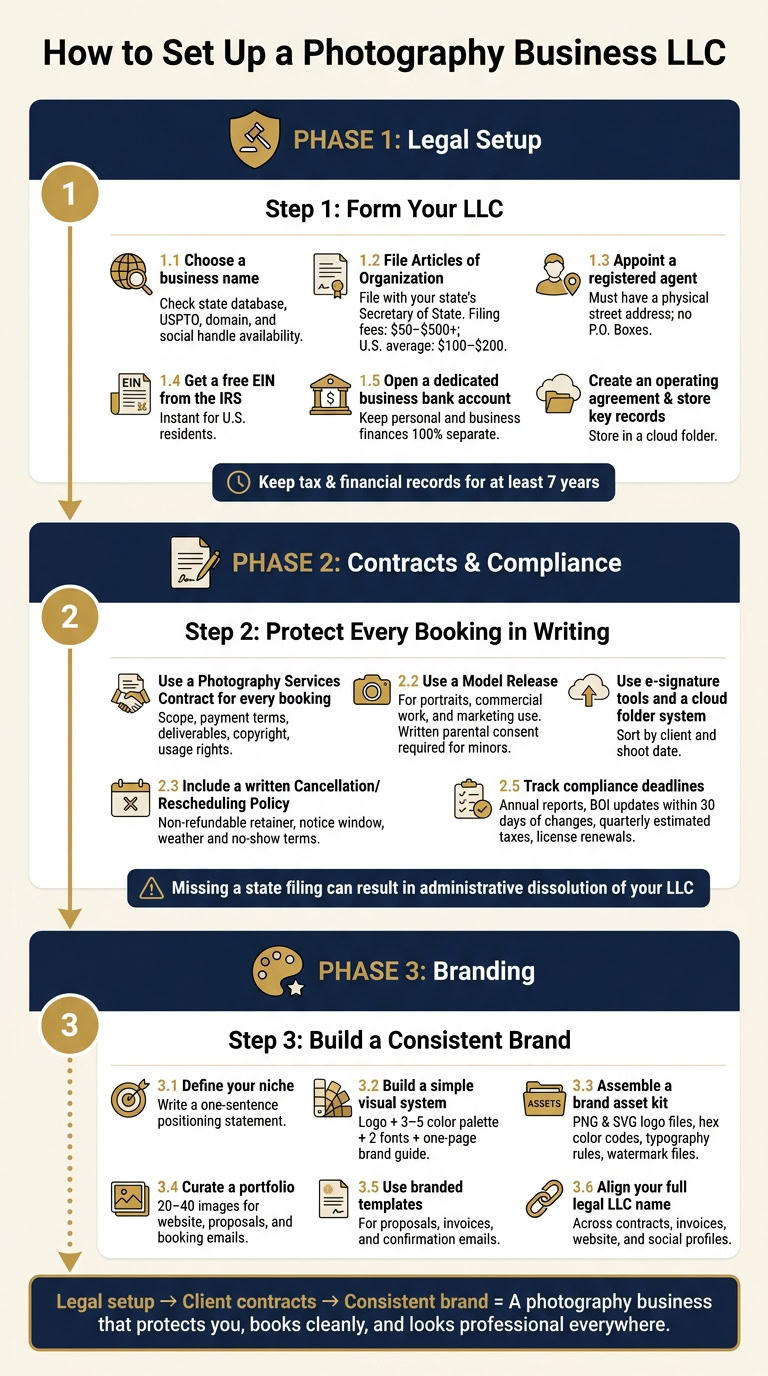
If I want my photography business to look legit and protect my personal money, I need three things in this order: an LLC, client contracts, and a clear brand.
Here’s the short version:
- I form the LLC and file with my state
- I get an EIN from the IRS
- I open a business bank account and stop mixing personal and business spending
- I keep records and track annual state filings
- I use written contracts, model releases, and cancellation terms for every booking
- I make sure my legal name, invoices, website, and social profiles match
That order matters. If I skip the setup and jump straight to logos or Instagram, I’m building on a messy base.
A few numbers stand out:
- LLC filing fees often run from $50 to $500+
- Many states fall around $100 to $200
- Tax and financial records should usually be kept for at least 7 years
- Brand kits can stay simple with 3–5 colors and a portfolio of 20–40 images
What this comes down to is simple: I need to separate the business from my personal life, put every job in writing, and make the business look the same everywhere a client sees it.
If I do those three things, bookings are easier to manage, records are cleaner, and problems are less likely to turn into bigger ones.
Choose the Right Legal Structure and Form Your Photography LLC
Once your photography business starts taking on regular sessions, weddings, events, studio rentals, pricey gear, or assistants, an LLC can put a legal line between the business and your personal assets. It does add filing and compliance work. But for photographers, it gives you a cleaner setup and better liability separation.
Pick a Business Name and Check State Availability
Start with the name. Then file.
Your LLC name must include "Limited Liability Company", "LLC", or another state-approved abbreviation, and it has to be different from other registered businesses in your state. Most photographers go one of two ways:
- A personal-name brand, which often fits portrait and wedding work where clients are hiring you
- A studio name, which gives you more room if you want to grow or bring in other photographers
Before filing, do a few checks first. Search your state’s Secretary of State business database to make sure the name is open, look through the USPTO trademark database to avoid infringement issues, and see whether the matching domain and Instagram handle are still available.
File the LLC and Appoint a Registered Agent
To form your LLC, you’ll file Articles of Organization with your state’s Secretary of State office and pay the state filing fee. Fees usually run from $50 to more than $500, with a U.S. average of about $100 to $200.
Every LLC also needs a registered agent with a physical street address in the state where the LLC is formed, and that person or service must be available during business hours to receive legal documents. A P.O. Box doesn’t count. A lot of photographers use a registered agent service so their home address stays off public records. BusinessAnywhere offers registered agent service for $147 per year and manages it in one dashboard along with LLC formation.
Get an EIN, Open a Business Bank Account, and Separate Your Finances
After your LLC is filed, get an EIN and open a bank account just for the business.
An EIN is your business’s federal tax ID. You’ll need it to open a business bank account, pay assistants, and handle tax filings. If you apply through the IRS website yourself, it’s free and usually instant for U.S. residents. BusinessAnywhere also includes EIN application help as part of the formation process.
A separate business bank account isn’t optional in practice. If you mix personal and business spending, you can weaken your LLC’s liability shield. Keep things separate from the start. It helps protect the LLC and makes bookkeeping a whole lot less messy. BusinessAnywhere also offers document templates, including an operating agreement and banking resolution, to help with account setup and recordkeeping.
Once the LLC and bank account are set up, the next move is handling the internal documents and compliance records that keep the business in good standing.
sbb-itb-ba0a4be
Set Up the Internal Documents and Compliance Basics Your LLC Needs
Once your LLC and bank account are set, the next step is simple: write down how the business works and how you’ll keep it in good standing.
Create an Operating Agreement and Core Internal Records
An operating agreement lays out ownership, profit splits, management, and exit terms for your photography LLC. It is a core internal document for your photography LLC. If you’re a solo photographer, it also helps show that the LLC is separate from you as a person, which supports liability protection.
It also helps to keep banking resolutions, member resolutions, and other key records in one cloud folder so they’re easy to find. That matters even more when you’re traveling for shoots or handling things from your phone.
Tax and financial records should be kept for at least seven years.
With those records in place, the next job is keeping up with state and federal filings.
Track Annual Reports, BOI Updates, and Business Address and Mail Handling
Use the checklist below to stay on top of the filings and records that keep your LLC in good standing. These are the items that help your studio run smoothly between shoots.
| Compliance Task | Purpose | Usual Timing | Typical Handler |
|---|---|---|---|
| Annual or Biennial Report | Maintains good standing with the state | Anniversary of formation or calendar year | Owner or Service Provider |
| BOI Reporting/Updates | Tracks ownership changes required by FinCEN | Within 30 days of any ownership or detail change | Owner or Service Provider |
| Registered Agent Renewal | Ensures legal documents are received | Annually | Service Provider |
| Franchise Tax/State Fees | State-level tax for doing business | Varies by state (often annual) | Owner |
| Estimated Tax Payments | Avoids underpayment penalties | Quarterly | Owner or CPA |
| License/Permit Renewals | Legal right to operate locally | Varies (usually annual) | Owner |
Annual report fees vary a lot by state, from $0 in some states to more than $800 in others. Miss one of these filings and your LLC can be administratively dissolved, which means it loses legal standing until you fix the issue.
If ownership details or member addresses change, you have 30 days to update that information with FinCEN. BusinessAnywhere offers compliance alerts and BOI reporting support to help keep those deadlines from slipping.
You can also use a virtual mailbox to get a public business address and mail forwarding without putting your home address out there.
The Contracts and Policies That Keep Client Work Running Smoothly
Your LLC helps protect your personal assets. But when it comes to day-to-day client work, paperwork is what keeps things clear.
Every booking should have a written record that spells out what you’re delivering, when you’ll be paid, and how image rights work. That simple step can help you avoid disputes, late payments, and crossed wires.
Keep these three documents ready for every booking:
| Document | Purpose | When to Use | Key Clauses |
|---|---|---|---|
| Photography Services Contract | Defines scope, payment, and deliverables | Every booking | Session date/time, package details, retainer, due dates, delivery timeline, usage rights, copyright |
| Model Release | Grants permission to use someone’s likeness | Portraits, commercial work, and marketing use | Scope of use, parental consent for minors |
| Cancellation/Rescheduling Policy | Sets terms for cancellations, no-shows, and weather | All bookings with reserved dates | Non-refundable retainer, notice window, rescheduling limits, weather contingencies, no-show terms |
Build a Photography Services Contract That Covers Payment, Deliverables, and Copyright
Once your LLC is active, these documents turn it from a legal setup into an actual client system.
Your photography contract should lay out the scope, payment terms, deliverables, and image rights before the shoot happens. At a minimum, include both parties, session details, payment terms, deliverables, delivery timeline, editing scope, and image rights.
In the U.S., the photographer usually keeps copyright and gives the client a written license for personal use – or for a defined commercial use if that’s part of the deal. Putting that in writing helps stop confusion about where and how the images can be used.
Add a Model Release and a Written Cancellation or Rescheduling Policy
A model release is the document you’ll use when you plan to use someone’s likeness for marketing or commercial use. If the subject is a minor, parental or guardian consent must be in writing. For portrait clients, this also helps protect portfolio use if a client later objects.
You’ll also want a written cancellation or rescheduling policy. It should cover retainers, rescheduling windows, weather, and no-shows. A non-refundable retainer holds the date and pays you for time you may have turned away from other clients. Written policies can cut down on disputes and chargebacks.
After that, the next step is to make the client process the same every time – sign, pay, file, done.
Standardize Signing, Invoicing, and Recordkeeping
An e-signature tool lets clients sign contracts from anywhere, sends signed copies to both parties, and creates a timestamped record. For invoicing, a billing platform can connect payment milestones to project stages and track expenses.
Store signed contracts, releases, invoices, and notices in one cloud folder sorted by client and shoot date. Use a document system that keeps contracts, releases, invoices, and official notices together, so you’re not digging through email when you need something fast.
Build a Clear Brand That Matches Your LLC and Client Experience
Once your legal setup and client paperwork are in place, branding is what makes the business feel polished. Your legal name, visuals, and client-facing documents should line up. If someone finds you on Instagram, signs a contract, and later gets a gallery, it should all feel like the same business from start to finish.
Define Your Positioning, Ideal Client, and Visual Identity
Choose one main client type and shape your message around what they want to fix, reach, or create. Then write a simple positioning statement that names your ideal client, their main goal, and what sets your approach apart. Use that statement as your guide for website copy, social bios, contract language, and email confirmations.
Once you know your niche, turn it into a simple visual system. You do not need a huge brand package. A logo, a color palette with 3–5 colors, two fonts, and a one-page brand guide with basic usage rules are enough to keep your materials consistent across the board.
Create a Portfolio, Brand Asset Kit, and Branded Client Documents
Use the same system at each client touchpoint. At a minimum, your brand asset kit should include logo files in PNG and SVG formats, your color palette with hex codes, typography rules, watermark files, a curated portfolio of 20–40 images, and branded templates for proposals, invoices, and confirmation emails.
| Brand Asset | Where It’s Used |
|---|---|
| Logo | Website header, contracts, invoices, email signature |
| Color palette | Website, gallery interface, PDFs, social graphics |
| Fonts | Contracts, invoices, client guides, website |
| Watermark | Proofing galleries, social media previews |
| Portfolio | Website gallery, proposals, booking emails |
| Invoice template | Payment requests, billing emails, payment reminders |
Your full legal LLC name should appear on contracts, invoices, and formal emails, even if your public brand uses a shorter version in your logo or social handle. When your legal name, contract, and public brand line up, the business feels more dependable. Carry that same branding into contracts, invoices, galleries, and email so each client interaction feels connected.
Conclusion: The Setup, Contract, and Branding Steps to Take First
Start with the legal basics. Pick an available business name, file your Articles of Organization, get an EIN, and open a separate business bank account. Once the entity is set up, move straight into banking and recordkeeping.
Then spell out how the business operates with an operating agreement, and keep a compliance calendar for annual reports, taxes, and state filings. When the back end is in order, put every booking on paper.
Next, standardize your client documents and line up your public brand with your legal name, domain, and social profiles. After the paperwork is set, make sure the brand matches the way you deliver the work.
The result is a photography business that protects you, books cleanly, and shows one clear brand from first inquiry to final gallery.
FAQs
Do I need an LLC to start booking clients?
No. You can start booking photography clients as a sole proprietorship.
But there’s a catch: you won’t get the liability protection that an LLC offers.
For many photographers, an LLC starts to make more sense once you’re actively working with clients, storing customer data, or taking on more financial risk. It can also help with long-term credibility, tax flexibility, and contracts with larger clients.
What should be in a photography contract?
Your photography contract should show your LLC’s legal identity, not your personal name. Sign it with your business title, such as "Your Name, Member of [LLC Name]," so there’s a clear line between your personal assets and your business liabilities.
Your contract should also list your LLC’s name and EIN. That legal setup can help support the corporate veil if a client dispute comes up.
Can I use a brand name different from my LLC name?
Yes. You can use a brand name that’s different from your LLC name by filing a DBA registration.
A DBA lets your business operate under an alias for marketing and client-facing use without creating a separate legal entity.
That said, you should still use your legal LLC name on official documents to help maintain liability protection. For example, contracts and invoices can be listed as "[Legal LLC Name] d/b/a [Trade Name]."