


If I expect to owe at least $1,000 in federal tax after withholding and credits, I usually need to pay the IRS during the year, not just at filing time.
Here’s the short version:
- LLC owners usually pay tax on profit, not draws
- Quarterly due dates are April 15, June 15, September 15, and January 15
- I need to estimate both income tax and self-employment tax
- Safe harbor rules can help me avoid underpayment penalties
- W-2 withholding can sometimes cover part or all of the gap
- Form 1040-ES, IRS Direct Pay, and EFTPS are the main tools
A few facts matter most:
- Self-employment tax is usually 15.3%
- The IRS often wants payments in 4 installments
- A common rule is to pay 90% of this year’s tax or 100% of last year’s tax
- For higher-income filers, that prior-year number can be 110%
In plain English: if my LLC makes money and no tax is being withheld, I need a plan to estimate, pay, and track taxes during the year.
This guide explains who has to pay, how I estimate the amount, which deadlines matter, and how I stay out of penalty trouble.
Who Must Make Quarterly Estimated Tax Payments
Most LLC owners need to make quarterly estimated tax payments when their business income creates tax that isn’t already covered by withholding or credits.
How LLC Profit and Owner Draws Create an Estimated Tax Requirement
For default LLCs taxed as sole proprietorships or partnerships, estimated tax is based on net profit. It is not based on how much money you take out of the business. In plain English, owner draws don’t change your tax bill.
When W-2 Withholding Can Reduce or Replace Estimated Payments
If you or your spouse has a W-2 job, there’s a useful workaround: you can increase federal withholding on that paycheck by updating Form W-4. That extra withholding can cut down – or even wipe out – the need for separate quarterly payments.
Here’s why that matters: the IRS treats withholding as if it was paid evenly throughout the year. So if you bump up withholding later in the year, it can help cover an earlier shortfall.
If there’s still a gap after withholding, safe harbor rules tell you how much you need to pay to avoid penalties.
Safe Harbor Rules That Lower Underpayment Penalty Risk
Even if you still owe money when you file, you may avoid underpayment penalties if you meet a safe harbor rule.
| Safe Harbor Category | Amount Needed to Avoid Penalty |
|---|---|
| Standard Rule | 90% of the current year’s total tax or 100% of the prior year’s tax |
| High-Income Rule (AGI > $150,000; $75,000 if married filing separately) | 90% of the current year’s total tax or 110% of the prior year’s tax |
| Low-Liability Rule | No estimated payments required if total tax due after withholding and credits is under $1,000 |
The prior-year safe harbor can be handy when your income is going up or feels hard to pin down. If you use that method, you can figure your quarterly payments by taking last year’s total tax and dividing it by four.
Once you know whether you owe estimated payments, the next step is to learn the deadlines and payment methods.
Quarterly Tax Deadlines, Forms, and Payment Methods
Standard IRS Due Dates for Quarterly Estimated Taxes
If estimated taxes apply to your LLC, the next job is keeping up with the due dates and picking a payment method to maximize your LLC tax benefits.
Estimated taxes are four prepayments for the current tax year. Later, you square them up on your tax return. The standard federal due dates are April 15, June 15, September 15, and January 15 of the following year. If one of those dates lands on a weekend or legal holiday, the due date shifts to the next business day.
| 2026 Payment | Income Period Covered | Federal Due Date |
|---|---|---|
| 1st Installment | Jan 1 – Mar 31 | April 15, 2026 |
| 2nd Installment | Apr 1 – May 31 | June 15, 2026 |
| 3rd Installment | Jun 1 – Aug 31 | September 15, 2026 |
| 4th Installment | Sep 1 – Dec 31 | January 15, 2027 |
One small IRS quirk: these quarters aren’t even. The second payment period covers just two months, while the fourth covers four.
How to Use Form 1040-ES to Calculate and Track Payments
Form 1040-ES is what many LLC owners use to estimate quarterly tax. The worksheet walks you through projected income, self-employment tax, deductions, and four equal payments.
Keep the worksheet with your records. It’s a handy reference when you need to check what you estimated earlier in the year.
The form also comes with four paper payment vouchers if you’d rather mail a check. That said, paying online is usually easier and gives you instant confirmation.
Payment Tools LLC Owners Can Use from Anywhere
IRS Direct Pay is the easiest route for most people. It’s free, doesn’t require registration, pulls money from your checking or savings account, and gives you an immediate confirmation number. Save that number every single time.
EFTPS takes a bit more setup. You have to enroll first, and that usually takes 5–7 business days. Still, it’s a good fit if you want to schedule all four payments in advance. It can also help LLC owners outside the U.S. avoid mail delays.
You can also pay by card through third-party processors. Just watch the fees. Debit and credit card charges can add up, so bank-based options are often the lower-cost pick.
A simple habit goes a long way here:
- Save each payment date
- Save each confirmation number
- Use those records when estimating the next quarter
Once you know the dates and payment tools, the next step is figuring out how much to send.
sbb-itb-ba0a4be
How to Estimate Your Quarterly Taxes from LLC Profits
Start with Net Profit, Not Cash Withdrawals
Estimated taxes are based on net profit, not owner draws. Net profit is your revenue minus ordinary business expenses. So if your LLC brought in $100,000 and you spent $20,000 to run the business, your net profit is $80,000 – and that’s the amount the IRS taxes.
That’s the key point: base your estimate on profit, not on what you moved from the business account to your personal account. Use that profit number as your starting point for each quarterly tax estimate.
A Simple Estimated Tax Calculation Using Income Tax and Self-Employment Tax
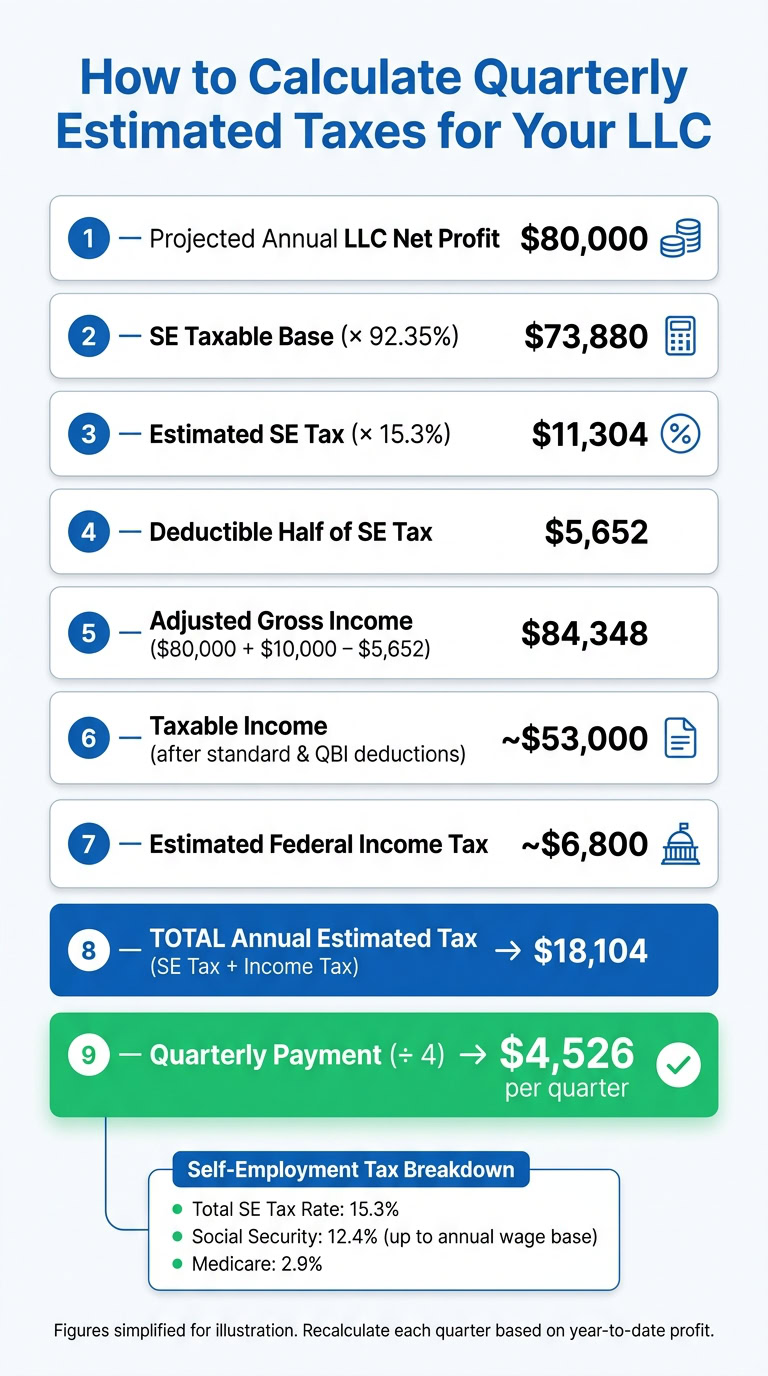
From there, estimate both income tax and self-employment tax. Below is a simple example using projected $80,000 LLC net profit plus $10,000 in other income for a single filer in 2026. This is just an example.
| Step | Description | Amount |
|---|---|---|
| 1 | Projected annual LLC net profit | $80,000 |
| 2 | SE taxable base ($80,000 × 92.35%) | $73,880 |
| 3 | Estimated SE tax ($73,880 × 15.3%) | $11,304 |
| 4 | Deductible half of SE tax | $5,652 |
| 5 | Adjusted gross income ($80,000 + $10,000 − $5,652) | $84,348 |
| 6 | Taxable income after standard & QBI deductions | ~$53,000 |
| 7 | Estimated federal income tax | ~$6,800 |
| 8 | Total annual estimated tax (Step 3 + Step 7) | $18,104 |
| 9 | Quarterly payment (Step 8 ÷ 4) | $4,526 |
Use the same process with your own filing status, tax planning strategies, and other income.
Self-employment tax is 15.3%: 12.4% for Social Security and 2.9% for Medicare. The Social Security part applies only up to the annual wage base.
Note: Figures are simplified for illustration based on 2026 projections [4][5][3].
If your income changes later in the year, recalculate before the next payment due date.
How to Adjust Payments When Income Changes During the Year
If your actual profit comes in higher or lower than expected, update your estimate before the next payment. A simple way to do that is to check your year-to-date revenue and expenses before each due date, then project the rest of the year from there.
If your income is seasonal or uneven, the annualized income method on Form 2210 Schedule AI lets you base each payment on income earned so far, without triggering a penalty.
It helps to update your books every month so each new estimate reflects your current profit.
How to Avoid Penalties and Stay Organized Year-Round
What Causes Underpayment Penalties and How to Prevent Them
After you figure out how much to pay, the next job is simple: pay on time.
The IRS can charge an underpayment penalty when your withholding and estimated tax payments don’t cover enough of your tax bill during the year. One of the easiest ways to avoid that problem is to meet a safe harbor threshold. If you do come up short, send the missing amount right away through IRS Direct Pay to cut down how much penalty can build up.
One deadline trips up a lot of LLC owners: Q2. It covers only two months, from April 1 through May 31, and the payment is due June 15. That shorter period can sneak up on people and lead to a low payment – or no payment at all – right in the middle of the year.
Common LLC Tax Mistakes That Lead to Surprises
The biggest mistakes are often the simplest ones, and they can cost you.
A common mix-up is treating owner draws as taxable income. Another is forgetting self-employment tax, which is 15.3% of LLC net profit. That number can hit hard if you haven’t planned for it.
If you or your spouse also has a W-2 job, there’s a practical fix: increase withholding from that paycheck. It can help cover the LLC’s tax gap without making every quarterly payment feel like a scramble.
Conclusion: Key Steps to Handle Quarterly Taxes with Less Stress
Here’s a simple system to keep in place during the year:
| Task | Frequency | Tool or Record |
|---|---|---|
| Income & expense review | Monthly | Invoices, bank statements, receipts |
| Tax estimate recalculation | Quarterly | Form 1040-ES worksheet |
| Estimated tax payments | Quarterly | EFTPS or IRS Direct Pay |
| Payment confirmation saved | Each payment | EFTPS confirmation number or Direct Pay receipt |
A few habits make this much easier:
- Set aside 25%–30% of net profit in a separate savings account as money comes in.
- Pre-schedule all four payments in EFTPS at the start of the year.
- Recalculate before each due date based on your year-to-date profit.
Clean records save time. When your books are updated each month, each quarterly estimate gets easier to figure out, and it’s less likely you’ll get blindsided by a payment deadline.
FAQs
How do I know if I should use safe harbor instead of estimating actual tax?
Use the safe harbor method if you want to avoid underpayment penalties and prefer a simpler way to figure payments from your prior-year tax return. It’s a good fit when your income is hard to predict.
If your income has gone up a lot, safe harbor can let you stick with a lower payment based on last year. If your income has dropped a lot, estimating your actual tax may cost less.
What if my LLC income changes a lot during the year?
If your income goes up and down, you usually have two main options.
You can use the safe harbor rule. This sets your estimated tax payments based on what you owed last year, which can help shield you from underpayment penalties.
If your income is seasonal or uneven, you can use the annualized income installment method instead. This method uses Form 2210 to figure your payments based on your actual year-to-date income for each quarter.
Should I pay quarterly taxes from my LLC or personal account?
Pay quarterly estimated taxes from your personal account, even if the cash starts in your LLC.
The IRS treats these payments as your personal tax bill, not the LLC’s. So a common setup is simple: move the money from your LLC account to your personal account as an owner’s draw, then send the estimated tax payment from your personal account.