

Colorado does not have one statewide general business license. In most cases, I’d expect you to pay a mix of state filing fees, sales tax registration, local city or county licenses, and trade-specific permits. For many small businesses, startup licensing costs can land anywhere from about $50 to $2,000+, and food or licensed trades can go far beyond that.
Here’s the short version:
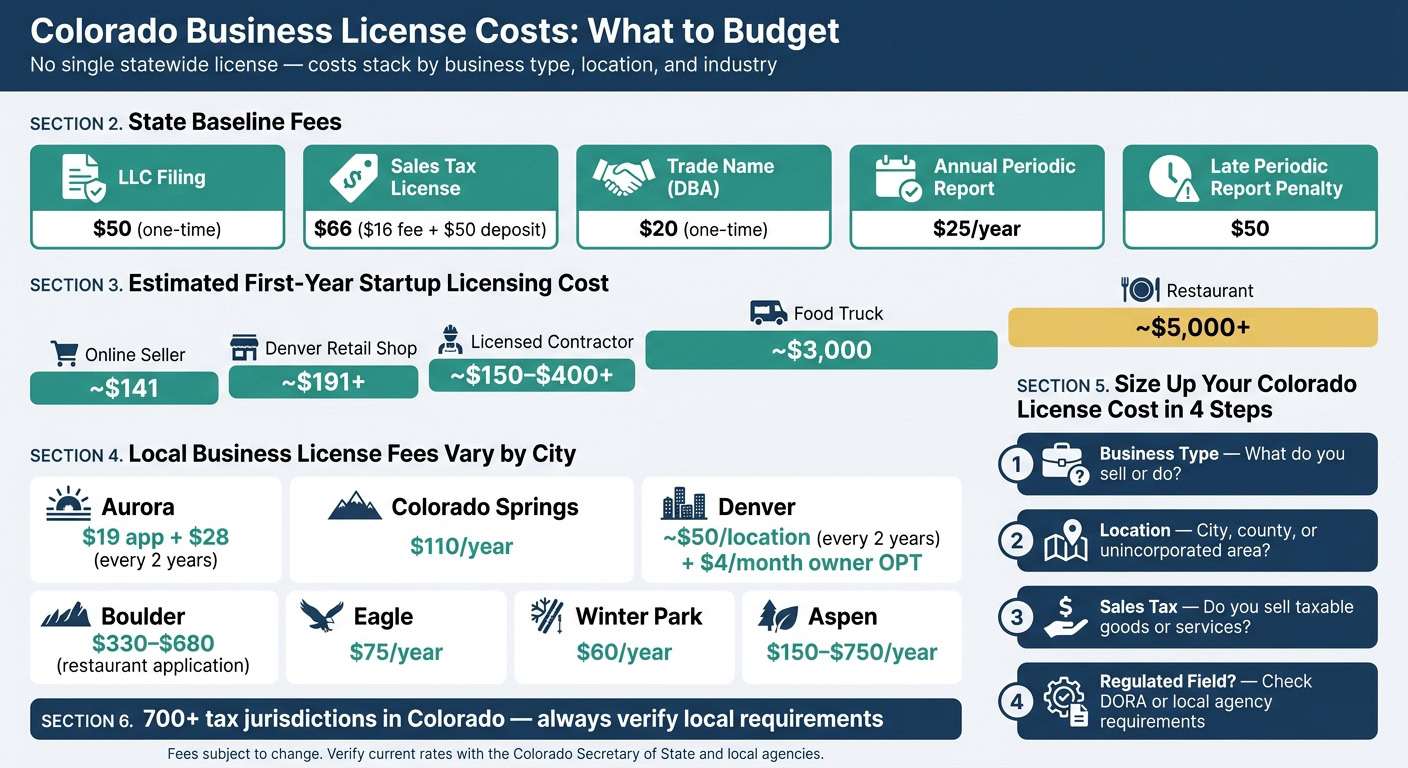
- I’d budget $50 to form an LLC or corporation with the Colorado Secretary of State.
- If you sell taxable goods or services, I’d add $66 for the state sales tax license: $16 fee + $50 deposit.
- If you use a business name that differs from your legal name, I’d add $20 for a trade name filing.
- Local costs change by city. For example, Aurora, Denver, Colorado Springs, Boulder, Aspen, Eagle, and Winter Park all use different fee setups.
- If you work in food service, construction trades, cosmetology, real estate, healthcare, or other licensed fields, permit costs can jump from a few hundred dollars to $5,000 or more.
- After setup, I’d still plan for renewals like the $25 annual Periodic Report, $16 sales tax renewal every two years, and city renewals where required.
A few numbers stand out right away:
- 700+ tax jurisdictions in Colorado
- $25 annual Periodic Report
- $50 late fee if that report is missed
- $4.00/month Denver owner OPT in some cases
- ~$136 state license fee for electricians or plumbers, plus local fees
- ~$3,000 for some food trucks
- ~$5,000 for some restaurants before opening
If I were sizing up Colorado business license costs fast, I’d check these four things first:
- Business type
- City or county location
- Whether sales tax applies
- Whether the field is licensed by DORA or a local agency
Quick comparison
| Business type | Common starting fees | Typical first-year pattern |
|---|---|---|
| Home-based online seller | $50 LLC + $66 sales tax + $20 trade name if needed | Often one of the lower-cost setups |
| Denver retail shop | State filing + sales tax + Denver tax license | More layers due to city tax rules |
| Contractor | State filing + local permit, and sometimes DORA | Costs depend on trade and city |
| Food truck | State filing + sales tax + local license + health permits | Often much higher than retail |
| Restaurant | State filing + local license + health review + food permits | Usually one of the highest-cost setups |
So the main point is simple: there’s no one Colorado license price to quote. I’d treat your total cost as a stack of fees tied to what you do, where you do it, and whether your work is regulated.
sbb-itb-ba0a4be
Colorado state registrations and baseline costs
Start with the base state fees in Colorado: entity formation, tax registrations, and employer filings. If you plan to hire employees, there’s another layer to budget for. That includes employer registrations for FAMLI and unemployment insurance, plus workers’ compensation coverage. These are the core state costs. After that, local licenses and industry permits come into play.
LLC, corporation, and periodic report fees
Filing Articles of Organization for an LLC or Articles of Incorporation for a corporation costs $50 through the Secretary of State’s eCorp portal. Colorado requires these filings to be done online only. At $50, Colorado has one of the lowest entity filing fees in the United States.
After your business is formed, you’ll need to file a $25 annual Periodic Report to stay in good standing. Colorado gives you a five-month filing window built around your entity’s anniversary month. Miss it, and the state adds a $50 late penalty. Let it sit too long, and your business can be administratively dissolved.
If you’re registering an out-of-state business in Colorado, the fee for an Authority Statement is $100. If your business falls into delinquent status and you need to bring it back, reinstatement also costs $100.
Trade name and DBA filing costs
If you operate under a name that doesn’t match your legal business name, Colorado requires a Statement of Trade Name, often called a DBA. The filing fee is $20, and renewal costs $5 per year.
Here’s the simple rule: if the name customers see is different from the name on your formation documents, file the trade name. So if your LLC is "Summit Retail Holdings LLC" but your store sign says "Summit Outdoor Gear", you need that DBA on file.
Sales tax, use tax, and event license fees
If you sell goods or taxable services at retail in Colorado, you need a Sales Tax License from the Department of Revenue. The starting cost is $66 – a $16 license fee plus a $50 deposit that gets credited toward future sales tax. Renewal is $16 every two years, and Colorado does this in odd-numbered years, such as 2025 and 2027.
Each extra business location adds $16 to register and $16 to renew. Colorado also says the license must be physically displayed at each location.
Use tax can also apply if you buy items out of state and then use, store, or consume them in Colorado.
If you sell at fairs, markets, or pop-up events, a Single Event Sales Tax License costs about $8. Online applications through the Department of Revenue can produce a Colorado Account Number the same day. Mail applications, on the other hand, can take four to six weeks.
These are the state-level fees most Colorado business owners deal with before city registrations or industry permits enter the picture.
| Filing | Initial Cost | Renewal |
|---|---|---|
| LLC Articles of Organization | $50 | N/A |
| Articles of Incorporation (Profit/Nonprofit) | $50 | N/A |
| Periodic Report | $25 | $25 annually |
| Statement of Trade Name (DBA) | $20 | $5/year |
| Sales Tax License (first location) | $66 ($16 + $50 deposit) | $16 every 2 years |
| Sales Tax License (each additional location) | $16 | $16 every 2 years |
| Single Event Sales Tax License | ~$8 | N/A |
| Foreign Entity Authority Statement | $100 | N/A |
| Reinstatement Fee | $100 | N/A |
Home-rule cities such as Denver and Boulder collect their own local sales taxes, so they also require separate local registrations.
Local Colorado license fees by city and county
City and county fees in Colorado can be all over the map, especially in home-rule jurisdictions and unincorporated county areas. Home-rule cities require local sales tax registration for sales made in their jurisdictions, separate from state registration. A simple way to size up your local cost is to check the city first, then the county, then any industry permit rules.
City business license fees: Aurora, Colorado Springs, and Denver
Aurora requires a general business license for all businesses, no matter the industry. The cost is a $19 application fee plus a $28 initial or renewal fee every two years. If ownership changes, there’s an added $43 fee.
Colorado Springs licenses regulated industries such as concrete contractors, mobile food vendors, tree services, security businesses, and massage businesses. The standard fee is $110 per year, and late renewals come with a 50% penalty.
Denver is a bit more layered because city tax licensing and owner-level taxes apply separately. Denver requires separate city tax licensing on top of state registration.
Denver tax licenses and occupational privilege tax
Denver charges about $50 per tax license, per location, every two years for licenses such as retail sales tax or use tax. If you’re budgeting, plan on about $50 per location every two years.
Denver also has an Occupational Privilege Tax (OPT). If you’re an active owner working in Denver, you owe $4.00 per month. Employees who earn more than $500 per month in Denver are subject to $5.75 per month. These are recurring compliance costs, not one-time filings.
Remote seller rules and county permit examples
If you sell remotely and have little physical presence in a jurisdiction, you may qualify for no-fee local general business licenses in some places. Still, you need to check with each jurisdiction. Colorado doesn’t use one simple rule across all cities.
County-level permits can add another cost layer for certain business types. In Boulder County, a retail food establishment plan review costs $155 plus hourly fees, with separate opening license costs on top. In Boulder, restaurant business license application fees range from $330 to $680. These county health permits are separate from any city license, so a food business in Boulder County may need both.
Eagle charges $75 per year, Winter Park charges $60 per year for a general business license, and Aspen uses a fee scale based on employee count, ranging from $150 to $750.
| Jurisdiction | License/Fee Type | Cost |
|---|---|---|
| Aurora | General Business License | $19 app + $28 (every two years) |
| Colorado Springs | General Business License (regulated industries) | $110/year |
| Denver | Tax License (Sales/Use Tax) | ~$50 per location (every two years) |
| Denver | Occupational Privilege Tax (owner) | $4.00/month |
| Boulder | Restaurant Business License | $330–$680 (application) |
| Boulder County | Retail Food Plan Review | $155 + hourly fees |
| Eagle | General Business License | $75/year |
| Winter Park | General Business License | $60/year |
| Aspen | Business License | $150–$750/year |
Once local licenses are sorted out, industry permits often create the biggest cost gaps. After that, the largest jumps usually come from regulated trades, food businesses, and professional licenses.
Industry-specific permits and typical cost ranges
After state and local filing fees, industry permits are often where startup costs jump.
Contractors, electricians, plumbers, and construction trades
Colorado doesn’t license general contractors at the state level. In plain English, that means city and county rules usually decide what you need. For general contractors, fees often land in the $150 to $500+ range.
Trade licenses work differently. Electricians and plumbing contractors need state licensure through DORA, and the state application fee is about $136. On top of that, many cities ask for a separate local registration. So if you’re a plumber or electrician, you may need to pay both the state fee and local fees.
Food and professional licenses can push costs even higher.
Restaurants, food trucks, and retail food businesses
Food businesses often face the biggest permit stack of any common business type in Colorado. A standard restaurant can expect to spend about $5,000 on permits before opening, while a food truck is closer to $3,000. Those totals include health department plan reviews and retail food licenses from CDPHE or the county health department. If you plan to serve alcohol, that’s another set of license costs.
There’s one useful exception for very small operators. Under Colorado’s Cottage Food Act, home-based food producers can sell up to $5,000 per year in certain foods without a retail food license.
Professional, home-based, and online businesses
Regulated professions like real estate, healthcare, cosmetology, and private investigation are licensed through DORA. Fees vary a lot by board, but most fall between $100 and $1,000+. A hair salon or barbershop, for example, often spends about $1,500 on first-year permits and licenses, including the DORA cosmetology license and local business registration.
Home-based and online businesses aren’t off the hook just because they don’t have a storefront. Local zoning rules often limit home businesses in very specific ways, such as:
- One customer at a time
- No exterior signage
- No commercial vehicle storage
Because of that, you’ll likely need a home occupation permit from your city or county.
These numbers make one thing clear: permit costs can change a lot based on the type of business you run.
| Business Type | Primary Licensing Body | First-Year Cost Range |
|---|---|---|
| General Contractor | Local Municipality | $150–$500+ |
| Electrician / Plumber | DORA + Local | ~$136 (state) + local fees |
| Restaurant | CDPHE / Local Health Dept | ~$5,000 |
| Food Truck | CDPHE / Local Health Dept | ~$3,000 |
| Hair Salon / Barbershop | DORA + Local | ~$1,500 |
| Home-Based / Online | Local Zoning + Dept. of Revenue | Local permit fees |
| Professional Services | DORA | $100–$1,000+ |
Next, renewal fees determine what those costs look like year after year.
Renewal costs, budget examples, and a closing checklist
Renewal fees that affect annual compliance costs
Recurring fees in Colorado are pretty low. The catch is simple: if you miss a deadline, the extra charges add up fast.
The LLC Periodic Report costs $25, and filing late adds a $50 penalty.
The state sales tax license renews every two years for $16 per location. Local licenses run on their own timelines. Aurora renews every two years at $27, while Colorado Springs renews every year at about $110. If you’re an owner-operator in Denver, the Occupational Privilege Tax stays in place at $4 per month.
First-year cost ranges by business type
These examples show how the state, local, and industry fees above can look in a first-year budget.
| Business Type | Key Costs Included | Est. First-Year Total | Recurring Cost |
|---|---|---|---|
| Online seller | $50 LLC + $16 sales tax license + $50 deposit + $25 periodic report | ~$141 | ~$33 |
| Denver retail shop | $50 LLC + $66 sales tax + ~$50 Denver license + $25 periodic report | ~$191+ | ~$33+ (plus Denver OPT if employees) |
| Food truck | $50 LLC + $66 sales tax + ~$110 local license + health permits | ~$250–$600+ | ~$150–$300+ |
| Licensed contractor | $50 LLC + DORA professional license + local permits | ~$150–$400+ | ~$75–$200+ |
Workers’ compensation insurance is mandatory in Colorado as soon as you hire your first employee, even if that person is part-time or a family member. That cost kicks in right away once you bring someone on, but it is not included in the table above.
Final checklist and key takeaways
After you estimate your startup and renewal costs, handle the required registrations in this order:
- File Articles of Organization with the Colorado Secretary of State ($50 online).
- Register for a state sales tax license through MyBizColorado ($16 + $50 refundable deposit).
- Apply for your local city or county business license (fees vary by city).
- Get a DORA professional license if your field requires one.
- Register for FAMLI and unemployment insurance if you have employees.
- Check zoning rules and get a home occupation permit if you’re running the business from home.
Once the business is set up, put every filing deadline and city renewal date on a compliance calendar. That’s the easiest way to avoid late fees, penalty charges, and frustrating delays.
FAQs
Do I need a Colorado business license if I work from home?
Maybe. Colorado does not issue a statewide business license. But if you run a home-based business, you may still need a local license or registration.
You might also need a home occupation permit so your business fits local zoning and land use rules. The best move is to check with your city or county clerk’s office, because the rules change from one place to another.
Which Colorado cities require a separate local license?
Colorado doesn’t issue one statewide business license. Instead, the rules usually depend on the city, town, or county where you operate. That means many local governments set their own licensing or registration rules.
For example, Aurora requires a general business license. Colorado Springs may only require a license for certain regulated industries. So the best move is simple: check with the local clerk’s office or government website in the place where you do business.
What permits add the most to startup costs in Colorado?
Colorado doesn’t have one statewide business license. So if you’re figuring out startup costs, the price depends a lot on what kind of business you run and which city you’re in.
The biggest costs usually come from industry-specific occupational licenses handled by DORA or federal agencies.
If you work in food service, specialized medical roles, or high-compliance fields like telecommunications, you may need more than one permit. On top of that, local city fees can add a few hundred dollars, especially in home-rule cities.