
If I start an Etsy shop in the U.S., I still have to deal with taxes from day one. Even $1 of profit is taxable, and if my net self-employment income hits $400 or more, self-employment tax can apply.
Here’s the short version:
- I need to decide if my Etsy activity is a business or a hobby
- Most sellers start as a sole proprietor
- An LLC can make sense if sales grow or product risk is higher
- I must report all profit, even if I do not get a 1099-K
- Etsy may collect sales tax on marketplace orders, but that does not cover everything
- I may still need an EIN, state permits, local licenses, and a separate bank account
- If I expect to owe $1,000 or more in tax, I’ll usually need quarterly estimated payments
A simple way to think about it: Etsy makes it easy to open a shop, but I still have to handle the legal and tax side. That means picking the right setup, tracking expenses, and knowing what Etsy handles versus what stays on me.
Quick Comparison
| Topic | What I need to know |
|---|---|
| Business vs. hobby | Profit motive matters for tax treatment |
| Sole proprietor | Default setup for many new sellers |
| Single-member LLC | Same federal tax treatment by default, but more legal separation |
| Taxable income | Profit = sales minus deductible business costs |
| Self-employment tax | Usually applies at $400+ in net earnings |
| Estimated taxes | Usually due if I expect to owe $1,000+ |
| Sales tax | Etsy may collect on marketplace sales; off-platform sales may still be my job |
If I want to start an Etsy business the right way, this is the checklist: choose a structure, get the IDs and permits I need, track every dollar, and file taxes based on net profit, not just gross sales.
Step 1: Choose a Business Structure for Your Etsy Shop
For tax purposes, the IRS starts with a basic question: is your Etsy shop a business or a hobby? After that, you can decide whether an LLC makes sense for the extra legal protection.
Business or Hobby: Why the Distinction Matters for Taxes
The IRS looks at your profit motive and how you run the shop over time to decide whether your Etsy activity is a business or a hobby.
If you post listings on a regular basis, restock supplies, set prices to make money, and promote your shop, the IRS is more likely to view it as a business. That matters because business income is reported on Schedule C, and you can generally deduct ordinary and necessary costs like Etsy fees, shipping, packaging, and materials. Hobby income is still taxable, but under current law, hobby expenses generally can’t offset that income.
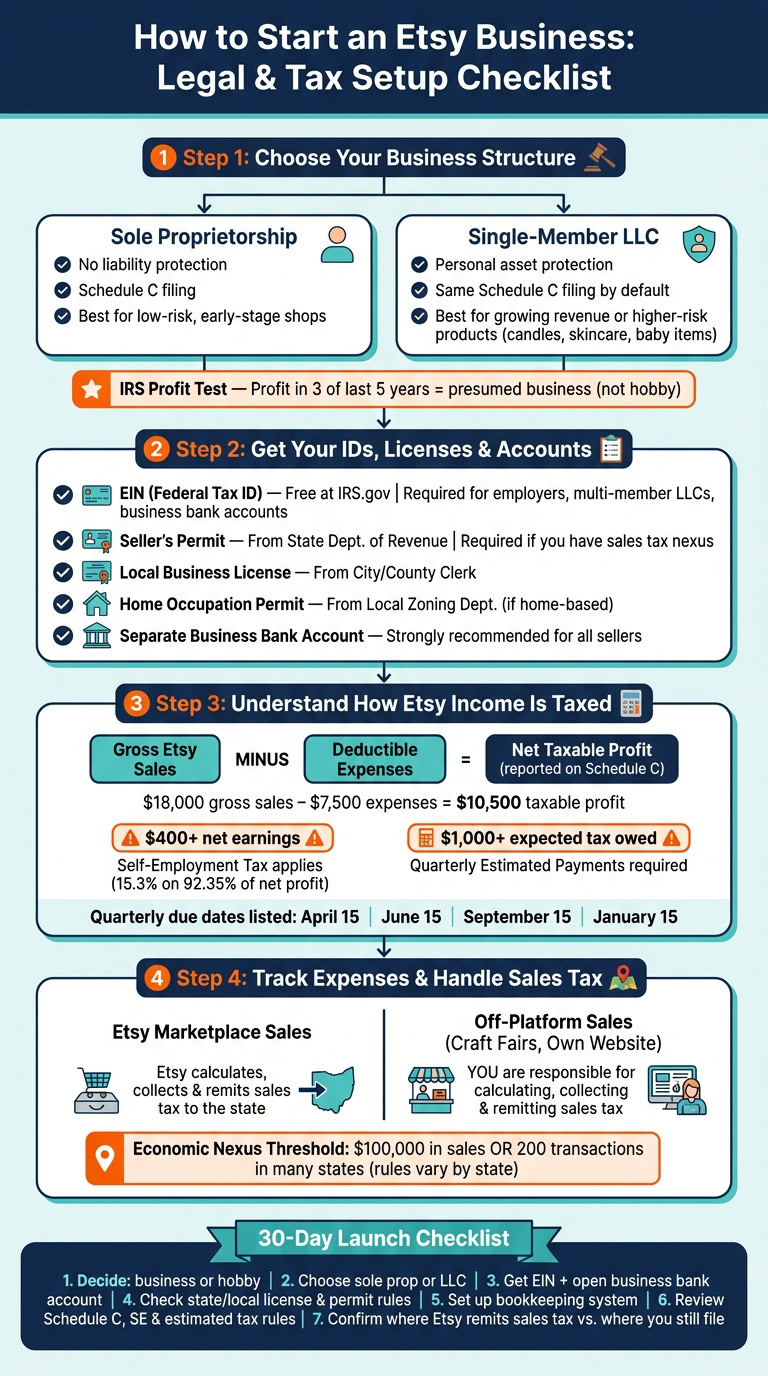
The IRS also uses a practical benchmark: if your shop shows a profit in 3 out of the last 5 years, it generally presumes you have a profit motive.
When to Form an LLC for Your Etsy Shop
If your shop has moved past the casual side-project stage, an LLC may be a cleaner setup for the long run.
By default, a single-member LLC is taxed the same way as a sole proprietorship. You still report Etsy income and expenses on Schedule C. So the tax side may not change much. What does change is legal exposure. An LLC can help protect your personal assets, which matters more if you sell higher-risk products like candles, skincare, baby items, or pet products.
Here’s a quick side-by-side look:
| Feature | Sole Proprietorship | Single-Member LLC |
|---|---|---|
| Liability protection | None; personal assets are generally exposed to business debts and lawsuits | Personal assets are generally protected |
| Tax treatment (default) | Schedule C; income and self-employment tax on net profit | Same as a sole proprietorship by default |
| Typical use case | Low-risk, early-stage shops | Growing revenue or higher-risk products |
How BusinessAnywhere Can Help with LLC Formation and Compliance
If you decide to form an LLC, the next step is setting up an LLC and keeping it in good standing. That usually means filing Articles of Organization with your state, naming a registered agent, and creating an operating agreement that lays out the company’s structure.
BusinessAnywhere can file your LLC, act as your registered agent, and help with compliance over time.
Step 2: Get Your EIN, Licenses, and Business Accounts Set Up
Once you’ve picked your business structure, take care of a few setup tasks before you start taking orders. Doing this early can save you a headache later, especially at tax time or when a bank asks for paperwork you haven’t gathered yet.
When Etsy Sellers Need an EIN
An Employer Identification Number (EIN) is a 9-digit federal tax ID for your business. If you’re a sole proprietor or a single-member LLC with no employees, you can often use your SSN. But in some cases, an EIN isn’t optional.
You need an EIN if you:
- have employees
- operate as a multi-member LLC, partnership, or corporation
- file employment or excise tax returns
Many U.S. banks also ask for an EIN before they’ll open a business checking account. Wholesale suppliers may want one too before setting up a trade account. It also keeps your SSN off vendor forms and tax paperwork, which is a smart move if you want a cleaner line between business and personal records.
The IRS issues EINs for free through its online application. If you don’t want to deal with the paperwork yourself, BusinessAnywhere’s EIN application service handles form prep, submission, and follow-up for $97.
With your EIN and licenses handled, the next move is making sure your records stay clean for tax time.
Licenses and Permits That May Apply by State or City
After your federal tax ID is set, check your state and local rules. Etsy doesn’t replace state or local licensing. Based on where you work and what you sell, you may need:
- A seller’s permit – also called a sales tax permit or sales tax license – if you sell taxable goods and have nexus in a state. This lets you collect and remit sales tax on orders Etsy doesn’t cover.
- A general business license from your city or county.
- A home occupation permit if you run the shop from home, so your setup matches local zoning rules.
- A resale certificate tied to your sales tax registration, which lets you buy raw materials wholesale without paying sales tax at checkout.
A good place to start is your state’s Department of Revenue website for sales tax registration. For local licenses and zoning permits, check with your city or county clerk’s office.
Separate Banking and Setup Support from BusinessAnywhere
Open a separate business checking account as soon as you start treating your Etsy shop like a business. Mixing personal and business money can make bookkeeping messy fast. If you run an LLC, it can also blur the line between you and the business.
Use that account for all Etsy payouts and all business expenses from day one. It makes tax prep smoother and gives you a clear paper trail if you’re ever audited.
If you want help with sales tax or entity setup, BusinessAnywhere’s tax and residency consultation includes a one-hour session and a custom plan for $535.
Here’s a quick reference for the main setup items:
| Setup Item | What It Is | When You Need It | Where to Get It |
|---|---|---|---|
| EIN | Federal business tax ID (9 digits) | Required for multi-member LLCs and employers; often needed for a business bank account; recommended for privacy | IRS.gov (free) or BusinessAnywhere ($97) |
| Seller’s Permit | State authorization to collect and remit sales tax | Needed when you sell taxable goods and have nexus in a state | State Department of Revenue |
| Local Business License | City or county permit to operate a business | Required by many local governments, including home-based shops | City or County Clerk’s Office |
| Home Occupation Permit | Zoning clearance for running a business from home | Needed in many cities for residential business operations | Local Planning or Zoning Department |
| Business Checking Account | Dedicated account for business income and expenses | Strongly recommended for all sellers; especially important for LLC liability protection | Bank or credit union |
Once your setup is done, the next thing to sort out is how your Etsy profit gets taxed.
Step 3: Understand How Etsy Income Is Taxed
Once your shop is up and running, the next job is reporting Etsy income the right way.
Your tax bill is based on net profit, not total Etsy sales and not the amount shown on Form 1099-K. So if Etsy reports $18,000 in gross sales, but you spent $7,500 on fees, materials, and shipping, your taxable profit is much closer to $10,500.
What Counts as Taxable Profit
Net profit is your gross Etsy sales minus ordinary and necessary business expenses. That usually includes things like Etsy fees, payment processing, materials, packaging, shipping, advertising, software, and mileage.
There’s one rule that trips people up all the time: you must report all income even if you never get a 1099-K. The 1099-K is just an information return. It does not decide whether your income is taxable.
Self-Employment Tax and Quarterly Estimated Payments
Most sole proprietors and single-member LLCs report Etsy income on Form 1040, Schedule C, and Schedule SE. Schedule C is where you list income and expenses. Schedule SE is used to figure self-employment tax, which applies when net self-employment earnings hit $400 or more.
Self-employment tax covers both the employer and employee portions of Social Security and Medicare. The combined rate is 15.3%, and it’s figured on 92.35% of your net profit – not the full amount.
Because Etsy doesn’t withhold income tax or self-employment tax from your payouts, you have to pay as you earn. If you expect to owe $1,000 or more in total tax for the year, you’ll usually need to make quarterly estimated payments. IRS due dates are April 15, June 15, September 15, and January 15.
When an LLC Taxed as an S-Corp May Be Worth Considering
For most new Etsy sellers, the default sole proprietor or single-member LLC setup is enough. Both follow the same filing path and both pay self-employment tax on 100% of net profit. Things start to change when profit becomes steady and much higher.
With an S-corp tax election, an LLC owner can split income into a reasonable salary and distributions. The salary is subject to payroll taxes. The distributions are not subject to self-employment tax. That can lower tax, but only if the profit level is high enough to offset the extra payroll work and filing load.
Here’s a quick side-by-side look at the three setups Etsy sellers use most often: Structure Primary Tax Forms SE Tax Treatment Complexity When It Makes Sense
That tax treatment leads straight into sales tax rules and year-round recordkeeping.
sbb-itb-ba0a4be
Step 4: Track Expenses and Handle Sales Tax Correctly
Recordkeeping and sales tax cause more tax-season headaches for Etsy sellers than almost anything else. The fix doesn’t have to be fancy. Start with a simple system and stick with it all year.
Records Etsy Sellers Should Keep All Year
Keep your Etsy sales reports, payout statements, receipts, bank and card statements, inventory records, and mileage logs throughout the year. If you sell physical products, track inventory on its own: beginning inventory, purchases, items sold, and ending inventory. That’s how you calculate cost of goods sold the right way. Keep most records for at least 3 years, and hold onto inventory and asset records longer. These records also back up the income you report on Schedule C.
Here’s a quick reference for common Etsy expense categories and how to keep them organized:
| Expense Category | Examples | How to Track |
|---|---|---|
| Etsy platform fees | Listing fees, transaction fees, payment processing fees, offsite ads | Save Etsy fee reports and monthly statements |
| Shipping & packaging | Postage, labels, boxes, packing tape, shipping insurance | Keep receipts and carrier invoices |
| Materials & supplies (COGS) | Fabric, yarn, wood, beads, packaging materials | Track purchases with inventory records |
| Advertising | Etsy Ads, social media ads | Save ad invoices and reports |
| Professional services | Bookkeeper, CPA, tax consultant, legal services | Keep invoices and payment records |
| Equipment & tools | Camera, printer, sewing machine, computer | Keep purchase receipts for depreciation or expensing |
| Travel & mileage | Post office runs, supply store trips, craft fair travel | Maintain a mileage log and travel receipts |
| Home office / studio | Portion of rent, utilities, internet | Keep utility bills and home office calculations |
What Etsy Handles – and What You Still Owe
Once your records are in order, the next step is separating what Etsy takes care of from what still lands on your plate.
Etsy collects and remits sales tax for eligible marketplace orders in most U.S. states. But that only covers sales made on Etsy. It does not cover off-Etsy sales, like craft fairs or sales from your own website.
For off-platform sales, you’re the one responsible for collecting the tax, sending it to the state, and filing the return.
| Aspect | Etsy Marketplace Sales | Off-Platform Sales (Craft Fairs, Own Site) |
|---|---|---|
| Who calculates the tax rate | Etsy, based on the buyer’s location | Seller |
| Who collects tax from the buyer | Etsy at checkout | Seller at point of sale |
| Who remits tax to the state | Etsy | Seller |
| Sales tax permit required | Depends on state nexus rules | Required if the seller has nexus |
| Filing returns | Some states still require informational or zero-dollar filings | Full sales tax returns required |
| Responsibility for errors | Etsy is generally responsible for facilitator-collected amounts | Seller is fully responsible |
Here’s the part that trips people up: even if Etsy remits the tax, some states may still require you to register for a sales tax permit or file informational returns that show total sales and what the marketplace already paid. Also check the rules in your home state and any state where you have physical presence or economic nexus. In many states, the threshold is $100,000 in sales or 200 transactions, though the rule changes from state to state.
Compliance Support from BusinessAnywhere
If you sell in more than one place, the admin side can pile up fast. Mail, notices, bookkeeping records, and state tax questions all become part of the job.
BusinessAnywhere’s virtual mailbox and bookkeeping support can help you stay on top of notices, records, and multi-state tax questions.
Conclusion: A Simple Compliance Checklist for Starting an Etsy Business
Starting an Etsy shop is simple. Staying compliant takes more care.
From day one, get your business structure, tax reporting, recordkeeping, and sales tax duties in order. Report all Etsy income. Keep records that back up your deductions. Think of these rules as your launch checklist.
Pick the simplest structure that matches your risk level and growth plans.
Your taxable profit is your sales minus deductible expenses. That net amount goes on Schedule C and is also used to figure self-employment tax.
Etsy handles marketplace sales tax in covered states, but off-platform sales are still on you. Check your state’s Department of Revenue website to see what applies in your case.
Here’s a 30-day checklist you can use:
- Decide whether you’re operating as a business or a hobby, and write down your pricing and profit goals.
- Choose sole proprietorship or LLC based on your risk and growth plans.
- Get an EIN, open a separate business bank account, and keep business and personal transactions separate.
- Check state and local government websites for business license, home occupation permit, and sales tax registration rules.
- Set up a bookkeeping system and log every sale, Etsy fee, material cost, shipping expense, and other deductible cost.
- Review IRS rules for Schedule C, Schedule SE, and estimated taxes.
- Review your Etsy sales tax reports and confirm where Etsy remits on your behalf and where you still need to file.
FAQs
Do I need an LLC to sell on Etsy?
No. You are not legally required to form an LLC to start selling on Etsy.
That said, an LLC can help protect your personal assets if your business runs into debts, legal claims, or other problems. Many Etsy sellers set one up because it offers a mix of liability protection, tax flexibility, and a more polished business image as their shop grows.
What taxes do I pay as an Etsy seller?
As an Etsy seller, you may owe income tax, self-employment tax, and sales tax.
You report your business income and deductible expenses on Schedule C with Form 1040. That’s the main place where you show what came in, what you spent, and what your business earned.
If your net earnings are more than $400, you may also owe self-employment tax. The rate is 15.3%. This tax covers things like Social Security and Medicare, so it can catch new sellers off guard if they only plan for income tax.
There’s also the timing piece. If you expect to owe $1,000 or more, quarterly estimated payments are usually required. In plain English: instead of waiting until tax season, you may need to pay the IRS during the year.
Sales tax works a bit differently. For orders placed on Etsy, Etsy generally collects and remits sales tax for you on the platform. That takes a lot off your plate.
But if you also sell through your own website, the rules can change. Once you go over a state’s economic nexus threshold, you may need to register in that state, collect sales tax from buyers, and remit it yourself.
Does Etsy handle all sales tax for me?
No. Etsy automatically collects and remits sales tax for many transactions under marketplace facilitator laws.
But you still need to understand your tax duties in any state where you have nexus. If you also sell on your own website or through other channels, you need to register and collect sales tax yourself once you pass that state’s thresholds.