
An LLC helps protect your personal money, but it does not let you start selling food by itself. If I want to run a food truck in the U.S., I usually need two separate tracks in place: business formation and local approvals.
Here’s the short version:
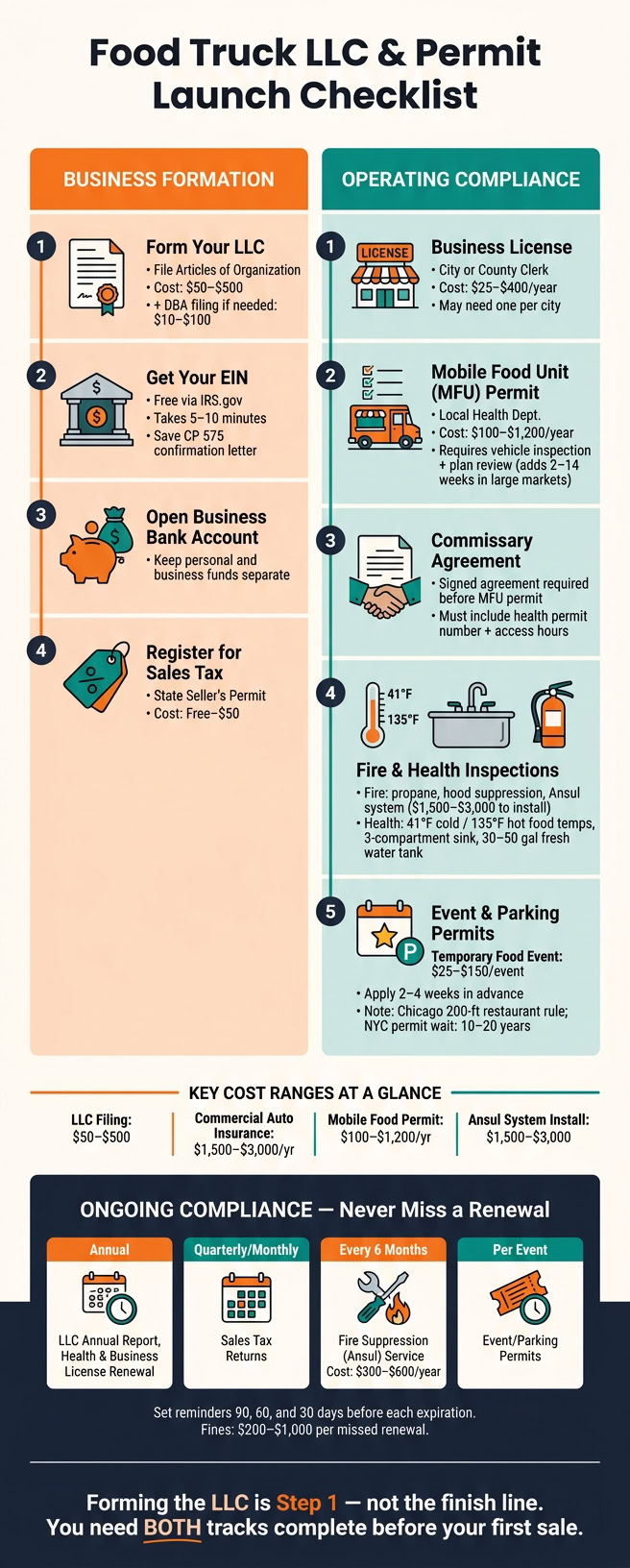
- I form the LLC with my state
- I get an EIN from the IRS
- I open a separate business bank account
- I register for sales tax
- I get a business license
- I get a mobile food or health permit
- I line up a commissary kitchen
- I pass fire and health inspections
- I keep up with renewals, which may be annual, monthly, quarterly, or every 6 months
A few numbers show how much rules can vary:
- LLC filing fees often run $50 to $500
- DBA filings often cost $10 to $100
- Business licenses often cost $25 to $400 per year
- Mobile food permits often cost $100 to $1,200 per year
- Event permits often cost $25 to $150 per event
- Commercial auto insurance often runs $1,500 to $3,000 per year
- Some cities add hard limits, like Chicago’s 200-foot rule
- In New York City, permit limits have led to wait times of 10 to 20 years
The main point is simple: forming the LLC is step one, not the finish line. I still need tax setup, health approval, fire clearance, vehicle paperwork, and local permission for where I park and sell.
That’s the full picture this guide covers, in plain English.
How to form your food truck LLC
Pick your state, business name, and registered agent
Start with the basics: your state, your business name, and your registered agent.
Your LLC name has to be different from every other registered business name in your state. It also needs to include "LLC" or "Limited Liability Company." Before you file anything, check name availability on your Secretary of State’s website. If the name is already taken, your filing can get held up.
If the name on the side of your truck is different from your legal LLC name, you’ll also need a Doing Business As (DBA) filing. That usually costs $10 to $100.
Every LLC also needs a registered agent. This is a person or company with a physical address in your state that can receive legal notices and tax mail. For a food truck owner, that setup makes a lot of sense. You’re mobile all day, and a registered agent service helps you avoid missing a deadline or legal notice while you’re out working. It also keeps your home address off public records.
File Articles of Organization and draft an operating agreement
The Articles of Organization are the form that officially creates your LLC with the state. Filing fees vary a lot by state, usually $50 to $500.
At the same time, draft your operating agreement with the rest of your formation paperwork.
One small detail can save you a big headache later: use the exact same legal name everywhere. That means your state filing, your EIN application, your bank account, and every permit application should all match. Even a small mismatch can slow things down.
Once your LLC is approved, the next step is tax setup and banking.
Get an EIN, open a bank account, and register for taxes
Wait until your state approves the Articles of Organization before you apply for your Employer Identification Number (EIN). You’ll need the EIN for banking, hiring, and most permit applications.
The EIN application is free through IRS.gov, and the online process usually takes five to ten minutes. After you get it, save the official confirmation letter, CP 575. Banks and permit offices often ask for that document.
Open your business bank account right after the EIN comes through. If you mix personal and business funds, you can weaken your LLC’s liability shield. In plain terms, separate accounts matter.
After the bank account is open, register for your state seller’s permit or sales tax ID. If you sell prepared food, you need this to collect and send in sales tax. In most states, the permit is free or costs up to $50.
| Tax/Identity Layer | Issuing Authority | Typical Cost | Purpose |
|---|---|---|---|
| EIN | IRS (Federal) | Free | Federal tax ID number, banking, hiring |
| Seller’s Permit | State Dept. of Revenue | Free – $50 | Authorization to collect and remit sales tax |
| Business License | City or County Clerk | $50 – $500 | Local permission to operate |
If your truck works across more than one city, check each area’s rules. Some cities and counties want their own business license on file. After that, you can move on to the local permits tied to where you park, how your truck is set up, and the type of food service you offer.
sbb-itb-ba0a4be
Permits and licenses your food truck needs
After LLC formation, you still need the separate permits that let you legally sell food. A food truck usually deals with local offices, state agencies, and the health department.
Business license, mobile food permit, and health approval
Your city or county business license is the basic local registration. It puts your business on record with the local jurisdiction, and fees usually range from $25 to $400 per year. If you plan to work in more than one city, check each area’s rules. Some places want a separate license for each jurisdiction.
The Mobile Food Unit (MFU) permit is the main health department permit for the truck itself. The local health department issues it after a physical vehicle inspection, and yearly fees often fall between $100 and $1,200, based on your jurisdiction and menu complexity. Before that inspection, many health departments ask for a plan package. That package usually includes your menu, equipment specs, tank capacities, storage method, and food safety manager certification. It often costs $100 to $200.
In large markets like Los Angeles and Chicago, the health department may also ask for a plan review before you can even book the inspection. You send in the truck’s blueprints and equipment layout, and the department checks them against local code. That extra step can add 2 to 14 weeks to your launch timeline. It’s smart to submit plan review materials before you build or modify the truck. Doing it later can turn into an expensive headache.
Once the health permit process is moving, the next items are sales tax registration and access to places where you can sell.
Seller’s permit, event permits, and parking or zoning approvals
Your seller’s permit, sometimes called a Sales Tax ID, is a state registration that allows you to collect and remit sales tax on prepared food. You need it before your first sale. In most states, registration is free or costs up to about $50.
After tax registration, look closely at the rules for events, private lots, and street vending. That’s where many new owners get tripped up.
Special event permits are often required for festivals and farmers markets. These Temporary Food Event permits usually cost $25 to $150 per event, and applications are often due 2 to 4 weeks before the event date.
Parking and zoning rules can still stop you from selling at a certain spot, even if all your other permits are set. Chicago, for example, does not allow food trucks to operate within 200 feet of a brick-and-mortar restaurant. Other cities use their own distance rules, which can limit where you can park and serve. Selling on private property may help you avoid some street-vending limits, but you still need written permission from the property owner and your core health approvals.
| Permit Type | Issuing Authority | Renewal Cycle | Food Truck Notes |
|---|---|---|---|
| Business License | City or County Clerk | Annual | May need one for every city you work in |
| Mobile Food Permit | Local Health Department | Annual | Tied to a specific vehicle and commissary agreement |
| Seller’s Permit | State Dept. of Revenue | Ongoing | Required before your first sale; usually free to register |
| Event/Parking Permit | City Planning or Public Works | Per event or location | Requires 2–4 weeks lead time; subject to distance rules |
These permits are only part of launch compliance; the next step is commissary, vehicle, fire, and inspection approval.
Commissary, vehicle, fire, and inspection requirements
Once your permits are moving, the next step is all about the truck itself, your kitchen base, and the inspections that clear you to operate.
Use an approved commissary kitchen
Most local health departments want you to work from a licensed commissary kitchen. In plain English: home food prep is usually not allowed. A commissary gives you approved space for food prep, dishwashing, and wastewater disposal.
In most places, you’ll need a signed commissary agreement before the health department will approve your mobile food permit. That agreement should list the commissary’s valid health permit number, your access hours, and the services you’re allowed to use.
A shared commissary is usually the lower-cost, easier way to get started. A private kitchen costs more, but it gives you more control and can bring extra permits.
Register the truck and clear health and fire inspections
After your commissary is approved, shift to the truck’s DMV registration and insurance. Register the vehicle with your state DMV and carry commercial auto insurance. That policy usually runs $1,500 to $3,000 per year and is separate from general liability insurance.
Fire inspections tend to focus on the parts that can go wrong fast: propane mounting, gas lines, leak detection, ventilation, hood suppression, and Class K fire protection. One common reason trucks fail? An untagged suppression system.
A new Ansul system usually costs $1,500 to $3,000 to install. You should also plan for $150 to $350 for professional servicing and tagging before inspection, plus $300 to $600 per year for semi-annual maintenance.
The health inspection looks closely at your water system, sink setup, food storage, and temperature control. Inspectors will check that cold food stays at 41°F or below and hot food stays at 135°F or above. Your truck also needs:
- A three-compartment sink
- A dedicated handwashing sink
- A fresh water tank with 30 to 50 gallons of capacity
- A wastewater tank that’s at least 15% larger than your fresh water tank
Bring your commissary agreement and food manager certifications to the inspection.
If you’re buying a used truck, get a pre-purchase inspection before you sign the deal. Problems with propane systems or refrigeration can turn into expensive repairs fast.
Keep every approval and its renewal date in one file. You’ll need that for the compliance-tracking step next.
Track documents, renewals, and ongoing compliance
Keep your formation, permit, and inspection records in one place
Once the truck is approved, compliance turns into a recordkeeping job. At that point, the work isn’t flashy. It’s mostly about staying organized.
Keep a physical binder in the truck and a digital backup for inspections, renewals, and emergencies. These are the files health, fire, and tax officials may ask to see on site.
Store your formation papers, permits, inspection records, insurance, vehicle registration, banking records, and staff food-safety certifications in one place. Food handler cards and at least one manager’s Certified Food Manager certificate should be easy to access.
A virtual mailbox or digital dashboard can help you keep renewal notices, scans, and compliance records together.
After storage comes scheduling.
Build a renewal calendar for annual reports, licenses, and taxes
Don’t assume every permit, license, and filing renews on the same date. Your LLC annual report follows your state’s schedule. Your health and business licenses may renew once a year. Sales tax filings are usually monthly or quarterly. Fire suppression service is typically required every six months. Miss one, and fines can run from $200 to $1,000 per incident.
Set reminders 90, 60, and 30 days before each expiration date. That gives you time to gather paperwork and deal with agency backlogs.
| Phase | Task | Typical Timing |
|---|---|---|
| Pre-Launch | File Articles of Organization & EIN | Weeks 1–2 |
| Pre-Launch | Secure Commissary Agreement | Weeks 2–4 |
| Pre-Launch | Health & Fire Inspections | Weeks 4–8 |
| First 30 Days | Register for Sales Tax | Before first sale |
| First 30 Days | Food Handler Cards (all staff) | Before first shift |
| Annual | LLC Annual Report & Franchise Tax | Anniversary Month |
| Annual | Health & Business License Renewal | 12 Months |
| Ongoing | Fire Suppression (Ansul) Service | Every 6 Months |
| Ongoing | Sales Tax Returns | Monthly or Quarterly |
If you operate in more than one city, keep a separate permit tracker for each jurisdiction. Approvals often don’t carry over from one location to another.
Conclusion: Form the LLC first, then clear every operating approval
A food truck launch has two tracks: business formation and operating compliance. You need both in place before serving your first customer.
Start with the LLC, get your EIN, open a dedicated business bank account, and register for sales tax. Then move through your health permit, mobile food unit license, commissary agreement, and vehicle inspections. Once you’re up and running, keep every document organized and use layered renewal reminders so nothing slips through the cracks.
Keep records current and put renewal dates directly into your operating calendar.
FAQs
Do I need an LLC to start a food truck?
No. You can run a food truck as a sole proprietorship, so an LLC isn’t required.
That said, an LLC is often the safer move. It can help shield your personal assets if the business runs into trouble, like a vehicle accident or a food safety claim. A sole proprietorship doesn’t give you that separation between you and the business.
Can I use my home kitchen for food prep?
No. In almost every U.S. jurisdiction, health departments require food prep to happen in a licensed commissary kitchen, not at home.
A commissary is a commercial kitchen where you handle food prep, store ingredients, clean equipment, and deal with grease and wastewater the right way. To get your health permit, you’ll usually need to submit a signed commissary agreement.
Skip that step, and you could face an immediate shutdown.
How long does food truck approval usually take?
In most U.S. cities, plan for 4 to 12 weeks to get full approval.
A few documents move faster. For example, a sales tax permit may be processed in as little as 1 week. But mobile food vendor licenses and health department permits usually take longer. If your city requires a plan review, that can add 2 to 6 weeks on its own.
The big takeaway is simple: timing depends on where you’re applying. What moves fast in one city can drag in another, so it helps to start early and give yourself some breathing room.