
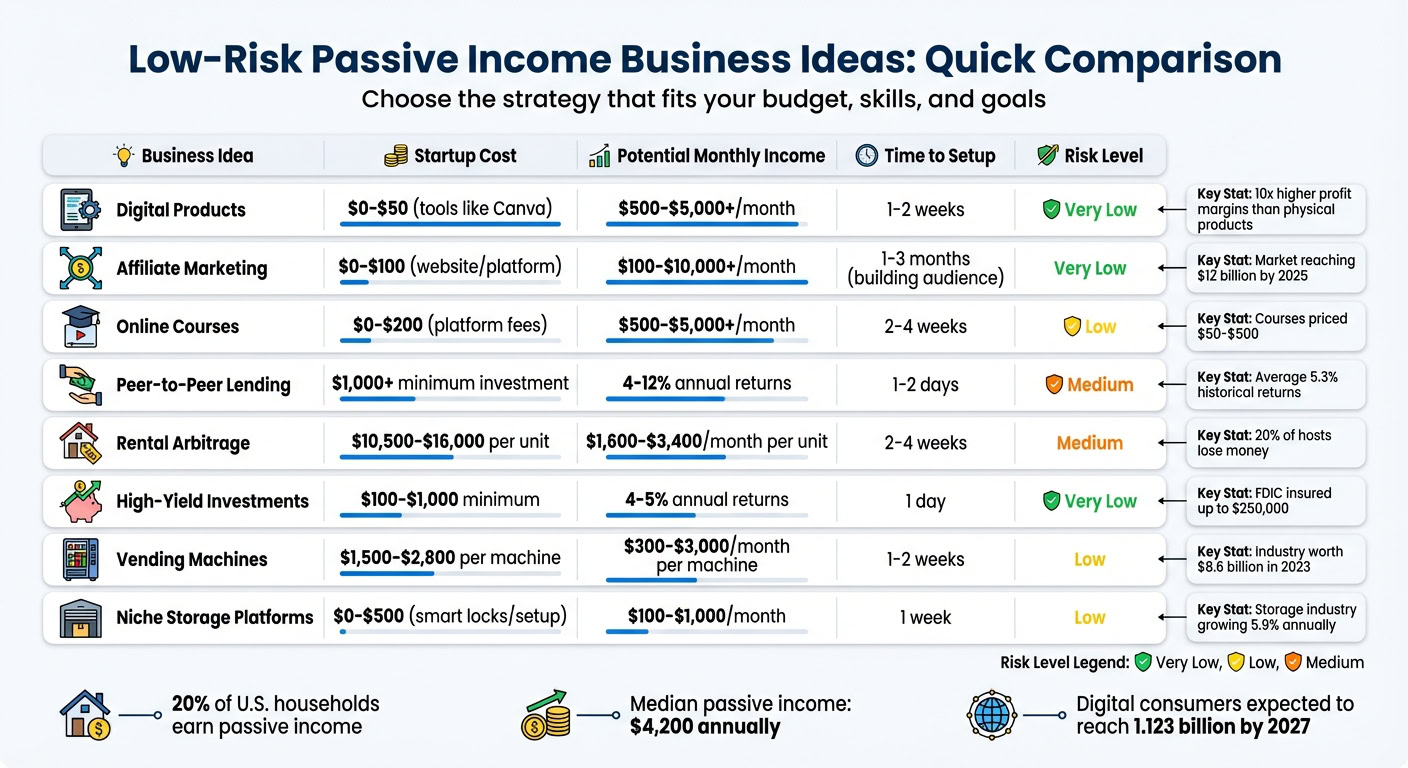
Creating passive income means setting up revenue streams that require minimal ongoing effort. In the U.S., about 20% of households earn passive income, with median earnings of $4,200 annually. This guide highlights low-risk options that are easy to start, need little upfront investment, and can generate consistent returns. Here’s a quick rundown of the ideas covered:
- Digital Products: Sell templates or guides online with high profit margins and no inventory.
- Affiliate Marketing: Earn commissions by recommending products via blogs or social media.
- Online Courses: Turn your skills into courses or templates for repeated sales.
- Peer-to-Peer Lending: Fund loans through platforms like Prosper for 4%-12% returns.
- Rental Arbitrage: Lease properties and sublet them on Airbnb for profit.
- High-Yield Investments: Use savings accounts, CDs, or Treasury securities for steady returns.
- Vending Machines: Place machines in high-traffic areas for consistent earnings.
- Niche Platforms: Rent out unused spaces like garages or parking spots for monthly income.
These strategies focus on simplicity, automation, and scalability, making them ideal for building passive income streams. Start by choosing one that fits your skills, budget, and goals.
1. Digital Products
Spreadsheet Templates and Digital Downloads
Creating and selling digital products like spreadsheet templates, planners, and e-guides is a straightforward way to generate passive income. The concept is simple: design the product once – whether it’s a budget tracker in Excel, a meal planning PDF, or a Notion dashboard – and sell it repeatedly. With no need for inventory, shipping, or manufacturing, the overhead costs are minimal. Even better, the profit margins are high since selling an extra unit costs practically nothing. By pricing these products affordably, say at $5, you can attract a larger audience and potentially earn 10 times more than physical products, thanks to the absence of production expenses.
This market continues to expand, with the number of digital consumers expected to hit 1.123 billion by 2027. Consider the story of Etsy seller Emily McDermott, who earned over $200,000 in less than two years by offering budgeting and habit-tracking templates for Excel and Google Sheets. Her success shows how niche digital tools can scale effectively without requiring significant upfront investment.
"A major advantage of digital products is that you create them once and can sell them repeatedly without extra effort."
- Taylor, Founder, Small Biz Refined
Getting started doesn’t require much beyond your time. Free or low-cost tools like Canva or Apple Pages can help you design polished PDFs and graphics. To figure out what will sell, try surveying your audience or researching trends on platforms like Google Trends and Etsy. Once your product is ready, you can automate the delivery process with platforms like SendOwl (starting at $9/month) or Shopify. These tools ensure that customers receive their files instantly after purchase, saving you from manual follow-ups.
The financial risk is minimal since there’s no need to stock physical inventory. If a product doesn’t sell, the only thing you’ve lost is your time. The key to success lies in addressing a specific problem – perhaps one you’ve solved yourself or something you’ve noticed others struggling with in online communities. Products that provide real solutions tend to resonate with buyers and can generate steady income.
Up next, let’s explore another low-risk option: affiliate marketing.
sbb-itb-ba0a4be
2. Affiliate Marketing
Promoting Products Through Trusted Recommendations
Affiliate marketing is a way to earn commissions by recommending products or services you genuinely believe in. Here’s how it works: you share a unique tracking link with your audience, and when someone makes a purchase or signs up through your link, you earn a commission. These commissions can vary widely – ranging from 10¢ to $1 per click, $5 to $100 per lead, or 5% to 25% of a sale. The beauty of this model is that you don’t have to worry about managing inventory.
This market is booming, with affiliate spending expected to hit around $12 billion by 2025. Take entrepreneur Pat Flynn as an example – he’s earned over $4 million in affiliate revenue since 2009. His success lies in building trust with a niche audience and only endorsing products he personally uses.
"Affiliate marketing allows you to generate passive income simply by recommending existing products to other people. If you’ve ever recommended something to a friend, you know how to do affiliate marketing already."
- Pat Flynn, Founder and CEO, SPI
To get started, you’ll need an audience. This could be through a blog, YouTube channel, social media, or an email list. For beginners, the Amazon Affiliate Program (Amazon Associates) is a great choice because of its vast product selection and the trust Amazon already has with consumers. Once you’ve built your platform, focus on a specific niche. Targeted recommendations to a smaller, engaged group often perform better than trying to appeal to everyone. And remember, always disclose your affiliate relationships to maintain transparency and comply with FTC guidelines.
The best part? You don’t need to create or store products. Your main investment is the time spent growing your audience. Even nano-influencers – those with just 1,000 to 10,000 followers – can earn between $5 and $25 for a single sponsored post on platforms like TikTok. This makes affiliate marketing a low-risk, time-efficient way to generate income while leveraging digital platforms effectively.
3. Online Courses and Templates
Turning Your Skills Into Scalable Digital Products
Online courses and templates offer a way to transform your expertise into products that can generate income repeatedly. The concept is straightforward: identify a skill you excel at, create the content once, and automate its delivery. This approach has proven especially effective in industries with a growing demand for specialized knowledge, such as starting a life coaching business, which was valued at life coaching, which was valued at $1.5 billion in 2022.5 billion in 2022.
Instead of creating something broad like "Introduction to Excel", focus on niche needs. For example, a course titled "Excel for Real Estate Agents" provides targeted solutions and clear results. Pat Flynn is a great example of success in this space. In 2017, he built a $1 million annual income from courses like "Power-Up Podcasting", which promised specific, actionable outcomes.
A smart way to start is by testing a beta version. Pre-sell your course to a small group, gather feedback, and use their testimonials to refine your final product. Platforms like Teachable, Thinkific, and Udemy simplify the process by handling checkout and delivery, making it easier to maintain passive income. Templates, such as Notion dashboards, Excel budget planners, or Canva designs, are another lucrative option. Marketplaces like Etsy and Gumroad allow you to sell these products to a ready-made audience without the need to build one from scratch.
There are plenty of real-world success stories to learn from. For instance, YouTube creator UK Curly Girl spent about a month developing a course and earned over $2,000 in passive income without needing to update it further. Similarly, digital artist Aurelie Maron expanded her earnings by selling Procreate brushes, lettering toolkits, and courses. These examples show how solving specific problems for a defined audience can lead to consistent income.
When pricing your products, focus on the value they deliver rather than the amount of content. Mini-courses typically range from $50 to $100, while more comprehensive programs can cost between $200 and $500. Templates vary widely, from $5 to $200. With the median passive income sitting at $4,200 annually, even a single successful product could make a noticeable difference.
4. Peer-to-Peer Lending
Earn Passive Income by Funding Loans
Peer-to-peer (P2P) lending offers a way to generate passive income by directly lending money to individuals or small businesses through online platforms. Instead of settling for the low returns of traditional savings accounts, you can fund loans that typically yield annual returns ranging from 4% to 12%. Platforms such as Prosper and LendingClub take care of the heavy lifting – like screening borrowers, processing payments, and handling collections – so once you’ve made your initial investment, your ongoing involvement is minimal. This makes it an appealing option for diversifying your income streams beyond conventional banking methods.
Here’s how it works: You choose loans to fund by evaluating borrower credit and associated risk. In return, you receive monthly payments that include both principal and interest. For example, Prosper reports an average historical return of 5.3%. If you were to invest $10,000, you could potentially earn around $540 in interest annually.
Managing Risk and Diversification
Effective risk management is key in P2P lending. Instead of putting all your money into one or two large loans, spread smaller amounts across multiple borrowers. This diversification helps cushion the blow if a borrower defaults. Many platforms have low minimum investment requirements, making it easier to create a diversified portfolio even with modest capital. However, it’s important to remember that your funds are typically locked in for several years, so only invest money that you won’t need immediate access to.
It’s also worth noting that P2P loans come with unique risks. Unlike bank deposits, these loans aren’t FDIC-insured. Additionally, platforms charge fees ranging from 1% to 5%, and the risk of borrower default is always present. To minimize potential losses, invest only what you can afford to lose and carefully review borrower risk data provided by the platforms. Starting with well-established platforms can help you learn the ropes and make more informed decisions as you gain experience.
5. Rental Arbitrage
Lease Properties and Sublet Them for Profit
Rental arbitrage is a strategy where you lease a property for the long term and then sublet it as a short-term rental. For example, in cities like Nashville or Austin, renting a two-bedroom apartment for $2,000 per month and charging $200–$300 per night on platforms like Airbnb or VRBO at 60% occupancy could generate a net profit of $1,600–$3,400 each month. The profit comes from the difference between the fixed monthly rent and the higher nightly rates of short-term stays.
The initial investment for each unit usually falls between $10,500 and $16,000. This includes the first month’s rent and security deposit ($3,000–$4,000), furniture and setup costs ($5,000–$8,000), and an operating reserve ($2,000–$3,000). What makes this approach appealing is that it allows you to enter the real estate market without actually owning property, making it a relatively low-cost way to start earning passive income.
"Rental arbitrage isn’t just about listing apartments on Airbnb. It’s a sophisticated strategy that, when done right, can create multiple income streams while building valuable relationships with property owners." – Justin Dossey, CEO, Ballpoint Marketing
To succeed, you’ll need written permission from your landlord to sublet the property and must follow local zoning and rental laws. Focus on properties in high-demand areas, such as those near hospitals, universities, or tourist hotspots. Listings that have been on the market for over 30 days may also offer better negotiation opportunities. When approaching property owners, highlight the benefits of a multi-year lease, guaranteed rent payments, and professional maintenance, which can reduce their vacancy risk.
However, this isn’t a guaranteed win. Around 20% of Airbnb hosts who tried rental arbitrage ended up losing money. That’s why doing your homework on the market and creating a solid plan is crucial to making this strategy work.
6. High-Yield Investments
Focus on FDIC-Insured Accounts and Low-Risk Securities
High-yield investments are a go-to for those who prioritize keeping their money safe while earning a steady return. These options are perfect for generating passive income without the hassle of managing properties or products. Some of the safest choices include high-yield savings accounts, certificates of deposit (CDs), and U.S. Treasury securities. These investments offer predictable returns with minimal risk. For instance, as of early 2025, high-yield savings accounts were offering interest rates around 5%, while 10-year Treasury bonds were yielding about 4.3%. Although these rates can change depending on Federal Reserve policies, they remain attractive for conservative investors.
One major advantage of these options is FDIC insurance, which protects up to $250,000 per depositor for savings accounts and CDs. This safeguard ensures your principal is secure, shielding it from the ups and downs of the stock or real estate markets. Another low-risk option is money market funds, which pool investor money into short-term debt like Treasury bills. These funds were recently paying returns of roughly 4%.
For better returns and flexibility, consider laddering your CDs. Instead of locking up $10,000 in a single five-year CD, you could split it into five $2,000 CDs that mature annually. This approach keeps some of your money accessible each year. Brokered CDs typically require a $1,000 minimum investment, but fractional CDs are available for as little as $100.
While these investments won’t make you rich overnight, they provide consistent, low-effort income. On average, households generating passive income bring in about $4,200 annually. For those who value stability over high-risk growth, this strategy offers a reliable way to grow your wealth without constant management.
7. Vending Machines
Start Small with Strategic Placement in High-Traffic Areas
If you’re looking for a straightforward way to generate passive income, vending machines might just be the answer. These low-maintenance investments can deliver consistent earnings with the right setup. In fact, the U.S. vending machine industry brought in over $8.6 billion in 2023 alone. The concept is simple: purchase products wholesale, mark them up by 3×–6×, and let the machines do the selling. While the average vending machine earns around $75 per week (or $300 per month), machines in high-traffic areas can bring in much more.
The entry costs are surprisingly affordable. Marcus Gram, founder of Joyner Vending, highlights this accessibility:
"Anyone can get into the vending-machine business for $1,500, which covers the cost of a basic drink machine and the first stock of products."
- Marcus Gram, Founder, Joyner Vending
Gram’s journey is a testament to the potential of this business. Starting in 2018 with $10,000 in savings, he expanded to 18 machines across four states by 2021, generating $307,000 in revenue. His most lucrative machine, located in a 500-student dormitory, cost $2,800 to install but brought in over $3,000 per month. Stories like his highlight how a small initial investment can lead to scalable income.
The key to success? Location. High-traffic spots with at least 50 to 100 daily passersby are ideal. Think manufacturing plants, gyms, dormitories, or offices – places where people have limited alternatives. Before buying equipment, secure a location contract to ensure the machine fits the venue’s requirements. Keep in mind that property owners often expect a commission, typically ranging from 5% to 25% of gross revenue.
To maximize profits, consider modern features. Adding credit card readers can boost sales by about 25%. Outsourcing restocking and maintenance – usually at $20 per hour – can make the operation even more hands-off. Opting for Wi-Fi-enabled machines allows you to monitor inventory and sales remotely, saving time and effort. Crystal Warren, founder of Vending Factory, scaled her vending business from a teaching side hustle to multiple locations, generating over $242,000 in sales in 2022.
The vending machine industry is on the rise, growing at 8.1% annually through 2030. Plus, there’s a growing preference for healthier options like protein bars and coconut water, giving operators a chance to cater to changing consumer tastes.
8. Niche Platforms
Specialized Storage and Rental Marketplaces
Got some extra space just sitting there? Niche platforms like StoreAtMyHouse and Neighbor can help you turn that unused garage, basement, or climate-controlled room into a steady income stream with minimal effort. With the storage industry growing at an annual rate of 5.9% through 2030, the demand for these services isn’t slowing down anytime soon. It’s a smart way to make the most of what you already own while keeping your risk low.
How much can you earn? That depends on what you’re offering. For instance, climate-controlled spaces tailored for wine collections or artwork can bring in $200 to $500 per month. If you’ve got room for classic cars, you might see earnings between $300 and $1,000 monthly. Even parking spaces in busy cities like New York can fetch over $300 per month. And that’s just the start – RV storage can earn between $100 and $500 per month, boat storage ranges from $200 to $600 monthly, and high-end clothing storage could bring in $100 to $300 per month.
Want to keep it truly hands-off? Install smart locks or automated entry systems to let renters access the space without you needing to be there. If you’re offering premium storage, consider adding temperature and humidity controls to protect valuables – this not only ensures safety but also justifies charging higher rates. Before listing, though, make sure to check local zoning laws, HOA rules, and insurance requirements to avoid any hiccups.
With the right setup and a bit of strategy, you can easily surpass the average annual earnings of $4,200 from similar ventures. Thanks to rising demand and automation tools, renting out storage space is a low-risk way to generate passive income from resources you already have.
Conclusion
Creating low-risk passive income doesn’t have to feel overwhelming or demand a hefty initial investment. The strategies we’ve explored – like digital products, affiliate marketing, rental arbitrage, and niche platforms – share a common advantage: they allow you to earn money without constant hands-on effort. These opportunities are more accessible today than ever before.
"Passive income isn’t just about growing wealth – it’s also about creating freedom and options in your life." – Navy Federal Credit Union
The key to success lies in diversification and automation. By diversifying your income streams, you can balance risk effectively. For example, pair investment-focused options like high-yield savings accounts with business ventures such as online courses or vending machines. Automation tools can take care of time-consuming tasks, from reinvesting dividends to managing operational workflows, keeping your income as passive as possible.
To get started, focus on understanding your market, researching tax obligations, and ensuring compliance with regulations. Tools like BusinessAnywhere simplify these processes, offering services like business registration for $0 (plus state fees), compliance support through registered agents, and virtual mailboxes for remote business management. With the right setup, you can sidestep common hurdles and hit the ground running.
Select an idea that aligns with your strengths, execute it effectively, and build a reliable, low-maintenance income stream that offers both security and flexibility for the long haul.
FAQs
What are the first steps to start earning passive income with digital products?
To start earning passive income with digital products, the first step is to identify a niche that has potential. Think about what you’re good at or knowledgeable about, and then check if there’s a demand for it. Tools like Google Trends or keyword research platforms can help you discover problems people are looking to solve – problems your product could address.
Next, decide on the best product format for your skills and what your audience is likely to find useful. Options include eBooks, online courses, templates, or even software. Start with something straightforward and within your capabilities to create.
Once you’ve planned your content, use budget-friendly tools like Google Docs or Canva to bring your product to life. After it’s ready, set up an automated sales system by listing your product on a digital marketplace or your own website. Connect a payment processor and ensure buyers can instantly access their purchase. Add some promotion to the mix, and your product can start earning for you without constant effort.
What are some effective ways to reduce risk in peer-to-peer (P2P) lending?
Managing risk in peer-to-peer (P2P) lending calls for thoughtful planning and smart decision-making. One effective way to protect your investments is by spreading them across several borrowers or platforms. This diversification ensures that if one borrower defaults, it won’t have a major impact on your overall returns.
Another key step is to carefully evaluate the creditworthiness of borrowers. Look for platforms that provide strong risk assessment tools, like borrower ratings or scores, to help you gauge their reliability. If you’re just starting out, consider making smaller investments initially. As you become more familiar with the process and feel more confident, you can gradually increase your investment amounts.
What should I consider when choosing the best location for a vending machine?
When choosing a spot for your vending machine, foot traffic should be your top consideration. Busy locations like office buildings, schools, hospitals, or transit hubs tend to generate higher sales. Pair this with a smart product selection tailored to the audience – think snacks for gyms or coffee and healthier options for office spaces and universities.
Make sure the machine is visible and easy to access. If people can’t spot it quickly or reach it conveniently, they’re less likely to use it. Security is another important factor – placing your machine in well-lit, monitored areas can reduce the chances of vandalism or theft. And don’t overlook the need for any necessary permits or agreements with property owners before installation. Avoid oversaturated areas where multiple vending machines are already competing for attention.
Finally, keep practical details in mind. Ensure there’s a power source nearby and consider climate control if you’re stocking perishable items. Seasonal trends also matter – cold drink machines perform best in the summer, while hot beverages are more popular during colder months. Balancing these elements will help you pick a location that boosts your vending machine’s success.