


- Liability Protection and State Selection: An LLC separates personal and business assets, shielding your savings, home, and car from lawsuits or business debts.
- Tax Savings: LLCs offer flexibility, especially with S-Corp election, which can reduce self-employment taxes significantly for those earning $60,000+ annually.
- Professional Image: Operating under an LLC name (e.g., "Smith Digital Solutions LLC") looks more established and can help secure larger clients and contracts.
If you’re earning over $50,000 annually or work in a field with higher risks, forming an LLC can be a smart step for your freelance business. It’s about securing your future while opening doors to new opportunities.
The Challenges Freelancers Face Without an LLC
Freelancers who operate without an LLC often encounter risks that affect their liability, tax situation, and professional reputation. While starting as a sole proprietor vs. LLC is the default for many, this simplicity can quickly become a disadvantage as income grows. The main challenges include legal vulnerability, tax inefficiencies, and missed business opportunities. Let’s break these down.
Personal Liability Risks for Freelancers
When you’re a sole proprietor, there’s no distinction between your personal and business assets. If a client decides to sue you, they’re not just targeting your business – they’re targeting you. That means your personal savings, car, and even your home could be at risk.
In industries like software development or consulting, lawsuits can result in damages that climb into six or seven figures. A single legal dispute could devastate your personal finances.
"If you are a sole prop and you get sued, they can take your personal house." – AlphaTax
Tax Burdens of Operating as a Sole Proprietor
Freelancers operating as sole proprietors face a 15.3% self-employment tax on all net earnings. This includes the full Social Security (12.4%) and Medicare (2.9%) contributions – costs that employees only partially pay because their employer covers the rest. As a sole proprietor, you’re on the hook for both halves.
This tax structure offers little flexibility. For example, an LLC that elects S-Corp status can reduce self-employment taxes by applying them only to a "reasonable salary" portion of income, rather than the entire profit. For someone earning $120,000 annually, this approach could save over $6,245 per year in self-employment taxes alone.
But the drawbacks don’t stop at taxes. Freelancers also face credibility challenges.
Why Sole Proprietors Struggle to Build Client Trust
Freelancers without an LLC often find it harder to gain the trust of larger clients. Many corporations require their vendors to be registered business entities to meet compliance standards. Sending an invoice as "John Smith" might not meet these requirements, whereas "Smith Digital Solutions LLC" projects a more professional image.
"Invoices from ‘Smith Digital Solutions LLC’ carry more weight than invoices from ‘John Smith.’ Larger clients, especially corporate procurement departments, may require invoices from a registered business entity." – Shepherd Nyakudya, Founder, USLLCGlobal
This isn’t just about appearances – it’s about access. Without an LLC, freelancers are often excluded from high-value opportunities like government contracts, enterprise clients, and premium platforms such as Upwork and Toptal. These opportunities often require a registered business entity, meaning sole proprietors are disqualified before they even get a chance to compete.
sbb-itb-ba0a4be
How an LLC Solves These Problems
Forming an LLC tackles three key challenges freelancers often face: personal liability, tax inefficiencies, and a lack of professional credibility. These solutions directly address the weaknesses of operating as a sole proprietor vs. an LLC, making an LLC a smart move for freelancers looking to take their business to the next level.
How an LLC Protects Your Personal Assets
An LLC creates a legal shield – called the "corporate veil" – that separates your personal assets, such as your home, car, or savings, from your business liabilities. This means if your LLC faces a lawsuit, your personal property is protected from being used to settle business debts or claims.
"Liability protection is the foundational benefit. If a client sues you over a deliverable… the LLC shields your personal assets." – StartupOwl
To maintain this protection, it’s crucial to set up a separate business bank account as soon as you receive your Employer Identification Number (EIN). Mixing personal and business funds can compromise the corporate veil, leaving your assets vulnerable.
While liability protection is a cornerstone of an LLC, the tax benefits are equally compelling.
Tax Benefits and Savings Available to LLC Owners
By default, a single-member LLC is taxed like a sole proprietorship, with income reported on Schedule C of Form 1040. However, significant tax savings become possible when you elect S-Corp status using IRS Form 2553.
With S-Corp status, your income is divided between a W-2 salary and shareholder distributions. Self-employment taxes apply only to the salary portion, which can lead to substantial savings. For instance, if your net profit is $100,000, you could save roughly $5,600 annually. At $200,000, the savings could jump to $12,800.
Most tax professionals suggest considering the S-Corp election once your net profits consistently exceed $60,000–$80,000. While there are additional costs – like payroll software and filings, which typically range from $500 to $2,000 per year – the savings often outweigh these expenses.
Beyond protecting assets and optimizing taxes, forming an LLC can also enhance your professional reputation.
How an LLC Builds a More Professional Image
Using a registered business name, such as "Jane Doe Design, LLC", instead of your personal name, instantly makes your business appear more established and credible.
"’Jane Doe Design, LLC’ looks more established than just ‘Jane Doe.’ It can help you win bigger B2B contracts." – AlphaTax Blog
Additionally, having an EIN allows you to use it on contracts, invoices, and W-9 forms instead of your Social Security Number. This not only adds a layer of professionalism but also meets the requirements of many larger companies and government agencies, which often prefer working with registered business entities. An LLC can open doors to opportunities that might otherwise be out of reach.
How to Move from Sole Proprietor to LLC
Is an LLC the Right Fit for Your Freelance Business?
Not every freelancer needs an LLC. Deciding whether it’s worth it depends on three key factors: your income, the risks involved in your work, and your long-term business goals.
If you’re consistently earning $3,000–$5,000 per month, the benefits of forming an LLC – like liability protection and tax options – start to outweigh the costs. And if your annual net profit reaches $50,000–$60,000, it’s time to discuss an S-Corp election with a CPA to optimize your tax situation.
Your industry also plays a role. Freelancers in areas like web development, marketing consulting, and accounting are often at greater risk of professional mistakes or disputes. For them, an LLC can provide a safety net by protecting personal assets.
"If you are consistently earning $3,000+ per month and working with clients who could sue you, an LLC is one of the smartest investments you can make." – Shepherd Nyakudya, Founder, USLLCGlobal
If you’ve decided that forming an LLC is the right move, here’s how to make the switch from a sole proprietorship.
How to Register and Set Up Your LLC
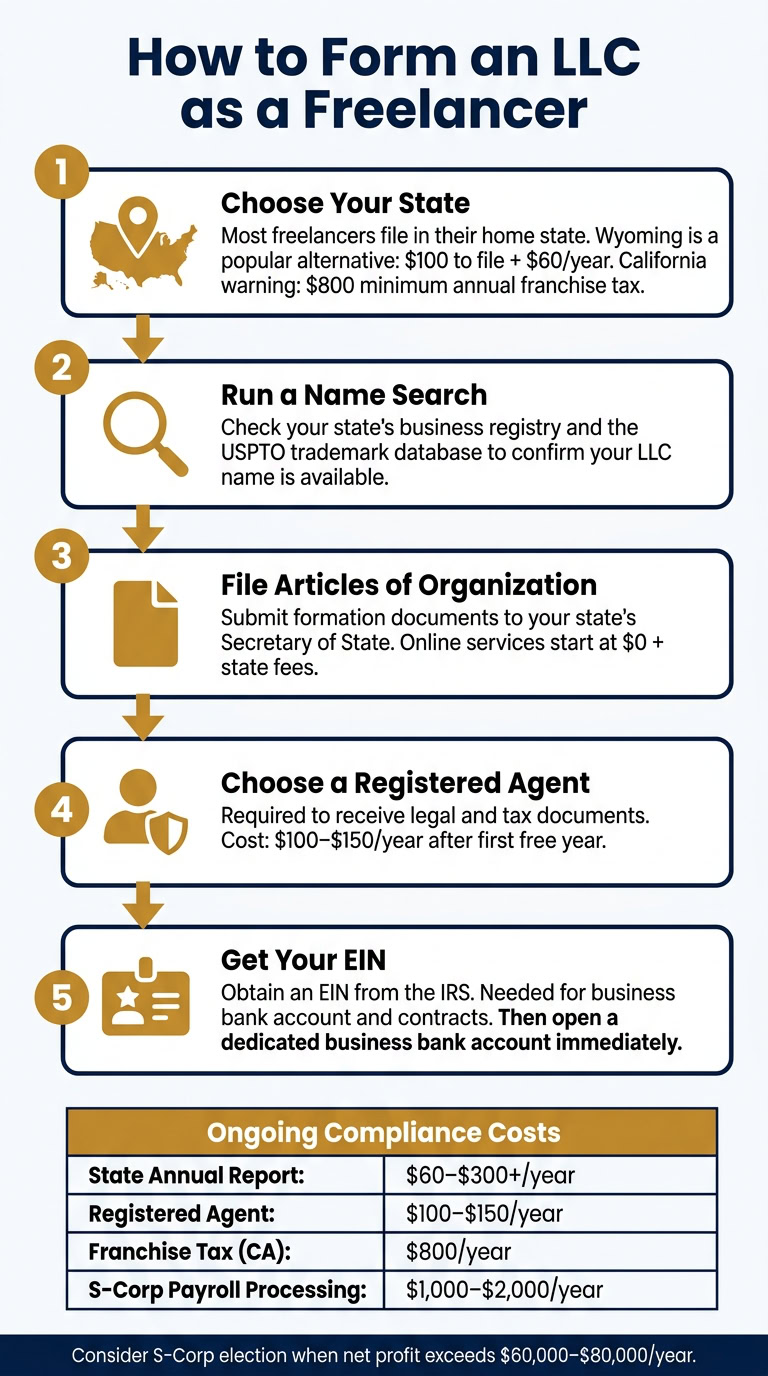
- Choose your state: Most freelancers stick to their home state for LLC formation. However, Wyoming is a popular alternative thanks to its low fees – just $100 to file and $60 annually – and strong privacy protections. If you’re in California, though, be prepared for the $800 minimum annual franchise tax, no matter your profit.
- Run a name search: Before filing, check your state’s business registry and the USPTO trademark database to ensure your chosen LLC name is available. Registering your LLC secures your business name at the state level, which a DBA (Doing Business As) doesn’t offer.
- File your Articles of Organization: Submit your LLC formation documents – often called "Articles of Organization" or "Certificate of Organization" – to your state’s Secretary of State. Services like BusinessAnywhere can handle this process online, starting at $0 plus state fees, and include free registered agent service for the first year.
- Choose a registered agent: Every LLC must designate a registered agent to receive legal and tax documents during business hours. After the first free year, this service typically costs $100–$150 annually. BusinessAnywhere offers it for $147 per year.
- Get your EIN: Obtain an Employer Identification Number (EIN) from the IRS. Even if you don’t have employees, you’ll need an EIN to open a business bank account and sign contracts professionally. BusinessAnywhere provides an EIN application service for $97, which includes preparation, submission, and follow-up. Once you have your EIN, open a dedicated business bank account. This step is crucial for keeping your personal and business finances separate.
Keeping Your LLC Compliant Over Time
After forming your LLC, staying compliant is essential to maintain its benefits (see this LLC compliance checklist for state-specific rules). Setting up the LLC is straightforward, but keeping it in good standing requires ongoing attention.
The most important rule? Keep your finances separate.
"Mixing personal and business finances is the fastest way to lose your LLC’s liability protection (piercing the corporate veil)." – Shepherd Nyakudya, Founder, USLLCGlobal
Run all business transactions through your LLC’s bank account. Update your contracts, invoices, and W-9 forms with the LLC name, and notify clients and vendors to direct payments to your business account.
On the administrative side, don’t miss deadlines for your state’s annual report or your registered agent service renewal. Failing to meet these requirements can lead to your LLC being dissolved. Here’s a quick breakdown of recurring costs to plan for:
| Compliance Requirement | Frequency | Estimated Cost |
|---|---|---|
| State Annual Report | Annually/Biennially | $60–$300+ |
| Registered Agent Service | Annually | $100–$150 |
| Franchise Tax (e.g., CA) | Annually | $800 |
| S-Corp Payroll Processing | Monthly/Quarterly | $1,000–$2,000/year |
If your net profit exceeds $50,000–$60,000 annually, consider filing IRS Form 2553 to elect S-Corp status. BusinessAnywhere offers an S-Corp tax election service for $97, which handles the filing process for you. Keep in mind that S-Corp status involves additional responsibilities, like running payroll and filing corporate tax returns, but the tax savings often make it worthwhile.
For freelancers who prefer a one-stop solution, BusinessAnywhere provides services for formation, registered agent renewal, EIN applications, annual filings, and S-Corp elections. Their business registration and existing company maintenance packages are designed to simplify the entire process.
Conclusion: Should You Form an LLC for Your Freelance Business?
The decision to form an LLC comes down to your annual net profit and the level of risk your business faces. If your net profit is under $30,000, sticking with a sole proprietorship or formalizing your business and securing liability insurance (which typically costs $300–$600 per year) might be enough. However, as your income grows, transitioning to an LLC – and possibly later to S-Corp status – can bring added benefits, including significant savings on self-employment taxes.
An LLC offers more than just tax perks. It protects your personal assets, provides more tax flexibility, and enhances your business’s credibility. These benefits not only safeguard you from potential lawsuits but also make your business more appealing to clients who prefer working with formally established entities.
"The $50–$100 you save by skipping an LLC can cost you tens of thousands if you’re sued. If you own a home or have savings, the LLC is worth it." – 1099Freelance
While forming an LLC does require paying state fees and annual report costs, for many freelancers, this is a small price to pay for the protection and professionalism it brings. While no business structure can solve every problem, an LLC effectively addresses three major concerns: personal liability, tax inefficiency, and credibility.
FAQs
Do I still need business insurance if I form an LLC?
No, forming an LLC doesn’t eliminate the need for business insurance. While an LLC helps shield your personal assets by limiting personal liability, it doesn’t cover everything. Business insurance steps in to protect against risks like malpractice, errors, or unforeseen incidents that the LLC structure alone can’t address. Together, they offer a more complete safety net for your business.
What counts as a “reasonable salary” with an S-Corp election?
A “reasonable salary” for an S-Corp owner usually falls between 40% and 60% of the net profit. This range is influenced by factors such as industry norms, your specific responsibilities, and where you operate. For instance, if your business generates $100,000 in profit, an appropriate salary might range from $50,000 to $60,000. This approach helps meet IRS requirements while still taking advantage of tax savings.
Will I need a new bank account and contracts after forming an LLC?
Yes, you’ll need to set up a separate business bank account and update your contracts to include your LLC’s legal name and EIN. This step is crucial for maintaining clear legal and financial boundaries, which helps protect your liability and ensures your business remains compliant with regulations.