


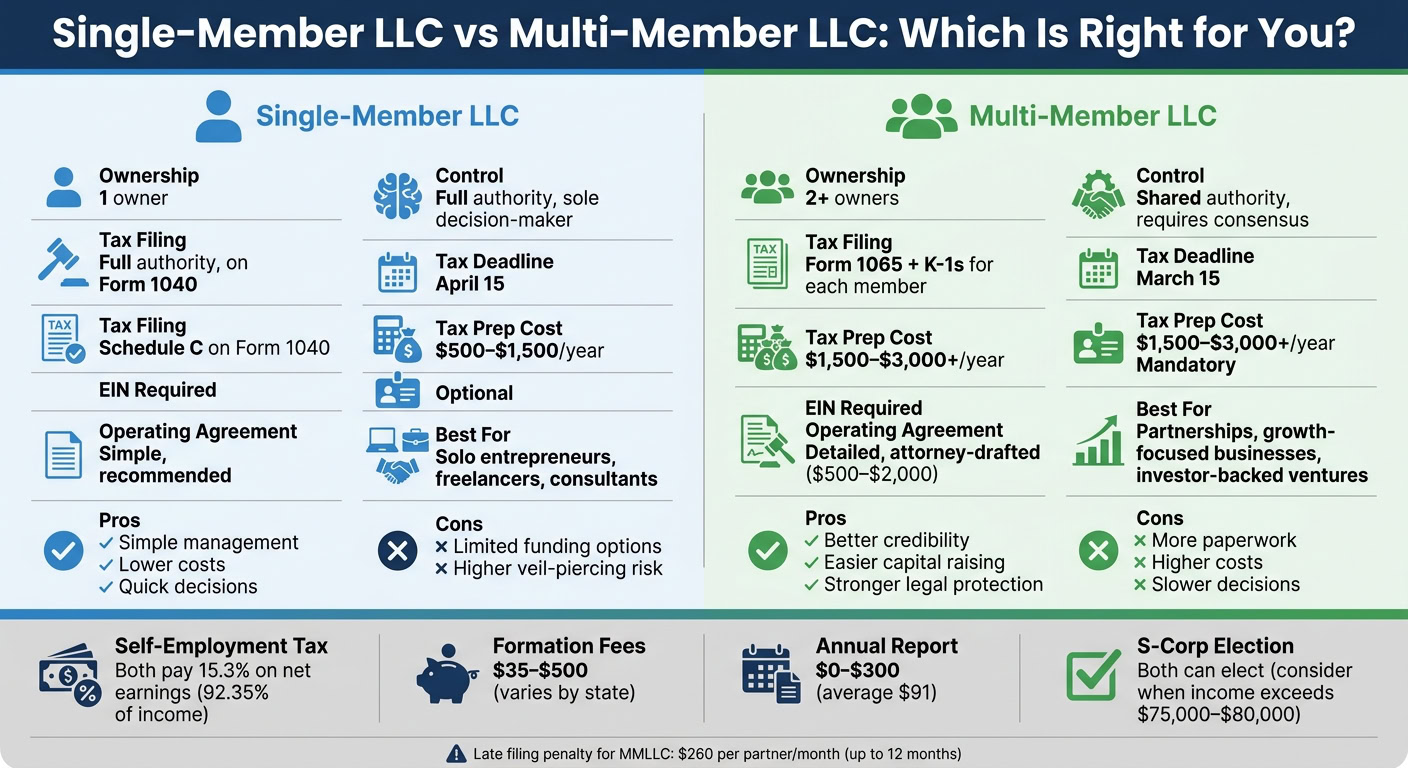
Choosing between a Single-Member LLC (SMLLC) and a Multi-Member LLC (MMLLC) depends on your goals, team setup, and willingness to manage complexity. Here’s a quick overview:
- SMLLC: Simple to manage, lower tax prep costs, full control, but limited funding options and higher personal liability risks.
- MMLLC: Shared decision-making, better for raising capital, stronger legal protections, but more paperwork, higher costs, and slower processes.
Key Differences:
- Taxes: SMLLCs file taxes through Schedule C (due April 15), while MMLLCs file Form 1065 and K-1s (due March 15).
- Control: SMLLCs offer sole authority; MMLLCs require collaboration and agreements.
- Compliance: MMLLCs need detailed operating agreements and stricter record-keeping and compliance.
Quick Tip: If you’re a solo entrepreneur, SMLLCs are simpler. For partnerships or growth-focused businesses, MMLLCs offer more flexibility and credibility.
Ownership and Management Control Differences
When it comes to LLC structures, the key distinction lies in who holds the decision-making power. In a Single-Member LLC (SMLLC), one person calls the shots. In contrast, a Multi-Member LLC (MMLLC) spreads authority across multiple owners, which can significantly impact how the business operates day-to-day.
Single-Member LLC: One Owner, Full Authority
In an SMLLC, you’re the boss – plain and simple. Every decision, from signing contracts to shifting strategies, is entirely up to you. This setup allows for quick changes without the need to consult others or reach a consensus.
However, with great control comes great responsibility. Since you’re the sole owner, you either handle all operational tasks yourself or delegate them. There’s no one to share the workload or the accountability.
One key point to remember: keep your business and personal finances completely separate. Courts are more likely to "pierce the corporate veil" in Single-Member LLCs if you fail to maintain this separation. Maintaining thorough records and having a clear operating agreement can protect your LLC’s legal status and make compliance tasks smoother down the road.
Unlike the streamlined control of an SMLLC, a Multi-Member LLC introduces shared authority, which brings its own set of dynamics.
Multi-Member LLC: Distributed Authority
In an MMLLC, decision-making becomes a collaborative process. Major actions – like taking out a loan, signing a significant contract, or altering the company’s direction – usually require a majority vote or, in some cases, unanimous approval. The specifics depend on the operating agreement.
You can choose between two management structures:
- Member-managed LLC: All owners are actively involved in daily operations and decision-making.
- Manager-managed LLC: Members appoint a manager (who could be a member or an outsider) to handle daily operations, while other members focus on broader strategies or remain passive. This setup works well if you have investors who want ownership but prefer not to handle the day-to-day grind.
The operating agreement is the backbone of an MMLLC. It should clearly outline voting rights, the percentage needed for various decisions, dispute resolution processes, and what happens if a member leaves or passes away. A well-thought-out agreement can save you from future legal headaches by setting clear rules from the start.
While shared control may slow down decision-making, it brings the advantage of diverse skills and perspectives. For example, one member might excel in financial management while another takes charge of operations. This collaborative approach also allows you to pool resources, making it easier to tackle challenges and grow the business.
Tax Differences Between Single-Member and Multi-Member LLCs
Now that we’ve covered management control, let’s dive into how your LLC structure affects tax obligations. Whether you’re operating as a Single-Member or Multi-Member LLC, the IRS treats each differently, impacting the forms you file, deadlines, and even self-employment tax responsibilities.
How the IRS Classifies Each LLC Type

The IRS views a Single-Member LLC as a disregarded entity by default. This means the LLC itself doesn’t need to file a separate tax return. Instead, all income and expenses are reported directly on your personal tax return – typically on Schedule C (for most businesses), Schedule E (for rental properties), or Schedule F (for farming activities).
"An individual owner of a single-member LLC that operates a trade or business is subject to the tax on net earnings from self employment in the same manner as a sole proprietorship." – Internal Revenue Service
On the other hand, the IRS treats Multi-Member LLCs as partnerships. These LLCs must file Form 1065, which is an informational return. Each member then receives a Schedule K-1 that outlines their share of the LLC’s profits, losses, and deductions. Members report this information on their personal tax returns, but the partnership itself doesn’t pay income tax – its members do.
Multi-Member LLCs are required to obtain an EIN (Employer Identification Number), while Single-Member LLCs can use the owner’s Social Security Number. However, getting an EIN is often recommended for Single-Member LLCs if you plan to hire employees or open a business bank account.
There’s a unique exception for married couples in nine community property states (Arizona, California, Idaho, Louisiana, Nevada, New Mexico, Texas, Washington, and Wisconsin). If both spouses own the LLC, they may qualify as a "qualified joint venture." This classification allows them to file as a Single-Member LLC by submitting two Schedule Cs, sidestepping the complexity of Form 1065.
Self-Employment Taxes and S-Corp Election
When it comes to self-employment taxes, both Single-Member and Multi-Member LLCs face the same rate: 15.3% on net earnings, applied to 92.35% of your income. For Single-Member LLCs, this tax applies to the entire net profit. In Multi-Member LLCs, each member pays this tax on their share of the profits.
Both types of LLCs can choose to file as an S-Corp by submitting Form 2553 to the IRS. This election allows you to split your earnings into two parts: a salary (subject to payroll taxes) and distributions (not subject to self-employment tax). For example, if your LLC earns $100,000 and you allocate $50,000 as salary, you could save around $6,480 in self-employment taxes. However, managing payroll introduces additional costs, so many experts suggest considering S-Corp status only when your net income consistently exceeds $75,000 to $80,000.
Tax Comparison Table
| Factor | Single-Member LLC | Multi-Member LLC |
|---|---|---|
| IRS Default Status | Disregarded Entity | Partnership |
| Primary Tax Form | Form 1040, Schedule C | Form 1065 |
| Member Tax Form | Reported on Form 1040 | Schedule K-1 |
| 2026 Filing Deadline | April 15, 2026 | March 15, 2026 |
| Self-Employment Tax | 15.3% on net profit | 15.3% on distributive share |
| EIN Requirement | Optional (unless you have employees) | Mandatory |
| Tax Prep Cost | $500–$1,500 annually | $1,500–$3,000+ annually |
Tax preparation costs also differ significantly between the two structures. Single-Member LLCs typically spend $500 to $1,500 annually, while Multi-Member LLCs can expect to pay $1,500 to $3,000 or more, given the added complexity of preparing Form 1065 and Schedule K-1. Missing deadlines can be costly, too – Multi-Member LLCs face penalties of up to $260 per partner, per month (for up to 12 months) if Form 1065 is filed late.
These tax distinctions are crucial when deciding which LLC structure best suits your business needs.
Paperwork and Compliance Requirements
When it comes to administrative tasks, Single-Member and Multi-Member LLCs differ significantly. While both share some basic requirements, Multi-Member LLCs involve more complex record-keeping and compliance obligations. These differences can directly impact how efficiently each structure operates. Here’s a breakdown of how their documentation and filing requirements vary.
Formation and Maintenance Documents
Both types of LLCs start with the same foundational step: filing Articles of Organization (or a Certificate of Formation, depending on the state). Filing fees range widely, from $35 to $500, depending on the state. For example, in Florida, the cost is $125, plus a $25 fee for designating a registered agent, totaling $150.
Every LLC must appoint a registered agent with a physical address in the state of formation to handle legal documents and service of process. This rule applies equally to both Single-Member and Multi-Member LLCs.
The Operating Agreement, however, is where things start to diverge. While not legally required in most states, this document is crucial – especially for Multi-Member LLCs. It outlines ownership percentages, voting rights, profit-sharing methods, and other key details. For Single-Member LLCs, a simpler version often suffices, focusing on management authority and succession planning. On the other hand, Multi-Member LLCs typically require attorney-drafted agreements, which can cost between $500 and $2,000.
When it comes to tax identification, Multi-Member LLCs are required to obtain an Employer Identification Number (EIN) from the IRS, even if they don’t hire employees. Single-Member LLCs can technically use the owner’s Social Security Number, but getting an EIN is highly recommended for tasks like opening business bank accounts and avoiding the need to share personal SSNs on forms like W-9s.
Annual Filings and Associated Costs
Ongoing filing requirements highlight another key difference. Single-Member LLCs report their income on the owner’s personal tax return (Form 1040, Schedule C), which is due by April 15. Multi-Member LLCs, however, must file Form 1065, an informational partnership return, by March 15, along with Schedule K-1s for each member.
This difference in tax filing translates into higher preparation costs. Single-Member LLC tax preparation typically costs between $500 and $1,500 annually. For Multi-Member LLCs, the added complexity of tracking capital contributions and preparing K-1 schedules can push costs to $1,500–$3,000 or more.
Most states also require LLCs to submit an annual or biennial report to maintain active status. Fees for these reports average around $91 but can range from $0 to $300 depending on the state. Missing this filing can result in administrative dissolution of the LLC. While both structures must file these reports, Multi-Member LLCs also need to maintain detailed records of member meetings and major decisions to reinforce liability protection.
Filing deadlines are especially critical for Multi-Member LLCs. The IRS imposes steep penalties for late Form 1065 filings – $260 per partner, per month, for up to 12 months. For example, a three-member LLC filing two months late would face $1,560 in penalties.
Compliance Comparison Table
Here’s a quick reference table summarizing the compliance differences:
| Requirement | Single-Member LLC | Multi-Member LLC |
|---|---|---|
| State Formation Document | Articles/Certificate of Organization | Articles/Certificate of Organization |
| Formation Fee Range | $35–$500 (varies by state) | $35–$500 (varies by state) |
| Operating Agreement | Recommended; simple format | Essential; detailed provisions |
| Operating Agreement Cost | $100–$500 (self-prepared) | $500–$2,000 (attorney-drafted) |
| EIN Requirement | Optional (recommended) | Mandatory |
| Annual State Report Fee | $0–$300 (avg. $91) | $0–$300 (avg. $91) |
| Record-Keeping Complexity | Basic financial separation | Capital accounts and distributions tracking |
| Meeting Minutes | Not required | Highly recommended |
| Late Filing Penalty | Standard personal tax penalties | $260/partner/month (up to 12 months) |
One key compliance rule for both structures is maintaining strict separation between personal and business finances. Single-Member LLCs are particularly vulnerable here, as failing to keep proper records could lead courts to classify the business as a sole proprietorship, removing liability protections.
If you’re transitioning from a Single-Member to a Multi-Member LLC by adding a partner, the process can take four to six weeks. This involves obtaining a new EIN, updating your Operating Agreement to reflect partnership tax rules, and amending state records. Services like Business Anywhere can help streamline this process, offering registered agent services for as little as $147 per year, with the first year free when bundled with business registration.
sbb-itb-ba0a4be
Pros and Cons: Single-Member vs Multi-Member LLCs
Choosing between a Single-Member LLC and a Multi-Member LLC comes down to weighing simplicity against shared responsibilities and protections. Each option has its own set of advantages and challenges, which can influence how your business operates and grows.
Single-Member LLCs are ideal if you prioritize simplicity and direct control. With this structure, you handle taxes through your personal return using Schedule C, avoiding the complications of partnership filings. Decision-making is entirely in your hands, making operations smoother and faster. However, you’ll shoulder the full self-employment tax of 15.3% on 92.35% of your net income. Raising capital can also be tough since bringing in new investors or partners isn’t straightforward. Additionally, courts may scrutinize single-owner LLCs more closely, which could impact liability protections. These factors shape both the financial and practical aspects of running your business.
On the other hand, Multi-Member LLCs spread out responsibilities, risks, and benefits among multiple members. This structure offers stronger legal protections through charging order provisions, which help shield LLC assets from personal creditors. Profits can be distributed flexibly, regardless of ownership percentages, and members can pool their skills and resources. Banks and investors often see multi-member LLCs as more credible. That said, tax preparation is more involved, requiring Form 1065 and K-1s for each member. The IRS imposes steep penalties – $260 per partner, per month (up to 12 months) – for late filings. Decision-making can be slower, as consensus is often needed, and one partner’s mistake could expose the entire group to liability.
Side-by-Side Comparison
| Factor | Single-Member LLC | Multi-Member LLC |
|---|---|---|
| Tax Filing Simplicity | ✓ Uses Schedule C on personal return | ✗ Requires Form 1065 and K-1s |
| Annual Tax Prep Cost | $500–$1,500 | $1,500–$3,000+ |
| Decision-Making Speed | ✓ Swift; sole control | ✗ Slower; requires consensus |
| Liability Protection | Standard; higher risk of veil piercing | Enhanced; charging order protection |
| Capital Raising Ability | ✗ Limited by a single owner’s resources | ✓ Can add members and distribute ownership |
| Self-Employment Tax | Full burden on sole owner | Shared among active members |
| Late Filing Penalty | Standard personal tax penalties | $260 per partner/month (up to 12 months) |
| Operating Agreement | Minimal, informal documentation | Detailed, often attorney-drafted ($500–$2,000) |
| Audit Risk (2026) | Low for income under $400,000 | 10x increase for complex partnerships |
| Credibility with Lenders | May appear less established | Viewed as more formal and credible |
| Partner Risk Exposure | None – no risk from partners | One member’s actions can affect all members |
Your decision ultimately hinges on whether you prefer the straightforward management and autonomy of a Single-Member LLC or the collaborative approach and increased legal protections of a Multi-Member LLC.
How to Choose the Right LLC Structure
What to Consider Before Deciding
Choosing between a Single-Member LLC and a Multi-Member LLC depends on your current needs and long-term plans. Start by evaluating your team setup. If you’re a freelancer or consultant who values complete control, a Single-Member LLC might be ideal. On the other hand, if you’re working with co-founders or plan to bring in investors, a Multi-Member LLC may better suit your goals.
Next, think about your decision-making style. A Single-Member LLC allows you to act quickly without needing to consult others – no meetings, no votes. In contrast, a Multi-Member LLC requires collaboration and agreement among partners, which might slow decision-making but can lead to more balanced outcomes for those who appreciate teamwork.
Your financial needs and ability to secure funding also play a role. Multi-Member LLCs often appear more established to banks and investors, as the involvement of multiple members suggests shared commitment and credibility. In comparison, a Single-Member LLC relies entirely on your personal credit and assets, which can limit funding opportunities. These financial considerations tie directly to your plans for growth.
If you anticipate rapid expansion or plan to add partners soon, starting as a Multi-Member LLC can save you the hassle of converting later. Transitioning from a Single-Member to a Multi-Member LLC takes four to six weeks and requires obtaining a new EIN from the IRS.
Example Scenarios
Here are a few examples to show how control, tax simplicity, and credibility might influence your decision.
A freelance graphic designer earning $65,000 a year might find a Single-Member LLC the best fit. She manages all her client relationships, makes quick decisions about her projects, and doesn’t need outside funding. Her tax filing is straightforward – she uses Schedule C on her personal tax return – and she retains full creative control over her work.
Now consider two software developers launching a SaaS product together. They pool $40,000 in startup capital and plan to seek angel investors within 18 months. One focuses on backend development, while the other handles sales and marketing. A Multi-Member LLC allows them to formalize their profit-sharing arrangement (e.g., 60/40 instead of an even split) and distribute Schedule K-1s to future investors. It also helps them appear more credible to clients and lenders.
Finally, think about a real estate investor who starts with a Single-Member LLC. As their net income grows beyond $75,000 to $80,000, they might consider switching to a Multi-Member LLC and electing S-Corp status to save on taxes. For instance, on a $100,000 income, allocating $50,000 as salary could save around $6,480 in taxes. Additionally, a Multi-Member LLC can provide stronger protection against personal creditors attempting to access LLC assets.
Conclusion
When deciding between a Single-Member LLC (SMLLC) and a Multi-Member LLC (MMLLC), the choice ultimately depends on your team setup, decision-making preferences, and how much complexity you’re willing to handle when you file taxes for an LLC. SMLLCs provide full control and simpler tax filing through Schedule C (due April 15). On the other hand, MMLLCs involve collaboration, require filing Form 1065 along with K-1s (due March 15), and often come with higher accounting costs. However, MMLLCs tend to be seen as more reliable by lenders and offer stronger protection against personal creditors.
Both structures involve self-employment taxes, but MMLLCs come with additional filing risks, including harsher penalties for late submissions. Administrative costs are also higher for MMLLCs, with annual tax preparation expenses typically ranging from $1,500 to over $3,000, compared to $500 to $1,500 for SMLLCs.
"Your LLC structure isn’t a matter of checking a box on articles of organization. It’s one of the first and most critical strategic decisions you make for your business." – LLC Attorney
This quote underscores how important it is to choose the right structure. If you value quick decision-making and simplicity, an SMLLC might be the best fit. But if collaboration and stronger legal protections are priorities, an MMLLC could be the better option. For those pooling resources with partners or seeking outside investment, an MMLLC provides the structure needed for growth.
Your decision should align with both your current situation and long-term goals. Solo professionals like consultants or freelancers often thrive with SMLLCs, while co-founders launching a business together benefit from the shared accountability and formal collaboration of an MMLLC. Regardless of your choice, keep personal and business finances separate. And if your net profit regularly exceeds $75,000 to $80,000, consider electing S-Corp status for potential tax savings.
FAQs
Can I switch from a single-member LLC to a multi-member LLC later?
Yes, transitioning from a single-member LLC to a multi-member LLC is possible. To make this change, you’ll need to file the appropriate forms with your state, update your operating agreement to reflect the new ownership structure, and inform the IRS. Additionally, you might need to apply for a new EIN (Employer Identification Number). Make sure to comply with all legal and tax regulations to ensure the process runs smoothly.
Do I need an EIN for a single-member LLC?
A single-member LLC typically needs an Employer Identification Number (EIN) if it has employees or is required to file specific tax returns. While many single-member LLCs can use the owner’s Social Security Number (SSN) for tax purposes, getting an EIN is often a smart move. Why? It helps keep personal and business finances separate, making it easier to manage taxes and open business bank accounts.
When does an LLC S-corp election make sense?
An LLC S-corp election can help single-member LLCs with higher profits save on self-employment taxes. Here’s how it works: only the owner’s salary is subject to payroll taxes, while the rest of the profits can be distributed as dividends, which aren’t subject to self-employment tax.
However, this setup comes with some responsibilities. You’ll need to file IRS Form 2553, pay yourself a reasonable salary, and handle payroll taxes. For LLCs with modest profits, the extra administrative work and costs might not be worth it.