


Managing taxes for remote employees across multiple states can be complex but essential to avoid penalties. Here’s what you need to know:
- Tax Withholding Rules: Taxes are usually based on where employees physically work, but some states also tax residents on all income, creating dual obligations.
- State Nexus: Hiring remote workers in new states often triggers tax responsibilities like payroll taxes, unemployment insurance, and state registration.
- Reciprocity Agreements: Some states simplify compliance by allowing taxes to be withheld only for the employee’s home state, but employees must submit exemption forms.
- Special Rules: States like New York enforce the "convenience of the employer" rule, taxing remote workers based on the employer’s location if remote work isn’t business-required.
- No De Minimis Threshold: In 21 states, tax withholding starts from day one of work in the state.
- Compliance Steps: Register as a foreign entity, set up payroll accounts, and track employee work locations accurately to meet state-specific requirements.
Key Takeaway: Stay proactive with tax registrations, monitor state laws, and use automated payroll systems to ensure compliance. Missing these steps can lead to hefty penalties and administrative headaches.
Understanding State Tax Obligations for Remote Employees
Navigating state tax requirements for remote employees can be tricky. To stay compliant, you need to figure out which state has the authority to tax your employee’s wages. A misstep here – like withholding taxes for the wrong state – can lead to missed registrations or unexpected penalties.
Work State vs. Residence State
Taxes are generally withheld based on where the employee physically works, not where your company is headquartered. However, most states also tax residents on all their income, no matter where they work. This means if an employee lives in one state but works in another – say, they commute across state lines – both states may want a share of the taxes.
"The physical location of work controls the withholding obligation." – Nicole Sievers, Warp
It’s worth noting that nine states don’t impose individual income tax on wages: Alaska, Florida, Nevada, New Hampshire, South Dakota, Tennessee, Texas, Washington, and Wyoming.
But taxes don’t stop at withholding. Hiring remote employees often creates a tax nexus, which carries additional responsibilities.
Tax Nexus and Remote Employees
When you hire a remote worker in a new state, you establish a tax nexus. This means you’ll likely need to handle payroll taxes, state income tax withholding, and state unemployment insurance (SUI). It also often requires registering as a foreign entity with the state’s Secretary of State.
"A single remote employee in a new state can trigger five or more separate registration and filing obligations for the employer. This is not hypothetical – state tax agencies actively use new hire reporting data to identify employers who should be registered but are not." – Rachel Richardson, Head of Growth & Marketing, Grove HR
Unemployment insurance is determined by a four-factor test that looks at where the work happens, the base of operations, the place of direction and control, and the employee’s residence. Many states require businesses to register for withholding and SUI within 20 to 30 days after issuing the first payroll in that state. To avoid delays, it’s smart to start the registration process before the employee’s first day.
These nexus rules lay the foundation for understanding more specific tax considerations, like reciprocity agreements and the convenience rule.
Reciprocity Agreements and Special Rules
Reciprocity agreements can simplify tax compliance for employees who live in one state but work in another. These agreements allow employers to withhold taxes only for the employee’s state of residence, eliminating the need for dual filings. Currently, about 16 states and the District of Columbia have reciprocity agreements.
However, reciprocity isn’t automatic. Employees must submit a state-specific exemption certificate – like Pennsylvania’s Form REV-419 – to ensure taxes are withheld for their home state. Without this form, employers must withhold taxes for the state where the employee works.
Then there’s the "convenience of the employer" (COE) rule, which adds another layer of complexity. This rule applies in eight states, including New York, Pennsylvania, Nebraska, Delaware, Connecticut, New Jersey, Alabama, and Oregon. If an employee works remotely for personal convenience rather than a clear business need, the employer’s state might require tax withholding – even if the employee doesn’t live there. New York, in particular, enforces this rule aggressively, as highlighted in the Zelinsky case decided by its Tax Appeals Tribunal in May 2025.
"Hiring remotely because that is where the candidate lives is not a qualifying business necessity [under New York’s convenience rule]." – Nicole Sievers, Warp
The financial impact of this rule can be steep. For instance, a remote worker living in New Jersey but employed by a New York-based company could face an additional $2,000 to $15,000 or more in annual taxes.
sbb-itb-ba0a4be
State Registration and Compliance for Multi-State Employers
When a remote employee triggers a tax nexus, it’s crucial to register within 20–30 days. Delaying could lead to penalties, back taxes, or even limitations on enforcing contracts in that state’s courts.
Registering as a Foreign Entity
This process includes two key steps: foreign qualification with the Secretary of State and employer registration with tax and labor agencies.
"Foreign qualification is a corporate law requirement; employer registration is a tax and labor law requirement. An employer can be delinquent on one and compliant on the other." – Multi-State Employer
Here’s what foreign qualification involves:
- Check business name availability in the new state.
- Obtain a Certificate of Good Standing from your home state (must be recent).
- Appoint a registered agent with a physical address in the new state.
- File for a Certificate of Authority and pay the required fees.
State filing fees vary widely. For example:
- California: $70 fee plus an $800 minimum annual franchise tax.
- Texas: $750 fee, with possible retroactive late fees.
- New York: $250 fee, potentially with additional newspaper publication costs.
Once foreign qualification is complete, take these steps:
- Open a state employer withholding account.
- Set up a State Unemployment Insurance (SUI) account.
- Secure workers’ compensation coverage.
- Report the new hire to the state within 20 days of their start date.
For businesses entering multiple states, professional registered agent services can simplify the process, offering a consistent point of contact in each location. After registration, staying compliant with each state’s specific requirements becomes an ongoing responsibility.
Staying Current with State Agency Requirements
Registering your business is just the beginning – keeping up with state agency requirements is an ongoing task. States often update filing deadlines, tax rates, and reporting rules. Missing these changes, even if other filings are up to date, can result in penalties.
"Under the aptly named ‘door-closing’ statutes adopted in virtually every state, a foreign entity doing business in a state without proper registration may be barred from filing suit to enforce its contracts." – Rob G. Breunig and Joshua L. Rojas, Adams and Reese LLP
Each state has unique requirements, such as annual report deadlines, unemployment insurance rate updates, and withholding schedules. Manually tracking these across multiple jurisdictions is challenging and prone to errors. A centralized compliance dashboard can simplify this process by flagging upcoming deadlines and changes to account details.
BusinessAnywhere‘s compliance support and existing company maintenance services offer tools for multi-state management. These services handle registered agent duties and annual filings, all accessible from a single online dashboard – making it easier to stay ahead of evolving state requirements.
Building Reliable Withholding and Reporting Workflows
Once registration is complete, the next step is creating dependable payroll workflows to maintain ongoing tax compliance. Multi-state withholding isn’t a one-time setup – it’s a continuous process that can falter if workflows are disorganized or data isn’t consistent.
Automating Payroll Calculations
The foundation of accurate multi-state payroll lies in automating calculations. A key step is making the work location field in your HRIS or payroll system mandatory, effective-dated, and separate from the home address. Without proper management of this field, payroll software won’t be able to calculate the correct withholding amounts.
Precise work location data is essential to ensure compliance with tax obligations. Many advanced payroll systems use geocoding to pinpoint exact local tax requirements, which is especially important in states like Ohio and Pennsylvania, where both city and county taxes often apply in addition to state taxes. Relying solely on ZIP code–based lookups can lead to missed local tax obligations.
Automation also simplifies complex scenarios like reciprocity agreements and "convenience of the employer" rules. For instance, eight states – Alabama, Connecticut, Delaware, Nebraska, New Jersey, New York, Pennsylvania, and Oregon – may tax remote workers based on the employer’s location if the remote work isn’t deemed a business necessity. Before you compare business formation and payroll services, check if they handle new-state registrations and local tax setups automatically or if they require you to provide this information.
Once calculations are automated, the next focus should be establishing clear filing calendars and internal controls.
Setting Up Filing Calendars and Internal Controls
While automation minimizes errors, disciplined processes are still critical. Every location change – whether it’s a permanent move or a temporary remote work arrangement – should follow a formal change process. This includes documented approval and a clearly defined effective date before payroll updates are made.
"Multi-state payroll is a ‘change control’ problem." – HR Decision Guide
Implementing a centralized notices workflow is equally important. State agencies often send notices about missing registrations, rate adjustments, or filing discrepancies. Without a structured process – such as a single inbox, an intake checklist, and clear deadlines – these notices can be overlooked, leading to penalties.
The table below outlines essential control steps for multi-state employers:
| Control Step | Purpose | Evidence to Retain |
|---|---|---|
| System of Record | Maintain a single source for work location | System configuration note |
| Effective Dating | Track when tax obligations change | Change log with approved dates |
| Approval Step | Prevent errors from informal location changes | Documented manager/HR approval |
| Preview Check | Validate setup before payroll runs | Screenshot or note of preview results |
| Notices Workflow | Avoid missed deadlines and penalties | Centralized notice log and resolution notes |
Regularly reviewing location changes is crucial to ensure payroll systems accurately reflect where employees are working. Store SUI notices in designated state folders and set calendar reminders for annual updates to keep everything on track.
Even with these controls, mistakes can happen, so having a plan to address errors is essential.
Correcting Reporting Errors
Even the most thorough payroll processes can occasionally result in errors. A common issue is withholding taxes for the wrong state, often caused by failing to update an employee’s work location after they move. To prevent this, conduct a "preview validation" before finalizing payroll runs or after any location changes. This ensures hours, earnings, and withholding amounts are accurate. If an employee moves mid-year, reconcile state withholding immediately to avoid complications at year-end.
At the end of the year, double-check W-2 forms, specifically Box 16 (State wages) and Box 17 (State income tax), for employees who worked in multiple states. If errors are found after filing, issue a Form W-2c (Corrected Wage and Tax Statement) and file amended returns in both the incorrect and correct states to reconcile year-to-date withholding.
For unresolved or older obligations, many states offer Voluntary Disclosure Agreements (VDAs). These agreements allow employers to come into compliance with reduced penalties and interest.
"Most states have voluntary disclosure agreements (VDAs) that let employers come into compliance with reduced penalties. The longer you wait, the more interest and penalties accrue." – Nicole Sievers, Warp
Special Situations for Multi-State and Mobile Employees
While standard payroll processes handle most scenarios, some situations require extra care. Employees who divide their time among multiple states, travel frequently for work, or temporarily relocate can create tax obligations that go beyond routine payroll handling.
Allocating Wages for Multi-State Work Assignments
When employees work in more than one state during a pay period, wages must be allocated accordingly. This often requires manual adjustments beyond automated payroll systems. The most common approach is time-based allocation: calculate the ratio of days worked in a specific state to the total workdays, then apply that ratio to the employee’s wages. For instance, if an employee works 60 days in New York and 180 days in New Jersey over a year, 25% of their wages would be allocated to New York and 75% to New Jersey.
Accurate day-tracking is crucial. Time logs or calendar records showing exactly where an employee worked each day are essential, especially during audits. Without these records, wage allocation becomes unreliable.
An important exception to this process is the "convenience of the employer" rule. This rule allows eight states – Alabama, Connecticut, Delaware, Nebraska, New Jersey, New York, Oregon, and Pennsylvania – to tax 100% of an employee’s wages if remote work is deemed the employee’s choice rather than a necessity for the employer. New York is particularly strict, requiring employers to start withholding taxes after just 14 days (on day 15).
"The physical location of work controls the withholding obligation." – Nicole Sievers, Warp
Unemployment Insurance (UI), however, is never split across states. It is assigned to a single state based on factors such as the employee’s primary work location, base of operations, direction and control, and residence.
Temporary Remote Work in Another State
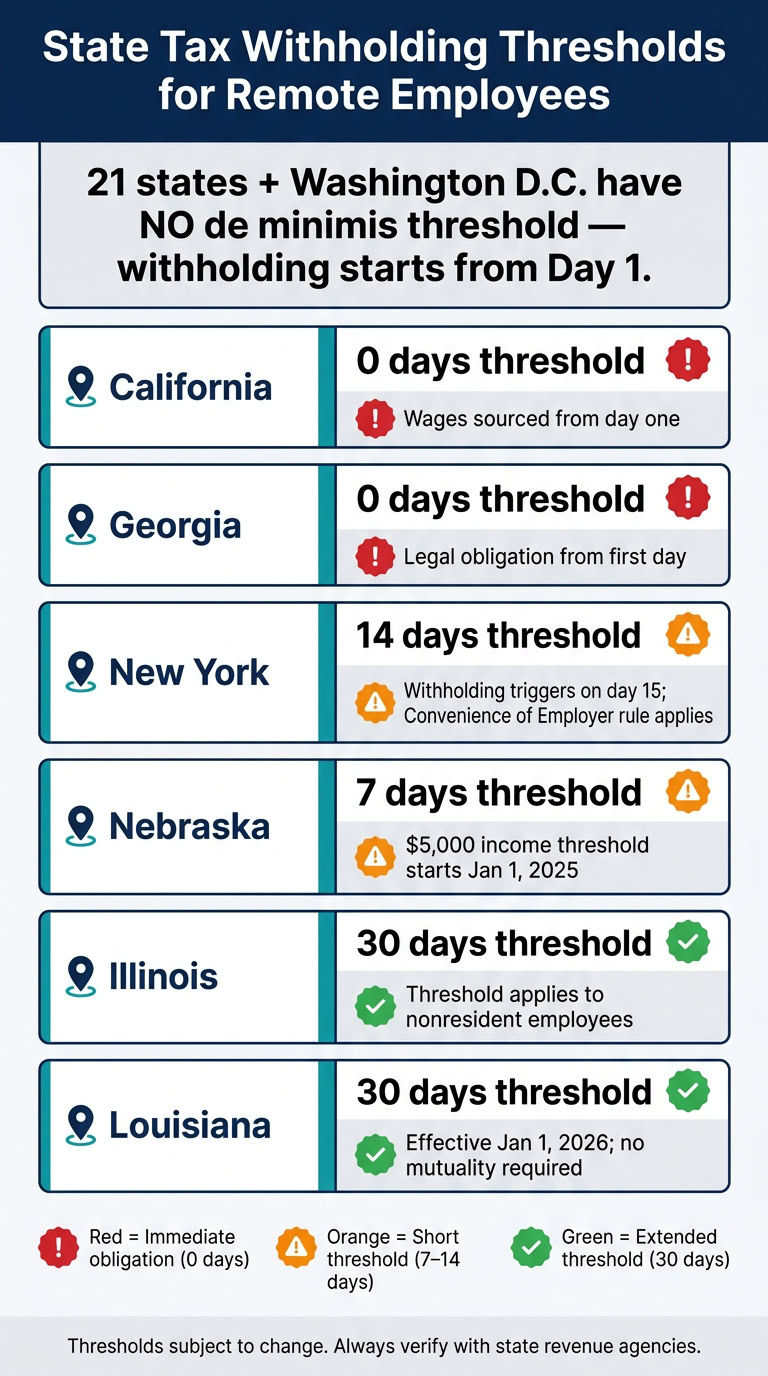
Even short-term work in a different state can trigger tax obligations. 21 states and Washington, D.C., have no de minimis threshold, meaning withholding can start from the first day. For example, California and Georgia require wage sourcing from day one.
Other states offer more leniency. Illinois allows a 30-day grace period before withholding begins, Nebraska has a 7-day threshold (with a $5,000 income requirement starting January 1, 2025), and Louisiana will implement a 30-day threshold starting January 1, 2026. The table below highlights varying thresholds across key states:
| State | Withholding Threshold for Nonresident Employees | Notable Rule |
|---|---|---|
| California | 0 days | Wages sourced from day one |
| Georgia | 0 days | Legal obligation from first day |
| New York | 14 days | Withholding triggers on day 15 |
| Nebraska | 7 days | $5,000 income threshold starts Jan 1, 2025 |
| Illinois | 30 days | Threshold applies to nonresident employees |
| Louisiana | 30 days | Effective Jan 1, 2026; no mutuality required |
"Discovering a multistate obligation in December – after twelve months of withholding to the wrong state – creates back registrations, amended filings, and potential penalties." – Vantage Advisors
Employees must inform HR immediately about any changes to their work location. This allows payroll teams to verify tax thresholds, check reciprocity agreements, and register in the new state if needed. Proactive communication prevents the chaos of retroactive corrections and penalties. Centralized tools can help simplify the tracking of these thresholds.
Using Centralized Recordkeeping Tools
Keeping detailed and organized records is critical for staying compliant with various state requirements. Managing multi-state compliance involves tracking numerous details, such as withholding certificates, registration credentials, time logs, tax notices, and employee location data. Disorganized records increase the risk of errors.
Platforms like BusinessAnywhere centralize compliance documentation, mail correspondence, and business records into one dashboard. For employers managing remote teams across multiple states, having all state tax notices, exemption certificates (like Pennsylvania’s Form REV-419 or Illinois’s IL-W-5-NR), and location records in one place makes responding to agency notices and conducting accurate wage allocations far easier during audits.
Ongoing Monitoring and Compliance Support
Managing multi-state tax compliance isn’t a one-and-done task. It requires constant attention as laws evolve, employees relocate, and your business expands.
Tracking Changes in State Tax Laws
Setting up accurate workflows is just the beginning – keeping them up-to-date is where the real challenge lies. State tax laws are constantly shifting, and even small changes can turn a compliant payroll process into a liability. For example, in 2026, 19 states increased their minimum wages, three new paid family and medical leave (PFML) programs were introduced, and Alabama and Louisiana adjusted their 30-day safe harbor thresholds. These updates directly impact withholding calculations, filing deadlines, and registration requirements.
To stay ahead, monitor official state revenue agency websites and subscribe to their email updates. Pay extra attention to states with remote employees, particularly those with strict enforcement like California, New York, and New Jersey. Additionally, keep an eye on reciprocity agreements – currently, only 15 states and Washington, D.C., participate. Any changes to these agreements can immediately affect how cross-border payroll withholding is handled.
"The general rule now is: employees create nexus wherever they work." – SmartSMS Solutions
Running Internal Payroll Audits
Regular payroll audits – ideally every quarter – are critical for catching compliance issues before they escalate into penalties. A major focus of these audits is ensuring that each employee’s recorded work address matches their actual location. This isn’t a one-time task but an ongoing process. As Teamed explains, "a single untracked remote-work move typically creates 4 additional compliance touchpoints covering tax registration, unemployment insurance, employment-law updates, and data privacy assessment".
Audits should reconcile quarterly state filings with payroll records to confirm accurate wage reporting for each state. In states with complex local tax systems, like Ohio – which has over 600 municipalities with their own income taxes – ensure employee addresses are geocoded correctly to the right jurisdiction. Also, check that exemption certificates are up-to-date and that paystubs comply with state-specific requirements. Missing deadlines for W-2 filings can be costly, with penalties ranging from $60 per form (if filed within 30 days) to $340 per form (if submitted after August 1).
Combining these internal checks with expert advice can help avoid expensive compliance missteps.
Getting Professional Tax Support
There are times when professional help is indispensable. If you’re dealing with a nexus questionnaire, multi-quarter withholding errors, or the complexities of "Convenience of the Employer" rules in strict states, consulting a SALT (State and Local Tax) advisor is a smart move. These experts are well-versed in apportionment formulas, multi-state tax and compliance requirements, and negotiating Voluntary Disclosure Agreements (VDAs) to minimize penalties for past mistakes.
For businesses managing remote teams across multiple states, tools like BusinessAnywhere can simplify compliance. These platforms centralize documents, state correspondence, and business records in one dashboard, making it easier to handle agency notices and keep everything audit-ready. Pairing such technology with expert tax advice ensures you have a system that scales as your team grows.
"When a company’s policies, processes and technology work in harmony, they can support tax compliance and help the organization effectuate its strategy." – RSM US
Conclusion: Keeping Multi-State Tax Compliance Under Control
Managing multi-state tax compliance for remote employees hinges on three key actions: tracking employee work locations accurately, registering in each state before processing payroll, and staying updated on changing laws. As Adam Morris, CPA and Founder of Vantage Advisors, aptly states, "Remote work is operationally easy and administratively tricky." These principles serve as the foundation for navigating compliance challenges.
The administrative workload can escalate quickly. When even one employee relocates to a new state, it can trigger a cascade of requirements – state registration, setting up new SUI accounts, recalculating withholding taxes, and adhering to labor laws. Relying on manual spreadsheets to manage these complexities is simply not enough, especially with the added layers of local tax jurisdictions and the evolution of PFML programs.
To handle this effectively, centralized tools are a must. Platforms like BusinessAnywhere simplify the process by consolidating compliance documents, state correspondence, and business records into one dashboard. These tools make it easier to manage agency notices, track filings, and stay prepared for audits. Additionally, their bookkeeping, accounting, and compliance support services help reduce the burden on HR and payroll teams managing distributed employees. By adopting such systems, businesses can alleviate administrative stress while maintaining compliance.
Long-term success in compliance isn’t about quick fixes – it’s about implementing integrated systems. As outlined earlier, every employee relocation involves multiple compliance checkpoints. Incorporating workflows for location changes into your HR processes and conducting quarterly payroll audits can help you stay ahead. The cost of proactive management is far less than the potential penalties, which can climb into six figures for multi-state violations.
"The tax cost of hiring in a new state can be significant, and it’s far easier to model that cost before extending an offer than to discover it during an audit." – Greg O’Brien, CPA, Anomaly CPA
FAQs
Which state should I withhold taxes for when an employee lives in one state and works in another?
When it comes to withholding income tax, the general rule is to withhold for the state where the employee is physically working. So, if an employee lives in one state but works remotely in another, you usually withhold taxes for the state where the work is performed.
However, there are exceptions to this rule. Reciprocity agreements between certain states allow you to withhold taxes for the employee’s home state, even if they work in another state. Another exception is the Convenience of the Employer (COE) rule, which might require tax withholding based on the employer’s location instead of the employee’s physical work state.
To stay compliant, it’s crucial to keep track of where your employees are working.
Does one remote employee in a new state really create nexus and require state registration?
Yes, in most cases, having just one remote employee working in a state creates a physical nexus. This means the state can impose tax and regulatory obligations, even if your business doesn’t have a formal office there.
This often means you’ll need to register for payroll withholding, unemployment insurance, and workers’ compensation. It could also result in corporate income, franchise, or sales tax obligations. Always perform a nexus analysis when entering a new state to understand the exact requirements.
How should we handle taxes when an employee temporarily works from another state?
When an employee temporarily works in a different state, employers are generally required to withhold income tax and pay unemployment insurance in the state where the work is being done. This often establishes a tax nexus, meaning you may need to register with that state’s revenue and labor agencies. Be aware that some states apply convenience-of-the-employer rules, making it crucial to monitor work locations closely to avoid fines or unexpected back taxes for noncompliance.