
If I need leads fast, I lean digital. If I need local visibility and face-to-face trust, I look offline. For most small businesses, the best choice is not one or the other. It’s one main channel plus one support channel.
Here’s the short version:
- Offline marketing works best for local reach, repeat visibility, and community presence.
- Digital marketing works best for targeting, tracking, and same-day campaign changes.
- SEO can take 6 to 12 months to pay off.
- Google Ads can bring traffic right away, with average search CPCs around $4 to $6.
- Facebook and Instagram ads average about $19 per lead.
- Retargeting can convert at 2–3x the rate of cold audiences.
If I were choosing, I’d compare both options on just five things:
- Cost
- Reach
- Targeting
- Tracking
- Speed of results
Quick Comparison
| Factor | Offline Marketing | Digital Marketing |
|---|---|---|
| Cost | Higher upfront costs | More control with daily budgets |
| Reach | Mostly local | Local, national, or global |
| Targeting | Broad | Narrow audience targeting |
| Tracking | Limited | Better performance data |
| Speed | Slower setup and changes | Paid campaigns can start the same day |
My takeaway: if you run a local service business, flyers, mailers, signs, and events can still do the job. If you want tighter control over spend and clearer lead data, digital usually makes more sense. And if your budget is tight, starting with 1–2 channels is often the safest move.
sbb-itb-ba0a4be
Traditional Marketing: Main Channels and Where They Work Best
Offline marketing tends to work best when local visibility, trust, and word of mouth matter more than precise online targeting. It’s a better fit for businesses that need to stay visible in their immediate area, not chase broad online reach.
Flyers, Direct Mail, Print, and Local Signage
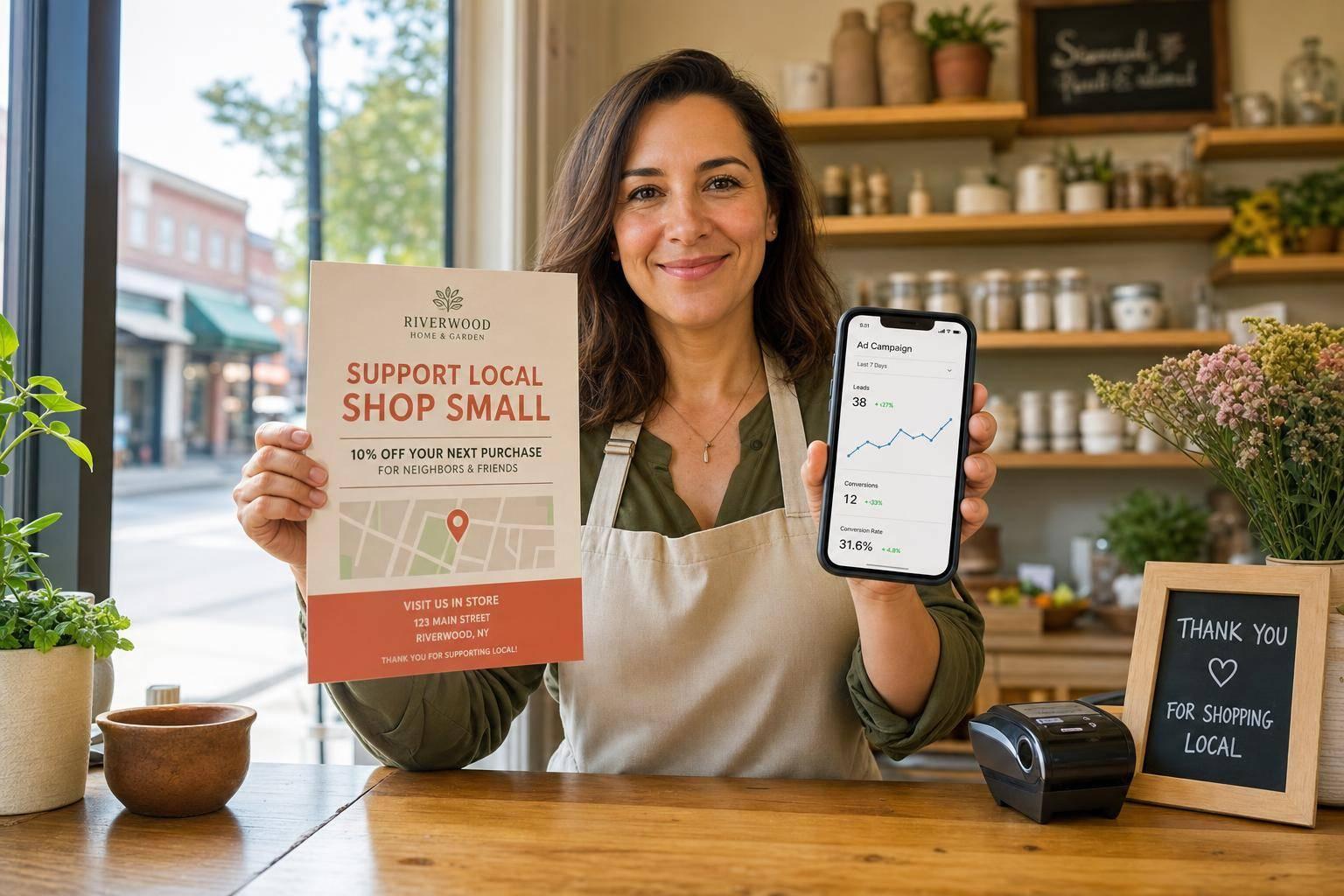
Flyers, direct mail, print ads, and local signage usually make the most sense for businesses with a clear local service area. Think restaurants, retail shops, real estate agents, and home service providers. These channels help people see your name again and again in the neighborhoods you serve.
That kind of repetition matters. If someone is already looking for a nearby option, seeing your brand on a flyer, in a local paper, or on a sign can make you feel familiar before they ever call or walk in. In many cases, that familiarity is half the battle.
Radio Ads, Events, and Sponsorships
Local radio, community events, and sponsorships are strongest when trust matters just as much as reach. They give small businesses a way to show up in the community, meet people face to face, and stay top of mind over time.
That’s a big deal for businesses like food service, childcare, and licensed contractors, where referrals often depend on trust and local reputation. People want to feel like they know who they’re hiring or buying from. Showing up at local events or sponsoring something people care about can help build that comfort level.
Strengths and Limits of Traditional Marketing
Traditional marketing helps build local credibility and supports word of mouth, which remains one of the most valuable assets for small businesses. That’s the upside.
The downside is pretty simple: these channels are harder to scale, slower to test, and tougher to measure with precision. You can’t always tell exactly which flyer, radio spot, or event led to a sale. So while offline marketing can be a strong match for businesses built on local trust, it’s usually not the best option for fast, highly trackable customer acquisition.
That tradeoff stands out even more when you put these channels next to digital marketing’s targeting and tracking.
Digital Marketing: Main Channels and Where They Work Best
Digital marketing gives small businesses a practical way to reach the right people, measure what’s working, and make changes fast. But not every channel does the same job. Some are built for quick lead flow. Others take time and stack up over months.
SEO, Content, and Google Ads
SEO and evergreen content are a long game. They usually take 6 to 12 months to produce meaningful ROI, but the upside is clear: traffic can build over time and keep bringing in visitors without per-click costs.
Google Ads are the opposite. In competitive markets, search CPCs average $4 to $6, and paid search can drive traffic right away. That speed is a big plus. Still, fast traffic doesn’t mean automatic results. If the offer misses the mark or the landing page falls flat, the budget can disappear in a hurry.
For local and service businesses, Google Search is often a strong match because it reaches people who are already looking for help. That’s a different kind of traffic than someone casually scrolling a feed. The intent is already there.
So, search channels tend to work best for two cases:
- Businesses that need immediate, intent-driven leads
- Businesses that want long-term organic traffic that grows over time
Email Marketing and Social Media Ads
Email is one of the best channels for retention and repeat business. It works well for promotions, follow-ups, and seasonal offers because you’re speaking directly to people who already know your business. In plain English: you’re not starting from zero.
Social media ads on Facebook and Instagram play a different role. They let you target by location, age, interests, and behavior. Average cost per lead on these platforms is around $19. That kind of targeting can be useful when you want to put an offer in front of a specific group instead of waiting for them to search.
UGC-style video ads can work especially well on social. They tend to feel more natural in the feed, which matters when you’re trying to stop the scroll without sounding like an ad shouting through a megaphone.
That makes email and social strongest for:
- Retention
- Promotions
- Audience growth
Strengths and Limits of Digital Marketing
The biggest upside of digital marketing is control. You can target specific groups, watch results in real time, and shift budget based on what’s happening. You can see what people clicked, how they responded, and what it cost to get a lead.
The downside is simple: these channels still need skill and patience. Google Ads and social campaigns can burn through budget fast if the offer or funnel is weak. SEO takes steady effort over time. And organic reach on social platforms is limited, so paid promotion is usually needed if you want steady visibility.
Each channel plays a different role in the funnel.
Side-by-Side Comparison: Cost, Reach, Targeting, Tracking, and Speed
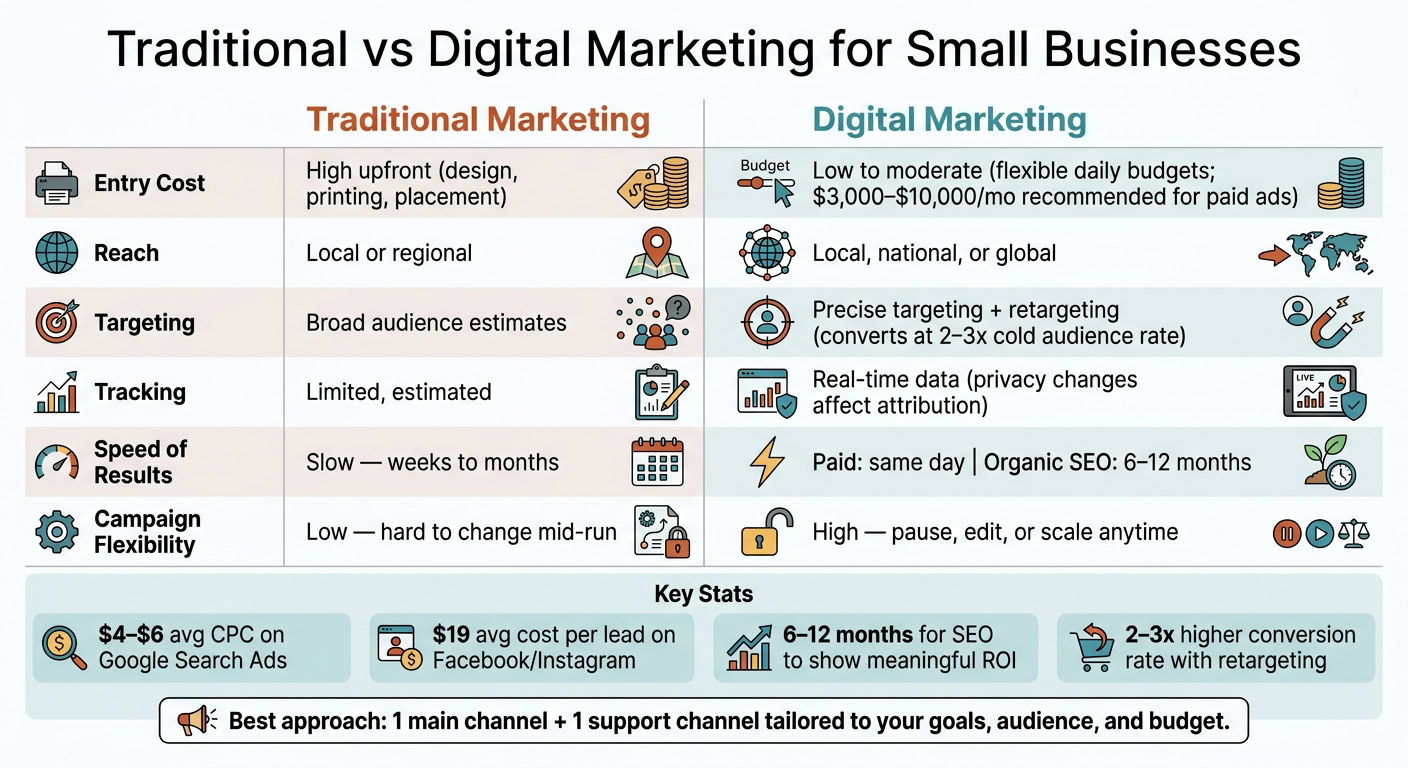
Cost and Budget Control
The first difference most small businesses notice is control: how much they spend, and how fast they can change course.
Traditional marketing usually asks for money up front. You pay for design, printing, and ad placement before a single customer even sees the campaign.
Paid digital works in a very different way. You can start with a modest daily budget, watch what happens, and pause or shift spend that same afternoon. That kind of control matters when cash flow is tight or you’re testing a new offer.
For coaches and high-ticket service businesses, a minimum of $3,000–$10,000 per month is often recommended for paid ads to work. Organic channels trade money for time. Paid channels trade time for money.
Budget doesn’t just shape cost. It also affects how closely each channel can get your message in front of the right people.
Reach, Targeting, and Tracking
Traditional channels tend to cast a wide net with limited control. A flyer in a coffee shop reaches everyone who walks in, not just the people most likely to buy.
Digital platforms flip that. They let you put spend behind people who already know your business or have engaged with it. And when you retarget those people, results can improve in a big way: retargeting audiences can convert at 2–3x the rate of new audiences.
Tracking is another big split between the two. Digital gives you much tighter feedback, often in real time, so you can see what’s getting clicks, leads, or sales. That said, privacy changes have made attribution less exact than it used to be.
Speed of Results and Campaign Flexibility
Speed matters because small businesses often need to test ideas, make changes, and bounce back fast.
Traditional campaigns usually move slowly. Production takes time, placements are booked ahead, and changing things mid-campaign can be expensive – or flat-out impossible.
Digital campaigns can go live the same day. But there’s a catch: when costs go up, efficiency matters a lot more. Paid digital can move fast, but fast testing matters just as much if you don’t want to burn through budget.
The table below gives you the practical tradeoffs at a glance.
| Factor | Traditional Marketing | Digital Marketing |
|---|---|---|
| Entry Cost | High (creative, printing, and ad placement costs) | Low to moderate (flexible daily budgets) |
| Reach | Local or regional | Local, national, or global |
| Targeting | Broad audience estimates | Precise targeting and retargeting |
| Tracking | Limited, estimated | Real-time, though privacy changes affect attribution |
| Speed of Results | Slow (weeks to months) | Fast for paid; organic typically takes 6–12 months+ |
| Campaign Flexibility | Low (hard to change mid-run) | High (pause, edit, or scale anytime) |
How to Choose the Right Marketing Mix for Your Small Business
Match Your Channels to Your Goals, Audience, and Budget
Once you’ve looked at cost, reach, targeting, tracking, and speed, the next move is simple: pick the channels that line up with how your customers actually buy.
Base your choice on three things: where your audience spends time, how fast you need results, and what your budget can support. A local business often does well with local Facebook groups, chambers, neighborhood associations, referrals, and in-person visibility. An online-first business usually gets more out of digital channels like SEO, email marketing, LinkedIn, and paid search.
The big thing here is staying power. Pick channels you can keep running long enough to measure what they’re doing. If you stop too soon, you’re basically judging the game after the first inning.
Start with 1 to 2 Core Channels, Then Expand
Don’t spread your budget across too many channels at once. That’s one of the fastest ways to burn time and money without learning much.
Instead, start with one or two channels that fit your business model. Run them with consistency. Track what’s working. Then add more once you have a clear read on performance.
A few common starting points:
- For B2B service businesses, LinkedIn is a strong place to begin.
- For local services, word-of-mouth can bring in local referrals.
- For e-commerce, UGC-style video ads paired with email retargeting can help you get traction.
Conclusion: Pick the Approach That Fits How Your Business Grows
Once you know where your audience is and how fast you need results, the decision gets easier. Most small businesses do best with a focused mix built around one main channel and one supporting channel.
FAQs
Should I use both traditional and digital marketing?
Use both only if you can handle them without stretching your team too far. Traditional marketing can help build local awareness and trust, especially when your customers tend to respond offline.
Digital marketing usually makes testing easier and results simpler to measure, though organic growth can take time. For many small businesses, the sweet spot is 2–3 channels total: a mix of faster paid or outreach efforts and longer-term organic work.
How do I know which channel to start with?
Start by getting clear on three things: your business goal, who you want to reach, and why someone should pick you over the other options out there. Once that’s set, choose the one channel most likely to put you in front of that audience.
Then stick with that channel for 2 to 4 months. That keeps your spending focused and makes results much easier to track. If you jump from one tactic to another every week, it’s hard to tell what’s working and what’s just noise.
Pick your channel based on fit:
- Social media if your main goal is awareness
- Email if you want to nurture leads and keep customers coming back
- SEO/content if you want long-term discovery
- Local partnerships or direct outreach if trust, referrals, or B2B prospecting matter most
- Paid ads if you want faster testing and have budget to spend
The main idea is simple: don’t try to be everywhere at once. Pick the channel that matches your audience and goal, then give it enough time to show results.
How long should I test a marketing channel?
Use a 90-day window to launch, test, and review results. Different channels move at different speeds. Paid ads can start showing results in 24 to 48 hours. Email marketing often needs 1 to 2 months. Social media usually takes 3 to 4 months.
If a tactic falls short of your key performance indicators, don’t rush to change your offer, targeting, or creative. First, make sure the gap is real. Then test again. If it still underperforms after repeated testing, move your time and budget to a channel that’s doing a better job.