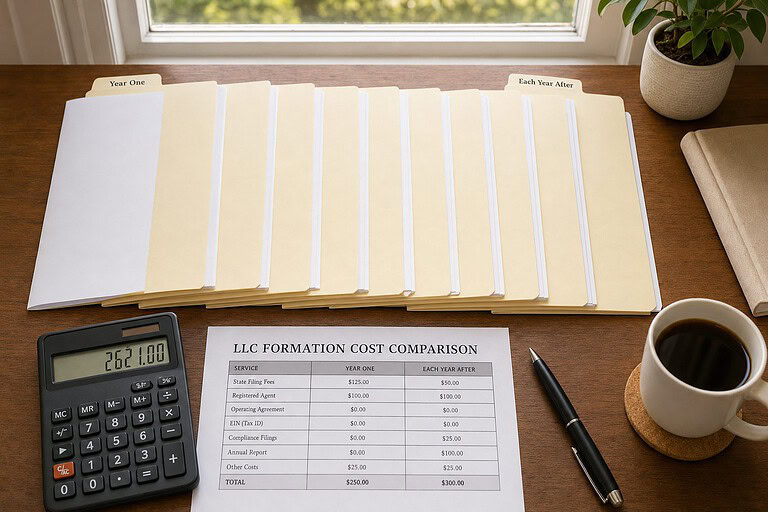


Choosing the right business structure for your real estate venture is critical. It influences your liability protection, tax obligations, and how you manage operations. Here’s a quick breakdown of the most common options:
- LLC (Limited Liability Company): A top choice for real estate investors. Protects personal assets from business liabilities and offers pass-through taxation, avoiding double taxation. Flexible and ideal for rental property owners.
- S Corporation (S-Corp): Beneficial for real estate professionals earning active income (e.g., agents, brokers). Allows tax savings by splitting income between salary (subject to payroll taxes) and distributions (not subject to payroll taxes).
- C Corporation (C-Corp): Suitable for large-scale operations or businesses seeking to raise significant capital. Offers growth potential but faces double taxation on profits and dividends.
- Sole Proprietorship/General Partnership: Simple to set up but provides no personal asset protection. Best for small-scale operations with minimal risk.
- Series LLC: Ideal for managing multiple properties. Each property is legally separate, reducing risk across investments.
Key Takeaway: For most real estate investors, an LLC strikes the best balance between liability protection, tax benefits, and simplicity. Professionals earning active income may benefit more from an S-Corp. Large-scale investors or those seeking institutional funding might consider a C-Corp.
Quick Comparison:
| Structure | Liability Protection | Taxation | Ideal For |
|---|---|---|---|
| LLC | Yes | Pass-through | Rental property owners |
| S-Corp | Yes | Pass-through, tax savings | Active income professionals |
| C-Corp | Yes | Double taxation | Large-scale operations |
| Sole Proprietorship | No | Pass-through | Small-scale, low-risk ventures |
| Series LLC | Yes | Pass-through | Multiple property investors |
Understanding your goals and consulting with a CPA or attorney ensures you select the right structure for your real estate business.
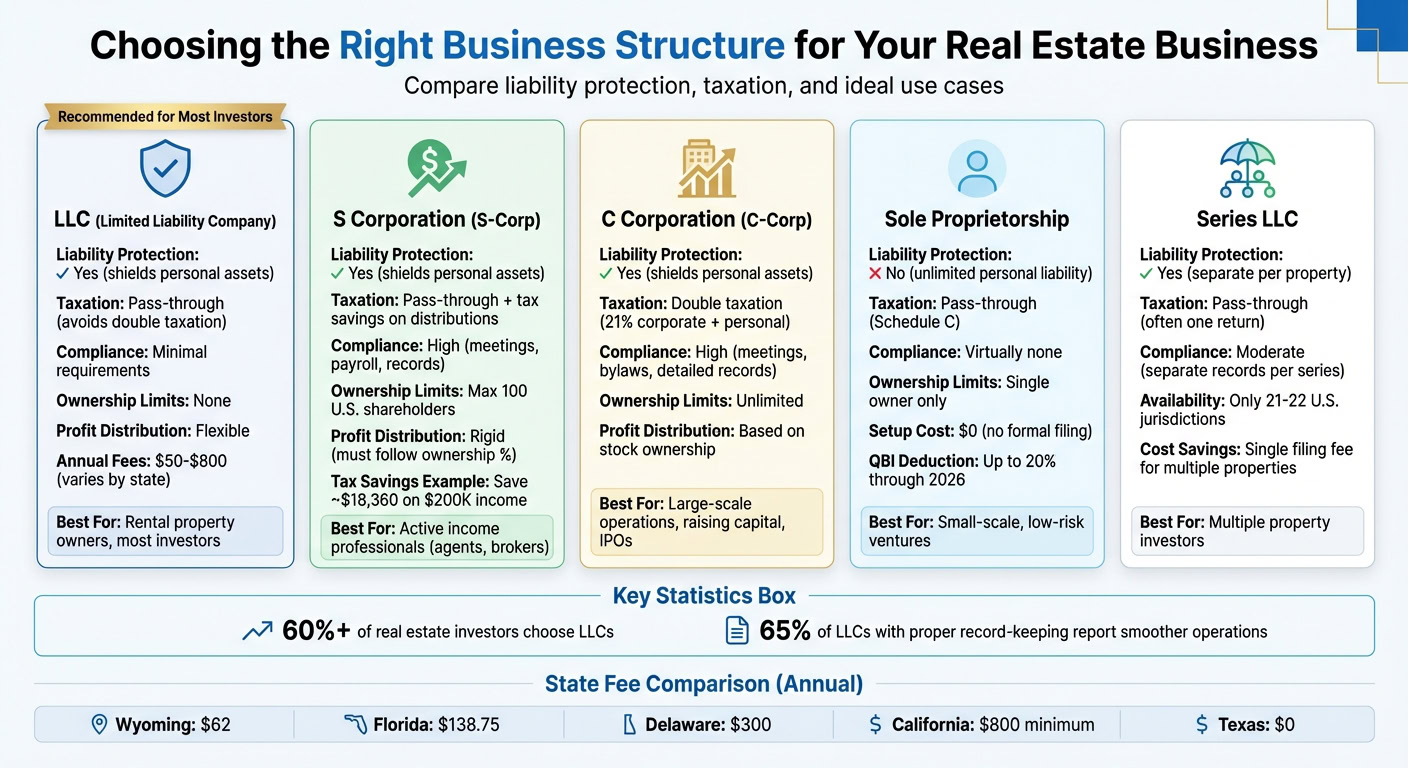
Common Business Structures for Real Estate
When starting a real estate business, one of the first decisions you’ll face is choosing the right legal structure. Your choice impacts everything from liability protection to taxes and administrative responsibilities. Here’s a breakdown of common business structures and how they differ in these key areas.
Sole proprietorships and general partnerships are the simplest to set up – often requiring just a DBA (Doing Business As) filing. However, simplicity comes at a cost: they offer no protection for your personal assets. This means if your business faces debts or lawsuits, your personal savings and property could be at risk.
For many real estate investors, LLCs (Limited Liability Companies) are a popular choice. They provide a clear separation between personal and business liabilities, which means your personal assets are shielded from business-related risks. Additionally, LLCs allow income to pass directly to the owners’ tax returns, simplifying taxation. As MGOCPA explains:
"If you’re starting out in real estate investing – whether you’re buying a rental home, an office for your business, or a short-term Airbnb – forming an LLC is usually the smartest and simplest move".
S-Corps and C-Corps offer strong liability protection but come with more administrative requirements, such as annual meetings and detailed record-keeping. While C-Corps face double taxation – once at the corporate level and again on dividends – S-Corps avoid this issue by passing income directly to shareholders. However, S-Corps have strict ownership rules, including a cap of 100 shareholders, all of whom must be U.S. citizens or residents. These structures are generally less favorable for holding appreciating real estate assets due to tax challenges when transferring property.
For those managing multiple properties, exploring more tailored options is key. A Series LLC can be particularly useful. This structure allows you to separate properties into individual entities, reducing risk. For example, if one property faces a legal issue, the protections for your other properties remain intact. This approach is especially valuable for investors juggling diverse portfolios.
Sole Proprietorship and General Partnership
Sole Proprietorship
A sole proprietorship is the easiest and most affordable way to start a real estate business. It doesn’t require any formal filings or fees, making the setup process simple. In fact, if you start buying or managing properties without creating a separate business entity, the IRS will automatically classify you as a sole proprietor.
With this structure, your business income flows directly to your personal tax return through Schedule C, meaning you only pay taxes once. Plus, thanks to the Tax Cuts and Jobs Act, you might be eligible to deduct up to 20% of your qualified business income through 2026. But while the simplicity is appealing, there’s a major downside: unlimited personal liability. If a tenant gets injured on your property or you face a lawsuit, your personal assets – like your home or savings – could be at risk.
Mark H. Cooter highlights this trade-off:
"The advantage to owning as an individual includes simplicity, control and the ability to make all management decisions for the property. The disadvantage is that this type of ownership comes with unlimited personal liability".
Another challenge is raising capital. Sole proprietors can’t sell stock, and lenders may hesitate to fund unincorporated businesses. As your real estate portfolio grows, learning how to set up an LLC for real estate could offer better personal asset protection while keeping tax benefits intact.
Now, let’s look at how partnerships, while sharing some similarities with sole proprietorships, come with their own set of risks.
General Partnership
A general partnership is created when two or more individuals join forces to run a real estate business, pooling their resources, expertise, or capital. Setting one up is relatively straightforward – it usually requires a partnership agreement and an Employer Identification Number (EIN), with minimal state filings involved.
From a tax perspective, the partnership files Form 1065 and provides each partner with a Schedule K-1. However, the biggest drawback is unlimited personal liability. Each partner is not only liable for the business’s debts but also for the actions of the other partners. This means if one partner makes a costly mistake or racks up significant debt, all partners’ personal assets could be at risk.
While partnerships offer flexibility in how profits and losses are divided, the lack of personal asset protection often makes them less appealing for those looking to scale a real estate business. For many, the risks outweigh the benefits as the business grows.
Limited Liability Company (LLC) for Real Estate Investors
An LLC strikes a balance between protection and simplicity for real estate investors. It creates a legal boundary between your rental properties and personal assets, safeguarding your home and bank accounts from lawsuits or creditor claims tied to your business activities. For example, if a tenant sues over an injury or you face debt collection, only the LLC’s assets are at risk – your personal finances remain untouched.
Tax-wise, LLCs are straightforward. They operate as pass-through entities by default, meaning profits and losses go directly to your personal tax return, avoiding the double taxation associated with C corporations. Plus, qualifying for the 20% Qualified Business Income (QBI) deduction provides additional tax savings.
As MGOCPA aptly explains:
"If you’re asking where to put your rental property, the default answer is often an LLC."
LLCs also offer operational flexibility. Unlike S-Corps, LLCs let you distribute profits in ways that don’t strictly align with ownership percentages. You can transfer real estate into an LLC without triggering a taxable event, and ownership can be passed to heirs via membership units, bypassing state transfer and recording taxes. However, it’s critical to keep personal and LLC finances separate – mixing them could jeopardize the liability protection the LLC provides. This blend of legal protection and tax benefits makes LLCs a popular choice for real estate investors.
Benefits of Using an LLC for Real Estate
The biggest advantage of an LLC is asset protection. Your personal assets – like your home and savings – are shielded if someone sues your rental property business. This separation becomes even more valuable as your portfolio expands. Many investors set up separate LLCs for high-value properties to further isolate liability.
LLCs also provide tax advantages. You sidestep corporate-level taxes while remaining eligible for the 20% QBI deduction. Holding property under an LLC can also enhance your credibility with lenders, investors, and tenants.
Another perk is the ease of transferring property. Adjusting ownership shares can be done through the LLC’s operating agreement rather than filing new deeds, making ownership changes simpler.
That said, owning property through an LLC doesn’t eliminate the need for comprehensive landlord insurance. Make sure the policy is in the LLC’s name for full coverage. Also, if your annual earnings exceed $40,000, consult a tax advisor to see if electing S-Corp tax treatment could help reduce self-employment taxes. Filing fees for LLCs vary by state, ranging from $35 to $500, with some states, like California, imposing an annual franchise tax of $800.
LLC vs. Other Structures: Liability and Taxes
Here’s how LLCs stack up against other business structures:
| Feature | LLC | S-Corp | Partnership / Sole Proprietorship |
|---|---|---|---|
| Liability Protection | Shields personal assets from business debts | Shields personal assets from business debts | Unlimited personal liability; personal assets at risk |
| Taxation | Pass-through; avoids double taxation | Pass-through; avoids double taxation | Pass-through; reported on personal returns |
| Compliance | Minimal ongoing requirements | Requires annual meetings, bylaws, and minutes | Virtually no formal setup or compliance |
| Profit Distribution | Flexible; can differ from ownership percentages | Rigid; must follow ownership percentages | Flexible distribution methods |
| Ownership Limits | No limits on members or types | Limited to 100 shareholders (U.S. citizens/residents only) | No limit on partners |
These comparisons highlight why many real estate investors prefer LLCs. As Amanda E. Clark notes:
"For most real estate investors, establishing an LLC represents the best balance between convenience, legal protection, and tax advantages."
The main downside is cost. While a sole proprietorship might have no setup fees, forming an LLC requires state filing and annual maintenance fees. These fees range from as low as $50 in some states to $800 in California. However, for many investors, this expense is a small price to pay for the peace of mind that comes with protecting personal assets from business risks.
S Corporation (S-Corp) for Real Estate Professionals
While LLCs are known for their flexibility and simplicity, S-Corps stand out for their tax planning benefits, especially for high-earning real estate professionals. S-Corp status is particularly advantageous for agents, brokers, and property managers who earn substantial commissions or service-based income. It allows you to divide your earnings between a W-2 salary (subject to FICA taxes) and shareholder distributions (which are not subject to payroll taxes). This setup can significantly reduce your self-employment tax. Essentially, as an employee of your own corporation, only your salary is subject to payroll taxes.
The key requirement here is paying yourself a "reasonable salary" that reflects what others in your profession typically earn. Any remaining profit can then be taken as distributions, avoiding payroll taxes while still enjoying the perks of pass-through taxation.
As Laura Schmidt from Wolters Kluwer puts it:
"An LLC taxed as an S corporation can do some tax planning that cannot be accomplished in an LLC taxed as a partnership or disregarded as an entity."
That said, S-Corps come with more stringent rules than LLCs. For instance, they are limited to 100 shareholders, all of whom must be U.S. citizens or residents, and they can only issue one class of stock. Additionally, S-Corp status requires formalities like payroll processing, regular meetings, and thorough record-keeping. To elect S-Corp status, you’ll need to file IRS Form 2553, typically within two months and 15 days after the start of your tax year. These specific requirements and tax benefits make S-Corp status a unique choice for certain professionals.
Tax Advantages of S-Corps for Real Estate
The biggest draw of S-Corp status is the potential savings on payroll taxes. In a typical LLC or sole proprietorship, your entire net income is subject to the 15.3% self-employment tax, which covers Social Security and Medicare. With an S-Corp, you pay FICA taxes only on the portion of your income allocated as a reasonable salary. The remaining profit, taken as distributions, isn’t taxed in the same way.
For example, let’s say a broker earns $200,000 annually. They might allocate $80,000 as a reasonable salary (subject to FICA taxes) and take the remaining $120,000 as distributions. This setup could save approximately $18,360 in self-employment taxes.
However, the IRS requires that your salary be reasonable. If you underpay yourself, you risk drawing attention from the IRS, which could reclassify your distributions as wages.
Stephen Morris, CPA, MBT, CCIM, Advise RE, explains this benefit clearly:
"Ability to reduce self-employment taxes by paying yourself a reasonable salary and distributing remaining profits as dividends."
S-Corps are generally best suited for active real estate professionals whose income is primarily service-based. If most of your earnings come from passive rental activities, an LLC might be a better fit.
S-Corp vs. LLC: Tax Savings Comparison
Deciding between S-Corp and LLC status depends on factors like your income, business model, and willingness to handle extra administrative work. The table below offers a quick comparison of the two:
| Feature | LLC (Default/Partnership) | S Corporation |
|---|---|---|
| Self-Employment Taxes | Entire net income is subject to self-employment tax | Only the W-2 salary is subject to payroll taxes |
| Payroll Flexibility | Limited – profits are generally treated as earned income | Greater flexibility with a mix of salary and distributions |
| Administrative Burden | Minimal formalities and record-keeping | Requires formal payroll processing, regular meetings, and detailed records |
| Ownership Rules | No limit on members; foreign ownership allowed | Limited to 100 shareholders who must be U.S. citizens or residents |
| Profit Distribution | Flexible allocations among members | Must be distributed pro-rata based on ownership |
| Suitability | Ideal for rental property holdings and smaller portfolios | Best for high-earning, active real estate professionals |
If your net income is significantly higher than what you’d consider a reasonable salary for your work, S-Corp status can lead to meaningful tax savings. However, if you need flexibility in profit allocations or involve foreign investors, an LLC might be the better option. Also, don’t forget to check how your state treats S-Corps, as some states impose additional taxes or don’t recognize federal S-Corp status.
C Corporation for Large Real Estate Operations
C-Corps aren’t the go-to choice for most real estate investors, but they can be a solid fit for large-scale operations with ambitious growth goals. These structures are built for businesses that need to raise significant capital, attract institutional funding, or aim for a public offering. Unlike S-Corps, which restrict ownership to 100 U.S. shareholders, C-Corps have no such limitations. They can issue multiple stock classes, welcome foreign investors, and even own other companies. This makes them a practical choice for managing complex, diversified real estate portfolios. But, as with most things, these perks come with their own set of challenges – particularly in the tax department.
As Tad Simons of the Thomson Reuters Institute explains:
"Most large businesses and public companies are formed as C corps because a C corp is a business structure that allows for limitless growth through stock sales (which makes them appealing to investors) and is ideal for large, retail-based businesses."
The main drawback? Double taxation. C-Corps face a flat 21% federal corporate tax on their profits. Then, shareholders are taxed again on any dividends they receive as personal income. Steven Barranca and Gregory Booth from EisnerAmper highlight this issue:
"The corporation itself pays taxes on profits, and shareholders are taxed again on any dividends they receive. This double tax hit can eat into your overall returns."
If you sell real estate held within a C-Corp, you’re hit with taxes at both the corporate and shareholder levels. For this reason, tax experts often advise against using a C-Corp to hold rental properties unless you plan to keep them indefinitely or sell the entire corporation as a single entity.
Still, it’s not all bad news. C-Corps have undeniable advantages for specific types of investors. They’re particularly appealing when you need to bring in venture capital, private equity, or institutional investors who prioritize the flexibility of multiple stock classes and strong liability protections. While the administrative requirements are more complex, C-Corps provide unlimited growth potential, perpetual existence, and a solid legal framework. If your real estate business involves raising substantial funds or preparing for an IPO, the benefits of a C-Corp might outweigh the downsides. Just make sure to work closely with a tax professional to avoid any costly mistakes when dealing with appreciating assets.
sbb-itb-ba0a4be
Series LLC for Managing Multiple Real Estate Investments
A Series LLC provides a practical way to manage multiple properties under a single umbrella while keeping each investment legally distinct. Think of it as a master LLC with individual "series", each functioning as a separate legal entity. Each series can have its own name, bank accounts, and membership interests, making it easier to manage diverse investments.
One of the standout benefits is risk isolation. If one property faces legal trouble, only the assets of that specific series are at risk – leaving the other series and the master LLC untouched. Nellie Akalp, CEO and Founder of CorpNet, highlights this advantage:
"If one series gets sued, other series aren’t liable. For example, if someone falls and becomes injured at one property, only the assets of the series set up for that property are at risk."
Another perk of a Series LLC is the potential to save on formation and maintenance costs. Instead of creating and maintaining separate LLCs for each property, you typically pay a single filing fee for the master LLC. Ongoing costs, like annual report fees and registered agent service expenses, are consolidated, and in many cases, you can file one federal tax return for the entire structure.
However, there are some important considerations. As of 2026, only about 21–22 U.S. jurisdictions allow Series LLCs, including states like Delaware, Texas, Nevada, Illinois, and Wyoming. California does not permit domestic Series LLCs, but it does allow foreign Series LLCs to register. Keep in mind, though, that California imposes an $800 annual fee and additional charges once income exceeds $250,000. Another challenge: federal bankruptcy courts have not consistently treated individual series as separate entities, and some institutional lenders and title insurers remain cautious about this structure.
To maintain the liability shield, it’s critical to keep each series separate and distinct. This means maintaining individual bank accounts, financial records, and clear documentation for each property. Sandra Feldman, Publications Attorney at Wolters Kluwer, emphasizes:
"Failure to properly maintain separate books and records can result in a loss of the liability shield."
Additionally, a strong operating agreement is essential. It should clearly state that each series is independent and not responsible for the debts of others. Before forming a Series LLC, confirm that the state where your property is located recognizes this structure. Otherwise, the liability protections may not hold up in court.
How to Choose the Right Business Structure
When deciding on the best structure for your real estate investments, several key factors can guide your choice. Let’s break it down.
Liability Protection and Asset Separation
One of the most important roles of a business structure is to create a legal shield between your personal assets – like your home, savings, and vehicles – and your real estate investments. Options like LLCs and corporations are designed to offer this protection, safeguarding your assets from business-related lawsuits or bankruptcy claims. In fact, over 60% of real estate investors opt for LLCs specifically for this reason.
If you manage multiple properties, asset isolation becomes even more critical. Many investors place each property into its own LLC to minimize risk. However, this protection isn’t foolproof. Courts can bypass it if you fail to keep your business and personal finances separate. For example, mixing personal and business funds can jeopardize your liability shield. To avoid this, maintain separate bank accounts and detailed financial records. Interestingly, 65% of LLCs that follow these practices report smoother operations and fewer audit issues.
If you’re planning to invest in real estate, consider forming an LLC before purchasing property. Doing so can help you avoid title and tax complications down the road.
Now, let’s look at how taxes vary depending on your chosen structure.
Tax Implications of Different Structures
Taxes play a huge role in determining the profitability of your real estate investments. Pass-through entities – like LLCs, partnerships, and S corporations – are often favored because they avoid double taxation. Instead of being taxed at both the corporate and individual levels (as with C corporations), income from these entities flows directly to your personal tax return, where it’s taxed only once.
C corporations, on the other hand, face double taxation. The company pays corporate taxes first, and then shareholders pay taxes again on dividends, which can significantly reduce your overall returns.
Another consideration is self-employment taxes. Sole proprietors, partners, and LLC members typically pay these taxes, but S corporations offer a way to save. By dividing income between salary and distributions, S corporations can reduce the portion subject to self-employment tax.
Additionally, partnerships and LLCs allow investors to include entity-level debt in their tax basis. This can enable larger loss deductions compared to S corporations.
State-Specific Considerations for Real Estate Structures
Beyond liability and tax concerns, state-specific rules can also influence the best structure for your needs. Each state has its own fees, tax rules, and privacy protections, which can directly impact your costs and overall strategy. For example, Delaware and Wyoming are known for their strong privacy protections, allowing property owners to keep their names out of public records. This can be particularly appealing for high-net-worth investors. Meanwhile, states like Texas, Nevada, and Florida have no state income tax, which can lead to significant savings over time.
Here’s a quick comparison of some popular states:
| State | Annual LLC Fees | Franchise Tax | Key Advantages |
|---|---|---|---|
| Delaware | $400 | None | High privacy and robust asset protection laws. |
| Wyoming | $62 | None | Low fees and strong privacy protections. |
| Florida | $138.75 | None | Low setup costs; widely chosen for real estate. |
| California | $800 | $800 minimum | High fees but strong legal protections. |
| Nevada | $200 | None | No state income tax; excellent for tax savings. |
| Texas | $0 | $0 | No state income tax and affordable formation. |
Keep in mind that California imposes a minimum annual franchise tax of $800 on LLCs, regardless of income. Additionally, S corporations in California face a 1.5% tax on net income. If you own property in multiple states, you’ll need to register as a foreign LLC in each state where you operate. This can add to your compliance costs and administrative workload.
How to Form Your Real Estate Business Structure with BusinessAnywhere

Once you’ve chosen your business structure, the next step is making sure the formation process is smooth and error-free. This step is critical because it lays the groundwork for the liability protection and tax benefits you’ll rely on. BusinessAnywhere simplifies this process with a free LLC formation service – you only need to pay the state filing fees, which can range from $50 in states like Arizona and New Mexico to over $500 in Massachusetts. It’s an excellent option for remote investors and international entrepreneurs managing real estate businesses from afar.
To establish your LLC, start by picking a unique business name that includes “LLC” or “Limited Liability Company.” Then, designate a registered agent to protect your privacy and handle legal documents – BusinessAnywhere provides this service for $147 per year, with the first year included at no cost. File your Articles of Organization using their automated platform, and if needed, create an operating agreement for $97. This document is particularly important for multi-member real estate groups, as it outlines ownership, profit sharing, and processes for resolving disputes.
Once your LLC is formed, the next step is to get an EIN (Employer Identification Number) from the IRS. BusinessAnywhere can assist with this for $97, and they even guide non-U.S. residents – who may not have a Social Security Number – through manual EIN applications via fax or mail. With your EIN in hand, you’ll need to open a dedicated business bank account to keep your personal and business finances separate, which is essential for maintaining liability protection. BusinessAnywhere often completes the formation process within 24–48 hours.
The platform also offers tools to help you stay compliant. Their automated compliance monitoring keeps track of annual reports and tax deadlines, so your business remains in good standing without the hassle of manual reminders. For digital nomads managing rental properties, BusinessAnywhere provides virtual mailbox services starting at $20 per month. This allows you to receive and manage property-related mail digitally from anywhere.
As one user shared in a testimonial:
"I’ve used many LLC formation services before, but this one is the best I’ve ever used – simple and fast!"
Compliance and Maintenance for Real Estate Entities
Keeping up with compliance is crucial for protecting your liability status and ensuring your business remains in good standing. Most states require LLCs and corporations to submit annual or biennial reports to update key details like your business address and management information. Missing these deadlines can lead to penalties ranging from $25 to over $2,000, depending on the state.
In addition to these reports, operational fees can significantly impact your budget. For instance, annual maintenance fees vary by state: $60 in Wyoming, $400 in Delaware, $800 (minimum) in California, and $138.75 in Florida. On top of that, registered agent fees typically range from $50 to $300. Corporations, compared to LLCs, often face more stringent requirements, such as holding annual shareholder meetings, maintaining bylaws, and keeping detailed meeting minutes.
To safeguard your personal assets, maintaining financial separation is a must. This means setting up separate bank accounts and keeping clear, accurate financial records.
Rick Mak, a Global Entrepreneur and Business Strategist, highlights the importance of making informed decisions:
"The wrong choice [of state or structure] can cost you thousands annually in extra taxes and compliance fees".
Federal regulations add another layer to compliance. For example, real estate entities are required to file FinCEN‘s Beneficial Ownership Information (BOI) report to disclose company control. Services like BusinessAnywhere can simplify this process by monitoring deadlines, handling document amendments, and filing your BOI report for $37. This allows you to stay compliant with federal rules while focusing on growing your real estate portfolio.
Staying on top of these compliance tasks not only secures your business but also positions it for future growth and success.
Conclusion
Picking the right business structure is a key step in protecting your assets, optimizing your taxes, and setting the stage for growth. As the U.S. Small Business Administration explains:
"The business structure you choose influences everything from day-to-day operations, to taxes and how much of your personal assets are at risk".
This decision will shape how you manage your real estate investments and achieve your goals.
For many real estate investors, forming an LLC is a popular choice. It offers liability protection while allowing for pass-through taxation, which helps you avoid double taxation. If you’re managing multiple properties, you might consider creating separate LLCs for each property or using a Series LLC to keep risks isolated. On the other hand, if you’re earning active income as a real estate professional, an S-Corp could help you reduce self-employment taxes.
It’s essential to consult with a CPA and an attorney to ensure your chosen structure aligns with your financial objectives and complies with state regulations. Also, be sure to establish your entity before purchasing property to lock in liability protection from the start.
Once your structure is in place, tools like BusinessAnywhere can help you stay compliant and focused on growing your portfolio. They offer a range of services, including $0 formation fees (plus state costs), a free registered agent for the first year, and compliance tools like BOI filing. Whether you’re just starting with your first rental property or managing a multi-state real estate operation, BusinessAnywhere provides the resources to safeguard your assets and simplify your operations.
FAQs
What’s the difference between a standard LLC and a Series LLC for real estate investments?
A standard LLC operates as a single legal entity that consolidates all your real estate assets under one umbrella. This structure provides liability protection for the company as a whole, with taxes applied collectively to all the assets within the LLC. While straightforward, this setup doesn’t separate the risks associated with individual properties – meaning if one property faces legal or financial trouble, it could impact the entire portfolio.
A Series LLC takes a different approach. Think of it as a "parent" LLC that can create multiple independent sub-entities, known as "series." Each series is treated as its own entity, with separate assets, liabilities, and members. This means the financial risks tied to one property don’t spill over to others. For real estate investors, this setup can help isolate risks for each property without the hassle of forming multiple LLCs. Plus, Series LLCs can lower administrative costs, as they often share a single registration and tax return. However, this structure isn’t available in all states, and the rules for compliance can differ depending on where you are.
To sum it up, a standard LLC offers unified liability protection for all assets, while a Series LLC provides separate protection for individual properties. It’s a practical option for investors in states that permit this structure.
How can an S-Corporation help real estate professionals save on taxes?
S-Corporations offer real estate professionals an effective way to reduce tax burdens by operating as a pass-through entity. This means the business’s profits are reported directly on the owner’s personal tax return, sidestepping the double taxation that C-Corporations face. Another advantage is the ability to divide income into two categories: a reasonable salary (subject to payroll taxes) and distributions (which aren’t subject to Social Security and Medicare taxes). For those with higher net earnings, this approach can lead to substantial savings on self-employment taxes.
In addition, S-Corporations allow owners to deduct qualified business expenses, such as health insurance premiums and contributions to retirement plans, which helps reduce taxable income even further. With a maximum of 100 U.S. shareholders, this structure is particularly well-suited for solo agents or small brokerages looking for a balance of tax efficiency and liability protection, without the complications that come with larger corporate entities.
When should a real estate business choose a C-Corporation?
A C-Corporation can be a strong choice for real estate businesses aiming to secure large amounts of capital through stock issuance or planning for long-term expansion strategies, such as going public or attracting institutional investors. This setup works well for large-scale developments, joint ventures, or companies seeking funding from venture capital or private equity sources. One of its key advantages is the ability to reinvest profits at the corporate tax rate, which benefits businesses prioritizing growth over immediate profit payouts. Plus, it provides solid liability protection for its shareholders.
This structure is also ideal for companies that want to offer employee stock options or equity-based incentives, something that’s more challenging to execute with LLCs or S-Corps. However, it’s essential to weigh the downside of double taxation – the corporation pays taxes on its earnings, and shareholders are taxed on dividends. Despite the added complexity, a C-Corp is a practical option for businesses ready to scale significantly and take advantage of these unique benefits.