

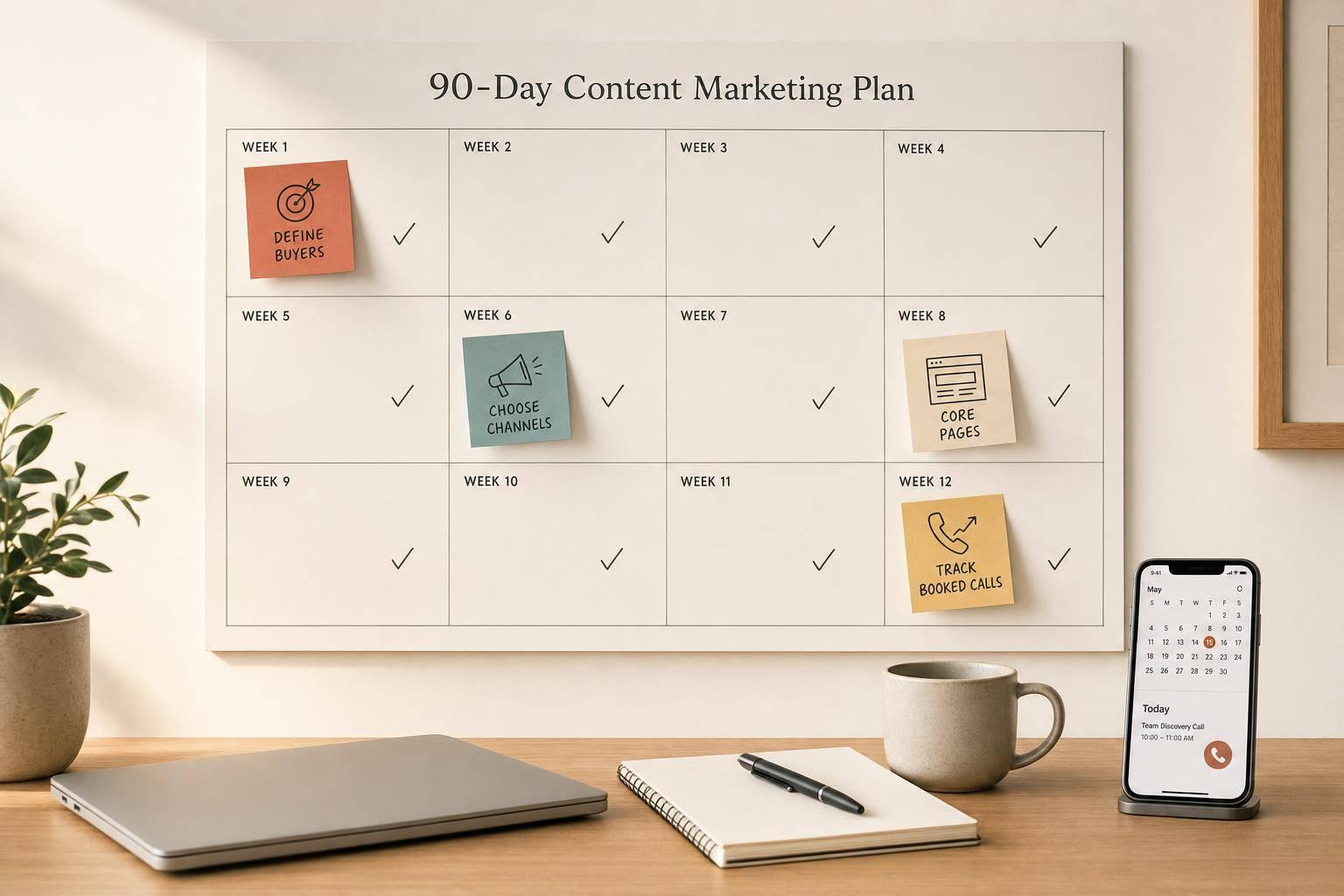
If I had 90 days to start content marketing for a service business, I’d do five things: define the buyer, pick 2 to 4 channels, build core pages and proof, publish each week, and track inquiries and booked calls.
Here’s the short version:
- I’d plan for a 30- to 90-day sales cycle, not same-week sales.
- I’d focus on buyer questions about cost, process, timelines, and proof.
- I’d build a small set of assets first: service pages, 4 to 8 blog posts, 3 to 5 emails, and 1 to 2 case studies.
- I’d expect early organic leads around weeks 8 to 10, not day 10.
- I’d measure traffic, email signups, inquiries, and booked calls.
This article lays out a simple first-90-days plan. I’d use it to build a small system that turns attention into leads instead of posting at random.
Define your audience, offer, and buying triggers
Get clear on three things first: who is most likely to buy, which 3 to 5 services you want to sell most often, and what pain is driving the purchase. That short list should shape every asset you publish in the first 90 days.
Map audience pain points and sales objections
Start with what people have already told you. Review 10 to 20 recent customers or discovery calls, then write down the top 3 to 5 problems and objections that showed up again and again. In many cases, buyers hesitate for a few familiar reasons: pricing uncertainty, unclear timelines, lack of proof, and confusion about your process.
Before they hire anyone, people usually look up pre-purchase questions like "best [service]", "[service] cost", and "[service A] vs [service B]." Those searches aren’t random. They’re a direct window into buyer intent, and they should shape your service page, FAQs, and case studies.
Turn service outcomes into content themes
Once you know the objections, build a service-page hub with support content around it. The goal is simple: answer the buyer’s main concerns at each step, from the problem to your approach, then cost, then the next step.
A simple three-stage content map makes this much easier:
| Content Stage | Buyer’s Focus | Example Topic for a Coach or Consultant |
|---|---|---|
| Awareness | Understanding the problem | "Why Your Team Keeps Missing Deadlines" |
| Consideration | Comparing approaches | "1-on-1 Coaching vs. Group Programs: What Gets Better Results?" |
| Decision | Logistics, pricing, and proof | "What to Expect During Your First Consultation" |
Use those themes to decide where buyers should find you first.
sbb-itb-ba0a4be
Choose your core channels and starter tools
Most new service businesses try to be everywhere at once. That usually backfires.
In the first 90 days, pick 2 to 4 channels and show up there on a steady basis. One channel used with discipline for 90 days will beat three used off and on.
Start with the places where buyers already look for answers. Go back to the objections, pain points, and buying triggers you mapped earlier. Those should tell you which channel deserves the first post, page, or email.
Pick 2 to 4 channels that drive inquiries and booked calls
Distribution matters. Content only brings in inquiries when people actually see it.
Choose one social platform where your buyers already spend time. LinkedIn tends to work well for B2B and professional audiences. Facebook can be a better fit for homeowners ages 30–65. If you sell to local buyers, put Google Business Profile near the top of the list because it can drive early inquiries fast.
| Channel | Role in Funnel | Effort Level | Trust Role |
|---|---|---|---|
| Website | Turns visitors into inquiries | High (setup) | Primary: proves legitimacy and hosts your call-to-action |
| Blog | Answers buyer questions and builds trust | Medium | High: demonstrates expertise through in-depth guides |
| Keeps leads warm until they book | Low | High: keeps you top-of-mind during long sales cycles | |
| Social | Extends reach and reinforces trust | Medium | Medium: humanizes your brand and circulates your content |
Set up a simple tool stack
Once you choose your channels, keep the setup lean. The goal is to move fast without turning your system into a mess.
Google Analytics 4 (GA4) should go in on day one. Track inquiries, phone clicks, and booking requests.
Canva can handle your visual work without bringing in a designer. Create 5 to 10 reusable branded templates for blog headers, social posts, and educational carousels.
Mailchimp can manage email capture and follow-up. Set up:
- one lead magnet tied to a specific service outcome
- an instant reply for new inquiries
- a monthly newsletter
Trello or Notion can run your content calendar. Build a 12-week board and a Topic Bank with 20 to 30 ideas pulled from real questions that come up on sales calls.
With the channels and tools in place, the next step is to build your first website copy, blog posts, email sequence, and case study.
Build your core content assets in the first 60 days
Once your channels are set, build the pieces that turn attention into inquiries.
Write website copy that answers why buy, why trust, and what to do next
Treat each page on your site like a conversion page. Your homepage hero section matters most. Lead with a clear outcome, not a vague service label.
Spell out:
- what the service is
- who it is for
- how it works
- what it costs
Add starting prices or price ranges. That helps build trust and screens out poor-fit leads. Keep one clear CTA per page so the next step is obvious and easy to take.
Once that path is set up, start publishing content that answers the questions buyers ask before they book.
Create starter assets: blog posts, email nurture sequences, and case studies
Use blog posts to attract attention, email to keep people warm, and case studies to close trust gaps.
Build your calendar from sales questions. Start with pricing, process, and comparison topics. If a prospect asks it before buying, it can become a blog post. Aim for 4 to 8 blog posts in the first 60 days. At least one should be a flagship guide of 2,000 to 3,500 words that answers the single biggest question your ideal client asks before hiring. That becomes your flagship asset.
Then squeeze more out of it. Turn one guide into social posts, an email, and FAQ content.
Email helps you stay in front of prospects between visits. A 3 to 5 email nurture sequence is enough to start. Each email can pull from content you already wrote, like a blog post summary, a client result, or a direct answer to a common objection. Email still pays off. Benchmarks show about $36 back for every $1 spent.
For case studies, keep the structure simple: Challenge → Action → Outcome. By day 60, publish one or two real case studies.
Here’s a realistic asset target for the first 60 days:
| Asset | Quantity |
|---|---|
| Service pages | 2–4 |
| Blog posts | 4–8 |
| Email nurture sequence | 3–5 emails |
| Case studies | 1–2 |
These assets give you enough material to start a 90-day publishing cadence. With these core assets live, the next move is to publish on schedule and track what pushes leads forward.
Run a 90-day publishing plan and track what works
Follow a simple month-by-month rollout
Once your core pages, posts, and email sequence are live, move into a 90-day publishing rhythm built to help you publish, learn, and tighten things up as you go.
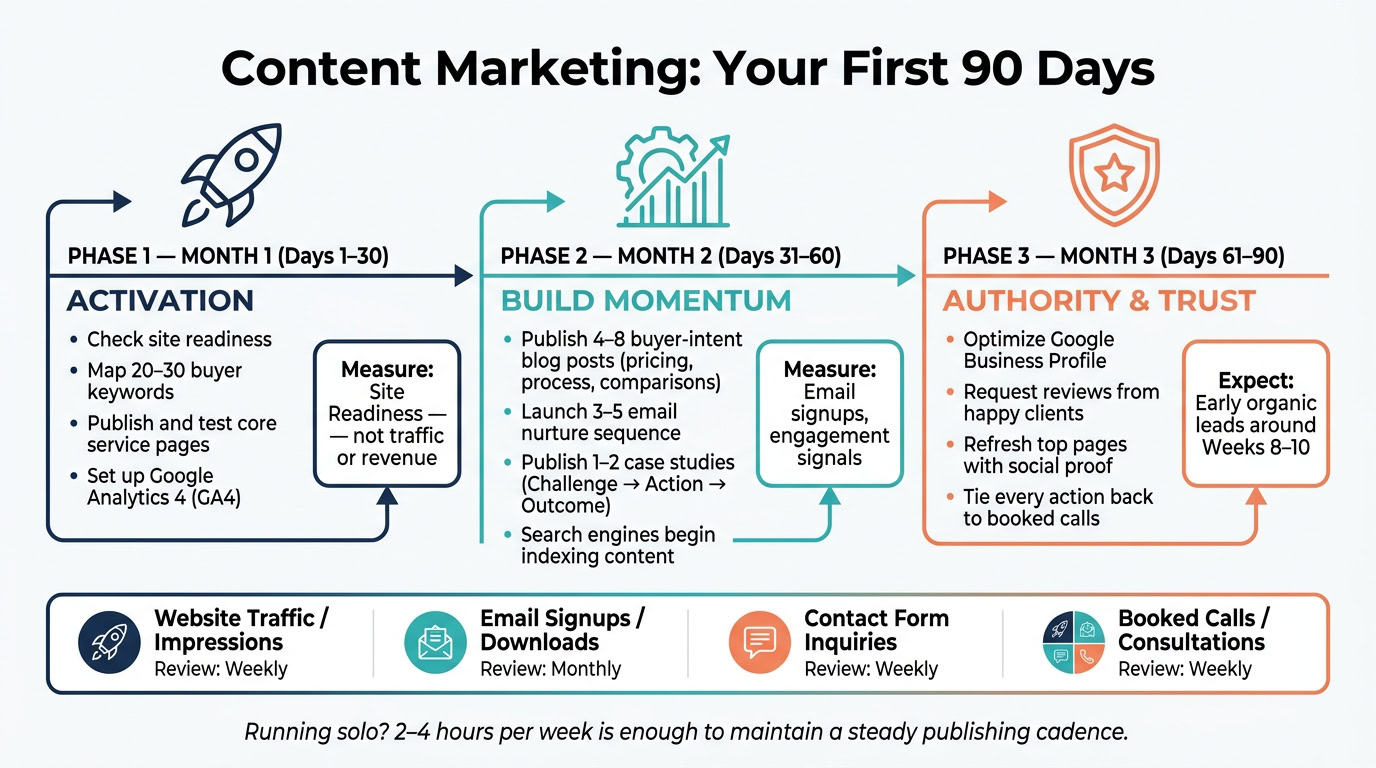
Month 1 (Days 1–30) is the activation phase. Start by checking site readiness, mapping 20–30 keywords your prospects search before they hire, and publishing and testing your core service pages. In this first month, success should be measured by site readiness, not traffic or revenue. And don’t start blogging before your service pages are ready. Traffic without a clear path to conversion won’t do much for you.
Once that base is in place, month two is about building momentum.
Month 2 (Days 31–60) is where your publishing system starts to take shape. Publish buyer-intent articles that answer pricing, process, comparison, and objection questions. Launch your email nurture sequence. Publish the case studies you built in the first 60 days. This is also the point when search engines may start ranking your content and early engagement signals begin to show up.
By month three, the goal changes a bit. You’re not chasing more output. You’re building proof and turning attention into booked calls.
Month 3 (Days 61–90) focuses on authority and trust. Optimize your Google Business Profile, ask every happy client for a review, refresh your top pages, and add social proof. Each of these steps should tie back to booked calls. Reviews and updated proof points help lower hesitation when someone is close to making a decision. You can expect early leads around weeks 8 to 10.
If you’re running things solo, 2–4 hours per week is enough to keep a steady publishing cadence going.
Track traffic, inquiries, signups, and booked calls
Don’t track everything. Track the numbers that show whether people are moving from finding you to booking time with you.
| Metric | What It Shows | Review Frequency |
|---|---|---|
| Website traffic / impressions | Awareness – are people finding you? | Weekly |
| Email signups / downloads | Consideration – are visitors interested in your expertise? | Monthly |
| Contact form / inquiry submissions | Decision – are visitors ready to discuss a project? | Weekly |
| Booked calls / consultations | Conversion – is content driving real revenue opportunities? | Weekly |
After 90 days, look for the 20% of content that drives 80% of your results, then make more of that kind of content.
If traffic looks strong but bookings stay flat, there may be friction in your pricing or booking process. If traffic is solid but inquiries are low, take another look at your trust signals and how clear your service pages are. Those patterns will tell you what to publish next.
FAQs
How do I choose my first two channels?
Choose your first two channels based on where your clients already spend time. Don’t try to show up everywhere at once. That usually spreads your time thin and makes it harder to get traction.
For most service businesses, a blog is the best starting point for long-term organic growth and search traffic. It gives you a home base for topics your audience is already searching for, and it keeps working long after you publish.
Then pair it with one support platform that matches your goal:
- LinkedIn for professional visibility
- YouTube for deeper trust
- Instagram for daily recall and short-form education
The key is simple: get good at those first two before you expand.
What if I have no case studies yet?
If you don’t have case studies yet, don’t worry. You can still build a strong content base by using industry benchmarks to shape your plan.
Start with educational and consideration-stage content that speaks to client pain points, your method, and the questions people ask all the time. It also helps to focus on:
- Helpful guides
- FAQs
- Clear pricing information
- Even one short case study in your first 90 days
That last point matters more than it may seem. One simple case study can give prospects a concrete example of how you work and what kind of result you aim for.
How much budget do I need to start?
Plan to spend about $500 to $3,000 per month to get started.
Your costs will depend on how you run things:
- DIY: about $200 to $500 per month for core tools and infrastructure
- Outsourced: add $100 to $400 per article for freelance writers
- Optional paid ads: about $1,000 to $2,000 per month for targeted search ads
That range can feel broad, but it usually comes down to one simple choice: are you doing the work yourself, hiring help, or putting money behind traffic from day one?