

No – I can use a virtual mailbox for mail, but not as my permanent home address.
Here’s the short answer: a virtual mailbox works for receiving business mail, keeping my home address off public records, and sometimes LLC mailing details. But it usually does not work for driver’s licenses, voter registration, school records, bank identity checks, best registered agent service, or proof of where I live.
If I want to stay out of trouble, I need to split my addresses like this:
-
Home address: for residency, tax, voting, and ID records
-
Registered agent address: for lawsuits and state legal notices
-
Virtual mailbox: for day-to-day mail and public business contact
A lot of people mix up mailing address and permanent address. That’s where problems start. A virtual mailbox can accept letters and packages. It does not show that I live there.
Here’s the fastest way to think about it:
|
Address type |
What I use it for |
Can a virtual mailbox work? |
|---|---|---|
|
Permanent address |
DMV, voting, residency, state tax records |
No |
|
Mailing address |
Letters, notices, invoices |
Yes |
|
Business address |
Website, client contact, some filings |
Often yes |
|
Registered agent address |
Service of process, legal notices |
No |
A few facts matter here:
-
Banks often ask for a home address during KYC checks, even if they let me list a business mailing address
-
The IRS may accept a mailbox for mailing, but some forms still need a physical street address
-
A CMRA mailbox customer usually has to complete USPS Form 1583
-
For many filings, the issue is not whether the address is “real” – it’s whether it shows where I live
So if I run a remote business, the rule is simple: use a virtual mailbox for mail, not for domicile. That one line covers most of the article.
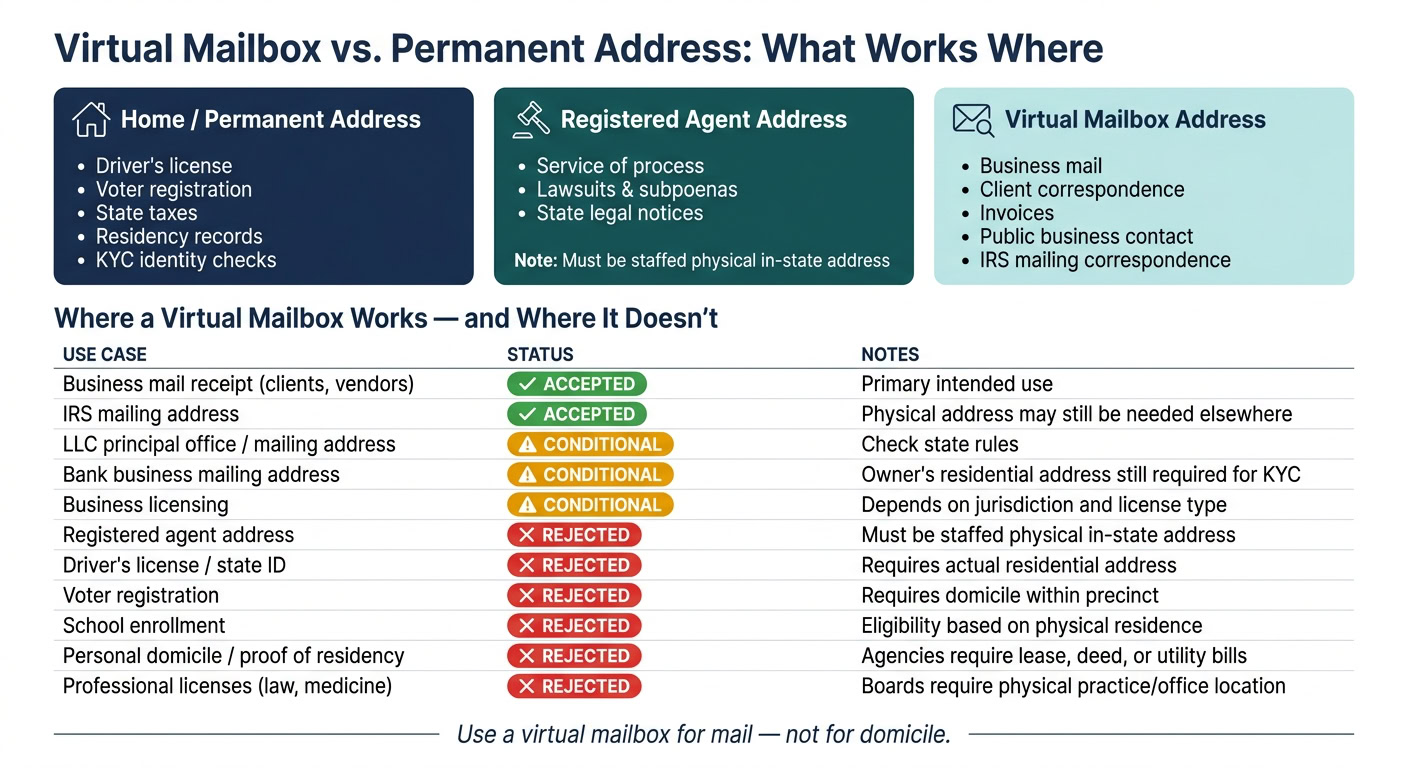
Virtual Mailbox vs. Permanent Address: What Works Where
Permanent Address, Mailing Address, and Business Address: What Each One Means
These terms don’t mean the same thing. And in the U.S., that difference matters for both legal and day-to-day use.
A business address is the address you use for business contact, filings, and public records. That might be an office, your home, or a virtual mailbox if the rules in your state allow it.
What Counts as a Permanent Address in the U.S.
Your permanent address, also called your domicile, is your fixed home. It’s the place where you live and plan to return to. States use this address for taxes, voting, licensing, and residency records.
A hotel, short-term rental, or virtual mailbox does not count as a domicile. If you travel full time, you still need one real domicile. And a virtual mailbox doesn’t change those residency rules.
What a Virtual Mailbox Is Actually Built to Do
A virtual mailbox gives you a real U.S. street address where you can receive and manage mail online. When mail shows up, staff scan the outside of the envelope, upload an image to your dashboard, and send you a notice.
From there, you choose what happens next:
-
Open and scan the contents
-
Forward the mail to a physical address
-
Shred it
-
Store it
That’s the key point: a virtual mailbox handles mail, not residency. You are a CMRA customer, not a tenant.
For remote business owners, this can be a clean way to keep business mail separate from home mail while staying compliant. It also keeps your home address off public business records, which can help with privacy.
The difference is pretty simple: one address shows where you live. The other is just for handling mail.
Here’s how the four address types compare in practice:
|
Address Type |
Primary Purpose |
Can a virtual mailbox be used? |
|---|---|---|
|
Permanent Address (Domicile) |
Driver’s license, voting, state taxes, residency |
No – requires a real physical residence |
|
Mailing Address |
Receiving letters, invoices, bank statements |
Yes |
|
Business Address |
Public contact point, invoices, website, some filings |
Yes, where state rules allow |
|
Principal Office Address |
LLC/corporate records, state formation filings |
Depends on the state |
With those definitions in place, the next step is looking at where a virtual mailbox works – and where it doesn’t.
Where a Virtual Mailbox Works and Where It Does Not
What a Virtual Mailbox Is Accepted For
A virtual mailbox works well for business mail, public-facing contact details, and day-to-day correspondence. It helps keep your home address off public business filings and creates a clean line between business and personal mail.
In some states, a CMRA street address can work for an LLC mailing address or principal office address, as long as it’s a real street address and not a P.O. Box. The IRS may also accept it as a mailing address for correspondence and some forms. That said, you may still need to give a separate physical address in other places.
The key point is simple: the address itself is real. But it does not prove where you live.
That’s where the convenience stops. Once a form or agency asks for an actual residence, a virtual mailbox usually won’t work.
Where a Virtual Mailbox Gets Rejected
The line is pretty clear: a virtual mailbox can work for business mail, but not for records tied to residency.
If a rule calls for proof of physical residence, a virtual mailbox won’t meet that test. That includes driver’s licenses, state IDs, voter registration, school enrollment, and other programs based on where you live. A CMRA address does not meet those rules.
Banks and payment processors may allow it as a business mailing address, but they still ask for the beneficial owner’s real home address for identity checks.
A virtual mailbox also can’t act as a registered agent address. States require a staffed physical in-state address for that role. A CMRA address does not qualify unless the provider also offers registered agent service and has been formally appointed to serve in that role.
Accepted vs. Rejected Uses at a Glance
Here’s the practical split between uses that usually work and uses that do not.
|
Use Case |
Virtual Mailbox Accepted? |
Notes |
|---|---|---|
|
Business mail receipt (clients, vendors) |
✅ Yes |
Primary intended use |
|
IRS mailing address |
✅ Yes |
A physical address may still be required in other fields |
|
LLC principal office / mailing address |
⚠️ Conditionally |
Check state rules |
|
Bank business mailing address |
⚠️ Conditionally |
Owners still need a residential address |
|
Business licensing (online/consultancy) |
⚠️ Conditionally |
Depends on the jurisdiction and license type |
|
Registered agent address |
❌ No |
Must be a staffed physical in-state address |
|
Driver’s license / state ID |
❌ No |
Requires an actual residential address |
|
Voter registration |
❌ No |
Requires a domicile address within the precinct |
|
School enrollment |
❌ No |
Eligibility is based on physical residence |
|
Personal domicile / proof of residency |
❌ No |
Agencies usually require lease, deed, or utility bills |
|
Professional licenses (law, medicine, contracting) |
❌ Usually no |
Boards often require a physical practice or office location |
LLC Formation, Registered Agent Rules, Banking, IRS, and Licensing
This matters most when you’re dealing with LLC filings, banking, and licensing. Here’s the problem: different agencies use the word address in different ways. And an address that works for one agency can get rejected by another. The first place this shows up is LLC formation.
LLC Principal Office Address vs. Registered Agent Address
When you form an LLC, many state forms ask for separate addresses for the principal office and the registered agent. Those fields are not the same thing.
In many states, a virtual mailbox may work for the principal office or mailing address field because that field is mainly about where business mail should go. The registered agent field is different. It is a legal requirement. A registered agent must have a staffed physical street address in the formation state and be available during normal business hours to receive legal papers, such as lawsuits or subpoenas. A virtual mailbox is not staffed for service of process. If you put one in the registered agent field, you could face rejected filings, missed lawsuit notices, or loss of good standing.
That is the clearest point where a mailbox and a legal address stop meaning the same thing.
How the IRS, Banks, and Licensing Agencies Each Check Your Address
Tax and banking records follow a different standard.
The IRS may accept a CMRA street address for correspondence and EIN-related notices, but it does not replace a physical address when one is required. Getting mail through a CMRA usually requires USPS Form 1583 [2].
Banks tend to check the hardest. They may let you use a virtual mailbox as the business mailing address, but still ask for the owner’s real home address for KYC. In plain English, that means you should be ready to show a driver’s license, lease, utility bill, or similar document that shows your actual residential address when opening a business account.
Licensing rules vary the most from place to place. Many city or county offices want a physical operating location, not just a mailing address, especially if inspections or zoning checks are part of the process.
|
Agency |
What They Accept |
What They Still Require |
|---|---|---|
|
State filing office |
Virtual mailbox for principal office or mailing address in some states |
Separate registered agent with a staffed physical in-state address |
|
IRS |
CMRA street address for correspondence |
Real street address, not a P.O. Box; USPS Form 1583 [2] |
|
Bank (business account) |
Virtual mailbox as business mailing address |
Residential or physical address for beneficial owner KYC |
|
City/county licensing |
Sometimes accepted as mailing address |
Physical operating location for inspections or zoning verification |
With those rules laid out, the next step is figuring out where a virtual mailbox fits into day-to-day business use.
How to Use a Virtual Mailbox Correctly for a Remote Business
A Simple Address Decision Framework for Business Owners
Now that the lines are clear, the next step is simple: match each type of mail or record to the right address.
Think of it like sorting keys onto the right keyring. One address is for you as a person. Another is for legal paperwork. A third is for public-facing business mail.
Use these three address categories:
-
Personal records: Use your home address for driver’s licenses, voter registration, tax records, and KYC forms.
-
Legal notices: Use your registered agent address for service of process and state notices.
-
Business mail: Use your virtual mailbox for public business contact and correspondence.
The same rule can look a little different based on who’s filing and what the filing is for.
|
Business Owner Type |
Residential Address |
Registered Agent |
Virtual Mailbox |
|---|---|---|---|
|
Freelancer working from home |
Home address for personal tax and identity records |
registered agent address in the state of formation, if you form an LLC |
Public business address on invoices and website |
|
Digital nomad traveling abroad |
A real U.S. domicile address |
Registered agent address in the state of LLC formation |
Day-to-day business mail, managed online |
|
Real estate investor (multi-state) |
Personal home address |
Separate registered agent address for each state LLC |
Unified mailing address across all entities and vendors |
Using BusinessAnywhere for Mail Handling and Compliance Support
Once you’ve assigned each address its job, a mail service can take care of the business-mail side without a lot of friction. BusinessAnywhere puts mail scans, forwarding, and document storage in one place for remote owners, and it includes fully online completion of USPS Form 1583 [1].
That said, it’s not a stand-in for everything. It does not create a domicile, replace a registered agent, or meet proof-of-residency rules.
FAQs
Can I use a virtual mailbox for my LLC?
Yes, but there are legal limits.
You can use a virtual mailbox as your business mailing address, principal business address, and on IRS EIN applications.
But it can’t be your Registered Agent address. States require a physical street address in the state where you formed the business so someone can accept legal service of process during business hours.
There’s one more part that matters: your provider must be a USPS-registered CMRA, and you need to complete USPS Form 1583.
What address should I use for banking and IRS forms?
For IRS forms and business banking, you can usually use a virtual mailbox address if it’s a verifiable street address and not a P.O. Box. The IRS accepts this kind of address for tax filings and EIN applications.
Bank rules are a bit different. Some banks allow a virtual mailbox for correspondence, while others may ask for proof of a physical business location to meet KYC requirements. It’s smart to check with the bank first so you know exactly what they’ll need.
What if I travel full time or live abroad?
A virtual mailbox is a common pick if you travel full-time or live abroad. It gives you a real U.S. street address, so you can receive mail, have it scanned, and manage it online from anywhere.
That said, it does not replace a Registered Agent, legal domicile, or proof of residency for things like a driver’s license or voter registration. And if you operate across borders, using a U.S. address can still come with tax implications.