
Yes – virtual mailboxes are legal in the U.S. if the provider is a USPS-registered CMRA, you file USPS Form 1583, and you use the address for lawful mail purposes.
If I had to boil the whole topic down, it’s this:
- The service itself is legal
- The provider must follow USPS rules
- You must verify your identity
- The address cannot replace every other type of legal address
That’s where people get mixed up. A virtual mailbox can work for business mail, privacy, mail scanning, forwarding, and remote access. But it does not automatically work as your registered agent address, home address, office, driver’s license address, or voter registration address.
Here’s the short version:
- USPS allows mail handling through a Commercial Mail Receiving Agency (CMRA)
- You must complete Form 1583
- You need 2 forms of ID
- A spouse or second recipient usually needs their own Form 1583
- If the provider skips Form 1583, that’s a major red flag
- A CMRA address should usually use PMB or #, not Suite
- Banks and state agencies may still ask for a separate physical address, which is a common challenge when using a virtual address for business banking.
A few facts stand out:
- USPS requires a CMRA to keep Form 1583 records for at least 6 months after the mailbox closes
- The CMRA must also remail mail for that same 6-month period after termination
- You need 1 photo ID and 1 address ID – one document cannot do both jobs
| What works | What does not |
|---|---|
| Receiving business mail | Acting as a staffed office |
| Scanning and forwarding mail | Replacing a registered agent by default |
| Keeping your home address off public records | Claiming false residency |
| Remote mail access while traveling | Using the address for people not listed on Form 1583 |
Bottom line: if I use a USPS-registered CMRA, submit a current Form 1583, and keep the address use honest, a virtual mailbox is lawful. The legal issue is usually not the mailbox itself – it’s how the service is run and how the address is used.
Are virtual mailboxes legal?
Yes. Virtual mailboxes are legal when the provider is a USPS-registered CMRA and the address is used lawfully. The answer comes down to three requirements for setting up a virtual address.
The 3 factors that determine legal use
- The provider is a registered CMRA. USPS allows certain businesses to receive mail for other people under the Domestic Mail Manual (DMM 508).
- You complete USPS Form 1583 with proper ID and notarization. Before a CMRA can accept mail for you, USPS Form 1583 must be completed with two forms of ID and notarization.
- The address is used for lawful purposes. That includes business mail, privacy protection, and other legitimate mail handling.
Those three conditions set the baseline. The USPS rules below explain how a virtual mailbox service can legally receive and handle mail.
What USPS rules actually require
USPS governs virtual mailboxes through DMM 508.1.8. The way a virtual mailbox works is pretty simple at its core: the provider must be a registered CMRA, and you must complete Form 1583 before that provider can handle your mail. For entrepreneurs, remote teams, and digital nomads, the main issue isn’t the address format. It’s whether the CMRA follows USPS rules.
USPS Form 1583 and identity verification
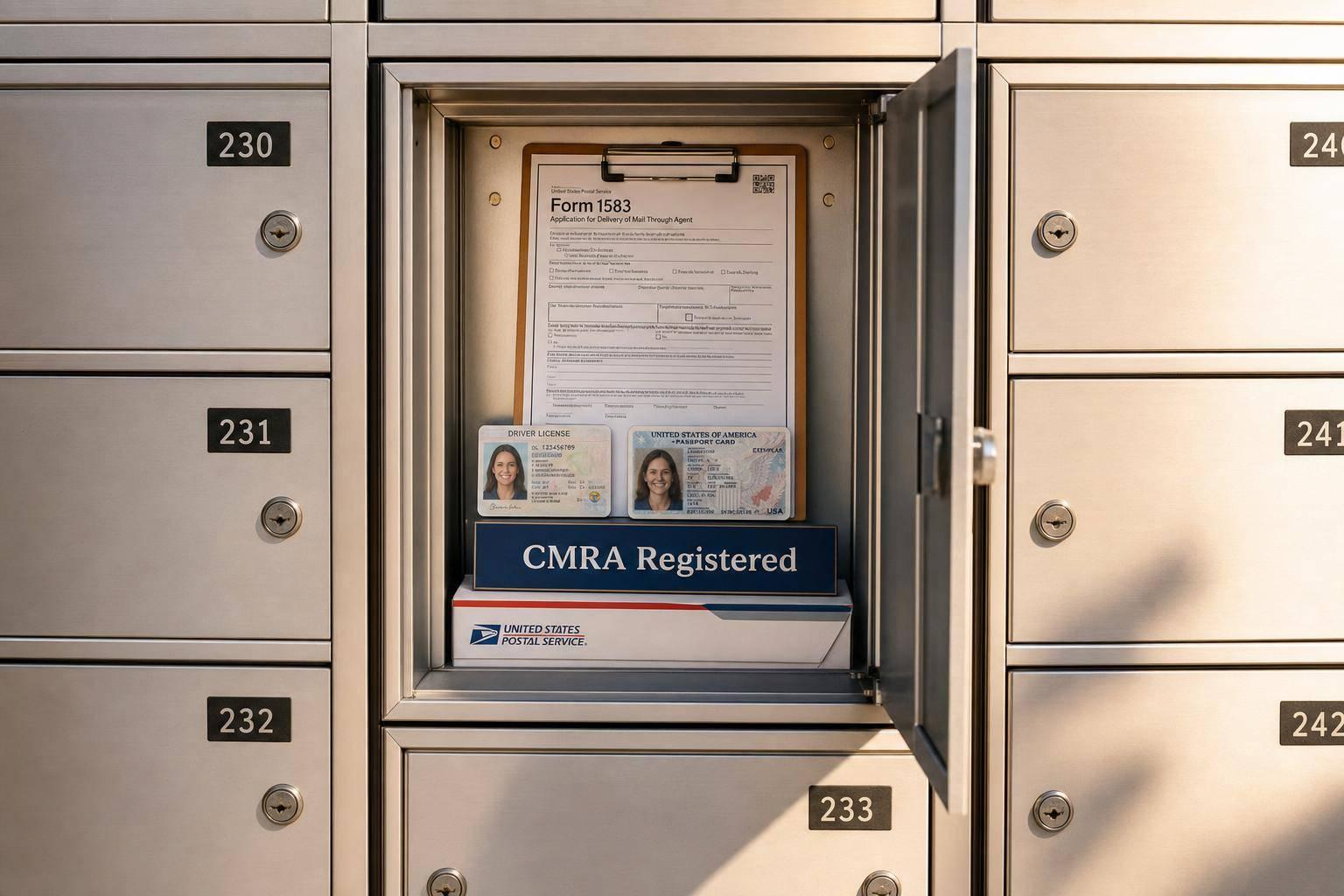
Form 1583, the Application for Delivery of Mail Through Agent, gives the CMRA permission to receive your mail. That’s what makes a virtual mailbox usable for business mail and for keeping your home address private.
But the form only counts if the identity check is done the right way. You need:
- one valid primary photo ID
- one separate secondary address ID
One document can’t do both jobs. Acceptable primary IDs include a U.S. passport, driver’s license, state ID, or military ID. Acceptable secondary IDs include a current lease, utility bill, voter registration, or vehicle registration.
The form must be signed either in person or by live video in front of the CMRA owner, manager, or an authorized employee, or a notary public commissioned in a U.S. state, territory, possession, or the District of Columbia. After that, the CMRA uploads your ID copies to USPS’s registration system.
Who may receive, open, scan, and forward mail
A CMRA may receive, open, scan, hold, or forward mail only for the people and entities listed on Form 1583, and only based on the customer’s instructions. If spouses share the same virtual mailbox, each person still needs a separate Form 1583.
There’s another detail that trips people up. If you want the CMRA to sign for mail that needs a personal signature, you must check Box 5 on Form 1583. If you don’t, those items may be returned to the sender.
When a customer closes a mailbox, the CMRA must keep a copy of Form 1583 for at least six months after termination. The CMRA must also remail that customer’s mail for the same six-month period. On your side, you’re responsible for giving correct information and updating Form 1583 whenever your home address or business name changes.
That’s why some virtual mailbox setups work for business use and others don’t. The line isn’t blurry. It comes down to whether the CMRA follows these USPS rules and whether your paperwork is current.
sbb-itb-ba0a4be
When a virtual mailbox works and when it falls short
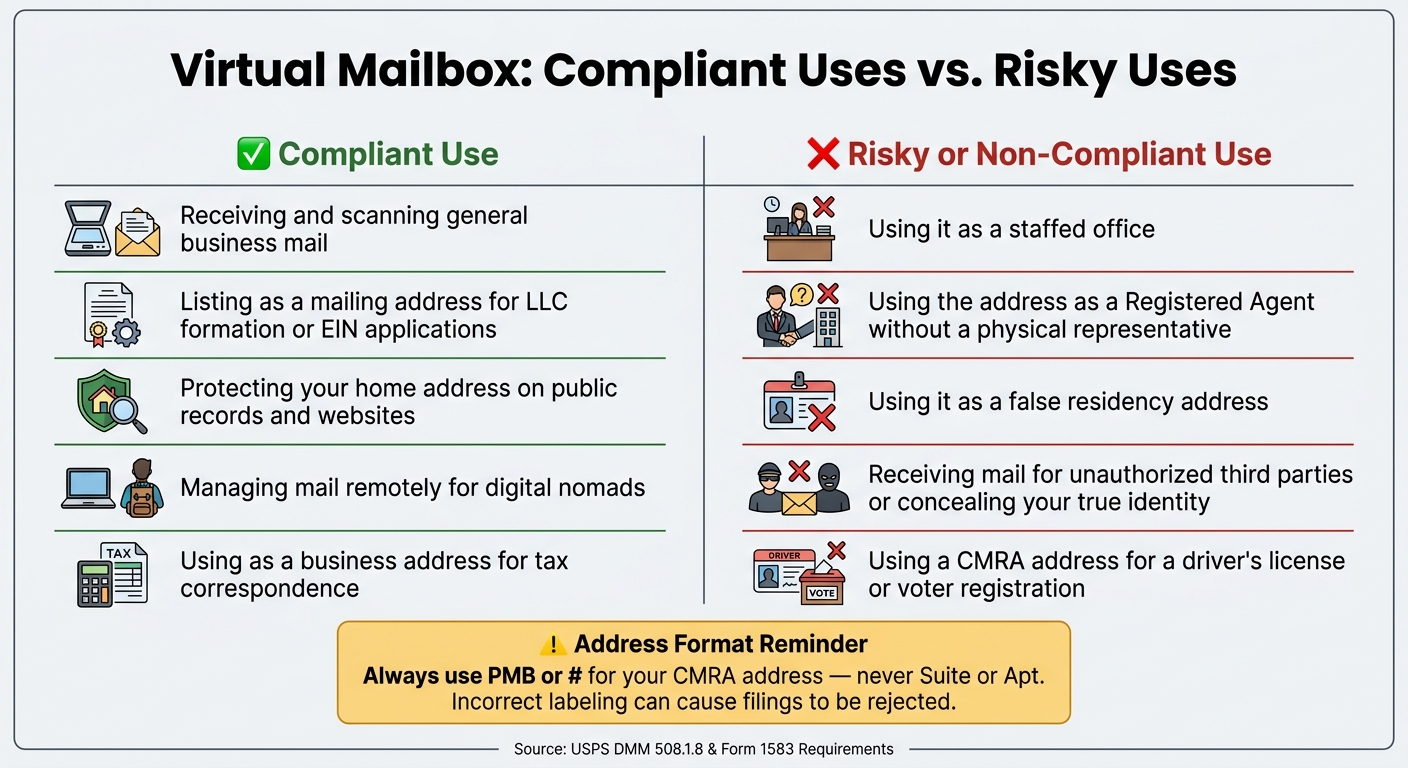
A virtual mailbox is for mail handling. That’s the job. It does not give you a physical office, a Registered Agent location, or a legal residence.
Compliant uses versus risky uses
| Compliant Use | Risky or Non-Compliant Use |
|---|---|
| Receiving and scanning general business mail | Using it as a staffed office |
| Listing as a mailing address for LLC formation or EIN applications | Using the address as a Registered Agent without a physical representative |
| Protecting your home address on public records and websites | Using it as a false residency address |
| Managing mail remotely for digital nomads | Receiving mail for unauthorized third parties or concealing your true identity |
| Using as a business address for tax correspondence | Using a CMRA address for a driver’s license or voter registration |
One small detail can trip people up: use “PMB” or “#” for a CMRA address, not “Suite.” If you use the wrong label, your filing can get rejected or delayed.
The main limit isn’t mail delivery. It’s what a CMRA can’t stand in for.
When a virtual mailbox does not replace another required address
That same line applies to legal notices. Form 1583 lets a provider handle your mail. It does not authorize service of process. Every LLC and corporation must keep a Registered Agent – a real person or service that is physically present at a street address in the state of formation during business hours and able to accept service of process. A CMRA can’t do that job unless the provider also offers a registered agent add-on with a physical person there to sign for legal documents.
USPS rules aren’t the only thing in play, either. Banks may still ask for a separate physical address when they verify an account, even if your CMRA address is fine for mail.
Once you know where the line is, picking a compliant service gets a lot easier.
How to choose and use a compliant virtual mailbox service
What to check before signing up
Start with the one question that matters most: Does the provider require USPS Form 1583 before activating your virtual mailbox?
If the answer is no, that’s a red flag. A provider that skips Form 1583 is not following USPS rules and can’t legally handle your mail. This isn’t just about making signup easy. It’s about showing that the address meets USPS rules before any mail gets accepted.
You should also confirm that the provider is a USPS-registered CMRA and uses a physical street address. On top of that, they should verify your identity with two separate forms of ID:
- one photo ID, such as a passport or driver’s license
- one address ID, such as a utility bill or lease
One document can’t do double duty for both.
If more than one person will receive mail, check that each recipient is listed on Form 1583 and that the plan covers your total recipient count. That small detail trips people up all the time.
USPS compliance mistakes to avoid
These are the most common USPS compliance mistakes.
| Mistake | Why It’s a Problem |
|---|---|
| Skipping Form 1583 or using an outdated version | USPS requires the current Form 1583; older versions are rejected |
| Using the same ID for both photo and address verification | USPS requires two distinct documents; one cannot serve both purposes |
| Listing unauthorized recipients | Only authorized recipients listed on Form 1583 should receive mail there |
| Using “Suite” or “Apt” instead of “PMB” or “#” | USPS Publication 28 requires PMB or # followed by the mailbox number |
| Relying on the mailbox for service of process | A standard virtual mailbox is not a Registered Agent unless that service is specifically offered with a physical person present |
Conclusion: The simple rule for staying compliant
Virtual mailboxes are legal. The catch is in the details.
A USPS-registered CMRA, a properly notarized Form 1583, verified identity, and honest address use – those four items keep you on the right side of federal rules.
The rule is simple: use a USPS-registered CMRA, complete Form 1583 the right way, and use the address only for permitted mail handling. A virtual mailbox can handle your mail, but it does not replace a Registered Agent, a physical office, or any other legally required address. If the CMRA is registered, Form 1583 is current, and the address is used only for permitted mail handling, the mailbox is lawful.
FAQs
Can I use a virtual mailbox to open a bank account?
Yes, you can often use a virtual mailbox to open a business bank account, but it depends on the bank’s rules.
Many banks accept compliant, CMRA-registered virtual addresses for business mail. That said, some banks also want a physical business address, like your home address, for their own records.
Your best move is simple: be upfront about your virtual mailbox during the application process.
Does every business owner need a separate Form 1583?
Yes. Each person who gets mail at a Commercial Mail Receiving Agency (CMRA) needs to fill out a separate USPS Form 1583.
That means each business owner and each spouse must submit their own form. Parents can list minors on their own application, but adults who share a mailbox still need to file separately.
What if my virtual mailbox provider is not a registered CMRA?
If your virtual mailbox provider isn’t a registered Commercial Mail Receiving Agency (CMRA), they may be operating outside USPS rules.
Any provider that receives mail on someone else’s behalf must register as a CMRA. They also need to keep the right records on file, including a notarized Form 1583 for each customer.
If they don’t, USPS may suspend delivery to that agency. And if that happens, your mail could be returned to sender.
Double-check that your provider is properly registered.