
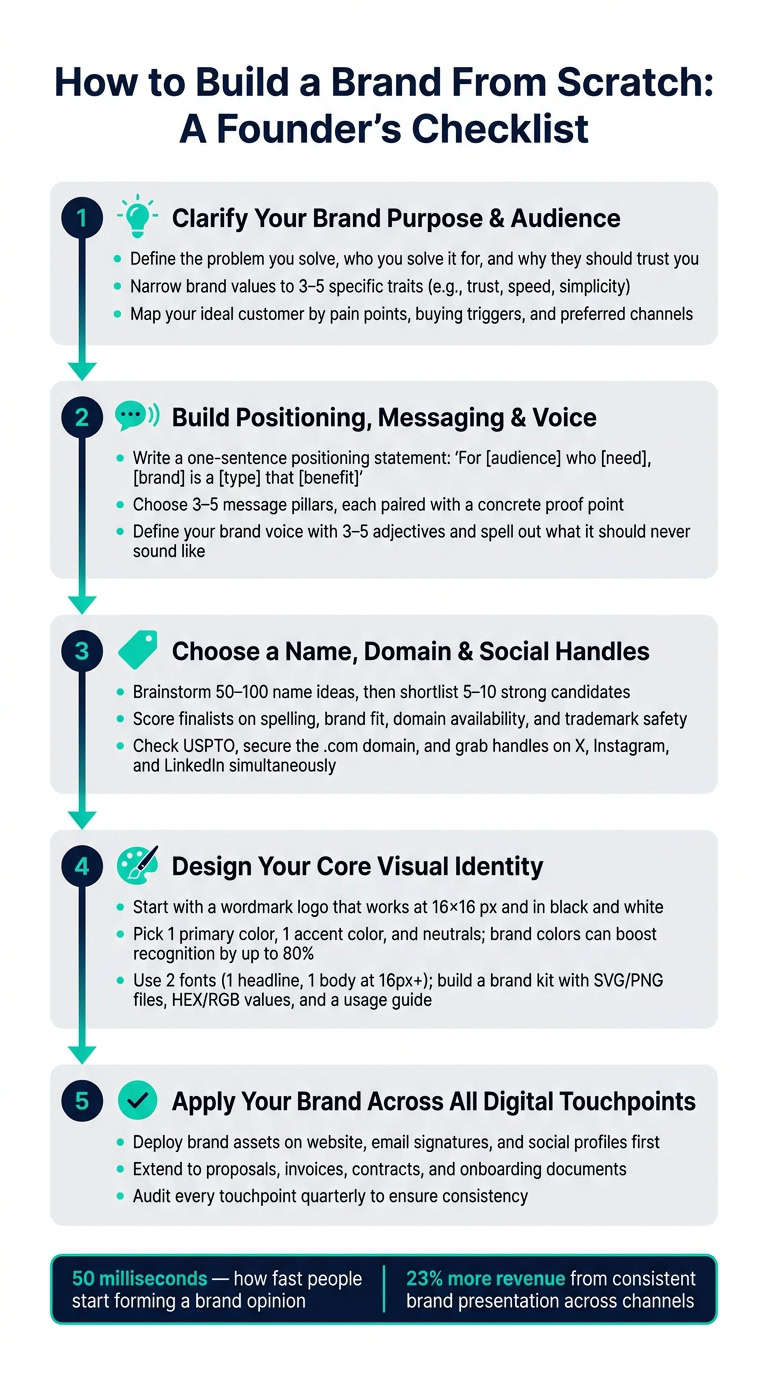
Most people judge your brand almost instantly. In about 50 milliseconds, they start forming an opinion, and up to 23% more revenue can come from steady presentation across channels.
If I were building a brand from scratch, I’d keep it simple:
- Start with the business, not the logo while protecting your business name
- Define who I help and why I matter
- Turn that into clear messaging
- Pick a name I can use legally and online
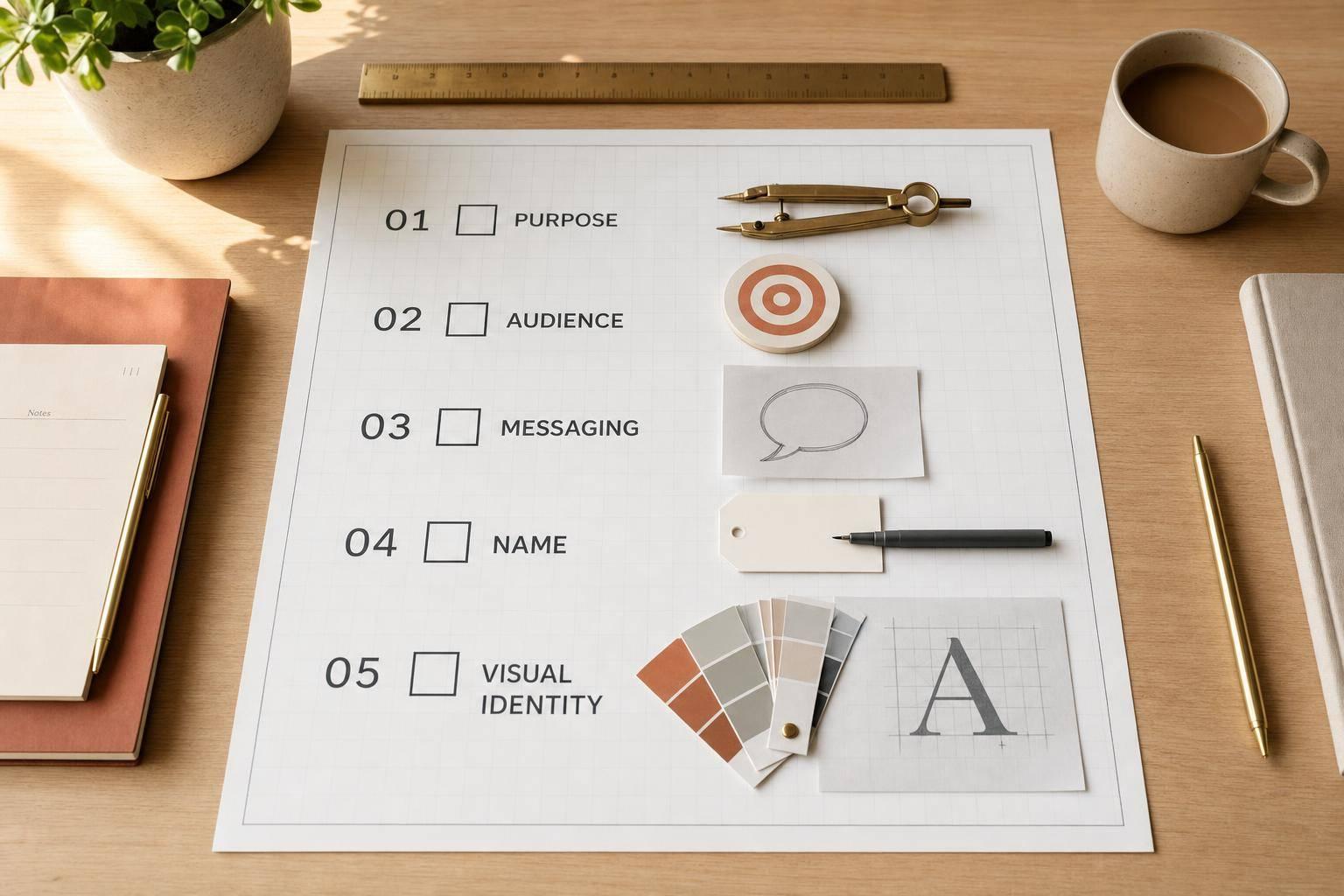
- Build a visual system I can apply everywhere
This article shows that a brand is not just design. It’s a set of rules for how I talk, what I show, and how I stay consistent on my site, social profiles, email, and documents.
A short version: if the message is fuzzy, the branding will be fuzzy too.
Clarify your brand purpose and target audience
Before you touch the name or the design, get clear on three things: the problem you solve, who you solve it for, and why people should believe you.
Define your purpose, mission, and values
Write one line for each of these:
- What problem do you solve?
- Who do you solve it for?
- Why should customers trust you to solve it?
Those answers shape your brand purpose. As Dayna Winter at Shopify puts it:
"Your company’s mission guides business decisions. Your values are what your brand stands for."
Then trim your brand values down to 3–5 specific traits. Think trust, speed, or simplicity.
That part matters more than it sounds. Values only mean something when they guide product choices, hiring, and marketing. Generic values get skimmed past. Specific values get used.
Once that’s locked in, connect it to a clear buyer.
Describe your ideal customer in concrete terms
Skip broad labels like “small business owners.” Instead, picture a buyer in a clear moment of need.
Michelle Shemilt, founder of Numi, says it well:
"The best businesses start with a pain point. I think, as a founder, if you are your consumer, then that helps a lot along the way too, because it’s truly a pain point for you."
A good way to map your audience is to focus on what shapes your messaging and where you show up:
| Segment | Main Pain Points | Buying Triggers | Preferred Channels |
|---|---|---|---|
| Freelancers | Inconsistent cash flow; admin overload | Landing a large contract; tax season | X (Twitter), LinkedIn, Slack communities |
| Remote Founders | High acquisition costs; team isolation | Seed round; product launch failure | Product Hunt, LinkedIn, Tech newsletters |
| Expats | Cross-border taxes; lack of local credit | Moving abroad; visa renewal | Facebook Groups, Reddit (r/expats), WhatsApp |
| Real Estate Investors (LLCs) | Liability exposure; messy bookkeeping | Buying a second property; legal audit | BiggerPockets, YouTube, Industry newsletters |
When you’ve picked the right buyer, they should feel understood almost at once.
The next move is to check whether that buyer already has plenty of options – or whether no one is serving them well.
Review the market to find a clear gap
Look at competitor messaging and spot the phrases that keep popping up. If every brand says it’s “the fastest,” “the easiest,” or “all-in-one,” they start to blur together.
Then dig into customer reviews and social comments on Reddit, G2, Capterra, and app stores. People tend to tell you where the gap is without meaning to. The complaints, friction, and repeated annoyances are the signal.
Pick one angle that fits your business and is missing from the market.
Use that gap to shape your positioning statement in the next step.
sbb-itb-ba0a4be
Build your positioning, messaging, and voice
Take what you learned about your audience and the gap in the market, then turn it into language your team can use every day. This is where research becomes a clear promise people can understand. That promise should shape your naming, messaging, and voice.
Write a simple positioning statement
Start with this fill-in-the-blank formula:
"For [target audience] who [need or problem], [brand name] is a [business type] that [key benefit]. Unlike [alternative], we [main difference]."
Write it in plain English. The goal isn’t to sound clever. It’s to give your team a simple line that helps with naming, design, and messaging. Be as specific as you can about the audience segment.
As the DesignX Team puts it:
"If a smart buyer lands on your homepage and cannot tell what category you belong to, your brand is doing extra work for no reason. Clever costs conversions."
Choose message pillars and proof points
Once your positioning is set, pick the three to five messages you want people to remember. These are your message pillars. Each one needs proof. Otherwise, it’s just marketing talk.
Here’s how that can look:
| Message Pillar | Customer Problem | Brand Promise | Proof Point | Primary Channel |
|---|---|---|---|---|
| Efficiency | Wasting 20+ hours/month on manual bookkeeping | Eliminate manual data entry | "Saves users an average of 15 hours per week" | Homepage / Sales Deck |
| Credibility | Distrust of new, unproven vendors | Built by experienced operators | Founder has 15+ years of industry experience | LinkedIn / About Page |
| Simplicity | Overwhelmed by complex software | Get set up fast | "Average setup time is 8.5 minutes" | Onboarding Emails |
| Results | Stagnant revenue growth | Drive measurable growth | Verified 23% average revenue increase | Proposals / Case Studies |
Use the same 3–5 pillars across your main channels, and pair each one with a proof point people can check or understand fast.
Set your voice, brand story, and tagline
Once the message is clear, define the voice that carries it. Your voice is the personality behind every word you publish. It should support the same promise your positioning statement makes.
Pick 3–5 specific adjectives and use them as guardrails. It also helps to spell out what your brand does not sound like. If your voice is direct, it should never feel evasive. If it’s warm, it shouldn’t sound cold or transactional.
Use plain English, direct "you" language, and USD pricing.
Your brand story should explain where you started, what you believe, and why you’re different. As Sarah Chisholm, founder of Wild Rye Baking, puts it:
"When someone can connect with your story, they become a lifelong customer – and perhaps even a fan."
Your tagline is the short version of that promise. Think of it as the line people remember when they forget everything else. Keep it short, easy to repeat, and tied to who the customer wants to be.
Choose a business name, domain, and social handles
Use your positioning to screen name ideas. The right name should carry your brand promise into the market – and it needs to be something you can register, protect, and publish everywhere you show up.
Set naming criteria and shortlist strong options
Use your positioning statement to narrow the list based on fit with your promise, not just personal taste.
Before you start brainstorming, set a clear filter. A strong name should be easy to spell after hearing it once, different from competitors, broad enough to grow with the business, and available across digital and legal channels.
Try a few naming styles before you cut the list down:
| Naming Style | What It Does | Example |
|---|---|---|
| Descriptive | Explains the service directly | FreshBooks |
| Suggestive | Hints at a benefit or feeling | Netflix |
| Invented | Made-up, highly ownable word | |
| Compound | Combines two real words | TaskForge |
| Metaphorical | Uses symbolism | Apple |
Come up with 50–100 options before narrowing anything down. Then cut the list to 5–10 names that have a real shot. Say each one out loud to a stranger. If they can’t spell it after hearing it once, that name may cost you word-of-mouth referrals. Memorable names are easier to remember.
Score the finalists based on spelling, brand fit, availability, and trademark risk:
| Name Candidate | Pronunciation & Spelling (1–5) | Brand Fit & Positioning (1–5) | Domain & Social Availability (1–5) | Trademark Safety (1–5) | Total Score |
|---|---|---|---|---|---|
| Candidate 1 | |||||
| Candidate 2 | |||||
| Candidate 3 |
Use this table to rank options by fit, availability, and risk.
Next, check whether your top candidates are open to use.
Check domain availability, social handles, and trademark conflicts
A strong name only works if you can own it across your website, social profiles, and legal filings.
Run availability checks before you commit to a finalist. Start with a clean .com. If it’s taken, test a clean alternative or a short modifier.
Check X, Instagram, and LinkedIn at the same time. Consistent brand presentation across all channels can increase revenue by up to 23%. Grab those handles as soon as you choose the name, even if your launch is still a few weeks away.
Then do a basic search in the USPTO database before you move ahead. Search the USPTO for the exact name and close variations so you don’t walk into a conflict.
"One lesson any entrepreneur trying to create a brand will quickly learn is that it’s actually not super easy to get a name trademarked." – Sandro Roco, Founder, Sanzo
Once a name passes those checks, match it to your legal setup.
Align your brand name with business setup and compliance
Use the same name across formation documents, domain registration, and social profiles. At this stage, consistency helps protect the brand identity you’ve built through positioning, messaging, and voice.
After the name clears domain, social, and trademark checks, register the entity and secure the domain and handles right away. That locks in the name across every channel and keeps your brand system in sync as you move into visual identity.
Design your core visual identity and brand assets
Once your name is set, turn your positioning into a visual system people can spot fast. Let the positioning statement, message pillars, and voice from the last section guide each design choice. The goal is simple: build something consistent and useful that you can put to work on your website, email, and social profiles from day one.
Set your visual direction and logo
Start with 3–5 adjectives that describe how your brand should feel. Think "modern", "dependable", "bold", or "minimal." These words become your filter. If a font or color doesn’t fit, cut it.
For the logo, a wordmark is often the best choice early on. It’s easier to make than a custom icon and usually works well in a website header, email signature, and pitch deck. Aim for a logo that stays clear at 16×16, works in black and white, and scales cleanly.
"If you cannot sketch it [a logo] from memory, it is probably too complex." – Bear My Brand Team
Choose colors, typography, and imagery
From there, build the rest of the system around the logo.
Pick one primary brand color, one accent color for calls to action, and a set of neutrals – near-black, grays, and white – for backgrounds and body text. Signature brand colors can increase brand recognition by up to 80%. All web text colors should meet WCAG AA contrast at 4.5:1 or higher.
For fonts, stick to two: one for headlines and one for body text. Common digital-friendly options include Inter, Söhne, and Geist. Keep body copy at 16 px or larger, with line height at 1.5 for readability.
For imagery, decide early if your brand will use photography, illustration, or both. The main thing is consistency. Glossier, for example, uses a simple wordmark logo for its website and packaging, with a stylized "G" as a secondary logo for small-scale uses like its YouTube channel profile photo.
Build a simple brand kit with ready-to-use files
Keep everything in one shared folder. Google Drive or Notion works well. Your starter brand kit should include:
- Primary and secondary logos
- A favicon
- SVG and PNG files
- HEX/RGB/CMYK values
- Font names and weights
- Background variants
- A one-page usage guide
That usage guide helps freelancers and teammates apply assets the same way across your website, social posts, pitch decks, and email signatures.
Document the rules in a simple table so nobody has to guess:
| Element | Usage Rules | Do | Don’t |
|---|---|---|---|
| Logo | Maintain clear space around the mark equal to the logo’s "X" height | Use the SVG version in web headers | Stretch, rotate, or add drop shadows |
| Colors | Primary color for CTAs; neutrals for backgrounds and body text | Use HEX codes for web and RGB for digital graphics | Use more than 3–4 colors in one layout |
| Typography | Heading font for H1/H2; body font for all other text | Keep line height at 1.5 for readability | Use decorative fonts for body copy |
| Imagery | Use a consistent filter or framing style across all photos | Use high-quality, authentic photos | Use generic, overly staged stock photos |
If you’re putting together a first version yourself, tools like Canva or Looka can help you move fast. A DIY kit can cost $0–$500. Freelance logo work usually runs $1,000–$5,000. Full identity packages often land between $2,000 and $10,000.
Then apply these assets to your website, email, and social profiles.
Apply your brand consistently across digital touchpoints
Once your brand kit is set, put it to work where people actually see it. Files sitting in a folder don’t build a brand. Consistent use does. Your brand shows up through every customer touchpoint, from your homepage to your invoice.
Apply the brand to your website, email, and social channels
Start with the three places people notice first: your website, email, and social channels.
On your website, use your logo, color palette, and typography across the homepage hero, service pages, buttons, forms, and product cards. On social profiles, use a circular logo avatar and add your brand colors and tagline to the banner. For email, keep the logo, typography, and tone the same across every team member.
Your social bios should match your current positioning statement. Also create a 1,200 × 630 px OG image with your logo and brand name.
Extend branding to documents and operations
Once your public-facing channels are aligned, carry that same system into customer documents and day-to-day operations. Apply your brand kit to proposals, invoices, contracts, intake forms, and onboarding PDFs.
A simple audit helps you spot gaps before they show up in more places. Review each touchpoint every quarter – or sooner if you add a new channel or change your messaging.
| Touchpoint | Current Brand Elements | Required Updates |
|---|---|---|
| Website (Homepage, About, Services) | Logo, colors, typography, voice, imagery | Check WCAG AA contrast ratios; align homepage promise with positioning statement |
| Email (Signatures, Welcome Sequence) | Logo, signature, tone, footer | Standardize signatures across all team members |
| Social Profiles (LinkedIn, X, Instagram) | Avatar, banner, bio, pinned post | Sync bios with your current positioning statement |
| Sales/Investor Docs (Pitch Decks, Proposals) | Typography, proof points, messaging | Update with latest customer results and metrics |
| Operations (Invoices, contracts, onboarding) | Logo, professional tone, layout | Apply brand kit to all outgoing documents |
Conclusion: Launch with a working brand system, not just a logo
A brand isn’t just a logo. It’s a system your team can use again and again.
This checklist walks through the full build: your purpose and audience, clear positioning and messaging, your name and handles, a lean visual identity, and steady use across every touchpoint. Each part supports the next. That way, your brand feels the same whether someone finds you on Instagram, reads your invoice, or lands on your homepage for the first time.
"A brand is a decision system. It tells your team how to talk, what to show, what to leave out, and how to stay consistent when the company grows." – DesignX Team
Write the rules down early. Use them everywhere. Review them on a regular schedule. Start with what you have, stay consistent, and treat your brand like something you maintain – not something you finish.
FAQs
How long does it take to build a brand from scratch?
There’s no set timeline for building a brand from scratch. It comes down to how much depth, focus, and discipline you bring to the work.
Some founders move with a tight 30-day roadmap or a 6-week process. And strategy work like positioning, messaging, and naming can sometimes be done in just a few focused days when there’s a clear framework in place.
What should I do first if I have a business idea but no brand yet?
Start with your brand strategy before you touch visual pieces like logos or color palettes. If you jump into design too soon, your branding can end up scattered and weak.
First, get clear on your brand positioning: the problem you solve, who you solve it for, and why people should pick you over other options. After that, move into your name, messaging, and visual identity.
How do I know if my brand messaging is actually working?
Your brand messaging is doing its job when customers talk about your product using language that sounds a lot like yours. You’ll see it when your team can clearly and consistently explain what you do, who you help, and why it matters without going off in five different directions.
It should line up with what customers are already saying, not fight against it. And it should give direction to your website, sales materials, and content so everything feels like it’s coming from the same place.
Over time, clear and consistent messaging builds trust and helps people recognize your brand at every touchpoint.