


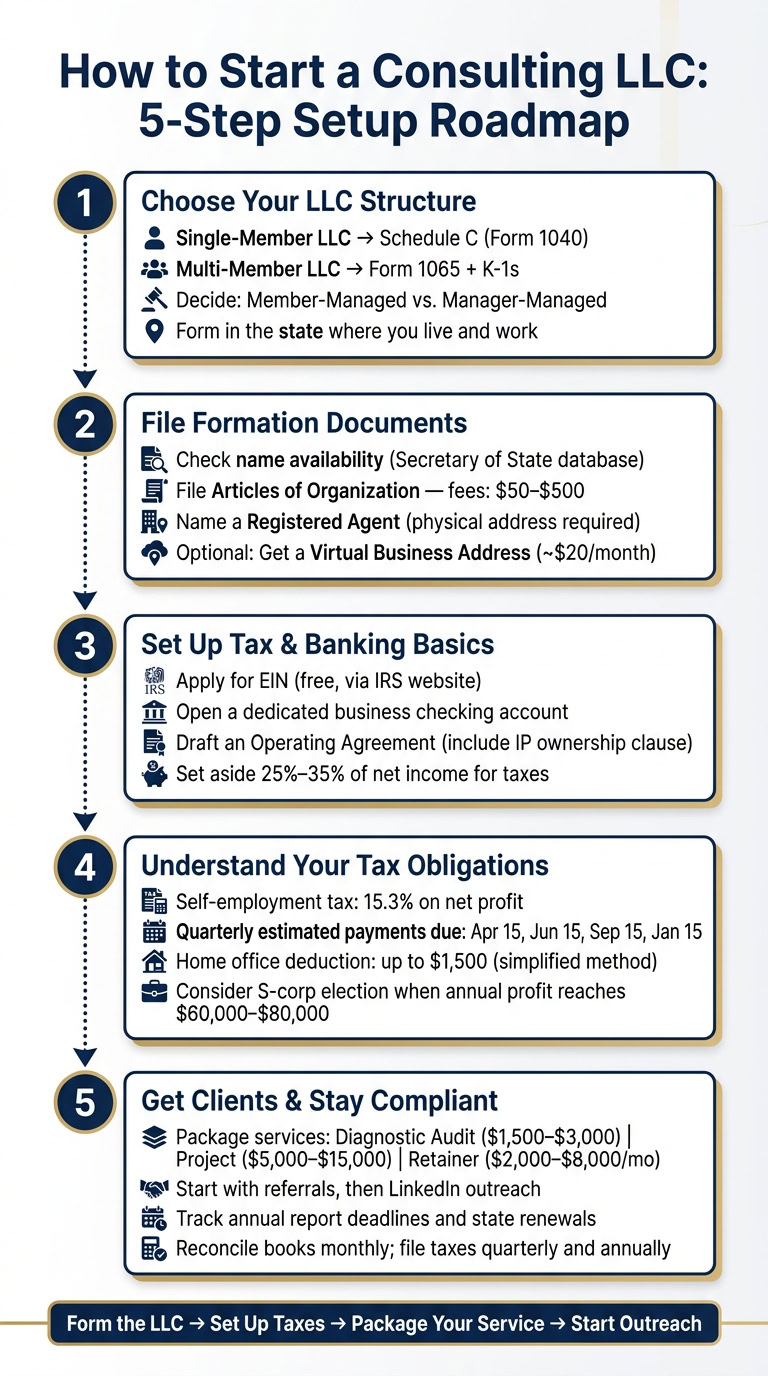
If I wanted to start a consulting LLC in the U.S. today, I’d focus on three things first: set up the LLC in the right state, get taxes and banking in order, and start selling a clear offer.
That’s the whole playbook in plain English. I’d pick between a single-member or multi-member LLC, decide who can manage and sign for the business, file formation papers, get an EIN, open a bank account, and keep business money separate. After that, I’d plan for self-employment tax at 15.3%, make quarterly estimated tax payments, and look at an S-corp election only when profit is often around $60,000 to $80,000+.
Then I’d move to client work:
- Pick a niche
- Turn skills into packaged services
- Start with referrals
- Use LinkedIn for outreach
- Send proposals and invoices through the LLC
- Track annual reports, tax dates, and state filings
A few numbers stand out right away:
- State LLC filing fees often run $50 to $500
- Virtual mailbox plans can start around $20/month
- Home office deduction under the simplified method is up to $1,500
- A diagnostic audit may be priced around $1,500 to $3,000
- Early project offers often land around $2,000 to $5,000
Here’s the short version: forming the LLC is just step one. What matters next is keeping clean records, using a separate business bank account, setting aside 25% to 35% of net income for taxes, and making it easy for clients to understand what you sell.
| Area | What I’d do first | Why it matters |
|---|---|---|
| LLC setup | Choose ownership, management, and home state | This affects filings, contracts, and control |
| Tax setup | Get EIN, track expenses, plan quarterly taxes | This helps avoid tax surprises |
| Banking | Open a business checking account | This keeps business and personal money apart |
| Client sales | Package one clear offer | This makes selling easier |
| Compliance | Track annual reports and deadlines | This helps keep the LLC active |
If you want a simple path, this is it: form the LLC, set up tax basics, package your service, and start outreach.
1. Choose the right LLC structure for your consulting business
Next, decide on ownership, management, and your filing state. These choices affect your taxes, your contracts, and who can legally act for the LLC.
Single-member vs. multi-member LLC
A single-member LLC (SMLLC) has one owner. That owner reports business income on Schedule C of Form 1040.
A multi-member LLC (MMLLC) has two or more owners. By default, the IRS taxes it as a partnership, which means filing Form 1065 each year and issuing a Schedule K-1 to each member. Members can divide ownership and profits however they agree, but those terms need to be written into the operating agreement.
| Feature | Single-Member LLC | Multi-Member LLC |
|---|---|---|
| Ownership | One person | Two or more members |
| Default tax filing | Schedule C (Form 1040) | Form 1065 + K-1s |
| Complexity | Low | Higher; requires detailed operating agreement |
| Best for | Solo consultants | Co-founders, consulting partners |
Once ownership is settled, the next call is simple but important: who gets to sign and manage the business?
Member-managed vs. manager-managed setup
In a member-managed LLC, each owner can sign contracts, approve proposals, and handle day-to-day decisions. In a manager-managed LLC, named managers run operations and can bind the LLC. Those managers can be members or outside managers. Other members stay more passive.
This setup matters because it decides who can sign client agreements and approve work.
| Feature | Member-Managed | Manager-Managed |
|---|---|---|
| Who signs contracts | Any member | Designated managers only |
| Best for | Solo or small active teams | Firms with passive members or nonmember managers |
| Risk of unauthorized commitments | Higher with many members | Lower; authority is clearly limited |
State choice, registered agent, and remote business address
In most cases, form your LLC in the state where you live and work. If you form in another state without a clear reason, you may add more paperwork and fees because you could still need to register as a foreign LLC in your home state.
Every LLC must name a registered agent. This must be a person or service with a physical street address in the state where the LLC is formed, and they must be available during normal business hours to receive legal notices and government mail. A P.O. Box doesn’t count.
A virtual business address can be used as your public mailing address for invoices and contracts, but it doesn’t replace the registered agent rule. They do two different jobs:
- A registered agent receives legal notices and state mail.
- A virtual address handles your public-facing business mail.
BusinessAnywhere offers business registration, registered agent services, and a virtual mailbox that lets you view and manage incoming mail online. That can help keep your home address off public records and help you avoid missing a compliance notice.
With structure and location decided, the next step is formation paperwork and tax registration.
sbb-itb-ba0a4be
2. Form your consulting LLC and set up core documents
Name the LLC and file Articles of Organization
Start with your state’s Secretary of State database to make sure the name you want is still open. Most states want the name to include "LLC" or "L.L.C.". You’ll also need to steer clear of restricted words like "bank", "insurance," or "university" unless you have special approval. It also makes sense to check the USPTO trademark database so you don’t pick a name that clashes with an existing mark.
Once the name is clear, file your Articles of Organization. States usually ask for:
- Your LLC name
- Principal office address
- Registered agent name and street address
- Management structure
- Business purpose
- Organizer signature
Filing fees often fall between $50 and $500, depending on the state. This filing is the legal step that puts the LLC into place. Once the state accepts it, move on to the EIN, bank account, and operating agreement.
Get an EIN, open a business bank account, and draft an operating agreement
An EIN (Employer Identification Number) is your LLC’s federal tax ID. You’ll need it to open a business bank account, send and receive W-9s and 1099-NECs, pay contractors, and make a future S-corp election. Apply on the IRS website. If you’re a U.S. owner, you can usually get it right away.
To open a business bank account, bring your Articles of Organization, EIN confirmation letter, Operating Agreement, and a government-issued ID. The bank uses these papers to confirm the LLC is in place and verify who has the right to approve transactions. It’s also smart to keep a separate savings account for quarterly estimated taxes or cash reserves. That small move can save a lot of stress later.
Your Operating Agreement is the LLC’s internal rulebook. Even if you have a single-member LLC, it helps show that the business is separate from you as a person, and many banks want to see one. For a multi-member consulting firm, this document matters even more. Spell out ownership percentages, how profits are split, who can sign contracts, and what happens if a partner leaves.
For consulting work, add an IP ownership clause. This should make it clear that the LLC keeps ownership of pre-existing frameworks and templates, while completed deliverables transfer to the client after full payment. That one clause can prevent a lot of confusion.
Set up a professional address and mail workflow
Your LLC’s address shows up on state filings, bank records, and marketing materials. So the choice between your home address and a virtual business address affects both privacy and how your business looks to clients.
| Factor | Home Address | Professional Virtual Address |
|---|---|---|
| Privacy | Personal residence is on public record | Keeps home address off state databases and public filings |
| Professionalism | Can appear less established to corporate clients | Looks more established on proposals and invoices |
| Mail handling | Manual; requires physical presence | Digital scanning, forwarding, and dashboard access |
If you work remotely or travel a lot, a virtual mailbox can make life much easier. It puts IRS notices, bank statements, client checks, contracts, and other mail in one online dashboard. When mail comes in, the provider scans it and uploads a PDF, often within 24–48 hours. If you need the physical item, like a signed contract or debit card, it can be forwarded to wherever you are.
BusinessAnywhere’s virtual mailbox starts at $20/month, billed annually, and includes unlimited scanning, storage, and worldwide forwarding.
With the LLC in place, the next step is tax setup and banking.
3. Understand LLC taxes, deductions, and S-corp options
After you form your LLC, the next job is figuring out how the IRS sees it and how that affects your cash flow.
Default tax treatment for single-member and multi-member consulting LLCs
By default, the IRS taxes the owner, not the LLC. In plain English, your LLC’s legal setup and its tax treatment are two different things.
If you have a single-member LLC, it’s usually taxed like a sole proprietorship or LLC. The IRS calls this a disregarded entity. You report your consulting income and expenses on Schedule C of Form 1040.
If your consulting LLC has more than one member, it’s usually taxed as a partnership. In that case, the LLC files Form 1065, and each member gets a Schedule K-1 that shows their share of the profit or loss.
EINs, self-employment tax, quarterly estimates, and common deductions
Tax planning gets a lot easier when you start tracking expenses from the first invoice, not six months later when you’re digging through old emails and bank statements.
If you actively work in the business, self-employment tax usually applies to your net consulting profit. That tax covers both the employer and employee shares of Social Security and Medicare, for a combined rate of 15.3% before regular income tax.
Because no employer is withholding taxes from your consulting income, you’ll usually need to make quarterly estimated payments with Form 1040-ES. These payments are generally due:
- April 15
- June 15
- Sept. 15
- Jan. 15
A simple starting point is to move 25%–35% of net income into a separate savings account after each client payment. It’s not glamorous, but it can save you from a nasty surprise at tax time.
Consulting businesses often have deductible costs tied to software, travel, marketing, and outside help. Common deductions include:
- Software subscriptions
- Travel to client sites
- Subcontractor fees
- Marketing costs
- Professional services like legal and accounting
- Home office expenses
For the home office deduction, the IRS requires regular and exclusive business use of the space. The simplified method allows a deduction of $5 per square foot for up to 300 square feet, with a maximum deduction of $1,500.
Keep receipts, invoices, and mileage logs from day one so your records are easier to back up if needed.
When an S-corp election may make sense
An S-corp election doesn’t wipe out taxes. What it does is change how your profit is divided.
After you file Form 2553 with the IRS, your LLC is taxed federally as an S corporation. You pay yourself a reasonable salary that is subject to payroll taxes, and then you take the rest of the profit as distributions that are not subject to self-employment tax. The LLC then files Form 1120-S and gives you a Schedule K-1.
A lot of consultants start running the numbers on an S-corp when annual profit hits around $60,000–$80,000. Below that range, the extra admin can eat up the tax savings fast. That usually means payroll filings, reasonable salary records, and sometimes higher accounting fees.
| Default LLC Taxation S-Corp Election | ||
|---|---|---|
| Federal filing | Schedule C (single-member) or Form 1065 (multi-member) | Form 1120-S + Schedule K-1 |
| Self-employment tax | Paid on net profit | Paid only on reasonable salary |
| Payroll required | No | Yes, for owner-employees |
| Complexity | Low | High |
| Best fit | Early-stage or lower-profit consulting | Established consultants with stable, higher profits |
The IRS Self-Employed Individuals Tax Center and S-corp guidance cover the basics.
Once the tax side is clear, package your services and start outreach.
4. Get your first clients and package your consulting services
With your LLC in place and your tax setup mapped out, the next job is simple: bring in revenue. Start with warm outreach. People who already know your work are often the fastest path to a first client. Once your offer is clear, focus on the channels most likely to get you that first conversation.
Pick a niche and turn your expertise into service packages
Start by listing 10–20 past projects. Then group them by industry or by the kind of problem you solved. That gives you a pattern to work with.
Next, write a one-sentence positioning statement: who you help, what you solve, and the result you deliver. For example: I help small U.S. SaaS companies reduce churn by improving onboarding and support processes.
After that, turn your work into clear offers instead of selling your time hour by hour. Why? Because packaged services are easier for clients to understand and easier for you to price.
A few common formats:
- A diagnostic audit runs 1–2 weeks and usually costs $1,500–$3,000. It gives the client a low-risk way to try working with you.
- A one-time project lasts 4–8 weeks and often falls in the $5,000–$15,000 range. This works well when the scope and deliverables are clear.
- A monthly retainer usually lands between $2,000 and $8,000 per month for steady support or fractional advisory work.
- An advisory call runs 60–90 minutes and often costs $300–$1,000, which makes it a solid entry point.
Once you have one offer nailed down, begin with referrals and LinkedIn.
Use referrals and LinkedIn outreach to get early clients
Build a list of 30–50 former colleagues, managers, and other people who trust your work. Send each person a short note that explains your niche and asks for introductions. Make it easy on them by adding a two- to three-sentence blurb they can forward as-is. If they don’t reply, follow up five to seven days later.
Over the first 90 days, steady and low-pressure referral outreach can lead to warm conversations. Those talks often convert better than cold outreach.
On LinkedIn, tighten up your profile so it says what you do at a glance. Your headline should follow this format: I help [audience] achieve [result] through [method]. Then rewrite your About section around past results and a clear call to action.
Post short case-style insights, checklists, or notes about repeat problems in your niche once or twice a week. You don’t need long essays. Short, useful posts often do the job just fine. On top of that, send 20 personalized connection requests a day to decision-makers in your target market. After they connect, follow up with conversation-first messages, not a hard pitch.
Here’s how the main early-stage acquisition channels compare:
| Channel | Speed to First Client | Out-of-Pocket Cost | Consistency |
|---|---|---|---|
| Referrals | Fast | Low | Variable (depends on network size) |
| LinkedIn outreach | Moderate | Low (organic) | High (scalable with regular posting) |
| Networking/events | Moderate | Variable (travel/fees) | Moderate |
| Cold email | Moderate | Low | High (volume-dependent) |
Once those conversations begin, the next step is turning interest into a proposal and an invoice.
Write proposals, set prices, and invoice through the LLC
A consulting proposal needs to do two things: win the work and spell out the work. Every proposal should include the scope, deliverables, timeline and milestones, fees and payment terms, and IP ownership.
Be direct. Don’t hide behind fuzzy wording like “unless listed in scope.” Instead, spell out revision limits, cancellation terms, and assumptions. For example, say that the client must provide system access within five business days if that affects your timeline.
Your pricing model should fit the kind of work you’re selling. Hourly billing – often $100–$300 per hour for many independent consultants – fits open-ended advisory work. Fixed project fees are usually a better match when the engagement is defined and you can estimate the effort ahead of time. Monthly retainers can smooth out revenue, but only if you set tight boundaries around what’s included. For early micro-offers, a fixed price in the $2,000–$5,000 range can keep approval fast and reduce friction.
Use the LLC’s legal name and bank account on contracts and invoices so business funds stay separate.
5. Keep your LLC active and compliant after launch
Forming an LLC is a one-time step. Compliance is the part that sticks around. Most states require annual or biennial reports and fees, and if you miss those deadlines, you can lose your good standing.
Once clients start paying you, this becomes part of the work. It’s not something you handle once and forget.
Track annual reports, state renewals, and operating agreement updates
Set up a compliance calendar the same week you form your LLC. Add your state’s annual report deadline, any franchise tax due dates, and your federal tax filing dates. Then set reminders at least 30 days early. Send state notices to your registered agent and make sure they get forwarded to you right away, so nothing gets missed.
Your operating agreement also needs updates when the business changes. That includes adding a member, changing profit splits, moving from member-managed to manager-managed, or adding new service lines. A quick email thread won’t replace a formal amendment.
Keep bookkeeping, tax filings, and deadlines organized
Use your business bank account for all client payments, business expenses, and tax set-asides. Mixing personal and business money is where small problems often turn into bigger ones.
A simple schedule makes this much easier:
| Frequency | Task |
|---|---|
| Monthly | Reconcile the business bank account; send invoices; categorize expenses; set aside money for estimated taxes |
| Quarterly | Pay estimated federal and state taxes if required; review profit and loss |
| Annually | File state annual or biennial reports, required federal returns, and any LLC amendments |
| As needed | Update registered agent info; amend the operating agreement for ownership or management changes |
Conclusion: Start simple, stay compliant, and build from there
Start with the right structure, keep the LLC compliant, and let client work grow on top of that base.
The businesses that stay out of trouble usually aren’t the ones with the most complicated setups. They’re the ones with simple systems they can repeat: a compliance calendar, clean books, and a registered agent who makes sure state mail doesn’t fall through the cracks. Start with what you need now, then add more structure as your consulting firm grows.
FAQs
Do I need an LLC before getting clients?
No. You can start working with clients as a sole proprietor under your own name. You do not need to form an LLC first.
That said, an LLC can help in a few ways. It can help protect your personal assets, make your business look more established, and help you meet vendor rules that some corporations and government agencies have.
If you’re bringing in $3,000 to $5,000 per month on a steady basis, forming an LLC may be a smart next step.
What should I include in my consulting operating agreement?
Your operating agreement lays out how your LLC will work day to day and helps protect its legal standing. For a single-member LLC, it’s often optional. For a multi-member LLC, though, it plays a BIG role in helping avoid disputes and showing that the business follows its own rules.
Your agreement should spell out the basics in plain terms, including:
- Ownership percentages
- Capital contributions
- Management duties
- Voting rules
- Profit and loss distributions
- Dispute resolution
- Buyout terms if a member leaves or passes away
Think of it as the rulebook for the company. If questions come up later, this document gives everyone something clear to point to.
When should a consulting LLC elect S-corp status?
Consider S-corp status when your business is bringing in steady net profits above $40,000 to $80,000 per year.
The big draw is pretty simple: you can split your income between a reasonable W-2 salary and shareholder distributions. That setup may lower what you pay in self-employment taxes.
That said, an S-corp isn’t free money. It also comes with payroll, tax filing, and compliance work, and those costs can eat into the tax savings. So before you make the switch, compare the money you may save with the added expenses.
A CPA can help you run the numbers based on your setup.