


When starting a business, you’ll need the right legal document to define how it operates. For corporations, this is the corporate bylaws. For LLCs, it’s the operating agreement. These documents serve similar purposes – outlining rules for governance and management – but they’re tailored to different business types.
Key Points:
- Corporate Bylaws: Internal rules for corporations (C Corps vs S Corps). They govern the board of directors, officers, and shareholders. Required in most states and often needed for banking or legal purposes.
- Operating Agreement: Internal contract for LLCs. Details ownership, profit sharing, and management. Required in only five states but highly recommended to avoid default state rules.
Quick Comparison:
| Feature | Corporate Bylaws | Operating Agreement |
|---|---|---|
| Entity Type | Corporations (C Corp, S Corp) | LLCs |
| Legal Purpose | Governance rules | Ownership & operations rules |
| Formality | High (meetings, minutes) | Flexible |
| State Requirement | Mandatory in most states | Required in 5 states |
| Filing | Private document | Private document |
Choosing the right document ensures legal compliance, protects personal assets, and keeps your business running smoothly. Let’s explore each in detail.
What Are Corporate Bylaws?
Corporate bylaws are the rules that outline how a corporation operates internally. Unlike the Articles of Incorporation – which are filed with the state to officially establish the corporation – bylaws are not filed with any government entity. Instead, they serve as the corporation’s internal playbook, defining how it is governed and managed.
As Vladislav Sergienko, Founder of Forms-Legal, puts it:
"The bylaws operate subordinate to the certificate of incorporation and state law, serving as the corporation’s operational manual for meetings, elections, officer duties, and internal procedures."
Bylaws are particularly relevant for C corporations and S corporations, as they establish the framework for interactions between shareholders, directors, and officers. They cover everything from decision-making authority to resolving disputes. Banks and lenders often request a copy of the bylaws when opening corporate accounts or approving loans, making them a practical requirement from the start.
In many states – including Delaware, New York, Florida, and Texas – corporations are legally required to adopt bylaws. Typically, incorporators draft these rules, and the board of directors adopts them during the corporation’s first organizational meeting. Keeping bylaws up to date is a shared responsibility between the board and, in some states, the shareholders.
Now, let’s dive into the key provisions that make up corporate bylaws.
Key Provisions of Corporate Bylaws
Corporate bylaws usually include several essential provisions, such as:
| Provision | What It Covers |
|---|---|
| Board of Directors | Number of directors, election process, term lengths, quorum requirements |
| Officers | Titles (e.g., CEO, CFO, Secretary), duties, appointment and removal procedures |
| Shareholders | Rules for annual meetings, notice periods, voting rights, and proxy voting |
| Corporate Governance | Policies on conflicts of interest, indemnification, and amendment procedures |
| Administrative | Details like the fiscal year, record-keeping requirements, and principal office location |
One critical provision is indemnification, which shields directors and officers from personal liability for decisions made in their official roles. Another is the amendment procedure, which specifies the voting threshold – whether a simple majority or a supermajority (commonly 66% or 75%) – required to modify the bylaws. Clearly defining this process helps avoid conflicts as the corporation grows and leadership changes.
sbb-itb-ba0a4be
What Is an Operating Agreement?
Operating agreements are essential for LLCs, serving as internal contracts that outline how the business will be owned, managed, and operated. These agreements establish rules for profit sharing, member exits, and more – essentially defining the inner workings of the business.
As Blake Cantrell, Attorney at Cantrell Law Firm, explains:
"The articles of organization you file with the state create the LLC as a legal entity, but the operating agreement is what actually tells everyone how the company works behind the scenes."
Unlike corporate bylaws, which are designed for corporations, operating agreements are specific to LLCs, whether single-member or multi-member. They remain private documents, not filed with the state, and are primarily used to override default state rules that may not align with the members’ preferences. For instance, without an agreement, many states automatically assume equal profit sharing among members, regardless of individual investments.
Operating agreements also help reinforce the LLC’s liability shield by demonstrating its status as a separate legal entity. This distinction protects members’ personal assets from business liabilities. Even single-member LLCs benefit from having an operating agreement – without one, courts might view the LLC as a sole proprietorship, leaving the owner’s personal finances vulnerable.
Currently, only five states – California, Delaware, Maine, Missouri, and New York – require LLCs to have an operating agreement. In New York, the agreement must be adopted within 90 days of filing the Articles of Organization. However, even in states without this requirement, skipping an operating agreement can lead to costly disputes. Without clear terms, disagreements between co-owners can result in legal battles costing anywhere from $50,000 to over $200,000.
Key Provisions of Operating Agreements
A well-crafted operating agreement addresses every stage of the LLC’s lifecycle, from its creation to its eventual dissolution.
| Provision | What It Covers |
|---|---|
| Ownership Interests | Defines each member’s ownership percentage |
| Capital Contributions | Specifies what each member contributes (cash, property, or services) |
| Profit/Loss Allocation | Details how income and losses are credited to members |
| Distributions | Outlines when and how members receive cash payments |
| Voting Rights | Defines decision-making rules (e.g., majority or unanimous votes) |
| Management Structure | Specifies whether the LLC is member-managed or manager-managed |
| Transfer Restrictions | Sets rules for selling membership interests, including Right of First Refusal (ROFR) |
| Buy-Sell Provisions | Details buyout terms in cases like death, disability, or voluntary exit |
| Dissolution Rules | Explains how the LLC will wind down and distribute assets |
One critical but often overlooked provision is the tax distribution clause. In an LLC, members are taxed on their share of the company’s profits, even if those profits aren’t distributed to them. Without this clause, members could face tax bills without receiving the necessary cash to cover them. Including a tax distribution clause ensures the LLC provides enough funds to cover members’ tax liabilities.
Other provisions focus on conflict resolution and maintaining operations. For LLCs with a 50/50 ownership split, the agreement should include a mechanism to resolve deadlocks – such as using a neutral mediator or a "shotgun" buy-sell clause – to avoid operational standstills during disputes.
Next, we’ll look at how operating agreements differ from corporate bylaws.
Key Differences Between Corporate Bylaws and Operating Agreements
At their core, corporate bylaws govern corporations, while operating agreements are designed for LLCs. These documents aren’t interchangeable – they cater to different business structures, each with unique rules, ownership setups, and governance requirements.
One major difference lies in the level of formality. Bylaws operate within a strict corporate framework involving shareholders, a board of directors, and officers. This structure requires formal meetings, recorded minutes, and structured voting procedures. On the other hand, operating agreements are flexible contracts signed by LLC members. They can be tailored to fit almost any ownership or management arrangement that the members agree upon.
The drafting process also varies. Bylaws are typically created by incorporators and then adopted by the board of directors. In contrast, operating agreements are collaboratively negotiated and signed by all LLC members.
As Stripe Atlas explains:
"LLCs don’t have bylaws in the legal sense. Bylaws are a corporate document. They belong to corporations and are designed for a governance system built around shareholders, boards of directors, officers and formal voting procedures."
Another key distinction is how these documents are treated publicly. While neither is filed with the state, corporate bylaws for public companies must be accessible to the SEC. Additionally, all corporate bylaws can be reviewed by the IRS upon request. Operating agreements, however, remain entirely private.
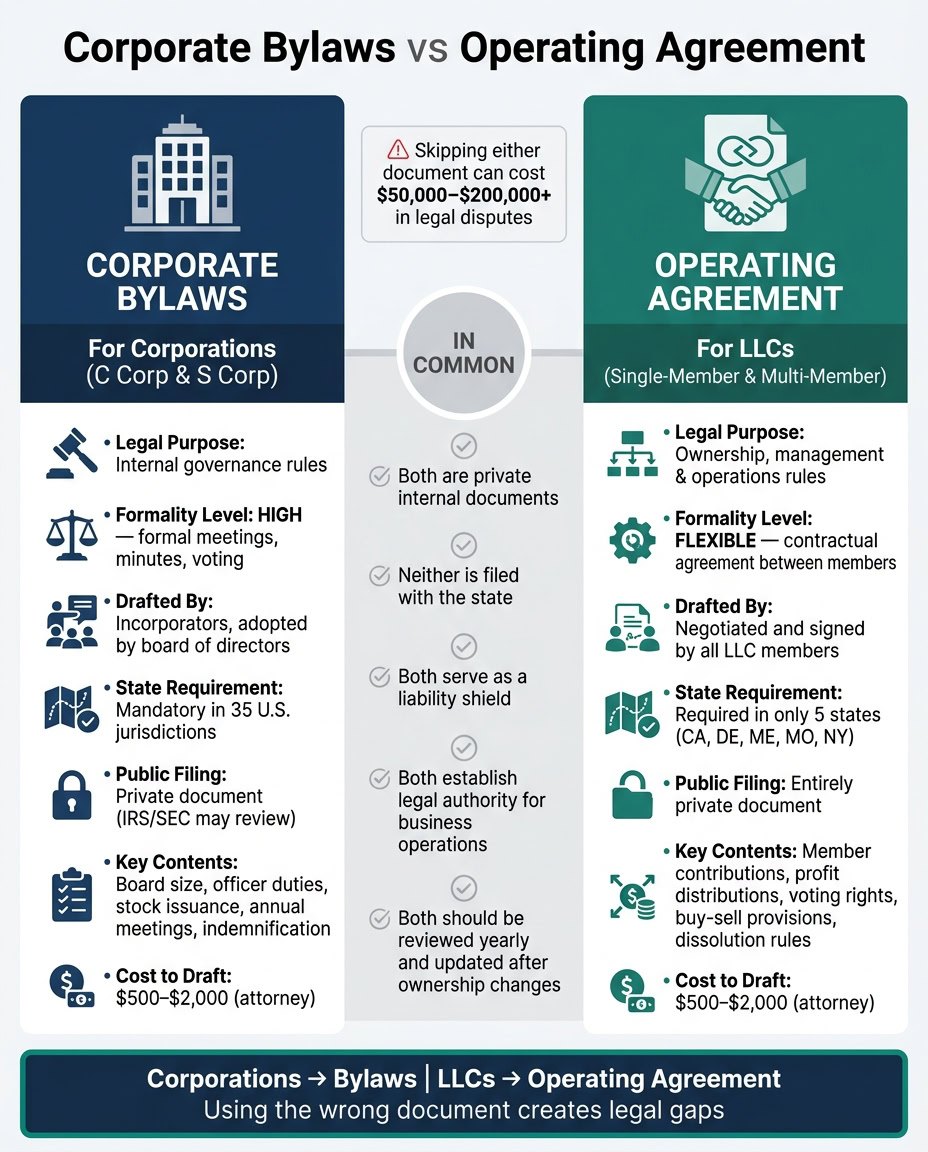
Here’s a quick comparison to highlight these differences:
Comparison Table: Corporate Bylaws vs Operating Agreements
| Feature | Corporate Bylaws | Operating Agreements |
|---|---|---|
| Business Entity | Corporations (C Corp, S Corp) | Limited Liability Companies (LLC) |
| Legal Purpose | Defines internal governance (board, officers, shareholders) | Defines ownership, management, and operational rules |
| Drafting/Adoption | Drafted by incorporators; approved by board | Drafted and signed by all LLC members |
| Formality Level | High – requires formal meetings, minutes, and voting | Flexible – contractual agreement between members |
| Typical Contents | Board size, officer duties, stock issuance, annual meetings | Member contributions, profit distributions, management structure |
| State Law Requirement | Required in most states (14 states do not require them) | Required in only 5 states (CA, DE, ME, MO, NY) |
| Public Filing Status | Private internal document | Private internal document |
Legal Requirements for Bylaws and Operating Agreements
The rules for bylaws and operating agreements vary depending on your business structure choice and the state where your business is registered. Let’s break down the key legal requirements for these documents.
For corporations, 35 U.S. jurisdictions – 34 states and Washington, D.C. – make bylaws mandatory. In contrast, 16 states, including California, Nevada, and Colorado, consider them optional. However, skipping bylaws can create problems. Without them, corporations must follow state default rules, which might not align with how you want to run your business. This can lead to complications during disputes or audits.
"Failure to maintain proper corporate formalities, including current bylaws, is one of the primary grounds for piercing the corporate veil, which exposes shareholders to personal liability." – Vladislav Sergienko, Founder, Forms-Legal
State laws also set specific rules for what bylaws need to address. For instance, California requires at least three directors once shares are issued, unless there are fewer than three shareholders. In Alaska, the same person cannot serve as both President and Secretary unless they own 100% of the company’s shares. These are just a few examples of mandatory governance rules under state corporate laws.
For LLCs, the legal requirements are less rigid but still important. Only five states – California, Delaware, Maine, Missouri, and New York – require an operating agreement. New York adds an extra layer, demanding that the agreement be adopted within 90 days of filing the Articles of Organization. In the remaining 45 states, operating agreements are optional. But skipping this document can have consequences: state default laws might enforce equal profit-sharing or even dissolve the LLC if a member leaves.
Even though operating agreements aren’t always legally required, they’re often needed in practice. Banks and lenders usually insist on one before opening accounts or providing credit. Ensuring your bylaws or operating agreement complies with state laws and supports your business goals is a crucial step in protecting your company.
Which Document Does Your Business Need?
The right document for your business depends on its structure: corporations need corporate bylaws, while LLCs require an operating agreement.
"Bylaws are for corporations, while operating agreements are for LLCs. Both establish internal governance rules, but they reflect fundamentally different legal frameworks." – Stripe
Corporate bylaws are tailored to the structured hierarchy of corporations, which typically includes shareholders, a board of directors, and officers. On the other hand, an operating agreement fits the adaptable nature of LLCs, outlining details like profit sharing, decision-making processes, and procedures for when a member exits. To avoid confusion – and ensure legal compliance – steer clear of using terms like "LLC bylaws".
These documents also play a vital role in confirming legal authority for everyday business operations. For instance, banks and lenders rely on them to verify who can open accounts or sign contracts on behalf of the business. Without these documents, your operations may fall under state default rules, which often don’t align with how you want to run your business.
Additionally, both documents act as your liability shield. They help establish that your business is a separate legal entity from its owners, which is crucial if you ever face risks to your personal assets. Choosing the appropriate document not only keeps your business in line with legal requirements but also ensures its governance structure supports your specific needs.
Once you’ve identified the right document, ensure all relevant parties sign it, keep it securely filed, and update it as needed when ownership or management changes occur. Having this in place is a key step in setting up your business for success.
Conclusion
The distinction is simple: corporate bylaws are for corporations, and operating agreements are for LLCs. These documents are tailored to their respective business structures, and failing to use the correct one – or skipping it entirely – can leave your business vulnerable to legal complications.
"Operating agreements belong to LLCs, and bylaws belong to corporations – mixing them up creates legal gaps that surface during the worst possible moments." – Brian Holloway, Author, EyesAI
Without the right document, your business will fall back on default state laws. These laws might impose rules about profit sharing, management decisions, or ownership changes – rules you didn’t choose and may not want.
To protect your business and stay compliant, here’s what you should do:
- Review governance documents yearly. This helps ensure they reflect your current business operations.
- Update documents after ownership or management changes. Any shifts in direction should be reflected promptly.
- Avoid generic templates. Custom documents drafted by experienced attorneys (typically costing $500 to $2,000) are a smart investment to prevent costly legal disputes.
Make sure your document matches your entity type, is properly signed, and is stored securely. These steps can save you from unnecessary headaches down the road.
FAQs
Can I use bylaws for an LLC?
Bylaws are exclusive to corporations and detail their management structure and decision-making processes. For LLCs, the equivalent document is an operating agreement, which aligns with the legal framework specific to LLCs. Unlike bylaws, which are often mandatory for corporations, operating agreements are optional for LLCs. However, having one is strongly advised to set clear internal guidelines and reduce the likelihood of disputes.
Do I still need an operating agreement for a single-member LLC?
Absolutely. Even if you’re the sole owner of an LLC, having an operating agreement is crucial. Here’s why:
- Legal Separation: It reinforces the distinction between you as an individual and your LLC, which is key to maintaining limited liability protection.
- Protects Limited Liability Status: Without an operating agreement, you risk blurring the lines between personal and business assets, potentially jeopardizing your liability shield.
- Banking and Financing: Many banks require an operating agreement to open business accounts or approve loans.
- State Requirements: States like California and New York legally require single-member LLCs to have one.
Even in states where it’s not mandatory, creating an operating agreement can help clarify management rules and avoid potential liability complications. It’s a small step that can save you from big headaches down the line.
How do I update bylaws or an operating agreement after ownership changes?
To revise bylaws or an operating agreement after ownership changes, start by reviewing the procedures outlined in the governing documents. These typically require internal approval, such as a vote by members or directors, followed by formal amendments.
The amendments should clearly detail the updated ownership structure and adhere to the steps specified in the original agreement. Make sure all approvals are documented in writing, and if the changes impact public records, file the necessary updates with the relevant state agency.