

When starting a business in the U.S., choosing the right formation document is critical. Articles of Incorporation are for corporations, while Articles of Organization are for LLCs. Both establish your business as a separate legal entity, but they serve different purposes and structures:
- Articles of Incorporation create corporations with shareholders, a board of directors, and the ability to issue stock.
- Articles of Organization form LLCs, offering flexible management and pass-through taxation.
Your choice impacts taxes, liability, and governance. Filing fees and requirements vary by state, so understanding the differences between LLCs and corporations is essential.
Quick Comparison
| Feature | Articles of Incorporation (Corporation) | Articles of Organization (LLC) |
|---|---|---|
| Entity Type | Corporation (C-Corp, S-Corp, Nonprofit) | Limited Liability Company (LLC) |
| Ownership | Shares of stock | Membership interests |
| Governance | Board of Directors, Officers | Members or Managers |
| Tax Treatment | Double taxation (C-Corp) or pass-through (S-Corp) | Pass-through by default |
| Compliance | High (meetings, bylaws, minutes) | Lower (operating agreement) |
| Filing Fees | $35–$300 (varies by state) | $35–$300 (varies by state) |
Filing the correct document ensures your business operates legally and protects your personal assets. Keep reading to learn more about their features, legal protections, and when to choose each structure.
Understanding Articles of Incorporation
Articles of Incorporation serve as the foundational document for establishing a corporation. Attorney David M. Steingold from Nolo describes it succinctly:
"A corporation’s articles of incorporation is its official formation document."
This document not only formalizes the existence of your business but also lays out the groundwork for its structure and operations. Once filed with the Secretary of State, it legally separates the corporation from its owners, creating a distinct legal entity.
Key Features and Typical Contents
The Articles of Incorporation generally include the following components:
| Component | Description |
|---|---|
| Corporate Name | Must include a designator like "Inc." or "Corp." and be unique within the state. |
| Registered Agent | A designated person or entity with a physical address to receive legal documents. |
| Business Purpose | A statement outlining the corporation’s activities; broad phrasing like "any lawful act" is common. |
| Authorized Shares | Specifies the maximum number of shares the corporation is allowed to issue. |
| Duration | Indicates how long the corporation will exist, typically listed as "perpetual". |
A helpful tip: use broad language in the business purpose clause. Narrow wording might limit your ability to expand into new areas later.
Legal Implications for Corporations
Filing Articles of Incorporation does more than just register a business name. It establishes a "corporate veil", which is a legal barrier protecting your personal assets from the corporation’s liabilities. Cornell Law School emphasizes the importance of this document, calling it "the highest governing document in a corporation".
Additionally, this filing is a prerequisite for issuing stock. A corporation cannot legally sell equity to investors until its Articles of Incorporation are approved by the state. Since these documents become part of the public record, it’s important to avoid including sensitive or confidential details.
Use Cases for Articles of Incorporation
Certain business scenarios make incorporation particularly advantageous. For example, venture-backed startups often incorporate as C-corporations. States like Delaware are especially popular since about 50% of U.S. public corporations are incorporated there, benefiting from its established corporate laws and business-friendly courts. Investors generally expect this structure when evaluating potential investments.
Nonprofits also rely on Articles of Incorporation but customize the purpose clause to align with their mission. Filing fees vary by state; for instance, California charges around $30 for nonprofits compared to roughly $100 for general stock corporations. Businesses planning to go public, offer stock options to employees, or seek institutional funding often find incorporation aligns with their long-term objectives.
This structured approach to forming a corporation contrasts with the more adaptable framework outlined in Articles of Organization for LLCs, which will be discussed next. You can also learn more about Articles of Organization to see how they differ.
Understanding Articles of Organization
Unlike corporations, forming an LLC through Articles of Organization offers a simpler and more adaptable structure. While corporations rely on Articles of Incorporation, Articles of Organization serve as the foundational document for a Limited Liability Company (LLC). As explained by the Legal Information Institute:
"The articles of organization is a public and official document used to create a limited liability company (LLC)." – Wex Definitions Team, Legal Information Institute
When filed with the state, this document officially establishes your LLC as a separate legal entity. It functions similarly to Articles of Incorporation but is customized to meet the needs of LLCs.
Key Features and Typical Contents
The requirements for Articles of Organization can vary by state, but they typically include these core elements:
| Component | Description |
|---|---|
| LLC Name | Must include a designator like "LLC" or "L.L.C." and be unique within the state |
| Principal Office Address | The physical location where business operations are conducted |
| Registered Agent | A person or entity designated to receive legal and government documents |
| Business Purpose | Broad language allows flexibility for future business activities |
| Management Structure | Indicates whether the LLC is member-managed or manager-managed |
| Organizer Signature | The signature of the person preparing and submitting the filing |
The management structure section is particularly important. A member-managed LLC gives all owners a say in daily decisions, making it ideal for small teams. On the other hand, a manager-managed LLC appoints specific individuals – who may or may not be members – to handle operations. This setup works well for LLCs with passive investors or a clear leadership hierarchy. Some states require you to specify the management structure; otherwise, the default is often member-managed.
Legal Implications for LLCs
Filing the Articles of Organization is a critical step in creating a legal distinction between yourself and your business. This separation protects your personal assets from business liabilities and enables essential activities like opening a business bank account, hiring employees, and signing contracts under the company’s name.
However, the Articles of Organization don’t dictate how the LLC operates internally. According to attorneys David M. Steingold and Amanda Hayes:
"The articles along with the LLC’s operating agreement will provide the framework for how your company is run."
While the Articles are public, the operating agreement is a private document that outlines internal rules, such as profit sharing, voting rights, and procedures for handling member exits. Together, these documents form the backbone of your LLC’s governance.
Filing fees for Articles of Organization vary widely, ranging from $40 to $500, depending on the state. Some states also offer expedited processing for an additional cost.
Use Cases for Articles of Organization
LLCs are a popular choice for solo entrepreneurs, small partnerships, and asset-holding entities across various industries. For example:
- A freelance graphic designer who wants liability protection without the complexity of a corporation.
- A two-person consulting firm that values flexible profit-sharing arrangements.
- A real estate investor looking to set up an LLC for real estate to hold rental properties under a distinct legal entity.
This structure appeals to many because it offers liability protection without the administrative burdens of a corporation. LLCs don’t require annual shareholder meetings, a board of directors, or stock issuance. This simplicity, combined with legal safeguards, makes LLCs a practical choice for many small business owners.
The next section will dive into a side-by-side comparison of LLCs and corporations, highlighting their differences in greater detail.
Key Differences Between Articles of Incorporation and Articles of Organization
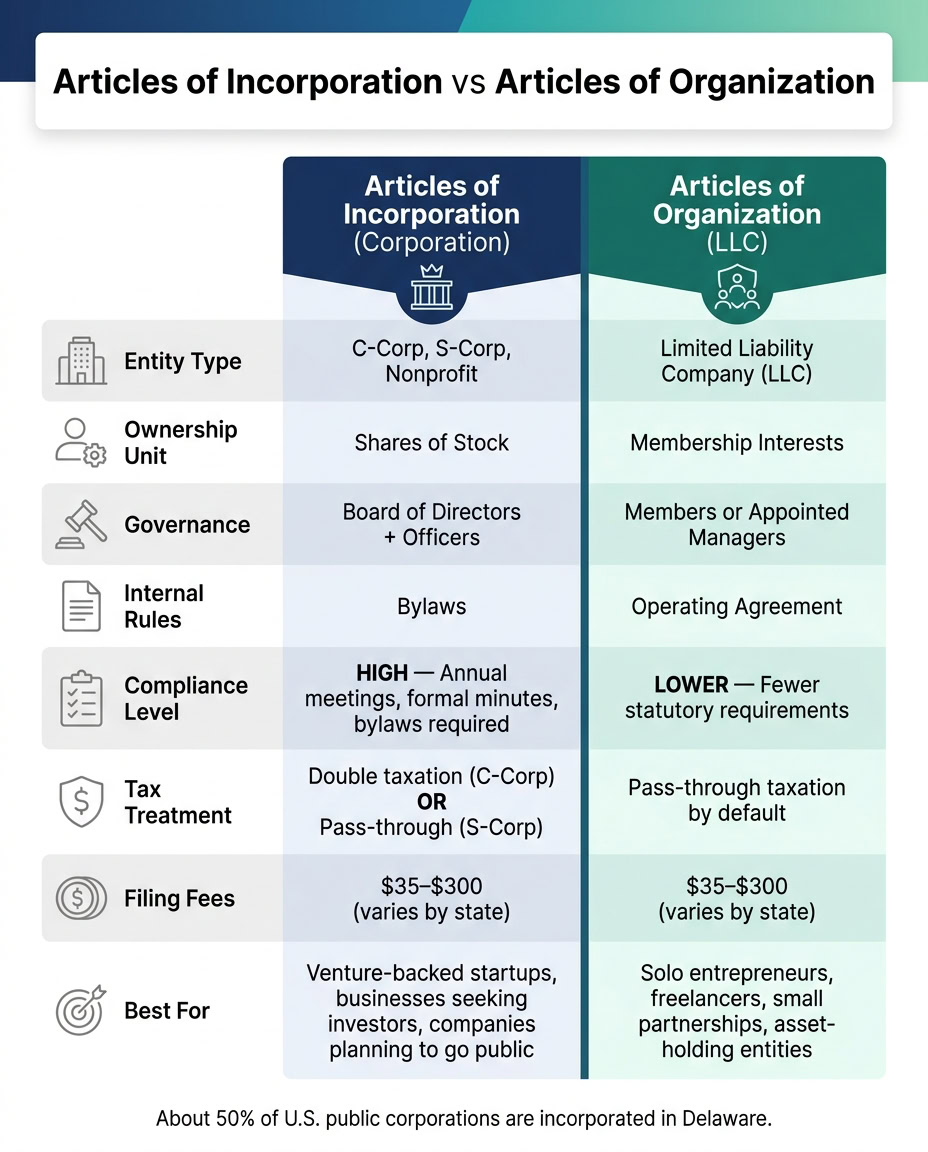
Understanding the differences between Articles of Incorporation and Articles of Organization is essential when deciding which structure best suits your business needs. Each serves a different type of entity and comes with its own set of rules, responsibilities, and advantages.
Comparison Table
| Feature | Articles of Incorporation (Corporation) | Articles of Organization (LLC) |
|---|---|---|
| Entity Type | C-Corp, S-Corp, Non-profit | Limited Liability Company (LLC) |
| Ownership Unit | Shares of stock | Membership interests |
| Governance | Board of Directors and Officers | Members or appointed Managers |
| Internal Rules | Bylaws | LLC Operating Agreement |
| Compliance Level | High (annual meetings, formal minutes) | Lower (fewer statutory requirements) |
| Tax Treatment | Double taxation (C-Corp) or pass-through (S-Corp) | Pass-through taxation by default |
| Filing Fees | $35–$300, depending on state | $35–$300, depending on state |
Let’s break down some of the key differences in governance and compliance between these two structures.
Governance and Ownership Structures
Corporations are built on a more formal governance model. Ownership is represented by shares of stock, which are held by shareholders. A board of directors oversees strategic decisions, while officers handle the daily operations. This clear chain of command ensures accountability but also adds layers of complexity.
On the other hand, LLCs offer a more flexible structure. Ownership is divided into membership interests, and management can be handled directly by the members or delegated to appointed managers. As RASi Staff explains:
"LLCs offer a simplified structure and allow members to choose how they want to manage the business."
This adaptability makes LLCs attractive to those looking for a less rigid framework. Unlike corporations, LLCs don’t require a board of directors or the issuance of stock unless specifically desired by the members.
Compliance Requirements and Costs
Corporations have stricter compliance obligations. They must hold annual meetings, maintain formal bylaws, and document major decisions in a corporate minute book. Neglecting these formalities can lead to legal risks. As Garrett Sutton, Esq., Principal Partner at Corporate Direct, emphasizes:
"An entity exists largely to protect you from losing your personal possessions if the business is sued. If you set up and maintain the corporate formalities, there is a corporate veil, that protects you."
LLCs, by contrast, have fewer statutory requirements. While the compliance burden is lighter, LLCs should still maintain clear boundaries between personal and business finances to ensure liability protection remains intact.
Both corporations and LLCs incur filing fees, typically ranging from $35 to $300 depending on the state. These fees are necessary for registering the entity but vary based on local regulations.
sbb-itb-ba0a4be
Choosing Between Incorporation and Organization
Matching Entity Type to Business Goals
When deciding between incorporation and organization, it’s important to align your choice with your business goals. As mentioned earlier, each structure has unique impacts on taxation, governance, and liability.
For solo entrepreneurs, freelancers, or small teams looking for liability protection with minimal administrative hassle, an LLC is often the best route. It provides pass-through taxation by default and keeps compliance requirements relatively simple.
On the other hand, if your vision involves raising venture capital, issuing stock to employees, or potentially going public, forming a corporation is usually more suitable. Investors – especially institutional ones – tend to prefer the C-Corp structure. States like Delaware and Wyoming are particularly appealing for corporations due to their business-friendly legal frameworks, as previously discussed.
These decisions become even more critical when your business operates in a virtual environment or crosses international borders.
Considerations for Virtual and International Businesses
If you’re a remote or international founder, there are extra steps to consider, no matter which entity type you choose. For starters, you’ll need to obtain an EIN from the IRS and ensure your registered agent complies with state-specific requirements. This means the registered agent must have a physical street address in the state of formation – P.O. Boxes won’t cut it.
If your business expands into another state by opening an office or hiring employees, you’ll need to register as a foreign entity in that state. Additionally, businesses formed in 2026 or later must file a Beneficial Ownership Information (BOI) report with FinCEN within 90 days of formation. Missing this deadline can lead to penalties of $500 per day.
How BusinessAnywhere Simplifies the Process
Virtual entrepreneurs often face a maze of cross-state formation and compliance requirements. BusinessAnywhere streamlines this process by offering everything you need on one platform, making it easier to register an LLC or corporation.
With BusinessAnywhere, you can start your business registration at $0 plus state fees, and the first year of registered agent service is included at no extra cost. Their EIN application service is particularly helpful for non-U.S. founders who can’t apply in person, as it handles preparation, submission, and follow-up. Additionally, their virtual mailbox service provides your business with a real U.S. street address, unlimited mail scanning, and global forwarding – ensuring compliance with U.S. address regulations.
For founders looking for a comprehensive solution, the Digital Nomad Kit bundles services like LLC formation, EIN assistance, bank account setup, and tax strategy into one package. This option is available to both U.S.-based and international entrepreneurs, making it a one-stop solution for business setup and compliance.
Conclusion
Choosing the right formation documents is all about aligning with your business goals and how you plan to operate. The decision between forming a corporation or an LLC comes down to a basic question: What does your business need? If you’re looking for flexibility, simpler compliance requirements, and pass-through taxation, an LLC with Articles of Organization might be the better choice. On the other hand, if your focus is on attracting outside investors, issuing stock, or preparing to go public, Articles of Incorporation and a corporate structure are likely the way to go.
Filing your formation documents is just the first step – keeping up with compliance is what truly protects your business. Corporate attorney Garrett Sutton warns that neglecting formalities can leave you personally liable. Many businesses lose legal protections by failing to follow requirements like maintaining records, separating personal and business finances, and filing necessary documents. Beyond the initial filing, staying compliant through practices like detailed record-keeping and proper documentation ensures your legal protections remain intact.
The good news is that starting doesn’t have to break the bank. Filing fees range from $35 to $300, making it affordable to establish your entity. To safeguard your personal assets, pair your filing with governing documents – Bylaws for corporations or an Operating Agreement for LLCs. These documents provide the legal framework your business needs to operate smoothly.
If you’re feeling overwhelmed or want to avoid the hassle of paperwork, BusinessAnywhere can help. They offer LLC and corporation formation starting at $0 plus state fees, and even include free registered agent service for the first year. Whether you’re based in the U.S. or launching your venture from abroad, starting with the right filing sets a strong foundation for your business.
FAQs
Can I switch from an LLC to a corporation later?
Yes, switching from an LLC to a corporation is possible, but it involves several legal and administrative steps. Depending on your state, you might need to dissolve your LLC and create a new corporation, or you could file a conversion document if your state allows it. This change can also impact your taxes, so it’s a good idea to consult with legal and tax professionals to ensure you follow the rules and fully understand the potential effects.
Do I need both Articles and an Operating Agreement or Bylaws?
When forming an LLC, you’ll encounter two essential documents: Articles of Organization and an Operating Agreement. While both are important, they serve distinct purposes.
- Articles of Organization: This document is mandatory for registering your LLC with the state. It officially establishes your business and includes basic details like the company name, address, and registered agent.
- Operating Agreement: Though optional in most states, it’s strongly recommended. This agreement outlines key aspects like ownership percentages, management structure, and operational procedures. It acts as a safeguard to prevent disputes and ensures the business runs smoothly.
In short, the Articles of Organization handle the legal formation, while the Operating Agreement focuses on internal rules and governance.
What mistakes can void my liability protection?
To keep your liability protection intact, it’s essential to handle formation documents correctly – this means filing Articles of Incorporation for corporations or Articles of Organization for LLCs – and staying on top of legal obligations. Mistakes like incomplete or incorrect filings, skipping compliance tasks (like annual reports or maintaining a registered agent), blending personal and business finances, or ignoring corporate formalities can put your liability shield at risk. Prioritize accurate documentation, meet compliance deadlines, and keep personal and business matters separate to safeguard your protection.