

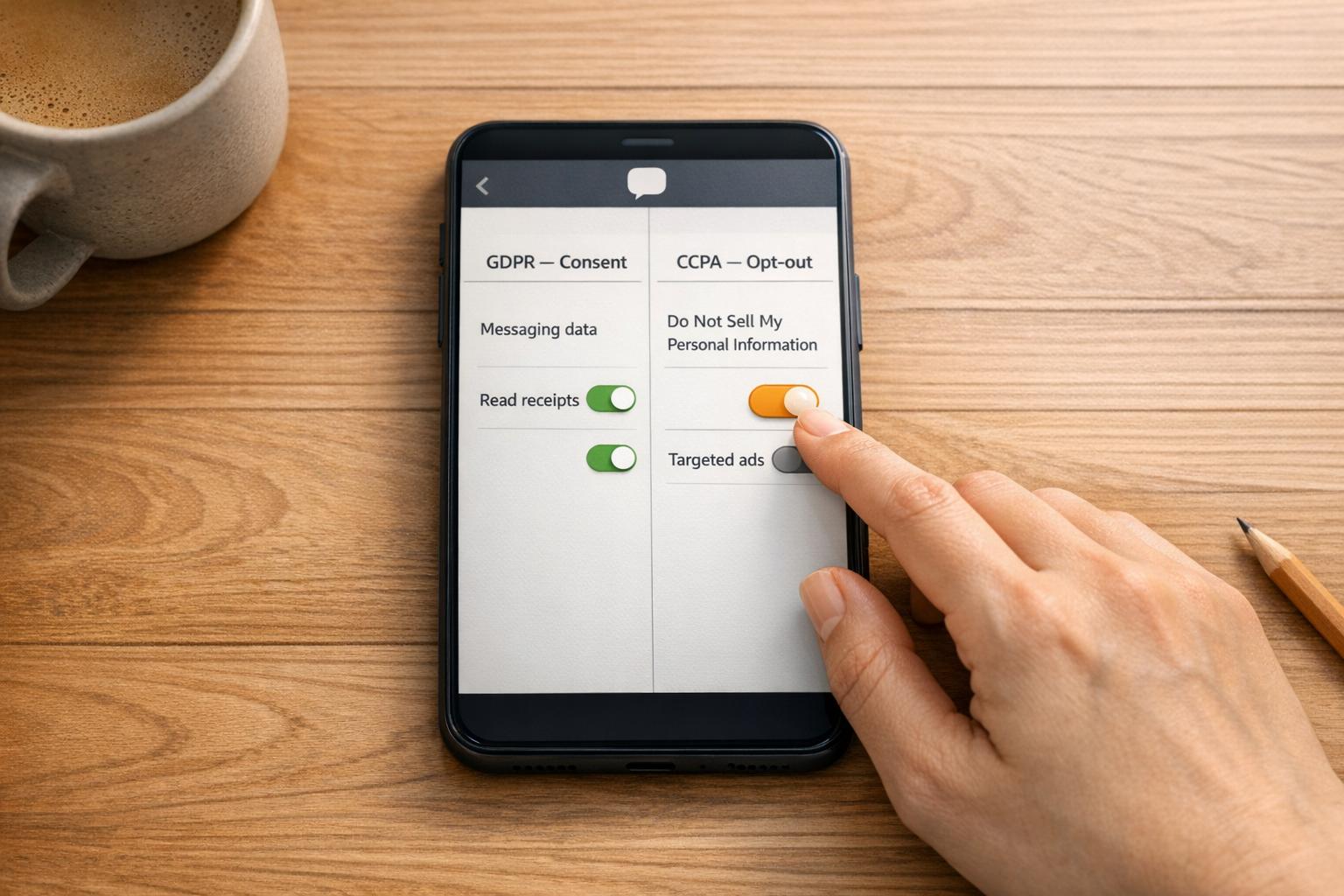
GDPR and CCPA govern how businesses handle personal data in messaging platforms. GDPR applies globally to companies processing EU residents’ data, focusing on opt-in consent and strict security. CCPA targets California residents, often requiring a registered agent in California, emphasizing opt-out rights and protecting sensitive personal information like message content. Both laws enforce user rights like data access, deletion, and portability, but differ in scope, penalties, and compliance models.
Key Highlights:
- GDPR: Global reach, opt-in consent, 30-day response for user rights, fines up to €20M or 4% of global revenue.
- CCPA: California-focused, opt-out model, 45-day response for user rights, fines up to $7,500 per violation.
- Both require robust security measures and clear user controls.
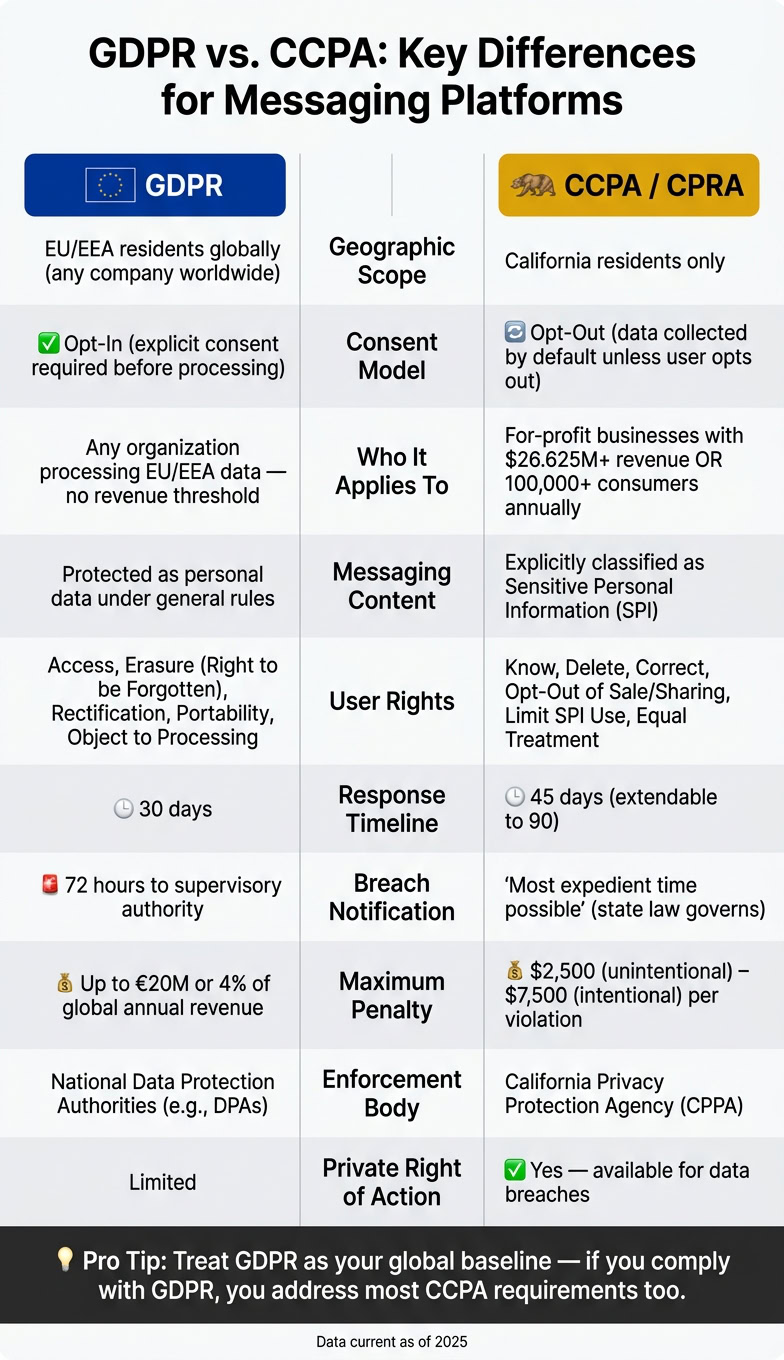
Quick Comparison:
| Feature | GDPR | CCPA/CPRA |
|---|---|---|
| Scope | EU/EEA residents globally | California residents only |
| Consent Model | Opt-in | Opt-out |
| User Rights | Access, Erasure, Portability | Know, Delete, Opt-Out, Limit SPI |
| Penalties | Up to €20M or 4% of global revenue | $2,500-$7,500 per violation |
| Response Timeline | 30 days | 45 days |
To comply, businesses should:
- Map data flows and roles (Controller/Processor).
- Implement consent mechanisms tailored to jurisdictions.
- Minimize data collection and ensure strong encryption.
- Honor opt-out and user rights promptly.
Treat GDPR as a global baseline, but adapt for CCPA specifics like opt-out links and SPI limitations.
How GDPR Applies to Messaging Platforms
This section explains how GDPR specifically applies to messaging platforms, setting the stage for later comparisons with CCPA.
Scope and Applicability
GDPR’s influence stretches well beyond Europe. According to Article 3, it applies to any company – even those based in the U.S. – that offers goods or services to EU residents or monitors their behavior, such as tracking users for targeted ads. So, if your messaging platform interacts with EU users, GDPR applies.
However, simply having a website accessible in the EU doesn’t automatically trigger GDPR. Indicators like accepting EU currencies or using EU-specific domain extensions (e.g., .de or .fr) demonstrate intent to serve EU residents. Companies outside the EU that meet these criteria must also appoint an EU Representative under Article 27, creating a local contact point for regulators and users. Skipping this step is considered a violation.
Key Obligations for Messaging Platforms
Messaging platforms dealing with EU user data must adhere to several GDPR requirements:
- Lawful Basis for Processing: Platforms need a valid legal basis for processing data. In most cases, this means obtaining explicit consent that is freely given, informed, and specific.
- Data Minimization and Purpose Limitation: Platforms should collect only the data necessary for communication and cannot use it for other purposes without separate consent.
- Security Measures: Personal data in messages must be safeguarded with strong encryption, both during transmission and while stored.
- Data Processing Agreements (DPA): If using third-party providers (e.g., WhatsApp Business Solution Providers), businesses must sign a DPA outlining roles and data protection measures. Typically, your business acts as the data controller, while the messaging platform serves as the processor.
A notable compliance issue involves the standard WhatsApp Business App. It uploads the entire device contact list to Meta‘s servers, including contacts who have never interacted with your business, which may violate GDPR. As the Waiflow Team highlights:
"The standard WhatsApp Business App: almost certainly not compliant… because it requests access to your device’s contact list [and] uploads those contacts – including people who have never interacted with your business – to Meta’s servers." – Waiflow Team
The WhatsApp Business API, on the other hand, processes only numbers from users who have opted in and operates under a formal DPA.
| Feature | WhatsApp Business App | WhatsApp Business API |
|---|---|---|
| Contact Access | Uploads entire address book | Processes opted-in numbers only |
| Data Storage | Mixes personal and business data | Keeps business data separate |
| Legal Contract | Standard Terms of Service | Requires a DPA |
| GDPR Suitability | Likely non-compliant | Compliant with proper setup |
Beyond these processing obligations, platforms must also respect the rights of EU users.
Data Subject Rights
Under GDPR, EU users have the right to access, delete, and transfer their data – including message histories, metadata, and account details – within 30 days:
- Right of Access (Article 15): Users can request a full copy of their data, including message history, metadata, and account details.
- Right to Erasure (Article 17): Known as the "right to be forgotten", this requires secure deletion of all messages, metadata, and related information.
- Right to Data Portability (Article 20): Users must be able to export their data in a structured, machine-readable format (like CSV or JSON) to transfer it to another provider.
The financial risks of non-compliance are steep. In late 2025, the Munich Regional Court ruled against a business for syncing a 3,000-contact address book with WhatsApp without proper consent, awarding damages of €250 to €750 per contact. This case serves as a stark reminder of how seriously regulators treat data misuse in messaging operations.
How CCPA and CPRA Apply to Messaging Platforms
Scope and Applicability
While the GDPR focuses on geographical coverage, the CCPA and CPRA take a different approach, targeting businesses based on their size and how they handle data. These laws apply to for-profit businesses operating in California if they meet at least one of these criteria:
- Annual gross revenue exceeds $26.625 million (starting January 1, 2025)
- Buy, sell, or share personal data of 100,000 or more California residents or households annually
- Generate at least 50% of their revenue from selling or sharing personal data
Messaging platforms, with their reliance on user data like contact lists, chat histories, and behavioral information, are often impacted by these thresholds.
Key Obligations for Messaging Platforms
Messaging platforms that meet these criteria have several responsibilities under the CCPA and CPRA. One of the most critical aspects is the protection of sensitive personal information (SPI). According to the California Privacy Protection Agency:
"Sensitive personal information includes… the contents of your mail, email, and text messages." – California Privacy Protection Agency
This means platforms must safeguard message content, especially if it is used for purposes beyond service delivery, such as advertising or analytics. In such cases, they must offer users a clear option to "Limit the Use of My Sensitive Personal Information."
Platforms are also required to honor opt-out signals like the Global Privacy Control (GPC). If a user enables GPC in their browser, the platform must interpret it as a legitimate request to opt out of data sales or sharing. Additionally, platforms must adhere to data minimization principles, collecting and retaining only the information necessary for their services.
These obligations tie directly into the consumer rights provided by the CCPA and CPRA.
Consumer Rights
The CCPA and CPRA grant California residents six key rights, summarized as "LOCKED":
- Limit the use of sensitive personal information
- Opt out of the sale or sharing of personal data
- Correct inaccuracies in personal data
- Know what personal information is collected
- Equal treatment without retaliation
- Delete personal information
Messaging platforms must follow strict timelines when responding to these requests. For example:
- Requests to opt out of data sales/sharing or limit SPI use must be fulfilled within 15 business days.
- Requests to know, delete, or correct data require confirmation within 10 business days and a final response within 45 calendar days (extendable to 90).
- Consumers can submit "right to know" requests twice per year at no cost.
Here’s a quick breakdown of these rights and their implications for messaging platforms:
| Consumer Right | What It Means for Messaging Platforms | Response Timeline |
|---|---|---|
| Right to Limit SPI | Restrict the use of message content to core service delivery only | 15 business days |
| Right to Opt-Out | Stop selling or sharing personal data for behavioral advertising | 15 business days |
| Right to Correct | Fix inaccurate personal data stored by the platform | 45 calendar days (extendable to 90) |
| Right to Know | Reveal data categories collected, including message content | 45 calendar days (extendable to 90) |
| Right to Equal Treatment | Prevent discrimination against users exercising privacy rights | N/A |
| Right to Delete | Erase messages, logs, and related personal data upon request | 45 calendar days (extendable to 90) |
One critical update to note: as of January 1, 2023, the CCPA applies fully to employee data and business-to-business (B2B) communications. This means internal communications on messaging platforms are subject to the same rules as consumer data. If your team uses messaging tools for work, those records must comply with CCPA and CPRA requirements.
GDPR vs. CCPA: Side-by-Side Comparison for Messaging Platforms
When comparing GDPR and CCPA, it’s clear they both aim to protect privacy but operate under different rules and scopes. Here’s how they stack up.
Scope and Territorial Reach
The scope of these laws highlights their different priorities. GDPR applies to any organization, regardless of location, that processes personal data of EU/EEA residents. This means even a small startup in Texas serving European users must comply. On the other hand, CCPA focuses on for-profit businesses that meet specific criteria, protecting only California residents.
"California has a GDP of approximately USD 4 trillion – the world’s fifth-largest economy. Any business with a meaningful US consumer base almost certainly has California consumers." – KSK Data Privacy
This distinction is crucial for messaging platforms operating globally, as they must navigate these varying requirements.
| Feature | GDPR | CCPA/CPRA |
|---|---|---|
| Geographic Scope | EU/EEA with extraterritorial reach | California residents only |
| Covered Entities | Any organization processing EU/EEA data | For-profit businesses meeting thresholds |
| Revenue Threshold | None | $26.625 million+ (adjusted for inflation) |
| Data Volume Threshold | None | 100,000+ consumers or households annually |
| Non-Profits | Covered | Exempt |
| Household Data | Not explicitly addressed | Explicitly protected |
For messaging platforms, serving both EU and California users means dealing with two distinct frameworks, each with its own registered agent costs vs. DIY compliance considerations.
Legal Basis vs. Opt-Out Models
GDPR takes an opt-in approach. Before processing data – like chat logs or metadata – a platform must have a valid legal basis. Common bases include consent, contractual necessity, or legitimate interests.
CCPA, however, uses an opt-out model. Platforms can collect data unless users specifically opt out, and businesses must provide clear notices at the point of data collection.
As security engineer Alban Veauté of Bastion explains:
"GDPR is generally stricter, requiring opt-in consent and applying to all organizations processing EU data. CCPA uses an opt-out model."
These differences are especially important for messaging platforms involved in behavioral advertising. For example, LinkedIn faced a €310 million fine in October 2024 under GDPR for lacking a valid legal basis to process personal data. Under CCPA, failing to honor a "Do Not Sell or Share" request can result in financial penalties.
Data Subject and Consumer Rights
Both GDPR and CCPA grant individuals control over their data, but the rights and mechanisms are not identical. GDPR offers access, deletion (the "Right to be Forgotten"), rectification, data portability, and the ability to object to or restrict processing. CCPA provides similar rights but adds the ability to opt out of the sale or sharing of personal data and limit the use of sensitive information.
| Right | GDPR | CCPA/CPRA |
|---|---|---|
| Access / Know | Yes | Yes |
| Deletion / Erasure | Yes ("Right to be Forgotten") | Yes (with certain business exceptions) |
| Rectification / Correct | Yes (since 2018) | Yes |
| Data Portability | Yes | Yes |
| Opt-Out of Sale/Sharing | Not applicable (consent is required) | Yes (core right) |
| Limit Sensitive Data Use | Prohibited by default (Art. 9) | Right to limit use (opt-out) |
| Object to Processing | Yes | No direct equivalent |
| Non-Discrimination | Implicit | Explicit |
| Response Timeline | 30 days | 45 days |
Under CCPA, messaging content is classified as sensitive personal data, giving users the right to limit its use. GDPR handles this through its rules on special categories of data.
Security Requirements and Breach Notification
Both laws emphasize security, but their breach notification rules and penalties differ. GDPR requires organizations to notify authorities within 72 hours of a breach. CCPA does not set a specific timeline but relies on California state law for breach notifications. GDPR fines can reach up to €20 million or 4% of global annual turnover, while CCPA fines range from $2,500 to $7,500 per violation, with additional statutory damages for consumers.
| Feature | GDPR | CCPA/CPRA |
|---|---|---|
| Breach Notification | 72 hours to notify supervisory authority | No specific window (state breach law applies) |
| Maximum Fine | Up to €20 million or 4% of global annual turnover | $2,500 (unintentional) or $7,500 (intentional) per violation |
| Private Right of Action | Limited | Yes – available for data breaches |
| Enforcement Body | National Data Protection Authorities | California Privacy Protection Agency (CPPA) |
The CPPA, established in 2023, has made privacy enforcement in California more proactive. For instance, Tractor Supply Company paid $1.35 million in 2025 to settle CCPA violations, showing increased enforcement activity.
For messaging platforms, understanding these distinctions is essential to designing effective compliance strategies.
sbb-itb-ba0a4be
How to Meet GDPR and CCPA Requirements in Your Messaging Operations
Understanding GDPR and CCPA is one thing, but turning those rules into actionable steps for your daily operations is where the real challenge lies. As the ITU Online Editorial Team explains:
"Privacy compliance works best when legal requirements are translated into operational controls, not treated as a legal-only exercise."
This means you need to build clear, practical processes that align with these regulations.
Data Mapping and Role Definition
Start by documenting all systems handling messaging data – this includes your CRM, support tools, SMS gateways, and any SaaS platforms you use. Then, determine your role in each case: are you acting as a Controller, Processor, Business, Service Provider, or Contractor? Misidentifying these roles can lead to compliance issues.
A 2025 survey noted that organizations using automated tools for discovering personally identifiable information (PII) reduced their audit prep time by 68%. Relying on manual mapping can quickly become outdated, especially in cloud environments where integrations frequently change. Once you’ve mapped your data locations, the next step is to ensure your consent processes are airtight.
Consent and Opt-Out Mechanisms
GDPR and CCPA have different requirements when it comes to consent. GDPR mandates explicit opt-in, meaning no pre-checked boxes or bundled permissions. CCPA, on the other hand, allows data collection by default but requires a clear opt-out option – think of the "Do Not Sell or Share My Personal Information" link.
To handle this, create a unified preference center that adjusts based on user location. For example, EU residents would see opt-in flows, while California residents would have opt-out controls. For messaging channels like SMS or WhatsApp, use double opt-in processes with verifiable timestamps.
Starting in January 2024, CPRA regulations also require businesses to honor Global Privacy Control (GPC) signals as valid opt-out requests. As the PrivaSift Team wisely points out:
"When in doubt about a user’s jurisdiction, default to GDPR’s stricter requirements. Over-protecting is always safer than under-protecting."
These mechanisms form the backbone of compliance for both GDPR and CCPA.
Data Minimization and Retention
Only collect the data you need for a specific purpose. For example, a transactional message like an order confirmation doesn’t require the same level of data as a marketing campaign. Retention periods should also reflect these differences.
Once a message’s purpose is fulfilled, consider keeping only a metadata stub – such as delivery timestamps, message IDs, and statuses – rather than the full content. Make sure your deletion policies cover backups, replicas, and analytics exports, not just your production databases. Neglecting residual data in backups is a common compliance failure.
Security Measures and Vendor Management
To protect your messaging data, use encryption standards like RSA-2048 and AES-256 for both data in transit and at rest. Implement role-based access control (RBAC) so that employees only access the data they need, and use field masking to shield sensitive information. These measures are key to meeting GDPR and CCPA requirements for security and breach notification.
Additionally, ensure that all vendor contracts include compliance agreements to support your operational controls. For API integrations, authenticate webhooks with HMAC signatures instead of relying solely on IP addresses, and rotate API keys regularly.
| Control Area | Implementation Step | Evidence for Audit |
|---|---|---|
| Consent | Capture timestamp, source, and disclosure version | Consent logs and opt-in form snapshots |
| Opt-Out | Automate "STOP" keywords for SMS/WhatsApp | Suppression logs and propagation test results |
| Security | RSA-2048 encryption and RBAC | Encryption specs and access review reports |
| Retention | Purpose-based lifecycle deletion | Deletion job logs and retention policies |
| Vendors | Execute DPAs and Service Provider Addendums | Signed contracts and subprocessor lists |
Even if your messaging infrastructure relies on providers like AWS or Azure, your business remains responsible for compliance. Shared infrastructure doesn’t mean shared legal accountability.
How BusinessAnywhere Helps Remote Businesses Stay Compliant

Running a remote business comes with its own set of challenges, especially when it comes to staying compliant with regulations like GDPR and CCPA. These rules require businesses to maintain a proper business address, manage legal documents efficiently, and ensure personal data remains separate from business information. BusinessAnywhere offers tools to simplify these tasks and help remote businesses meet these requirements.
For example, the CAN-SPAM Act and CCPA both require businesses to have a valid postal address for marketing emails and opt-out notices. BusinessAnywhere’s virtual mailbox provides a legitimate U.S. business address starting at $20/month (billed annually). This service keeps your home address private while ensuring your marketing communications remain compliant.
"A virtual business address for LLC use allows you to keep your personal information private while still being able to receive important mail and packages." – Rick Mak, Global Entrepreneur and Business Strategist
BusinessAnywhere also simplifies document management with a secure dashboard that scans and uploads incoming mail within two business days. This creates a digital archive of important regulatory notices and legal correspondence, making it easier to maintain proper records and avoid common compliance mistakes.
Their registered agent service is another key offering. It’s free for the first year, then costs $147/year, and ensures your personal address doesn’t appear on public records. This aligns with GDPR’s focus on privacy and CCPA’s emphasis on minimizing unnecessary data exposure.
"We only provide the minimum legally required details to the Secretary of State. In most states, we do not even include your name in the public filing." – BusinessAnywhere
For remote business owners, these services – offering a compliant business address, streamlined document management, and reduced public exposure – help minimize risks, all without requiring a legal team.
Key Takeaways
Here’s a quick comparison of GDPR and CCPA as they apply to messaging platforms:
The core difference lies in their approach to data processing. GDPR uses an opt-in model, meaning no data processing can occur until a lawful basis is established. On the other hand, CCPA employs an opt-out model, allowing data processing by default unless a consumer actively opts out. This distinction is especially important because CCPA explicitly categorizes messaging content as Sensitive Personal Information.
| Feature | GDPR | CCPA/CPRA |
|---|---|---|
| Default Model | Opt-in | Opt-out |
| Who It Protects | EU/EEA residents | California residents |
| Business Threshold | None | $26.625M+ revenue or 100,000+ consumers |
| Max Penalty | €20M or 4% of global revenue | $7,500 per intentional violation |
| Breach Notification | 72 hours to authorities | "Most expedient time possible" |
| Response Timeline | 30 days | 45 days |
These differences highlight the need for robust data protection strategies, especially when managing U.S. business formation for digital nomads. Regulatory enforcement continues to intensify – by early 2025, GDPR fines exceeded €5.8 billion, and California regulators secured multi-million-dollar settlements for CCPA violations.
A practical way to ensure compliance is to treat GDPR as your global baseline. As RecordPoint explains:
"If you can comply with the GDPR, you can comply with anything, including the CCPA."
Aligning your privacy program with GDPR standards addresses most CCPA requirements. However, don’t overlook California-specific measures. For example, include "Do Not Sell or Share My Personal Information" and "Limit the Use of My Sensitive Personal Information" links on your homepage, recognize Global Privacy Control (GPC) signals, and offer a toll-free request channel. Preparing now also positions your business to meet future deadlines, such as the January 1, 2027 ADMT opt-out requirement and the April 1, 2028 cybersecurity audit submission for larger businesses.
FAQs
Do I need to follow GDPR if my business is based in the U.S.?
Yes, businesses based in the U.S. must follow GDPR regulations if they handle the personal data of individuals in the European Union (EU). GDPR applies no matter where your business is located if you:
- Operate a physical presence or establishment within the EU.
- Offer goods or services (whether free or paid) to individuals in the EU.
- Track or monitor the online behavior of EU users.
However, simply having a website that EU residents can access doesn’t automatically mean your business falls under GDPR requirements. The key factor is whether your activities actively target or involve EU individuals.
How do I handle users in both the EU and California without breaking either law?
To navigate compliance with both GDPR and CCPA, you’ll need to balance GDPR’s opt-in requirements with CCPA’s opt-out approach. Start by using an opt-in framework to satisfy GDPR’s lawful basis for processing personal data. Then, for California users, include a ‘Do Not Sell My Personal Information’ link, as mandated by CCPA.
Make sure your privacy policy clearly explains how data is collected, used, and shared under both laws. Update your cookie consent tools to align with GDPR’s strict consent standards while also addressing CCPA’s opt-out provisions. Additionally, implement systems that allow users to exercise their rights, such as accessing, deleting, or requesting portability of their data. These steps will help ensure your practices meet the requirements of both regulations.
What privacy controls should a messaging platform add first to reduce risk?
Messaging platforms need to focus on creating a strong consent management system to minimize risks. This system should meticulously record details like the version of the disclosure, timestamp, source, and context when users give their consent. It’s crucial to move away from vague, general checkboxes – regulators expect clear and specific opt-ins for every communication channel.
After obtaining consent, platforms should enforce precise data retention policies and ensure any opt-out requests are processed across all systems without delay. This approach not only ensures compliance but also builds trust with users.