

If I want to sell homemade food legally in 2026, I need to check my state’s cottage food law first. All 50 states now have some form of cottage food law, but the rules change by state, county, and city.
Here’s the short version:
- I can usually sell low-risk, shelf-stable foods made in my home kitchen
- I usually can’t sell foods that need refrigeration, meat products, or low-acid canned foods under standard cottage food rules
- I may need a permit, registration, training, labels, and local approval
- I often must sell directly to customers and stay inside my state
- I need to track gross sales, because many states set an annual sales cap
In plain English: cottage food laws let me sell certain homemade foods without renting a commercial kitchen. But that does not mean I can sell anything I want, anywhere I want, or from any home setup.
Before I start, I should check five things:
- My state approval type – permit, registration, exemption, or license
- My food list – what foods my state allows or blocks
- My label – ingredients, allergens, net weight, and home-kitchen disclaimer
- My sales channels – farmers markets, pickup, delivery, online, wholesale, shipping
- My local rules – zoning, HOA, lease terms, and home occupation permits
A few facts stand out. Some local home occupation permits cost about $25 to $100 per year. Many states block interstate shipping. And labels often must show all 9 major allergens, including sesame.
| What I need to check | Why it matters |
|---|---|
| State cottage food rules | They decide what I can sell and whether I need approval |
| Local zoning and home permits | State approval alone may not let me sell from home |
| Allowed foods | Shelf-stable foods are often allowed; refrigerated foods often are not |
| Label rules | Missing label details can lead to compliance problems |
| Sales cap and records | Going over the cap may push me into commercial licensing |
So if I want to do this the right way, I should treat cottage food as a legal checklist, not just a baking project.
Understand Cottage Food Laws and What Type of Approval Your State Requires
Before you sell anything, check what your state calls cottage food approval and which agency handles it. The name changes by state – exemption, registration, permit, or license – but the goal is the same: to let you legally sell non-TCS foods made in a home kitchen. After that, find out which agency oversees cottage food sales where you live.
Non-TCS foods are shelf-stable and don’t need refrigeration to stay safe. Think bread, cookies, jams, granola, and hard candy. Foods that need refrigeration – like cheesecakes, cream-filled pastries, and meat- or dairy-based items – usually fall outside standard cottage food rules. Some states do allow limited TCS foods, but the rules are tighter.
Cottage Food Permit vs. Commercial Food License
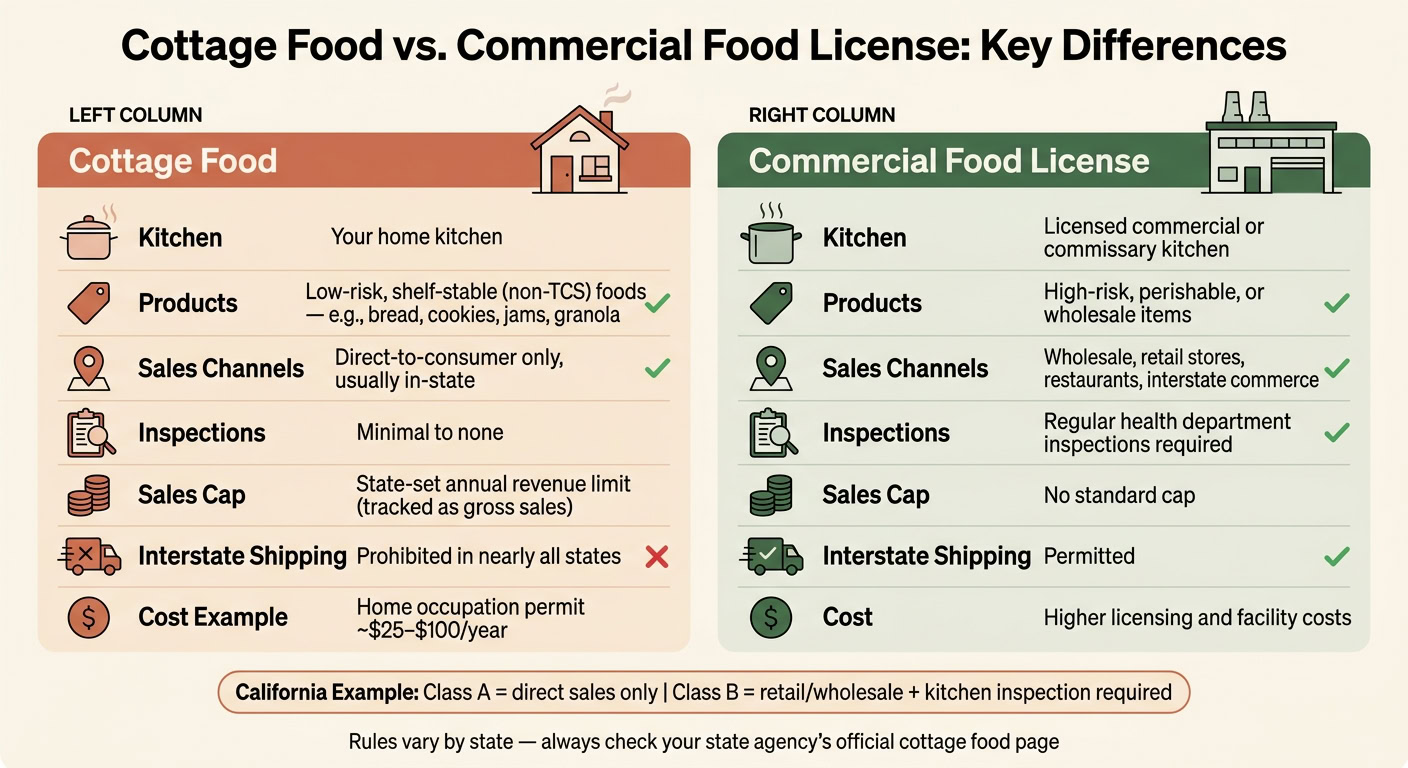
A cottage food approval usually covers low-risk, shelf-stable products sold straight to consumers, often only within your state. A commercial food license is for a different setup. You need it if you want to sell perishable foods, supply restaurants or grocery stores wholesale, or ship products across state lines.
Here’s how that split usually looks:
| Factor | Cottage Food | Commercial Food License |
|---|---|---|
| Kitchen | Your home kitchen | Licensed commercial or commissary kitchen |
| Products | Low-risk, shelf-stable (non-TCS) | High-risk, perishable, or wholesale items |
| Sales Channels | Direct-to-consumer, usually in-state | Wholesale, retail, interstate commerce |
| Inspections | Minimal to none | Regular health department inspections |
California makes this easy to see: Class A covers direct sales only, while Class B allows indirect sales, including retail and wholesale, and requires a kitchen inspection.
Once you know which approval fits your business, check whether your state also sets limits on sales channels, revenue, or inspections.
Which Agencies Regulate Cottage Food Businesses in Your State
The agency in charge depends on where you live. In many states, cottage food businesses fall under either the State Department of Agriculture or the State Department of Health. Some places also add local permits or health-board approval. Massachusetts is one example – cottage food there goes through local boards of health.
If you plan to ship across state lines, that’s usually where cottage food rules stop. At that point, federal food rules may apply instead, because cottage food laws generally don’t cover interstate shipping.
Then check the state, county, and city rules tied to your address.
sbb-itb-ba0a4be
Check State and Local Requirements Before You Sell Anything
Start with your state’s official cottage food page and read the rules all the way through. Don’t skim it. Fees, training, inspections, and sales caps change from state to state, so it’s smart to check before you spend money on ingredients or start taking orders.
And here’s the part many people miss: state approval is only one layer. You might meet state rules and still get blocked at the local level.
How to Find and Review Your State’s Cottage Food Rules
Use your state agency’s official cottage food page. Focus on the parts that spell out the approved foods list, annual revenue cap, permitted sales channels, labeling requirements, and any permits or training you need.
Once you’ve confirmed the state rules, check your city rules, your lease, and your HOA rules next.
Local Zoning, HOA, and Lease Rules That Can Block Home Sales
State approval does not automatically mean you can sell from your home. Your city, county, landlord, or homeowners association can still say no. Local zoning rules decide what counts as an allowed business activity in a residential area, and many places require a home occupation permit before you offer customer pickups.
A simple way to check is to call your city clerk and ask: "I’m starting a cottage food business from my home. Do I need a general business license or home occupation permit?" Home occupation permits often cost $25 to $100 per year, and skipping one can lead to legal trouble even if the state has approved you.
If you rent or live in an HOA community, read your lease or HOA covenants closely. Look for wording like "home-based businesses," "commercial activity," or "signage." Some HOAs ban all commercial activity outright.
Permits, Training, and Records to Prepare Before You Launch
Before you sell your first item, get these pieces in place:
- Your state cottage food registration or permit application, plus your approval notice once it arrives
- An approved food handler or food safety course certificate, which farmers market managers often ask for
- A water potability test result if your home uses a private well
- A written product list for each item you plan to sell, including ingredients and whether it is shelf-stable and does not need refrigeration
- Your home occupation permit, if your local area requires one
From day one, track every sale in a spreadsheet. It sounds a little boring, but it can save you a headache later. That record helps show you’re staying under your state’s revenue cap. If you go over that cap, you may need a full commercial food license.
Choose Legal Foods and Meet Labeling, Kitchen, and Sales Rules
Once you have your approvals, the next job is simple in theory and picky in practice: follow your state’s rules for the food itself, the label, the kitchen, and how you sell it.
Foods Commonly Allowed and Commonly Prohibited Under Cottage Food Laws
First, check each recipe against your state’s rules and ask one basic question: Is it shelf-stable?
Shelf-stable baked goods, high-acid jams and jellies, and dry mixes are often allowed. Foods that need refrigeration, contain meat or poultry, or involve low-acid canning are often prohibited.
One detail matters more than most people think: your state may use either an "approved list" or an "exclusion list" model. In an approved-list state, the state tells you exactly what you can sell. In an exclusion-list state, such as Texas, the state blocks higher-risk foods and allows the rest. That rule type should be your filter for every recipe before you print labels or start taking orders.
| Food Category | Typical Status | Why It May Be Restricted |
|---|---|---|
| Baked Goods (Cookies, Bread) | Allowed | Low moisture, shelf-stable, non-TCS |
| High-Acid Jams & Jellies | Allowed | High sugar/acid content helps prevent bacterial growth |
| Dry Mixes & Granola | Allowed | Low moisture content |
| Cheesecakes & Cream Pies | Usually prohibited* | Require refrigeration (TCS food) |
| Meat, Poultry & Jerky | Prohibited | High risk; regulated by USDA |
| Low-Acid Canned Vegetables | Prohibited | Risk of botulism without pressure canning |
*Some states allow certain TCS foods under special cottage food conditions, often with additional safety training [8].
After you lock in your menu, label each product exactly the way your state says.
Required Labels and Basic Home Kitchen Standards
Each label needs the product name, a full ingredient list in descending order by weight, allergen disclosures, net weight in both U.S. customary and metric units, your name and address – or a state-issued registration number if your state allows that – and the required home-kitchen disclaimer. Use the disclaimer exactly as your state writes it.
For allergens, the FDA recognizes 9 major allergens that must appear on your label: milk, eggs, fish, crustacean shellfish, tree nuts, peanuts, wheat, soybeans, and sesame. Sesame was added in 2023. Add a separate "Contains:" statement along with the ingredient list. If you use a compound ingredient, such as royal icing, break it out in parentheses. For example: Royal Icing (Sugar, Meringue Powder, Water).
Your kitchen rules matter too. Keep equipment clean, wash hands properly, store ingredients safely, and keep pets out during production. Use a digital kitchen scale to measure net weight. Guessing is not legally compliant. If your home uses a private well, some states require yearly water testing to stay in line with the rules.
The goal is plain: a clean, controlled home kitchen and a label that holds up if someone checks it.
Where You Can Sell: Farmers Markets, Pickups, Delivery, and Online Orders
Once your product clears the rules, sell it only through channels your state allows.
| Sales Channel | Generally Allowed? | Common Limitations |
|---|---|---|
| Farmers Markets | Yes | Local vendor permits may apply |
| Home Pickup | Yes | Subject to local zoning and HOA rules |
| Local Delivery | Yes | Usually restricted to in-state customers |
| Online Orders | Yes | Usually limited to in-state delivery or pickup |
| Wholesale (Retail/Cafes) | No | Prohibited in most states; some higher-tier rules allow limited indirect sales |
| Interstate Shipping | No | Prohibited in nearly all states; North Dakota and Montana are rare exceptions |
Avoid Common Legal Mistakes and Build a Simple Compliance System
The most common compliance slipups are pretty straightforward: selling foods your state doesn’t allow, leaving out label disclosures, using sales channels your state bans, and skipping local rules. A simple pre-sale checklist can help you avoid all four.
One point matters more than it might seem: track gross sales, not profit, against your state’s annual cap. That cap changes from state to state. And because the limit connects straight to your sales records, it helps to log every transaction from day one.
After that, keep your paperwork simple. Use one compliance file and one log system so nothing gets scattered. Your file should include approvals, permits, certificates, batch logs, sales records, and renewal dates. Before any renewal – or even a menu change – check your state agency’s current rules.
Use this short checklist before you open for orders:
- Verify that each product is allowed under your state’s cottage food rules, and finish all required registrations, training, and local permits before you sell.
- Label every product with the state-required disclaimer, a full ingredient list, all 9 major allergen disclosures, and net weight in both U.S. customary and metric units.
- Sell only through channels your state clearly allows.
- Track gross sales against your state’s cap from the first sale.
FAQs
Do I need a cottage food license in my state?
Every U.S. state has cottage food laws, but the rules change from one state to the next and can also shift by city or county. In some places, you may need a formal license. In others, a simple registration is enough. And in a few areas, you might not need a permit at all.
Some states also ask for food handler training, a home kitchen inspection, or local approvals such as a business license or home occupation permit. Before you start selling, check the current rules in your state and local area.
Can I sell homemade food online or ship it out of state?
It depends on your state’s cottage food laws.
In many states, you can take online orders for local or in-state delivery. But shipping across state lines is usually not allowed.
North Dakota and Montana are two exceptions.
That said, the fine print matters. Even if online sales are allowed, delivery is often limited to addresses within your state. So before you sell anything, check both your state and local rules.
What happens if I go over my state’s sales cap?
If you go over your state’s annual sales cap, you can’t keep operating under cottage food rules. If you keep selling without the right license, you may face fines, suspension, or be told to shut down.
To stay on the right side of the law, you’ll usually need to move into a commercial setup. That often means using a licensed commercial kitchen that meets standard food safety and inspection rules.