


Starting an SEO business or side hustle is one of the best ways to tap into a growing $100 billion market. With small businesses needing help ranking online and AI reshaping how search works, there’s a huge demand for specialists who can deliver results. Here’s how you can get started:
- Pick a niche: Focus on a specific industry (e.g., dental, SaaS) or service (e.g., local SEO, technical audits) to stand out and charge higher rates.
- Learn SEO essentials: Master search intent, technical SEO, and emerging areas like Answer Engine Optimization (AEO) to stay ahead.
- Set up your business: Register as an LLC for your freelance business, use affordable tools like Google Search Console, and create a professional website to attract clients.
- Land your first clients: Start with your network, offer beta deals, and use simple audits to show value upfront.
- Build systems to grow: Streamline onboarding, reporting, and workflows to handle more clients and hire contractors as you scale.
Step 1: Define Your SEO Niche and Services
Identify the Core SEO Services You’ll Offer
Start by deciding which SEO services you want to provide. SEO covers a lot of ground, and trying to do it all can lead to burnout and underwhelming results. Instead, focus on what you’re good at and build your services around those strengths.
For instance, if you have a knack for technical details, you might specialize in technical SEO audits and site migrations. If writing is your strong suit, consider offering content strategy and topic clusters. Prefer working directly with local businesses? Google Business Profile (GBP) optimization and local citations are in high demand and relatively straightforward to manage consistently.
Another area to consider is Answer Engine Optimization (AEO). With AI-driven tools like Google’s AI Overviews, ChatGPT, and Perplexity becoming major discovery platforms, businesses need experts who can secure citations in AI-generated answers. The shift toward AI has reduced traditional informational clicks by 20–45%, making this a skill worth developing.
Once you’ve outlined your core services, take the next step: narrowing your focus to a specific, profitable niche.
Pick a Specific and Profitable Niche
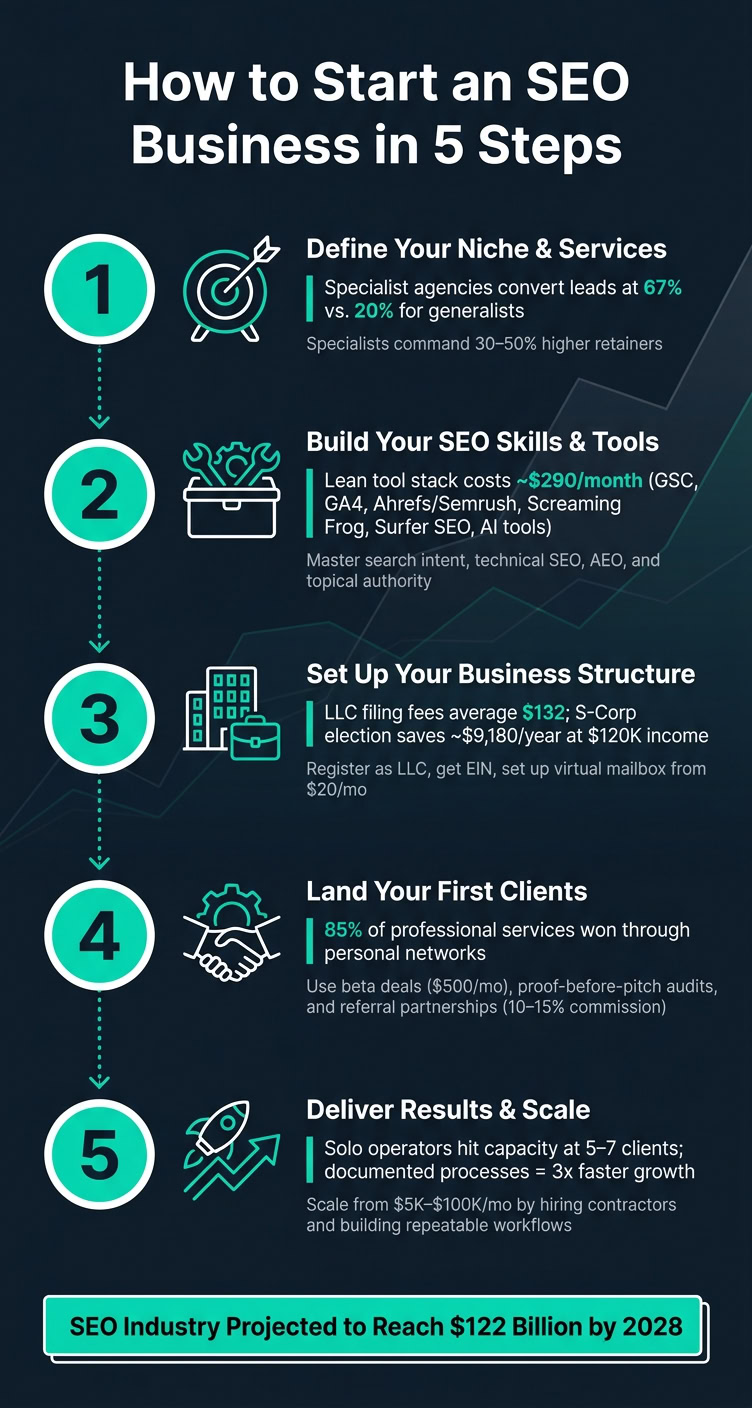
Choosing a niche is absolutely crucial when starting out. Research shows that specialist agencies convert leads at a rate of 67%, compared to just 20% for generalists. That’s a massive difference and could be the deciding factor between a thriving business and constant struggle.
"Specialization is the single highest-leverage pricing move available to a small service business." – Searchlab
To define your niche, focus on at least two of these four dimensions: the industry you serve (e.g., SaaS, dental, or home services), the buyer role you target (e.g., CMOs or solo practice owners), the specific problem you solve (e.g., low lead flow or poor local visibility), or the outcome you deliver (e.g., doubling patient bookings). The more specific you are, the easier it becomes to close deals and charge premium rates.
Some lucrative niches to consider include legal fields (personal injury and family law), medical and dental practices, B2B SaaS companies, and home services like HVAC and roofing. Not sure if your niche is viable? A quick test: if you can’t name 10 companies you could pitch today, your niche may be too narrow, or you might need more market research.
Build Service Packages and Set Your Pricing
Once you’ve defined your niche and services, create clear service packages to simplify the decision-making process for your prospects. Start with two or three tiers – commonly called Starter, Growth, and Scale – so potential clients can easily choose based on their needs and budget.
Here’s a quick reference for pricing and package ideas:
| Package | What’s Included | Monthly Rate |
|---|---|---|
| Starter | Basic on-page SEO, 2–4 content pieces, monthly report | $1,000–$2,000 |
| Growth | Technical SEO, 4–8 content pieces, link building | $2,500–$5,000 |
| Scale | Full-service, dedicated strategist, advanced reporting | $5,000–$25,000+ |
One-time projects like technical audits ($800–$5,000) or content strategy plans ($2,000–$4,000) can serve as great entry points. However, aim to transition these clients into long-term retainers. Monthly retainers are the foundation of a steady SEO business, as SEO results build over time. Clients who commit to 6–12 months typically see much better outcomes than those who opt for a one-off audit and leave.
"Specialists command 30–50% higher retainers than generalists. A generic SEO retainer might go for $1,500/month. A ‘dental SEO specialist’ package? $2,500–$4,000/month." – Atlas Marketing
If a prospect balks at your pricing, adjust the scope of work rather than lowering your rates. Discounting your price can suggest a lack of confidence in your value and may set a negative tone for the client relationship.
Step 2: Build Your SEO Skills and Get the Right Tools
Learn the Key SEO Concepts and Workflows
Before pitching to clients, it’s crucial to nail down the basics of SEO and stay updated on its evolving landscape. As of 2026, search has expanded far beyond Google’s traditional results page. AI-driven features like AI Overviews, ChatGPT Search, Perplexity, and platforms like YouTube and TikTok are now central to the search ecosystem.
Start by mastering search intent. Every keyword aligns with one of four stages: informational (seeking knowledge), navigational (looking for a specific brand or site), commercial (comparing options), or transactional (ready to make a purchase). Misjudging intent is a common reason content fails to rank. Once you’ve got that down, dive into technical SEO. This includes tasks like site audits, optimizing Core Web Vitals (LCP, INP, CLS), implementing schema markup with JSON-LD, and managing crawl budgets. Keep in mind that Google’s LCP threshold has tightened to 2.0 seconds as of March 2026, so technical precision is more important than ever.
Two standout skills for SEO agencies are topical authority building and Answer Engine Optimization (AEO). Topical authority involves creating interconnected pillar pages and topic clusters rather than isolated articles. AEO, on the other hand, focuses on structuring content to be featured in AI-generated answers. Agencies that use clustered content – five or more interconnected pages – see 3.2 times more AI citations than those relying on standalone pages.
"SEO is about helping search engines understand your content and helping users find your site through search engines." – Google’s Search Engine Optimization Starter Guide
Lastly, focus on outcome-based reporting. Clients aren’t just looking for minor ranking improvements; they care about tangible results like leads, revenue, and pipeline value. Connecting SEO metrics to these outcomes will make client retention much easier.
Once you’ve built a solid foundation in SEO, it’s time to put that knowledge into practice using the right tools.
Use Industry-Standard SEO Tools
You don’t need to spend a fortune on tools when starting out, but your toolkit must cover the essentials. Begin with Google Search Console (GSC) and Google Analytics 4 (GA4). These free tools are invaluable for gathering baseline data and identifying opportunities. GSC, for instance, can help you find "quick wins" by spotting keywords ranked in positions 4–15 with high impressions but low click-through rates – perfect for optimization.
When you’re ready to invest in premium tools, consider Ahrefs and Semrush. While both are industry leaders, they cater to slightly different needs:
| Feature | Semrush | Ahrefs |
|---|---|---|
| Best For | Local search terms, intent analysis, keyword gap analysis | Competitive intelligence, traffic potential forecasting, backlink data |
| Unique Metric | Keyword Magic Tool (combines volume, KD, and intent) | Traffic Potential (TP) metric for realistic traffic estimates |
| AI Integration | AI Toolkit for tracking generative search trends | Brand Radar for monitoring AI mentions, Agent A for automation |
To round out your toolkit, add Screaming Frog (~$22/month billed annually) for technical audits, Surfer SEO ($89/month) for optimizing on-page content, and Claude Pro or ChatGPT Plus ($20/month) for AI-assisted workflows. Altogether, this lean stack costs around $290/month – a manageable expense once you land your first retainer client.
"Volume is easy to chase. The right traffic takes real thinking." – Keidar Sharoni
With the right tools in hand, the next step is to establish your credibility online.
Build a Professional Online Presence
Your website serves as your first proof of expertise. As Sergii Steshenko, CEO of Lengreo, notes:
"An SEO agency that can’t rank its own website faces immediate credibility issues." – Sergii Steshenko, Lengreo
Create a clean, professional site with clear service descriptions, a business email address (avoid using generic providers like Gmail), and at least one case study showcasing real metrics. If you don’t have client work yet, build a test site, rank it for a low-competition keyword, and document its 60-day progress. This can act as your first case study. Include trust-building elements like certifications or measurable results from personal projects.
On LinkedIn, optimize your profile headline to reflect your niche, such as "SEO for SaaS Startups" or "Local SEO for Medical Practices." Post regularly with insights and analysis relevant to your focus area. Since 85% of professional services are secured through personal networks, an active LinkedIn presence can be a powerful business development tool.
Step 3: Set Up a Remote-Friendly Business Structure
Now that you’ve honed your skills and built your online presence, it’s time to make your SEO business official. This includes selecting a legal structure, registering your business, and setting up the tools you’ll need to operate remotely.
Choose the Right Business Entity
Your choice of business structure impacts everything from taxes to liability and administrative requirements. The U.S. Small Business Administration explains:
"The business structure you choose influences everything from day-to-day operations, to taxes and how much of your personal assets are at risk."
For many SEO side businesses, forming an LLC is a popular option. It provides personal asset protection without the complexities of other structures. On average, state filing fees are about $132, ranging from $35 in Montana to $500 in Massachusetts.
| Entity Type Liability Protection Tax Treatment Setup Complexity Best For | ||||
|---|---|---|---|---|
| Sole Proprietorship | None | Pass-through (self-employment tax) | Very low | New freelancers testing ideas |
| LLC | Full | Flexible pass-through | Low/Moderate | Most SEO agencies and consultants |
| S-Corp (Election) | Full | Pass-through with payroll tax savings | Moderate | Profitable agencies earning $80k+ net |
| C-Corp | Full | Double taxation (21% flat rate) | High | Agencies seeking venture capital funding |
For those earning net profits above $80,000 annually, consider an S-Corp election to reduce self-employment taxes. For example, on a $120,000 income, this setup could save you around $9,180 per year by splitting income between salary and distributions.
Once you’ve chosen your structure, the next step is registering your business and setting up essential tools.
Register Your Business with BusinessAnywhere
After deciding on your entity type, platforms like BusinessAnywhere streamline the registration process. They allow you to form an LLC or corporation in any U.S. state, entirely online. Registration starts at $0 (plus state filing fees), with processing completed in as little as two business days.
To operate legally, you’ll need a few essentials:
- Registered Agent: Required to handle official government correspondence and legal notices. BusinessAnywhere offers this service for $147 per year, with the first year free when bundled.
- EIN (Employer Identification Number): Necessary for opening a business bank account or hiring contractors. BusinessAnywhere can handle the IRS application for $97.
- Operating Agreement: This document separates personal and business matters, available for $97.
"LLCs create a legal separation between you and your business. If your business faces lawsuits or accumulates debt, your personal assets (home, savings accounts, vehicles) generally remain protected." – Rick Mak, Global Entrepreneur and Business Strategist
With your registration complete, the next step is setting up a professional virtual office.
Set Up a Virtual Office and Mail Handling
To maintain a professional image and operate remotely, you’ll need a U.S. street address that’s separate from your home. BusinessAnywhere provides virtual mailbox services, giving you a professional address with mail scanning, filtering, and forwarding options. This keeps your personal address private.
"One of the most essential things you can do as an entrepreneur is to build a professional image for your company. This involves having an actual mailing address separate from your personal address." – Rick Mak, Global Entrepreneur and Business Strategist
Plans start at $20 per month (billed annually) for the Basic tier, which includes unlimited mail scans, junk mail filtering, and worldwide forwarding for up to two recipients. To activate the service, you’ll need to complete USPS Form 1583, which authorizes a third party to receive mail on your behalf. BusinessAnywhere simplifies this process with an online notary service for $37 per document.
| Virtual Mailbox Plan (Annual) Price Recipients Key Features | |||
|---|---|---|---|
| Basic | $20/mo | Up to 2 | Unlimited mail/scans, junk mail filtering, worldwide forwarding |
| Premium | $30/mo | Up to 5 | Unlimited mail/scans, junk mail filtering, worldwide forwarding |
| Advanced | $65/mo | Up to 20 | Unlimited mail/scans, junk mail filtering, worldwide forwarding |
sbb-itb-ba0a4be
Step 4: Get Your First Clients and Prove Your Offer
With your business structure in place, it’s time to focus on landing your first clients. Here’s the good news: you don’t need a massive portfolio or a hefty marketing budget to get started.
Start with Your Network and Beta Offers
Your best chance at securing your first client is through people you already know. Thibault Besson-Magdelain, Founder of Sorank, emphasizes this point:
"85 percent of professional services work is won through personal networks. Before building anything external, go through your LinkedIn connections, your phone contacts, and your email history."
Start by combing through your LinkedIn connections, phone contacts, and email history for potential leads. If you have expertise in a specific field – like healthcare, real estate, or law – use it to your advantage. That kind of industry experience can create trust, even if you don’t have a long list of clients yet.
Consider offering a 3-month beta deal to get your foot in the door. For example, propose a discounted retainer (around $500/month) with a clear exit option: if you don’t deliver measurable progress within 60–90 days, the client can end the deal. This minimizes risk for them while giving you the chance to build a case study and secure a testimonial. To show early results, track and share leading indicators like keyword ranking improvements or increased Google Business Profile views within the first month – long before organic traffic gains start to show.
Once you’ve landed a few initial clients, you can expand your efforts through targeted outreach.
Build a Niche-Specific Outreach Plan
After exhausting your immediate network, it’s time to create a focused outreach strategy aimed at businesses in your chosen niche. Use a "proof before pitch" approach: identify potential clients with clear SEO issues (like an unclaimed Google Business Profile, slow mobile load times, or missing title tags). Then, send them a one-page audit that highlights three specific problems, estimates their revenue impact, and compares them to a competitor.
Keep your messaging simple and focused on outcomes. Avoid technical jargon like “backlinks” or “meta tags” and instead talk about what matters to them: more leads, more bookings, and higher revenue. Dewang Mishra of Passionfruit explains it well:
"The prospect who comes to you already believing you can help them is worth ten times the prospect you have to convince from scratch."
Another effective way to grow is through referral partnerships. Partner with professionals like web designers, copywriters, or social media managers who already work with your target clients but don’t offer SEO services. Offer them a 10%–15% commission for the first three months of any contract they refer. This approach not only brings in warm leads but also eliminates the need for cold outreach.
Once you start generating leads, the next step is to seal the deal with a strong proposal and clear reporting.
Write Clear Proposals and Send Simple Reports
When a prospect is ready to move forward, your proposal must quickly communicate value. Research shows that 74% of B2B buyers choose the vendor who demonstrates an understanding of their specific situation first, and proposals that are six pages or fewer are 66% more likely to be accepted.
Start your proposal with an analysis of their current situation, not a generic introduction. Highlight what you found on their site and tie it directly to a business outcome. For example, Paul DeMott, CTO at Helium SEO, secured a $12,000/month retainer in 2026 by sending a proposal that revealed a $40,000 monthly organic traffic gap compared to five competitors. That level of detail makes a big impact.
When it comes to pricing, offer three tiers – Foundation, Growth, and Scale. This shifts the conversation from “yes or no” to “which option works best for me,” with most clients opting for the middle tier. End your proposal with a clear deadline, such as "Sign by Friday to secure a kickoff call within 48 hours." This creates urgency without applying too much pressure.
Once a client signs on, keep your reports straightforward and focused on results. Highlight what has improved, why it’s important, and what’s coming next. Simple, outcome-driven updates help build trust and keep clients engaged.
Step 5: Deliver Results and Grow Your SEO Business
Building a successful SEO business isn’t just about landing clients – it’s about running things smoothly and keeping those clients happy. To grow long-term, you need strong systems in place from the start.
Set Up a Standard Onboarding and Reporting Process
The first month with a new client is critical. A structured onboarding process can lower client churn by as much as 60%. Once you’ve signed a contract, send over a welcome document and an intake questionnaire right away.
A good onboarding kit includes six key pieces:
- A welcome document
- An intake questionnaire
- An access request checklist
- A kickoff call agenda
- A 30-60-90 day plan
- A communication protocol
Clearly outline what happens in each phase of the engagement. For example, Month 1 focuses on discovery and setting up infrastructure, Month 2 is for implementing fixes, and Month 3 is about measuring results and refining strategies. This helps you manage client expectations – no one should be expecting ranking leaps in the first two weeks.
Thibault Besson-Magdelain, Founder of Sorank, emphasizes the importance of this process:
"The onboarding kit is the highest-leverage investment you can make in client retention. It takes two to three days to build properly and saves dozens of hours over the course of every engagement."
When it comes to reporting, automated dashboards are your best friend. Use Looker Studio to pull data from GA4 and Google Search Console, ensuring reports refresh automatically each month. Short video walkthroughs can replace time-consuming meetings and keep clients informed.
Once onboarding is locked in, focus on fine-tuning your daily workflows.
Create Repeatable Workflows for SEO Tasks
Templates are a game-changer. Use them for technical audits, content briefs, and reporting dashboards. Organize your work into 30–90 day sprint cycles with clear deliverables, so it’s easy to show results.
Each task should have a clear owner, a due date, and specific completion criteria to maintain accountability. Tools like Asana, Monday.com, or ClickUp can serve as your central hub for project management. Automate handoffs wherever possible – when a content draft moves to "Review", for instance, the editor should get an automatic notification.
Terrence Ngu, AI SEO Specialist at Hashmeta, highlights the importance of execution:
"SEO rarely fails because of bad strategy. More often, it fails because of poor execution – missed deadlines, unclear ownership, and workflows that collapse."
Tracking how much time your team spends on different tasks can also help you refine your processes. This data is invaluable for accurate project scoping and identifying services that might be cutting into your profits.
With workflows running efficiently, you can focus on scaling by bringing in specialized contractors.
Hire Contractors and Systemize Your Operations
Once your onboarding and workflows are sorted, scaling your agency becomes a matter of smart delegation. Most solo operators hit a capacity ceiling at around 5–7 clients. To grow beyond that, you need to document your processes – companies that do this grow three times faster.
Start by hiring a contract content writer. This can free up 15–20 hours a month, giving you more time to focus on strategy. Next, consider a Virtual Assistant for repetitive tasks like citation building or generating reports. Bring on a full-time SEO specialist only when your monthly revenue consistently hits $15,000–$20,000.
Here’s a look at how team structures and profit margins typically change as you scale:
| Revenue Stage | Team Structure | Founder Role | Profit Margin |
|---|---|---|---|
| $5K–$10K/mo | Solo + 1–2 contractors | Strategy, execution, sales | 60–70% |
| $10K–$25K/mo | Solo + 2–4 contractors | Strategy, sales, oversight | 45–55% |
| $25K–$50K/mo | 3–5 team members | Sales, partnerships, strategy | 35–45% |
| $50K–$100K/mo | 6–12 people | Vision, culture, relationships | 25–35% |
The ultimate goal is to build a business that doesn’t rely on you handling every single task. As Thibault Besson-Magdelain wisely notes: "The path to a profitable agency transition requires a different sequence: systems first, then people, then scale."
Conclusion: Next Steps for Starting Your SEO Business
Launching an SEO business involves five key steps: selecting a niche, honing your skills, setting up a legal structure, attracting initial clients with a diagnostic approach, and streamlining your processes before scaling. Skipping any of these steps could jeopardize your progress. Once you’ve got the basics down, focus on simplifying your legal and operational setup to create a solid foundation.
The legal side of things is often less complicated than it seems. Setting up an LLC not only safeguards your personal assets but also enhances your credibility. Plus, it’s a quick and cost-effective process, especially when handled through services like BusinessAnywhere. This approach aligns with the remote-friendly, centralized strategies discussed earlier, ensuring you can manage everything efficiently from the start.
On the revenue front, the earning potential is promising right out of the gate. Small business SEO retainers typically range between $500 and $2,000 per month, while one-time audits can bring in $500 to $2,000 per project. With the SEO industry expected to hit $122 billion by 2028, and more than half of SEO agencies planning to raise retainer prices by 2026, the growth opportunities are substantial. These figures underscore the benefits of building a well-structured SEO business.
What sets thriving agencies apart from the rest is their positioning. As Martial Notarangelo, Founder of Authority Specialist, explains:
"Specific positioning generates more referrals, higher average project values, and shorter sales cycles because the right clients self-select in."
This idea of positioning ties everything together. By establishing your niche, building efficient systems, and laying a solid legal foundation early on, you’ll set yourself up for sustainable growth and long-term success.
FAQs
How long does it take to get SEO results for a new client?
Most clients notice progress within 3 to 6 months, but meaningful increases in traffic and revenue often take 6 to 12 months. For local SEO, results tend to appear faster – usually within 2 to 4 months. However, if you’re working with a new domain, it can take 6 to 12 months to establish trust. Quick wins, like technical optimizations, may show effects in just a few weeks, but long-term growth depends on steadily building authority and quality content over time.
What should I include in a first SEO audit to win clients?
Your first SEO audit should be a short, focused document – ideally 6 to 10 pages – that demonstrates your expertise and pinpoints opportunities with the biggest potential impact. Center your audit around three critical questions:
- Where is the client now? Analyze their current SEO performance.
- Why are they there? Identify the factors contributing to their current position.
- What should they do next? Provide clear, actionable recommendations.
Make sure to include a prioritized action plan that addresses key areas like technical issues, content gaps, and backlink opportunities. To maximize its impact, present the audit live. This not only helps build trust but also allows you to showcase your problem-solving approach in real time.
When should I switch from a side hustle to an LLC or S-corp?
Forming an LLC is a smart move if your business involves legal risks – like handling contracts or engaging in high-stakes projects – or if you want to shield your personal assets. Many entrepreneurs choose to take this step once their monthly revenue becomes consistent, often around $1,000, or when they start working with larger clients who may require it.
On the other hand, opting for S-corp status usually makes sense when your net annual profit reaches the $80,000–$100,000 range. At this level, the tax savings can outweigh the added compliance costs. If your profits are below $60,000, however, the tax advantages are generally too small to justify the switch.