

If you’re looking for the best state to set up a virtual mailbox, your choice impacts taxes, privacy, and compliance costs. Here’s a quick breakdown of top options:
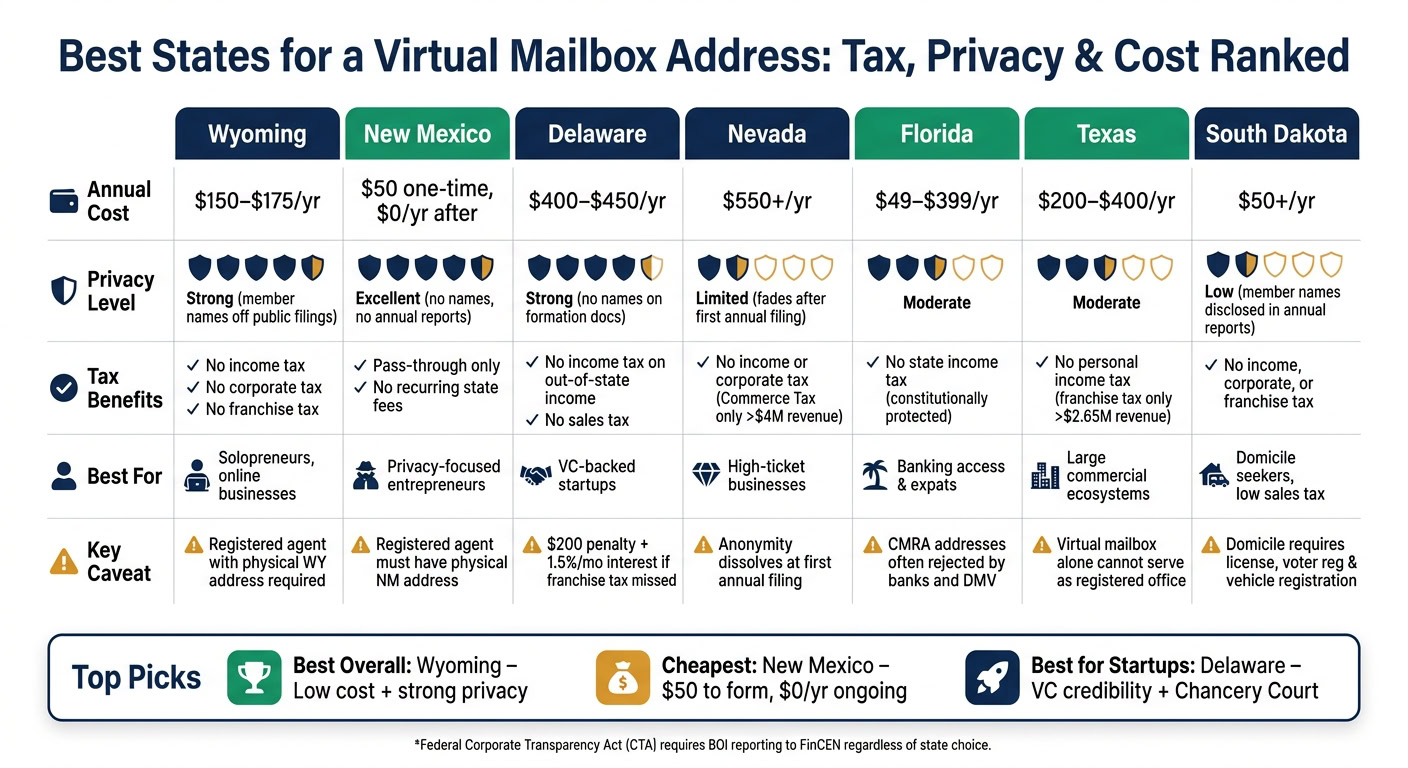
- Wyoming: Low costs ($150–$175 annually), no income or corporate tax, and strong privacy (member names stay off public filings).
- New Mexico: The cheapest option ($50 to form, $0 annual fees), with top-tier privacy (no member names or annual reports).
- Delaware: Popular for startups, with strong legal credibility and a $400 annual franchise tax.
- Nevada: No income tax but higher costs ($550/year) and limited privacy after initial filings.
- Florida: No state income tax and good usability for banking, but privacy protections are average.
- Texas: No income tax, but a virtual mailbox alone won’t meet registered agent requirements.
- South Dakota: No income or corporate tax, but less anonymity (LLC member names disclosed in annual reports).
Quick Comparison
| State | Annual Cost | Privacy Level | Tax Benefits | Best For |
|---|---|---|---|---|
| Wyoming | $150–$175 | Strong (no public names) | No income/corporate tax | Solopreneurs, online businesses |
| New Mexico | $50 (one-time) | Excellent (no names, no reports) | No recurring state fees | Privacy-focused entrepreneurs |
| Delaware | $400–$450 | Strong (no public names) | No income tax on out-of-state income | VC-backed startups |
| Nevada | $550+ | Limited after 1st year | No income/corporate tax | High-ticket businesses |
| Florida | $49–$399 | Moderate | No state income tax | Banking and accessibility |
| Texas | $200–$400 | Moderate | No state income tax | Large commercial ecosystems |
| South Dakota | $50+ | Low (member names disclosed) | No income/corporate tax | Domicile seekers, low sales tax |
For most entrepreneurs, Wyoming and New Mexico offer the best mix of low costs and privacy. If you’re pursuing venture capital, Delaware is the way to go. Choose based on your priorities – privacy, taxes, or ease of use.
Best States for a Virtual Mailbox: Tax, Privacy & Cost Compared
1. Wyoming
Wyoming often stands out as a top choice for virtual mailbox users. Since it introduced the LLC structure in 1977, the state has cultivated a business-friendly atmosphere that appeals to entrepreneurs and remote businesses alike.
Tax Exposure
Wyoming’s tax benefits are hard to beat: no state income tax, no corporate income tax, and no franchise tax. The annual report fee is a modest $60 minimum, calculated based on assets physically located in the state – which most remote businesses don’t have. To put this in perspective, California imposes an $800 annual franchise tax, and Delaware charges $400 annually for LLCs. Wyoming’s affordability is clear. But tax savings are just one part of the equation – let’s look at its privacy protections.
Privacy Protections
Under Wyoming Statute W.S. 17-28-107, an “organizer” can file the Articles of Organization, which means member and manager names don’t appear in public records. Additionally, Wyoming’s annual report doesn’t require ownership disclosure, unlike states such as Nevada.
“Wyoming is the benchmark against which every other anonymous LLC state is measured… W.S. 17-28-107 is the explicit legal basis for the filing-as-organizer approach. This is not a loophole or a gray area.” – State LLC Service
A Wyoming virtual mailbox enhances this privacy setup by keeping your personal address off EIN applications, banking records, and business filings.
Compliance and Costs
Setting up and maintaining an LLC in Wyoming is straightforward and affordable. The one-time formation fee is $100, and the annual report costs $60, due on the LLC’s anniversary month. Additional costs include a registered agent, which ranges from $39 to $125 per year, and a virtual mailbox, priced at $10 to $20 per month. Altogether, the total annual maintenance typically falls between $150 and $175.
One critical requirement to note: Wyoming law (W.S. § 17-29-201) mandates a registered agent with a physical street address in Wyoming. A virtual mailbox alone won’t meet this requirement.
Practical Usability
For a Wyoming virtual address, Cheyenne is the go-to city. As the state capital and a prominent commercial center, a Cheyenne address can simplify bank account verification. It’s a smart move to secure your Cheyenne virtual mailbox before filing to ensure consistency across all your documents.
“Matching your mailbox address to Wyoming reinforces that your business is operating from Wyoming, at least on paper, and keeps your state tax situation simple.” – Trevor Fenner, Owner, Ecommerce Paradise
With its combination of low costs, strong privacy measures, and ease of use, Wyoming remains a top choice for virtual business operations.
sbb-itb-ba0a4be
2. Delaware
Delaware is home to over 2 million incorporated businesses, with 60% of Fortune 500 companies and 90% of U.S.-based IPOs choosing to incorporate there. This track record boosts credibility with both investors and financial institutions.
Tax Exposure
For Delaware LLCs, taxation operates on a pass-through basis. If your business has no physical presence, employees, or sales in Delaware, state corporate income tax doesn’t apply. On top of that, the state has no sales tax and doesn’t tax intangible assets like trademarks or patents. However, there is a $400 annual franchise tax, which is higher than Wyoming’s $60 but often seen as a fair trade for Delaware’s reputation and credibility.
“Venture capitalists and institutional investors often require portfolio companies to incorporate in Delaware.” – Save Office Team
In addition to its tax benefits, Delaware also offers strong privacy protections.
Privacy Protections
Delaware’s Certificate of Formation doesn’t require listing member or manager names in the public record. Similarly, annual franchise tax filings don’t reveal ownership details. These features place Delaware in Tier A for privacy – quite strong, though not as robust as Wyoming’s Tier S, which allows organizer-only filings by statute. To protect your personal address, it’s a good idea to use a registered agent service, as their details will appear in public filings.
Compliance and Costs
The formation fees range between $90 and $110, with the $400 annual franchise tax due by June 1 each year. Missing the deadline results in a $200 penalty and 1.5% monthly interest. Delaware LLCs don’t require annual reports, simplifying compliance. Factoring in registered agent fees (typically $49–$150 per year), the total annual maintenance costs come to around $400–$450.
With compliance straightforward, selecting the right address is another key consideration.
Practical Usability
For better banking compliance, opt for a Wilmington address, ideally on Market or King Street. Make sure to secure this address before filing your Certificate of Formation, as it will need to be listed as the principal office. Be cautious with virtual mailbox services – some are flagged as CMRAs in USPS records, which can complicate opening traditional bank accounts. If having a traditional bank account is a priority, verify the type of address you’re using in advance.
3. Nevada
Nevada stands out with its zero state income tax and strong privacy measures. While its setup and annual fees are on the higher side, having a Nevada business address can enhance your brand’s image – particularly in industries like luxury goods, consulting, or high-ticket e-commerce.
Tax Exposure
Nevada does not impose personal or corporate income taxes. The Nevada Commerce Tax only applies to businesses with gross revenues exceeding $4,000,000 annually, so most small and medium-sized businesses are exempt. Additionally, the Modified Business Tax, set at 1.378%, only applies to quarterly payroll wages above $50,000.
“Nevada has no corporate income tax. This alone saves thousands annually for growing ecommerce businesses.” – Trevor Fenner, Owner, Ecommerce Paradise
Although Nevada’s fees are higher compared to states like Wyoming, its privacy protections and the prestige of a Nevada business address can make the extra cost worthwhile. Business owners in high-tax states like California or New York should consult a tax advisor to avoid inadvertently creating a tax nexus. Beyond tax savings, Nevada offers an added layer of privacy for business owners.
Privacy Protections
Nevada ensures privacy by not requiring LLCs to disclose member (owner) names in public databases. For added discretion, you can appoint a nominee manager to appear on public filings while retaining control through a private agreement. Using a virtual mailbox can also keep your home address off public records, further protecting your personal information.
“Nevada’s privacy laws mean your personal information stays personal. Your home address doesn’t appear in searchable business records like it does in other states.” – Trevor Fenner, Owner, Ecommerce Paradise
Compliance and Costs
Starting a business in Nevada comes with initial fees totaling $425. These include $75 for filing Articles of Organization, $150 for the Initial List of Managers, and $200 for the State Business License. Annual costs include $350 for the renewal of the Business License and Annual List, along with registered agent fees ranging from $100 to $150 per year. It’s important to note that these fees are due on the last day of your formation anniversary month. Missing this deadline results in a $75 penalty.
Practical Usability
Nevada requires a physical street address for both the Principal Office and the Registered Agent listed in your Articles of Organization – P.O. Boxes are not allowed. A virtual mailbox with a suite number can fulfill this requirement and is also valid for bank and business verifications. However, some banks may flag Commercial Mail Receiving Agency (CMRA) addresses during Know Your Customer (KYC) checks. In such cases, they may request a residential address for the physical location field while still accepting the virtual address for mailing purposes. It’s wise to confirm these details with your bank ahead of time.
| Fee Type | Cost | Frequency |
|---|---|---|
| Articles of Organization | $75 | One-time |
| Initial/Annual List of Managers | $150 | Annual |
| State Business License | $200 | Annual |
| Registered Agent Service | $100–$150 | Annual |
| Virtual Mailbox (Basic) | $10–$50/month | Monthly |
4. New Mexico
New Mexico stands out as a budget-friendly option, offering solid privacy protections and low ongoing costs.
Tax Exposure
New Mexico LLCs are treated as pass-through entities. This means the LLC itself doesn’t pay state income tax – members report the income on their personal tax returns instead. If your business doesn’t have a physical presence or customers in the state, you likely won’t owe state income tax or Gross Receipts Tax (GRT). However, if applicable, the GRT replaces traditional sales tax and applies to services and digital products like SaaS. Rates vary by location, ranging from 5.125% to 9.3125%. For out-of-state sellers, economic nexus kicks in only after $100,000 in annual sales to New Mexico customers.
“New Mexico is the cheapest state in the country for LLC formation and maintenance. Specifically, the mandatory formation cost is $50 – and the ongoing state cost is $0/yr forever.” – LLC Starters
Privacy Protections
New Mexico offers strong privacy features. Neither member nor manager names are required on the Articles of Organization. Additionally, New Mexico doesn’t mandate annual reports, so there’s no recurring public filing that could reveal ownership details. This earns the state a Tier S privacy ranking. Pair this with a virtual mailbox providing a real street address and unique suite number, and you can keep your home address off public records.
Compliance and Costs
The formation fee for a New Mexico LLC is just $50, the lowest among states offering anonymity. There are no annual state fees or franchise taxes for LLCs. Starting December 2024, all filings must be completed online via the Secretary of State’s Business Services Portal. Registered agent services typically cost between $39 and $150 per year.
| Cost Component | Year 1 | Annual (Ongoing) |
|---|---|---|
| State Filing Fee | $50 | $0 |
| Virtual Mailbox | $120–$600 | $120–$600 |
| Registered Agent | $39–$150 | $39–$150 |
| Annual Report | $0 | $0 |
| Total Estimated | $209–$800 | $159–$750 |
“For absolute lowest total cost of ownership over the LLC’s life, New Mexico wins outright. $50 to form, $0 every year after.” – Shepherd Nyakudya, Founder, USLLCGlobal
This streamlined cost structure makes New Mexico an appealing choice for those balancing affordability and privacy, especially when factoring in virtual mailbox needs.
Practical Usability
Keep in mind that your registered agent must maintain a physical address in New Mexico – a virtual mailbox cannot fulfill this role. Fintech banks like Mercury and Relay generally accept New Mexico LLCs, though traditional banks might require a Certificate of Good Standing to confirm your business is active. Since New Mexico doesn’t require annual reports, this certificate becomes your primary proof of active status. Be sure to request one from the Secretary of State before opening a bank account. Lastly, if you operate in another state, such as California, you’ll still need to comply with that state’s foreign qualification rules, regardless of where your LLC is formed.
5. Florida
Florida stands out as an appealing choice for remote business owners seeking a U.S. address with no state income tax. Unlike Wyoming’s low-cost anonymity or Delaware’s reputation for investor-friendly policies, Florida offers a unique combination of tax benefits and privacy measures.
Tax Exposure
Florida has a 0% personal income tax rate, a policy cemented in the state constitution, making it highly resistant to future changes. Additionally, there are no estate or inheritance taxes. This is particularly beneficial for U.S. expats, as Florida does not tax income excluded under the federal Foreign Earned Income Exclusion (FEIE), unlike states such as California.
“Florida is the gold-standard domicile choice in 2026 because Article VII §5 of the state constitution bars a personal income tax.” – YourTaxBase Editorial Team
To formalize your Florida residency, you can file a Declaration of Domicile under Florida Statutes §222.17. This document serves as a public record of your intent to reside in Florida, which can be crucial if a high-tax state like New York – known for conducting over 3,500 residency audits annually – challenges your move. These tax advantages are complemented by Florida’s privacy protections.
Privacy Protections
Florida’s privacy regulations operate on two levels. The Florida Digital Bill of Rights (FDBR) applies to companies with over $1 billion in global revenue. For smaller businesses, the Florida Information Protection Act (FIPA) mandates reasonable data protection measures and requires notification of affected individuals within 30 days of a data breach. If a breach impacts 500 or more Florida residents, the company must also notify the Department of Legal Affairs.
For virtual mailbox users, this means your provider must inform you within 10 days if your data is compromised. However, be aware that the Florida Secretary of State maintains public records of registered agents and office addresses. If you use your virtual mailbox as your registered office, that address will be publicly searchable.
Compliance and Costs
Florida law requires all LLCs and corporations to have a registered agent with a physical street address; a virtual mailbox alone doesn’t meet this requirement under FL Statutes §605.0113 and §607.0501. Registered agent services typically cost between $49 and $149 per year. Virtual mailbox services range from $49–$99 annually for basic forwarding services to $199–$399 for premium plans that include features like mail scanning and check depositing. Filing a Declaration of Domicile generally costs about $10 in county recording fees, with many counties now accepting Remote Online Notarization (RON).
These costs and requirements are essential to consider when setting up a compliant and functional virtual address in Florida.
Practical Usability
It’s important to distinguish between a Commercial Mail Receiving Agency (CMRA) address and a residential-class address. Many institutions, including banks, the Florida DMV, and state tax auditors, increasingly reject CMRA addresses for Know Your Customer (KYC) checks and residency verification. A residential-class address, supported by a formal lease and utility bill, ensures compliance.
To solidify your Florida domicile, update your business address with the IRS using Form 8822-B, and consistently use your Florida address for bank statements, your driver’s license, voter registration, and IRS records. Meeting these standards is key to maximizing Florida’s tax and privacy benefits through a virtual mailbox address.
6. Texas
Texas draws attention with its tax-friendly policies, strong privacy protections, and straightforward compliance requirements.
Tax Exposure
Texas is one of the nine states in the U.S. with no personal income tax, which can lead to considerable savings. Additionally, there’s no state estate tax. For businesses, the Texas franchise tax only kicks in if your annual revenue exceeds $2.65 million. This means most small businesses and solo entrepreneurs either pay nothing or aren’t even required to file a report.
“Texas is one of just a few states with no state corporate or personal income tax.” – Texas Virtual Office LLC
However, it’s important to note that simply using a Texas virtual address doesn’t exempt you from tax obligations in another state where you might actually operate. For instance, if your business activities are based in New Jersey, your tax liabilities remain tied to that state, not to where your mail is sent.
Privacy Protections
Beyond tax advantages, Texas also prioritizes privacy. The Texas Data Privacy and Security Act (TDPSA), effective July 1, 2024, grants residents key rights over their personal data. These include the ability to access, correct, and delete data, as well as opt out of data sales. Non-compliance with the TDPSA could result in civil penalties of up to $7,500 per violation, enforced by the Texas Attorney General.
For business owners, Texas allows the use of a registered agent’s address on formation documents. This keeps your personal address out of public, searchable state databases. However, it’s crucial to ensure you meet postal compliance requirements when setting up your virtual address in Texas.
Compliance and Costs
While Texas offers appealing benefits, compliance requires careful attention. According to Texas law (Section 5.201 of the Business Organizations Code):
“The Registered Office… may not be solely a mailbox service or a telephone answering service.” – Texas Business Organizations Code Section 5.201
This means a standard virtual mailbox address won’t meet the legal requirements for a registered office. You’ll need a registered agent with a physical street address and regular business hours. Failing to stay on top of compliance, such as missing a Public Information Report (PIR) notice sent to your registered agent, can lead to administrative dissolution of your business.
Costs are relatively manageable:
- Registered agent services typically cost around $25 per year.
- A basic virtual office in cities like Austin starts at about $15 per month, often including mail scanning and a local phone number.
- Premium options, such as Regus, range from $129 to $179 per month.
Practical Usability
Banking presents a unique challenge. Federal regulations (31 CFR 1020.220) require banks to verify a physical address where the business operates or where the owner resides – a mailing address alone won’t suffice. Many low-cost CMRA (Commercial Mail Receiving Agency) addresses are flagged during KYC (Know Your Customer) checks and may be rejected. Using a commercial virtual office address in a recognized business building can simplify banking, streamline Google Business Profile verifications, and support professional licensing needs.
7. South Dakota
Tax Exposure
South Dakota stands out as one of only three states with zero individual income tax, corporate tax, and regular LLC franchise taxes. There are no estate or inheritance taxes either. Ranked 2nd on the 2026 Tax Competitiveness Index, South Dakota is a prime choice for digital nomads and business owners looking to minimize taxes.
“South Dakota does not have an individual income tax. South Dakota does not have a corporate income tax… South Dakota’s tax system ranks 2nd overall on the 2026 State Tax Competitiveness Index.” – Tax Foundation
The state’s main tax is a 4.2% sales tax, with a combined state and local average of 6.11%. Remote sellers earning over $100,000 in gross revenue from South Dakota sales are required to secure a sales tax license. Now, let’s explore South Dakota’s privacy advantages.
Privacy Protections
For businesses, South Dakota offers less anonymity compared to states like Wyoming or New Mexico. LLC annual reports must disclose members (if member-managed) or managers (if manager-managed). However, the state excels in trust privacy. South Dakota is the only state where trust litigation filings, proceedings, and dockets are permanently sealed by statute – no court motion is needed. This airtight trust privacy has helped the state’s trust industry manage over $500 billion in assets. Keep in mind, establishing domicile in South Dakota involves more than obtaining a virtual mailbox.
When it comes to consumer data privacy, South Dakota lacks a comprehensive privacy law but does recognize common law invasion of privacy torts.
Beyond privacy, compliance requirements in South Dakota are straightforward and affordable.
Compliance and Costs
While getting a virtual mailbox is easy, establishing legal domicile takes more effort. You’ll need to obtain a South Dakota driver’s license, register to vote, and register your vehicle.
“A mail forwarding address does not establish domicile: you need the supporting actions (license, voter registration, banking) to make it stick.” – Greenback Expat Tax Services
To get a driver’s license, you must provide proof of physical presence with at least a one-night stay at a hotel or campground. Voting in state elections requires 30 consecutive days of physical presence in an in-state residence as of 2026. Additionally, as of 2023, South Dakota PMB addresses cannot be used for payroll or unemployment tax purposes.
Costs remain competitive. Virtual mailbox plans range from $10 to $47 per month, depending on the service level. Filing an LLC annual report costs $50 online or $65 for paper submissions. Registered agent services typically range from $100 to $299 annually.
Practical Usability
South Dakota makes vehicle registration simple – it’s an “Open State”, meaning no inspections are required, and non-residents can register vehicles even before establishing full residency. For banking, federal rules mandate a physical street address for the principal place of business, not just a mailing address. To ensure smooth banking operations, have a residential address ready, as CMRA addresses may flag know-your-customer checks. This is especially important in South Dakota given its domicile requirements. Business filings in the state are processed quickly, usually within 1–2 business days, making setup efficient.
State-by-State Pros and Cons
Choosing the right state for your virtual mailbox comes down to weighing factors like taxes, privacy, compliance costs, and usability. Below is a quick comparison to help you decide which state aligns best with your goals.
| State Tax Exposure Privacy Compliance & Cost Practical Usability | ||||
|---|---|---|---|---|
| Wyoming | No income, corporate, or franchise tax | Member names stay off public filings at formation and annually | $60/year annual report; $147/year registered agent | Virtual address accepted for principal office |
| Delaware | No income tax on out-of-state income | No names on Articles at formation; registered agent leaves a paper trail | $400/year flat franchise tax; registered agent must maintain a physical location (effective August 2025) | Preferred for VC-backed startups; Chancery Court is a major draw |
| Nevada | No individual or corporate income tax | Privacy protection is limited after the initial filing | Approximately $550/year (Annual List + Business License); high ongoing cost | Popular but expensive; anonymity is short-lived |
| New Mexico | No state income tax on pass-through LLC income | Highest anonymity – member names not required at formation or in annual filings; no annual report required | $0/year recurring state fees; $50 one-time formation fee | Ideal for lean operations; virtual address accepted for principal office |
| Florida | No state income tax (one of only nine states) | No standout privacy protections; standard public disclosure rules apply | Moderate compliance costs; requires notarized USPS Form 1583 | High practical usability; widely accepted by banks and institutions |
| Texas | No state income tax | No standout privacy protections | Registered agent must have a physical street address; a virtual address alone cannot replace RA | Strong banking and business infrastructure; large commercial ecosystem |
| South Dakota | No income, corporate, or franchise tax | Trust filings permanently sealed by statute; LLC member names disclosed in annual reports | $50/year annual report (online); domicile requires license, voter registration, and vehicle registration | Open state for vehicle registration; PMB addresses cannot be used for payroll or unemployment tax |
Wyoming and New Mexico stand out for privacy. These states ensure member names never appear in public filings, either at formation or in annual reports. New Mexico also offers a cost advantage with no recurring annual state fees, a benefit unmatched by other states on this list.
Nevada provides some privacy initially, but this fades after the first annual filing:
“The anonymity [in Nevada] dissolves at the first annual filing.” – State LLC Service
Delaware remains a go-to for startups pursuing venture capital, thanks to its Chancery Court and established corporate law. However, the $400 annual franchise tax and stricter registered agent requirements (effective August 2025) add to its costs.
Florida and Texas, with no state income tax and strong banking infrastructure, cater to entrepreneurs prioritizing simplicity and usability over privacy.
It’s worth noting that the Corporate Transparency Act (CTA) requires all LLCs to report beneficial ownership information (BOI) to FinCEN. This federal requirement applies regardless of the state, meaning state-level privacy protections only shield you from public – not federal – disclosure. These comparisons set the stage for deeper insights in the conclusion.
Conclusion
The states discussed in this article cater to different types of business owners, each offering distinct advantages. The best choice for you depends on your priorities – whether that’s minimizing taxes, maintaining privacy, reducing compliance costs, or appealing to investors.
Here’s a quick guide to help you decide:
- Solopreneurs and e-commerce sellers: Wyoming strikes a great balance with 0% state income tax, strong privacy protections (owners aren’t listed in public records), and low annual costs of around $150–$175.
- Privacy-focused entrepreneurs: New Mexico is ideal for those prioritizing privacy, as it doesn’t require annual reports and keeps LLC member names off public records.
- Venture-backed startups: Delaware remains the go-to for startups seeking investor confidence, thanks to its Chancery Court and well-established corporate laws.
- Businesses with high sales volume: South Dakota is appealing due to its low sales tax environment.
- Ease and banking access: Florida and Texas combine the benefits of no state income tax with strong financial systems and broad institutional acceptance.
No matter which state you choose, one essential tip is to ensure your virtual mailbox provides a real commercial street address rather than a P.O. box. Banks and state agencies often reject P.O. boxes for LLC formation and account setup.
“Wyoming is best for most non-residents (e-commerce, consulting, freelancing) due to low costs ($150/year total), strong privacy, and simplicity.” – GlobalLLCGuide Editorial Team
If you’re looking for a one-stop solution, BusinessAnywhere offers virtual mailbox services, registered agent support, and business registration across all seven states mentioned. With addresses in cities like Cheyenne (WY), Wilmington (DE), Las Vegas (NV), Albuquerque (NM), Jacksonville (FL), Austin (TX), and Sioux Falls (SD), their plans start at $20/month (billed annually) and include unlimited mail volume and page scans with no hidden fees. This setup allows you to handle everything – formation, compliance, and mail management – through a single, streamlined dashboard.
FAQs
Does a virtual mailbox reduce my state taxes?
A virtual mailbox won’t necessarily save you money on state taxes – in fact, it could even increase your tax burden. Many states use the address listed on your formation documents to determine where your business is legally based. If that state imposes taxes or fees, you might end up with extra financial responsibilities. Additionally, using a virtual mailbox could establish a physical nexus, which may trigger tax obligations in that state. It’s always a good idea to consult a tax professional to ensure your address choice supports your overall tax strategy.
Can a virtual mailbox replace a registered agent address?
A virtual mailbox cannot take the place of a registered agent address. States mandate that a registered agent must have a physical address and be available during standard business hours to receive legal documents. While a virtual mailbox works well as a business address for regular mail, it doesn’t fulfill the legal requirements unless the provider also offers registered agent services as an additional feature. To stay compliant, you’ll need both.
Will banks accept a virtual mailbox for KYC?
Yes, some banks might accept a virtual mailbox to meet Know Your Customer (KYC) requirements, but this depends on their specific compliance policies and the nature of the address provided. Most banks require a verifiable physical address and usually don’t accept P.O. boxes or Commercial Mail Receiving Agency (CMRA) addresses. However, if your virtual address includes a legitimate street address and suite number, it’s more likely to be accepted. In some cases, you may also need to provide extra documentation, like a lease agreement or utility bill, to verify the address.