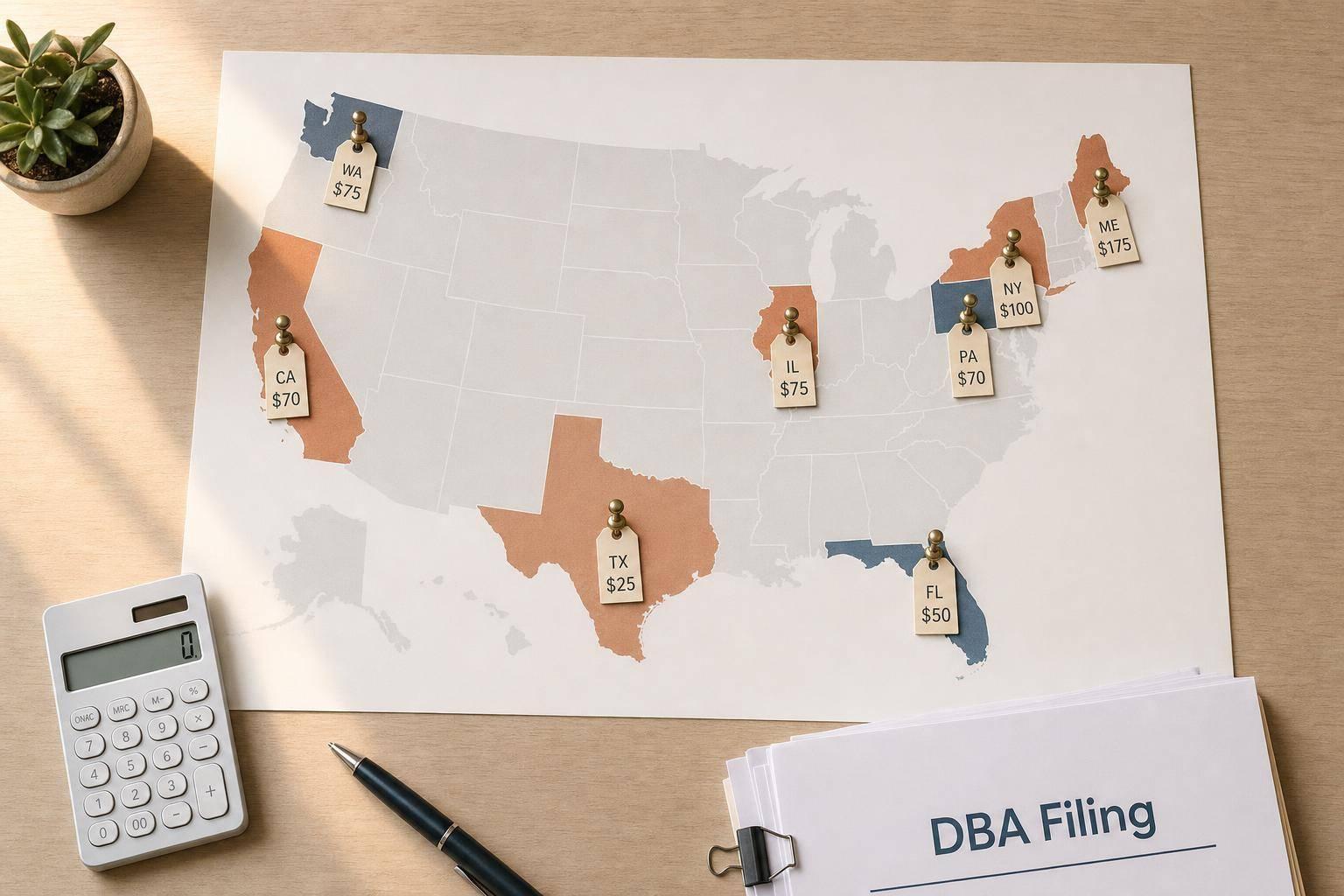
A DBA can cost as little as $5 to $7 or more than $200 before extras. The price depends on where you file, whether newspaper notice is required, and how often you have to renew.
If I wanted the short answer, I’d look at it this way:
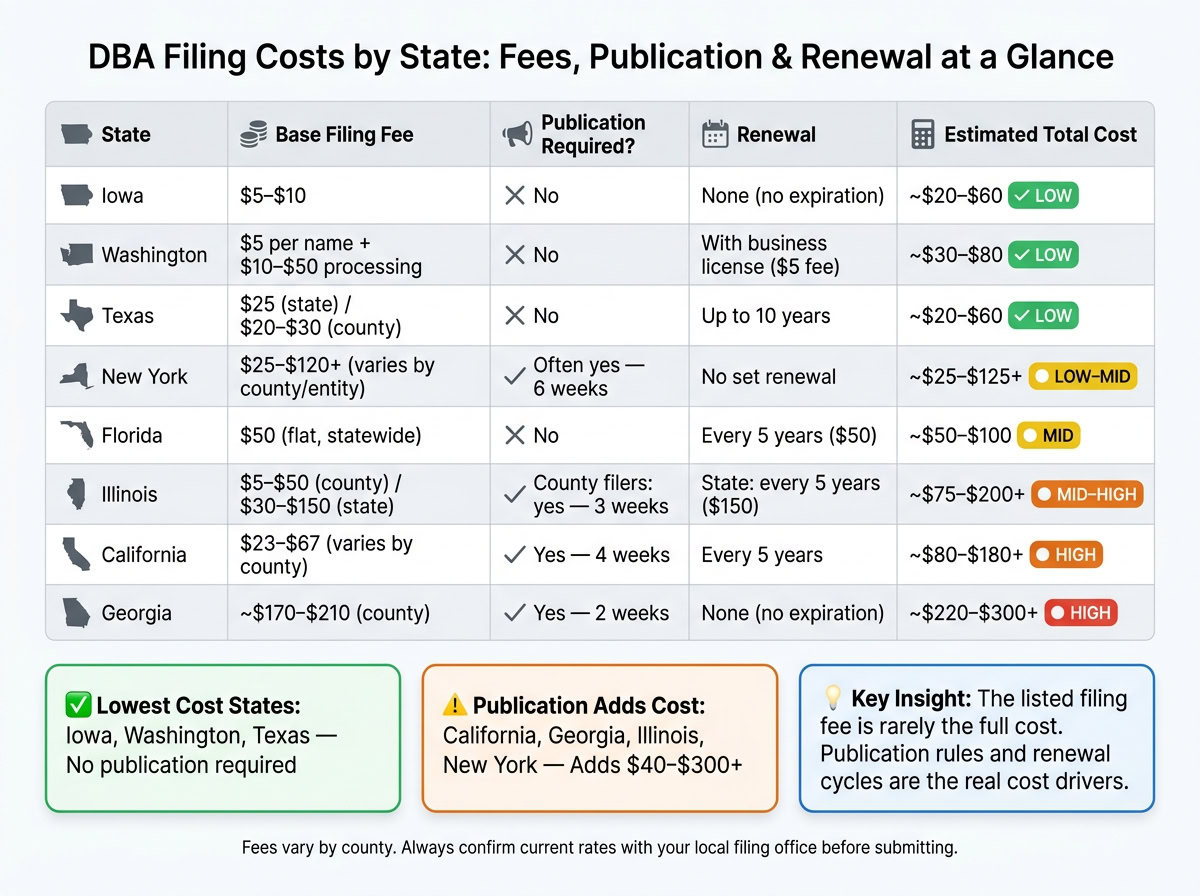
- Lowest-cost states in this group: Iowa, Washington, and Texas
- Most common base fee range: $20 to $50
- Biggest cost driver: newspaper publication
- Highest totals in this group: Georgia, California, and some New York cases
- Renewal can matter more than the first fee: especially in Florida and Illinois
Here’s the part most people miss: the listed filing fee is often not the full cost. In states that require publication, the ad can cost more than the filing itself. And in county-based systems, the same DBA can cost one amount in one county and a very different amount in another.
If I were budgeting fast, I’d use these rough ranges:
- No publication required: about $30 to $75
- Publication required: about $80 to $300+
- Outlier cases: some New York publication setups can run far higher
This comparison covers California, New York, Florida, Texas, Washington, Iowa, Georgia, and Illinois and looks at:
- Filing level: state, county, or both
- Base filing fee
- Publication or notice rules
- Renewal period and renewal fee
- Extra charges like copies, notarization, and name checks
Quick Comparison
| State | Filing level | Base fee | Publication | Renewal |
|---|---|---|---|---|
| California | County | $23–$67 | Yes, 4 weeks | Every 5 years |
| New York | County or state | $25–$120+ | Often yes, 6 weeks | No set renewal |
| Florida | State | $50 | No | Every 5 years |
| Texas | County or state | $20–$30 county / $25 state | No | Up to 10 years |
| Washington | State | $5 per name, plus filing fees | No | With business license |
| Iowa | County or state | $5–$7 | No | No expiration |
| Georgia | County | about $170–$210 | Yes, 2 weeks | No expiration |
| Illinois | County or state | $5–$150 | County filers: yes, 3 weeks | State filers: every 5 years |
Bottom line: if you want the lowest out-of-pocket cost, look for states with no publication rule and no short renewal cycle. If you file in a county-based state, check the exact local office before you submit anything, because that one detail can change the price a lot.
sbb-itb-ba0a4be
1. California
In California, a DBA goes by Fictitious Business Name (FBN). And you don’t file it with the state. You file it at the county level with the County Clerk or Registrar-Recorder in the county where your main place of business is located.
That setup is what pushes California into the mid-to-high cost range. The county filing fee matters, but the newspaper publication often ends up being the bigger part of the bill.
Filing Fee
County filing fees change based on where you do business. For one business name and one registrant, here’s how some major counties stack up:
| County | First filing | Additional name or owner |
|---|---|---|
| Orange County | $23 | $7 |
| Los Angeles County | $26 | $5 |
| Placer County | $30 | $5.50 |
| Sacramento County | $44 | – |
| San Diego County | $54 | $5 |
| San Francisco County | $60–$67 | $15–$17 |
So, yes, the filing fee can vary a lot from one county to the next. But in many cases, publication adds more to the total than the filing itself.
Publication Requirement
California requires you to publish your FBN statement in a local newspaper of general circulation once a week for four consecutive weeks after filing. You need to start publication within 45 days. Miss that window, and you have to refile and pay again.
This cost is separate from the county filing fee because you pay the newspaper directly. In most major counties, the four-week run usually costs $75–$200. That said, some discount services in Los Angeles advertise packages starting at about $40.
After the four weeks are done, the newspaper files an Affidavit of Publication with the county.
Renewal
California FBN statements expire after five years. Renewal fees often match the first filing fee. For example, Los Angeles County charges $26 for both initial and renewal filings.
In some counties, if your renewal is clean, you may not need to publish again.
Total Cost to Expect
For most sole proprietorships and LLCs in California, the all-in cost usually lands around $100–$300. If you’re planning your budget, the newspaper cost is the part that tends to sneak up on people – not the county filing.
2. New York
New York handles DBA filings a bit differently from California. Here, a DBA is called an Assumed Name.
The key detail is who is filing. Sole proprietors and general partnerships file a Business Certificate with the county clerk. LLCs, corporations, and limited partnerships file a Certificate of Assumed Name with the New York Department of State (DOS). If you file in the wrong place, you can end up with delays and duplicate fees.
Filing Fee
For LLCs, corporations, and limited partnerships, the DOS filing fee is $25. Corporations also pay county surcharges: $100 per county in the five NYC boroughs and $25 per county everywhere else. LLCs and limited partnerships usually don’t pay that county surcharge. So if a corporation plans to operate in all five NYC boroughs, the filing fees alone come to $525.
For sole proprietors and partnerships, county clerk fees usually fall between $25 and $120, with New York City sitting at the top end of that range.
| Location | Filing Fee |
|---|---|
| Manhattan (New York County) | $100 |
| Bronx, Queens | $100 |
| Brooklyn (Kings County) | $120 |
| Staten Island (Richmond County) | $120 |
| Monroe County (Rochester) | $25 |
| Orange County | $25 |
| Broome County | $25 |
Copy charges can push the total higher. In Broome County, for example, the cost reaches $30.20 once you add a $5.20 certified copy to the $25 filing fee.
That means New York can be cheap for some filers and much more expensive for corporations doing business in New York City.
Publication Requirement
Many New York counties require sole proprietors and partnerships to publish their DBA notice in two newspapers designated by the county clerk for six consecutive weeks after filing. After that, they must file an affidavit of publication.
Those publication fees go to the newspapers, not the county clerk, and they are separate from the filing fee. Depending on the county and the papers picked by the clerk, the cost may run a few hundred dollars, and in pricier areas it can go much higher. In a lot of cases, publication costs more than the filing itself.
Certified Copies and Other Costs
Certified copies cost $5 to $10 at county clerks and $10 at DOS. If you need faster DOS processing, expedited service adds:
- $25 for 24-hour filing
- $75 for same-day service
- $150 for two-hour service
Renewal
New York Assumed Name registrations do not have a set renewal date. Once the name is filed, it stays active until it is canceled or amended.
Most New York DBAs cost $25 plus publication, but sole proprietors and partnerships in high-cost counties may end up paying several hundred dollars more.
3. Florida
Florida handles DBA filings through the Florida Department of State, Division of Corporations (Sunbiz) at the state level. That means one filing covers all 67 counties. You don’t need to file again at the county level.
Filing Fee
The state filing fee is $50. That same fee applies to sole proprietors, LLCs, corporations, and partnerships.
That makes Florida one of the easier states to plan for. No sliding scale. No county add-ons. Just a flat $50 fee, which keeps it toward the lower-cost side of this comparison.
Publication Requirement
Florida does not require newspaper publication, so there is no added publication cost.
Renewal
A Florida DBA stays active through December 31 of the fifth year. The renewal fee is $50.
If you miss the renewal deadline, the registration expires. At that point, you’d need to file again and pay the fee again.
Other Costs
Outside the filing and renewal fee, only a few extra charges may come up.
| Item | Cost |
|---|---|
| Certified copy | $30 |
| Certificate of status | $10 |
| Cancellation or re-registration | $50 |
4. Texas
Texas handles DBA filings in two different ways, and your business type decides which path you take. Sole proprietors and general partnerships usually file with the county clerk. LLCs, corporations, limited partnerships, LLPs, professional associations, and foreign filing entities file an Assumed Name Certificate with the Texas Secretary of State.
That split matters because it affects both where you file and what you pay. The good news: Texas is pretty simple to budget for. The state uses a flat fee, and there’s no newspaper publication rule.
Filing Fee
At the state level, Texas charges a flat $25 filing fee. Sole proprietors and general partnerships filing at the county level should plan for about $20 to $30, plus small recording or copy fees.
If you file through the Secretary of State’s SOSDirect portal and pay by credit card, Texas adds a 2.7% convenience fee on top of the $25 base fee. If you want to skip that extra cost, paying by check does the job.
Publication Requirement
Texas does not require newspaper publication for a DBA. That helps keep costs more predictable than in states where filing is only part of the bill.
Renewal
A Texas assumed name certificate can last for up to 10 years. To keep using the name, you need to refile within six months of the expiration date and pay the full filing fee again. If you stop using the DBA before then, the abandonment filing fee is $10.
| Item | Cost |
|---|---|
| State filing | $25 |
| Credit-card convenience fee | +2.7% |
| County filing (sole proprietors/general partnerships) | Typically $20–$30 |
| Abandonment filing (state level) | $10 |
Washington follows with a different filing structure and cost pattern.
5. Washington
Washington uses the term trade name instead of DBA. You register it through the state’s Business Licensing Service (BLS), not at the county level.
Filing Fee
The base fee for a Washington trade name is $5 per name.
What you pay on top of that depends on whether you’re starting a business or adding a name to one you already have:
- A new business pays a $50 license fee.
- An existing business adding a trade name pays $10.
- Filing online may add about $1.79.
So the math usually looks like this:
- New business with one trade name: about $56.79
- Existing business adding one trade name: about $16.79
If you want more than one trade name on the same application, each extra name costs just $5.
Before you file, Washington offers a free Business Lookup tool so you can check whether the name you want is available.
Publication Requirement
Washington does not require newspaper publication for trade name registration.
Renewal
Washington trade names renew with the underlying business license. The renewal handling fee is $5, and a late renewal can add a delinquency charge of up to $150 per location. That puts Washington near the low-cost end of this comparison.
| Item | Cost |
|---|---|
| Trade name registration fee | $5 per name |
| New business license processing fee | $50 |
| Existing business processing fee | $10 |
| Online processing surcharge | ~$1.79 |
| Business license renewal handling fee | $5 |
| Late renewal delinquency fee | Up to $150 per location |
Iowa follows with one of the lowest-cost DBA filings in the comparison.
6. Iowa
Iowa uses the term trade name, and it’s one of the lower-cost states in this comparison. The filing office depends on how your business is set up: sole proprietors and general partnerships file with the county recorder, while LLCs, corporations, and other registered entities file with the Iowa Secretary of State.
Filing Fee
For sole proprietors and general partnerships, the county recorder charges $7 for the first page and $5 for each additional page. For LLCs, corporations, and other registered entities, the filing fee with the Secretary of State is $5.
That puts Iowa near the low end on cost before extras. One thing to watch: Iowa also requires notarization, so your total can go up once you notarize a document online or add notary, mailing, copy, or rush-processing fees.
Publication Requirement
Iowa does not require newspaper publication for trade name registration.
Renewal
Iowa trade name registrations do not expire. Once you file, the registration stays active with no renewal cycle.
| Item | Cost |
|---|---|
| County trade name filing fee (first page) | $7 |
| County trade name filing fee (each additional page) | $5 |
| State fictitious name filing fee (LLCs, corporations, and other entities) | $5 |
| Publication requirement | None |
| Renewal fee | None |
Iowa stays low-cost because there’s no publication fee and no renewal fee.
Georgia returns to county-level filing, but newspaper notice can push the total higher.
7. Georgia
Georgia handles DBA filings at the county level, not through the Secretary of State. You file with the Clerk of Superior Court in the county where your business is based. In plain English, that usually makes Georgia a pricier option than Iowa.
Filing Fee
County filing fees vary. Examples include Gwinnett County at $172, DeKalb County at $174, Fulton County at $175, and Columbia County at $209. These amounts can change, so check the current fee with the right county before you file.
Publication Requirement
Georgia also requires a newspaper notice. You must publish it in the paper chosen for legal notices once a week for two consecutive weeks. That publication usually costs $40–$60, depending on the county and newspaper. After that, keep the affidavit for your records.
Renewal
Georgia trade name registrations do not expire, so there’s no renewal fee. You only need to file again if the ownership, address, or use changes.
| Item | Estimated Cost |
|---|---|
| County filing fee | ~$170–$210 (varies by county) |
| Publication fee | ~$40–$60 |
| Notarization | $2–$10 |
| Certified copies | A few dollars each |
| Renewal fee | None |
If your business operates in more than one county, you may need to register in each county, which pushes the total cost up.
Illinois comes next with another county-based filing system, but the fee structure is different.
8. Illinois
Illinois handles DBA filings in two different ways. Sole proprietors and partnerships file at the county level, while LLCs and corporations file with the Secretary of State. That split matters because the cost can stay pretty low for county filers, but jump quite a bit for state filers.
Filing Fee
County filing fees depend on the clerk. Cook County charges about $50, DuPage charges $10, Adams charges $25, and Peoria charges $5.
State filings follow a tiered schedule based on the filing year. The fee can be $150, $120, $90, $60, or $30.
For county filers, the filing fee is often only part of the story. In many cases, publication ends up costing more than the filing itself.
Publication Requirement
If you’re on the county track – meaning a sole proprietor or general partnership – you must publish notice in a local newspaper for three consecutive weeks.
That cost can vary a lot based on the paper you use. In Sangamon County, for example, publication in the State Journal-Register costs $27, while the Illinois Times charges $71.
LLCs and corporations filing through the state do not have a publication requirement.
Renewal
State-level assumed names renew every five years at $150 per name. If you renew late, Illinois adds a $100 penalty.
At the county level, many clerks do not use a fixed renewal date unless business details change.
| Item | County Track (Sole Prop/Partnership) | State Track (LLC/Corp) |
|---|---|---|
| Filing fee | ~$5–$50 (varies by county) | $30–$150 (tiered by year) |
| Publication required | Yes – 3 weeks | No |
| Publication cost | ~$27–$71+ depending on newspaper | N/A |
| Renewal fee | Varies; many counties have no fixed expiration | $150 every 5 years |
| Late renewal penalty | No uniform countywide penalty | $100 |
| Online payment fee | +2.25% | +2.25% |
In Illinois, the listed filing fee doesn’t always tell you what you’ll spend. For county filers, publication can be the bigger expense. For state filers, the long-term cost tends to show up later through renewal fees and late penalties.
Hidden Costs, Cost Tiers, and How to Budget for a DBA
The filing fee is only one piece of the bill. Across these eight states, the final amount usually comes down to three things: whether newspaper publication is required, whether you file at the county or state level, and which add-ons fit your case.
That’s why the same DBA can feel cheap in one state and oddly pricey in another.
Low-cost states like Washington and Iowa tend to stay close to the filing fee because they don’t require newspaper publication. California, Georgia, and Illinois often cost more because publication adds to the total. New York and Florida work a bit differently – their costs are shaped more by county rules or filing setup than by publication. In some counties with pricey designated newspapers, publication alone can hit $500–$2,000+.
It also helps to plan for a few extra charges that catch people off guard:
- Certified copies
- Name searches
- Amendments
- Renewal fees
Filing fees are usually nonrefundable if the name gets rejected. So paying a little upfront for a pre-filing name search can save money and hassle later.
A simple budgeting rule works well here: expect about $30–$75 total in states without publication, and about $80–$300+ in states that require newspaper notice.
Use the tiers below to size up your likely total a lot faster.
| State | Cost Tier | Base Filing Fee Range | Common Hidden Costs | Estimated Total Cost |
|---|---|---|---|---|
| Iowa | Low | $5–$10 | Recording fees, certified copies | ~$20–$60 |
| Washington | Low | $5–$24 | County recording surcharges, certified copies | ~$30–$80 |
| Texas | Low | $25 at the state level; county-level filings usually $20–$30 | County recording fees, certified copies, optional name search | ~$20–$60 |
| New York | Low–Mid | $25–$100 | County fees in some areas, certified copies, extra names/owners | ~$25–$125 |
| Florida | Mid | ~$50 | Certified copies, certificate of status | ~$50–$100 |
| Illinois | Mid–High | $10–$150 | 3-week newspaper publication, extra names, certified copies | ~$75–$200+ |
| California | High | $23–$67 | 4-week newspaper publication, extra names/owners, certified copies | ~$80–$180+ |
| Georgia | High | $170–$210 | 2-week newspaper publication, notarization, certified copies | ~$220–$300+ |
Next, the pros and cons section shows which states are cheapest, simplest, and most burdensome.
Pros and Cons by State
DBA costs don’t work the same way across the country. Some states keep things simple with a one-time filing. Others add renewals, county-level steps, or publication rules that push the total up. The table below gives you a fast side-by-side look at cost and compliance. If you are ready to move forward, you can follow these steps to register a DBA across different states.
| State | Pros | Cons | Best fit for |
|---|---|---|---|
| Iowa | Lowest-cost option with no publication or renewal. | Confirm whether your filing goes to the county or state level depending on filer type. | Sole proprietors who want the lowest out-of-pocket DBA cost |
| Washington | Centralized state filing with no publication or renewal cycle. | Adding or changing a trade name on an existing registration carries a small processing fee. | Businesses that want a one-time filing with no renewal deadline |
| Texas | Low filing cost, no publication, and a long validity period. | Operating across multiple counties means separate filings and fees for each. | Businesses that want low ongoing compliance burden and a long registration term |
| New York | Flat state filing for entity filings, with county costs varying by location. | County fees vary widely, and NYC counties cost significantly more than upstate counties. | NYC businesses that can justify the county surcharge, or upstate businesses where county fees stay lower |
| Florida | Predictable flat fees. | Renewal is required every five years, so the cost recurs on a fixed schedule. | Businesses that want a uniform, easy-to-budget cost with no publication step |
| California | DBAs last five years, so renewal is infrequent. | County filing plus publication makes the total higher. | Established local businesses that plan to hold the DBA for the full five-year term |
| Georgia | No renewal cycle, so the registration is a one-time filing. | High county filing cost plus required newspaper notice. | Businesses with a long-term trade name that want to register once and avoid renewals |
| Illinois | State-level filing is available for LLCs and corporations; county-level filing can be lower cost. | State renewal fees apply on a fixed schedule, and county-level filings follow their own rules. | LLCs and corporations that need a state-recognized assumed name and can plan around the renewal schedule |
A simple pattern shows up here. If you want the lowest hassle, states like Iowa, Washington, and Texas are easier on both cost and paperwork. If you’re filing in places like New York, California, or Georgia, the extra county fees or publication steps can change the math in a hurry.
That’s why the “best” state setup isn’t just about the filing fee. It’s also about how long the registration lasts, whether renewals show up later, and whether filing in more than one county means paying more than once.
Conclusion
After looking at the eight states above, one thing is clear: the base filing fee is just the entry point. Publication costs, renewals, county add-ons, and certified copies can push the total up fast.
Your actual DBA cost comes down to where you file, whether publication is required, how long the registration stays active, and what renewals cost over time. Once you know what a DBA is, the filing level, and the rules in your state, check the exact local fee before you submit anything.
Before you file, contact the exact county clerk or Secretary of State office and confirm:
- the current filing fee
- publication rules
- approved newspapers
- certified-copy cost
If your goal is to keep costs down, focus on states with no publication requirement, renewal terms that are easy to track, and fee schedules that are easy to read. That’s how you get the lowest actual DBA cost, not just the lowest fee shown at first glance.
FAQs
What is the total cost of a DBA?
The total cost of a DBA depends on where you file and how your business is set up. In most cases, you can expect to pay $10 to $300 or more. The main state or county filing fee usually falls between $10 and $175.
There may also be extra fees on top of that. These can include:
- Newspaper publication fees
- Notary fees
- Certified copy fees
Those extra charges can change a lot from one state or county to another, so check with your local filing office before you set your budget.
Do I need to publish my DBA in a newspaper?
It depends on your state or local jurisdiction. Many states no longer require newspaper publication. But some, including California, New York, and Florida, still do.
If publication is required, you may need to submit proof to the state or county clerk to complete your registration. Miss this step, and your filing can become ineffective.
Do DBA fees depend on my business type?
Yes. DBA filing fees and rules often depend on your business type because many states decide where you need to file based on your legal structure.
For example, sole proprietors and general partnerships may file at the county level, while LLCs and corporations often file with the Secretary of State. And since those offices usually have different fee schedules, your total cost can change based on your entity type.