

Most businesses in Nevada need a state business license to operate legally, but some qualify for exemptions from the $200–$500 annual fee. These exemptions are based on specific criteria, such as being a nonprofit, a small landlord, or running a low-earning home-based business. Here’s what you need to know:
- Who Qualifies: Nonprofits, government entities, home-based businesses with limited income, small landlords (4 or fewer units), and corporations sole.
- Filing Requirements: Most exempt businesses must file an annual "Claim for Exemption", except for nonprofits under NRS Chapters 82 or 84 and corporations sole, which are automatically exempt.
- Key Points: Missing renewal deadlines can result in penalties, and exemptions don’t apply to local city or county licensing rules.
Takeaway: If your organization qualifies, applying for an exemption can save you hundreds annually, but staying compliant requires careful annual filing.
Nevada State Business License Requirements at a Glance
Who Needs a Business License in Nevada?
If you’re planning to do business in Nevada, chances are you’ll need a business license. According to NRS 76.100, no person or entity can legally operate a business in the state without first securing a state business license from the Secretary of State.
Nevada takes a broad view of what it means to "operate a business." You’re considered to be conducting business in the state if:
- Your entity is organized under Nevada’s Title 7 (covering LLCs, corporations, limited partnerships, and LLPs).
- You maintain an office or base of operations in Nevada.
- You have a registered agent in the state.
- You pay wages to employees working in Nevada.
When you need to apply depends on your business structure. For Title 7 entities like LLCs and corporations, the business license application is submitted alongside the initial or annual list of officers. In contrast, sole proprietors and general partnerships must obtain their licenses before engaging in any business activities.
Here’s a useful tip: If you’re a sole proprietor managing multiple business activities that are all reported on the same federal tax forms, you only need one state business license to cover all of them.
While the licensing requirement is extensive, there are specific exemptions for certain businesses.
What Is a Business License Exemption?
Some businesses qualify for an exemption from paying the annual licensing fee, which ranges from $200 to $500 depending on the entity type. However, qualifying businesses must submit an annual Application for a Certificate of Exemption – unless they fall under specific categories like nonprofit corporations under NRS Chapter 82 or corporations sole under NRS Chapter 84, which are automatically exempt from this requirement.
Exemptions are defined under NRS 76.020(3) and include:
- Governmental entities.
- Qualifying nonprofits.
- Home-based businesses operated by individuals with limited net earnings.
- Small landlords renting out four or fewer dwelling units.
- Entities organized under certain Nevada laws.
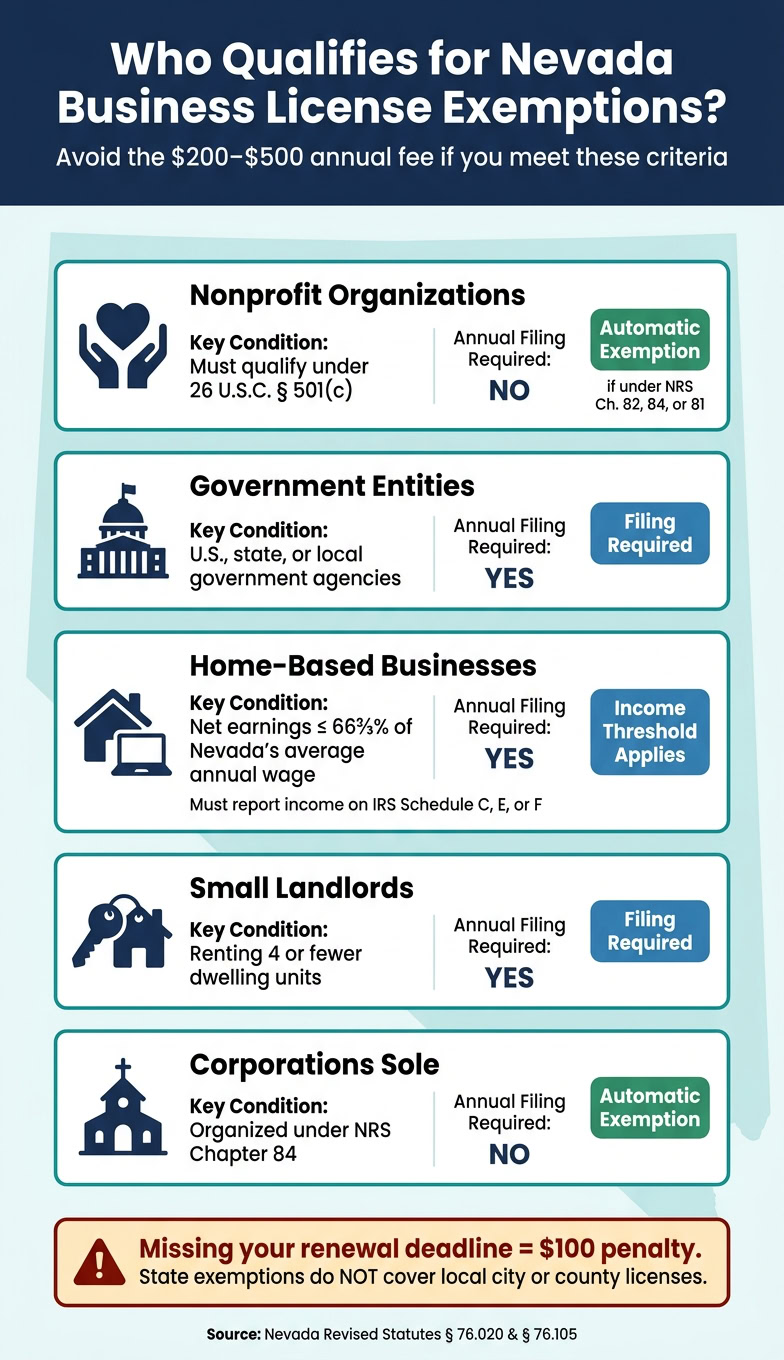
Here’s a breakdown of the exemption categories, conditions, and filing requirements:
| Exemption Category | Key Condition | Annual Filing Required? |
|---|---|---|
| Governmental Entities | U.S., state, or local government agencies | Yes |
| 501(c) Nonprofits | Must qualify under 26 U.S.C. § 501(c) | No, if under NRS Ch. 82 or 84 |
| Home-Based Businesses | Net earnings ≤ 66⅔% of the state’s average wage | Yes |
| Small Landlords | Renting 4 or fewer dwelling units | Yes |
| Corporations Sole | Organized under NRS Chapter 84 | No |
Notably, nonprofit corporations under NRS Chapter 82 and corporations sole under NRS Chapter 84 are excluded from the general definition of "business" in Nevada. This means they don’t even need to file the annual exemption application. However, other exempt businesses must renew their exemption status annually to remain compliant.
sbb-itb-ba0a4be
Business Types That Qualify for Nevada License Exemptions
In Nevada, certain types of entities are exempt from the requirement to hold a state business license. Here’s a closer look at the categories that qualify.
Nonprofit Organizations
Nonprofit organizations recognized under 26 U.S.C. § 501(c) – such as religious, charitable, educational, and fraternal groups – are not required to obtain a Nevada business license for your LLC.
The specific statute under which your nonprofit is organized (NRS Chapter 82, 84, or 81) determines its filing requirements:
| Organization Type | Statutory Basis | Annual Exemption Filing Required? |
|---|---|---|
| Nonprofit Corporations | NRS Chapter 82 | No |
| Corporations Sole | NRS Chapter 84 | No |
| Nonprofit Unit-Owners’ Associations | NRS Chapter 81 | No |
| Other 501(c) Organizations | 26 U.S.C. § 501(c) | Excluded from "business" definition |
Nonprofits organized under NRS Chapters 82, 84, or 81 are not required to file for an annual exemption with the Secretary of State. However, other 501(c) organizations are still excluded from being classified as a "business" under Nevada law. To maintain this status, it’s crucial to ensure your 501(c) designation is active with the IRS.
Let’s move on to exemptions available for home-based businesses.
Home-Based Businesses Run by Natural Persons
If you operate a home-based business, you may qualify for an exemption, provided your net earnings fall below a certain threshold. This threshold is set at 66⅔% of Nevada’s average annual wage for the previous calendar year, as determined under NRS Chapter 612. The figure is rounded to the nearest $100 and recalculated annually, so it’s important to check each year to confirm your eligibility.
This exemption applies to income-generating activities reported on IRS Schedule C, E, or F. However, unlike nonprofits, home-based business owners must file an annual application for a Certificate of Exemption.
One key point to remember: a state-level exemption does not automatically exempt you from local business licensing requirements. Depending on your location, you may still need to obtain a city or county license.
Now, let’s look at the specific exemption for corporation sole entities.
Corporation Sole Exemption
Entities structured as a corporation sole receive an automatic exemption under Nevada law. This structure is typically used for religious or charitable leadership. If your entity is organized under NRS Chapter 84, you are not required to pay a license fee or file for an annual certificate.
The Secretary of State assigns a state business identification number to corporation sole entities, but no licensing obligation applies. This exemption is automatic, with no additional filings required.
"The provisions of subsection 1 [requirement to apply for a certificate of exemption] do not apply to a business organized pursuant to… Chapter 82 or 84 of NRS." – Nevada Revised Statutes § 76.105
How to Apply for a Nevada Business License Exemption
The steps for applying for a Nevada business license exemption vary depending on your business structure. For Title 7 entities – like LLCs, corporations, and limited partnerships – the process is straightforward. Simply check the designated exemption box on your Annual List of Officers form. If you miss this step, the standard license fee will apply. This is different from the process for non-Title 7 entities, which requires a separate filing.
For sole proprietors and general partnerships, you’ll need to complete a separate Application for Certificate of Exemption. This form must be submitted to the Nevada Secretary of State’s Compliance Division. You can file it online (if available), by mail, or via fax, and it must be accompanied by the Customer Order & ePayment Packet.
Filing an Exemption with the Nevada Secretary of State
Once you’ve submitted the application, the next step is to file your exemption with the Secretary of State. After approval, you’ll receive a Certificate of Exemption, which includes your state business identification number. Be aware that incomplete or incorrect applications will be sent back for revisions.
The person signing the application must align with the type of business. For example:
- Sole proprietors must sign their own applications.
- Partnerships require a signature from a general or managing partner.
- LLCs need a manager or managing member to sign.
- Corporations require an officer’s signature.
Documents and Information You Need to Prepare
The documents and information you’ll need depend on your business type. Here’s a quick breakdown:
| Entity Type | Filing Method | Signature Authority |
|---|---|---|
| LLC, Corporation, LP (Title 7) | Check exemption box on Annual List Form | Officer, manager, or general partner |
| Sole Proprietor, General Partnership | Submit Application for Certificate of Exemption | Owner or partner |
| Nonprofit (NRS Chapter 82/84) | No filing required | N/A |
| 501(c) Organization (NRS Chapter 81) | Submit Application for Certificate of Exemption | Authorized officer |
If you’re a natural person applying for a home-based business exemption, you’ll need to reference IRS tax forms that show your income is reported on Schedule C (Form 1040), Schedule E, or Schedule F. This documentation will help verify your eligibility for the exemption.
Keeping Your Nevada Business License Exemption Active
If your business operates under a license exemption in Nevada, keeping that status active requires annual renewal. Missing this step can lead to penalties and even legal trouble.
Annual Renewal Requirements
Renewing your exemption is just as important as the initial application. Under NRS 76.105, businesses must renew their certificate of exemption every year. The process differs slightly depending on your business type:
- Title 7 entities: Renew alongside your Annual List by checking the exemption box.
- Non-Title 7 entities: Submit a separate renewal by the last day of your certificate’s anniversary month.
The Nevada Secretary of State usually sends a renewal notice 90 days before your deadline, but there’s a catch. According to NRS 76.130:
"Failure of any person to receive a notice does not excuse the person from the penalty imposed by law."
This means you’re responsible for tracking your renewal deadlines, even if you don’t get a reminder. If your business stops engaging in exempt activities, you must notify the Secretary of State in writing at least 10 days before your renewal date to avoid compliance issues.
Now, let’s look at common mistakes that can jeopardize your exemption status.
Common Compliance Mistakes to Avoid
One of the most common errors for Title 7 entities is forgetting to check the exemption box on the Annual List Form. If you skip this step, your business will automatically be charged the standard license fee – $200 for most entities or $500 for corporations.
For non-Title 7 entities, mistakes during the filing process can cause delays or penalties. Double-check that your renewal includes:
- Your Nevada business ID
- The correct exemption code
- Updated contact information
Missing the renewal deadline comes with a $100 penalty.
Home-based business owners face an additional challenge: keeping an eye on their net earnings. If your income surpasses 66.67% of the average annual wage during any tax year, you’ll lose your exemption. In that case, you must secure a standard state business license within 180 days after the end of that federal tax year.
Conclusion: Key Takeaways
Nevada’s business license exemption process is straightforward for those who meet the requirements. Before applying, it is helpful to search for your business entity to ensure your records are up to date. Nonprofit organizations formed under NRS Chapters 81, 82, or 84, including corporations sole, automatically qualify for exemptions. For Title 7 entities, exemptions are claimed by checking the appropriate box on the Annual List. Non–Title 7 entities, however, need to file separately by the end of their anniversary month.
It’s important to note that state-level exemptions don’t apply to local licensing. Always check city and county rules to ensure compliance with local requirements.
Feeling bogged down by deadlines, renewals, and paperwork? BusinessAnywhere offers a streamlined dashboard to handle it all in one place.
FAQs
How do I know if my business counts as “operating” in Nevada?
In Nevada, you’re classified as running a business if you’re a non-natural person (like a corporation or LLC) performing a service or trade for profit, or if you’re an entity formed under Title 7 of the Nevada Revised Statutes. For natural persons, you’re considered operating a business if you’re engaged in a trade for profit and file federal tax schedules C, E, or F. Services like BusinessAnywhere can assist in making compliance easier.
What income counts toward the home-based business exemption limit?
Net earnings for the Nevada home-based business license exemption are determined by the amount you reported on your federal income tax return for the prior tax year. To qualify, your net earnings must be no more than 66 2/3% of the average annual wage for the most recent calendar year before your license renewal date. If your earnings go over this limit, you’ll need to obtain a state business license.
If I’m exempt at the state level, do I still need a city or county license?
Yes, a state business license is entirely separate from local licensing requirements. Even if you’re not required to obtain a Nevada state-level business license, you still need to verify the rules in the city or county where your business operates. Local licenses and permits are regulated by municipal or county ordinances, which operate independently from any state-level exemptions.