

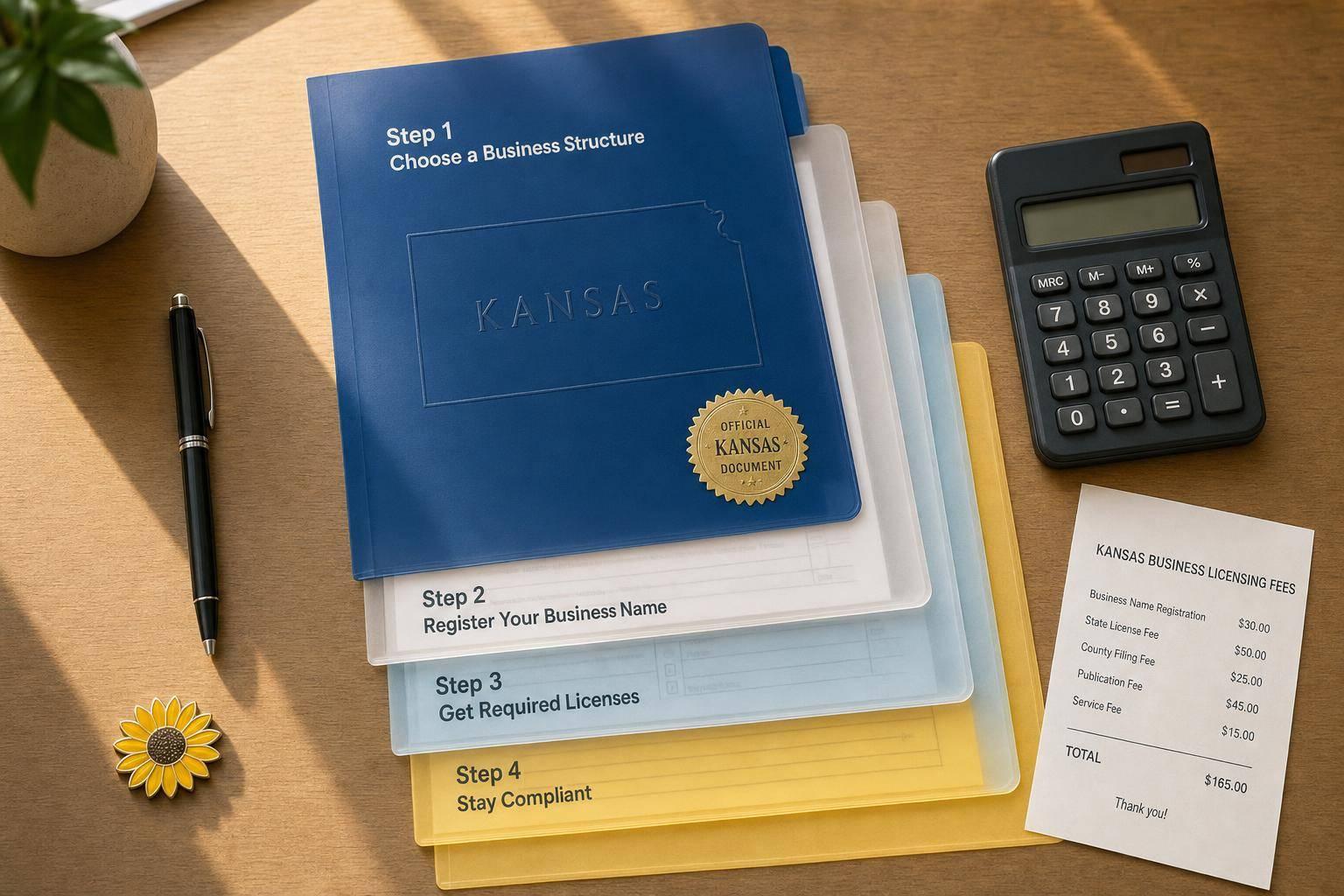
Kansas does not have one statewide business license. In most cases, I’d start with entity setup, then Kansas tax registration, then city or county rules, and then any job-specific license.
Here’s the short version:
- If I form an LLC or corporation, I file with the Kansas Secretary of State
- If I sell taxable goods or services, I register with the Kansas Department of Revenue
- If I hire workers, I add withholding and unemployment accounts
- If I’m in a regulated field, I check the right state board or agency
- If my city requires it, I get a local business license or permit
A few key numbers stand out:
- $85 to file a Kansas LLC online
- Free for Kansas sales tax registration
- $50 for the Kansas biennial report filed online
- Local license costs often land around $50 to $160, but some permits cost more
- Kansas state sales tax starts at 6.5%, before any local sales tax is added
What matters most is where I operate and what my business does. A home-based service business may need very little, while a restaurant, contractor, or child care business may need city permits, inspections, or board approval before opening.
That’s the full picture in plain English: Kansas licensing is usually a stack of filings, not one form.
1. Identify which Kansas licenses and registrations apply to your business
Before you file anything, get clear on one thing: in Kansas, licensing often means more than one filing. You may need separate filings with the Secretary of State, the Department of Revenue, and sometimes your city, county, or a state licensing board.
This section helps you sort those requirements into three buckets: state, local, and professional.
Kansas does not have a general statewide business license
Kansas does not issue one statewide business license for every business. What you need depends on:
- your legal structure
- what your business does
- where it operates
So even if your city doesn’t ask for a general business license, you still might need a professional or occupational license if you work in a regulated field.
Business license vs. tax registration vs. permit vs. professional license
These terms get lumped together all the time. In Kansas, though, they mean different things. Here’s a simple breakdown by agency:
| Type | Issued By | What It Does |
|---|---|---|
| Entity formation filing | Kansas Secretary of State | Establishes your LLC, corporation, or LP as a legal entity |
| Tax Registration | Kansas Department of Revenue (KDOR) | Registers you for sales tax and withholding accounts |
| Local License | City or County Government | Lets you operate in a specific city or county |
| Professional License | State boards | Required for licensed professions and activities |
Starting an LLC in Kansas with the Secretary of State does not mean you’re licensed to do business. It only creates your legal entity. You still need to handle tax registration through KDOR and check local rules with your city or county. And if your work is regulated, you may need a license from a state board too.
Sole proprietorships are a little different. They don’t file formation documents with the Secretary of State, but they may still need tax, local, or professional filings.
Kansas businesses that commonly need extra licenses or permits
Some industries need more than basic registration and tax setup. These business types often need extra state or local approval:
| Business Type | Extra Approvals Needed | Licensing Agency |
|---|---|---|
| Restaurants / Food Trucks | Food Code Permit, Liquor License | KDHE / Local Health Dept / ABC |
| Daycare Providers | Child Care License | Dept. for Children and Families (DCF) |
| Cosmetologists / Salons | Practitioner & Facility License | Kansas Board of Cosmetology |
| Construction Trades (HVAC, Electrical, Plumbing) | Trade-specific license | Local City/County |
| Real Estate Agents | Professional License | Kansas Real Estate Commission |
| Pesticide Applicators | Commercial Applicator License | Kansas Dept. of Agriculture |
| Private Investigators | PI License | Kansas Office of the Attorney General |
Construction trades are a good example of how Kansas can get a bit patchwork. HVAC, electrical, and plumbing work are often licensed at the local level instead of through one statewide contractor license. If you work in more than one city or county, check each area’s rules on its own.
sbb-itb-ba0a4be
2. Set up your business before you apply
Set up your entity, tax accounts, and address before you file. Three things drive the next steps: entity type, business activity, and EIN. Get those lined up first, and you’re less likely to hit delays later.
Choose your entity type and confirm your business name
Your entity type decides which filings you need. LLCs, corporations, LPs, and LLPs must register with the Kansas Secretary of State. Sole proprietorships don’t file formation documents with the Secretary of State.
Before you submit anything, check that your business name is available. Use the Kansas Secretary of State’s online database to make sure no other entity is already using it.
If your structure changes later – for example, you start as a sole proprietor and then form an LLC – you’ll need to re-register for state taxes with the Kansas Department of Revenue. After that, you can move on to tax and local registration.
Identify your business activity, sales and withholding tax, and location
Once your structure is set, get clear on what your business does day to day. Kansas uses an activity description or NAICS code to assign the right tax types and decide whether any industry-specific licenses may apply.
Two tax questions matter most:
- Do you sell tangible personal property or provide taxable services? If yes, you need a Retailers’ Sales Tax Registration Certificate through the Kansas Department of Revenue. Kansas generally charges a 6.5% state sales tax on retail sales, rentals of physical goods, and certain services.
- Will you hire employees? If yes, you’ll also need to register for withholding tax.
Your location matters too. The Department of Revenue requires a street address for your business location – no PO boxes. And this is where people sometimes get tripped up: city zoning and occupancy rules can change what you need to file. Check local zoning and license rules before you move ahead. That will shape the state and local filings that come next.
Set up your registered agent and federal tax ID
If you’re forming an LLC or corporation in Kansas, you must name a registered agent when you file with the Secretary of State. That agent must be a person or service with a physical Kansas address. Kansas requires this for LLCs and corporations. The registered agent receives legal papers and official state notices for your business.
Get your EIN from the IRS before you handle state tax registration. You’ll need it to complete state tax registration and to hire employees.
If you’re an out-of-state owner with an entity already formed in another state, you’ll usually need to submit Form FA to qualify to do business in Kansas. Once that’s done, you can file the Kansas registrations that fit your business.
| Requirement | Sole Proprietorship | LLC / Corporation (Domestic) | Foreign Entity (Out-of-State) |
|---|---|---|---|
| Register with Secretary of State | No | Yes | Yes |
| Registered Agent | No | Yes | Yes |
| EIN Required | Optional, but recommended | Yes | Yes |
| Filing Method | N/A | Online or paper | Paper only (Form FA) |
3. Step-by-step: How to get a business license in Kansas
With your entity, EIN, and business address set, handle your Kansas filings in this order.
Register your entity and state tax accounts
If you’re starting an LLC or corporation, file your Articles of Organization or Articles of Incorporation with the Kansas Secretary of State first. The online filing fee for an LLC is $85, or $90 if you file by paper. You’ll also need to list your Kansas registered agent and principal office address.
Next, get a free Federal Employer Identification Number (EIN) from the IRS before you move into state tax registration. Then use the Kansas Business One Stop portal, ksbiz.kansas.gov, to set up your state tax accounts in one session.
That portal lets you register for:
- Sales tax
- Use tax
- Withholding tax
- Unemployment insurance
Sales tax registration is free, although some new accounts may need a bond.
Check city and county licensing requirements
After state registration, look at your city and county rules.
Kansas City, KS requires almost every business to get an Occupation Tax License through the DotteBiz portal, which is run by the Unified Government of Wyandotte County. Wichita does not have a general business license, but it does regulate certain activities, including mobile food vending and pawnshops, through its Office of Central Inspection. For most businesses, the best starting point is the city clerk or planning office tied to your address.
Zoning also comes into play here. If you plan to run a home-based business, the rules are often tighter than they are for commercial space. Check zoning before you sign a lease or lock in a location.
Once you’ve cleared local rules, move on to any state board or industry permit you need before opening.
Apply for industry pre-opening approvals
Apply for any state board, health, or industry permit required before opening.
| Requirement Type | Agency | Typical Cost | Ongoing Requirement |
|---|---|---|---|
| Articles of Organization (LLC) | Secretary of State | $85 online / $90 paper | One-time filing |
| Biennial Information Report | Secretary of State | $50 online / $55 paper | Biennial report |
| Sales Tax Registration | Dept. of Revenue | Free | Active account |
| Unemployment Insurance | Dept. of Labor | Varies | Quarterly reporting |
| Occupation Tax License | City/County (e.g., KCK) | Varies by industry | Annual permit |
| Food Establishment Permit | KDA or KDHE | Varies | Annual permit |
| Professional License | State Boards | Varies | Varies by board |
| Workers’ Comp Insurance | Private Insurer | Varies by payroll | Annual policy |
4. Kansas business license costs and budget planning
Fee categories to plan for
Once you know which filings apply to your business, the next step is simple: plan for the full cost picture. That means looking at formation, local licenses, permits, and repeat filings.
Local licensing is where prices can swing the most. Kansas City, KS charges an annual Occupation Tax License, while Wichita tends to license only certain business activities. In most cases, it’s smart to set aside $50–$160 for a local license, depending on your city and business type. If your business falls into a regulated field, you’ll also need to account for inspection fees, health permits, or other permit charges on top of that.
A couple of optional items can add to your yearly budget too. A [choosing a registered agent service](https://businessanywhere.io/best-registered-agent-service/) starts at $39+ per year. And if you plan to use a business name different from your legal name, a trade name (DBA) filing costs about $30.
Cost examples by business type
The biggest jumps in cost usually come down to where you operate and what kind of work you do.
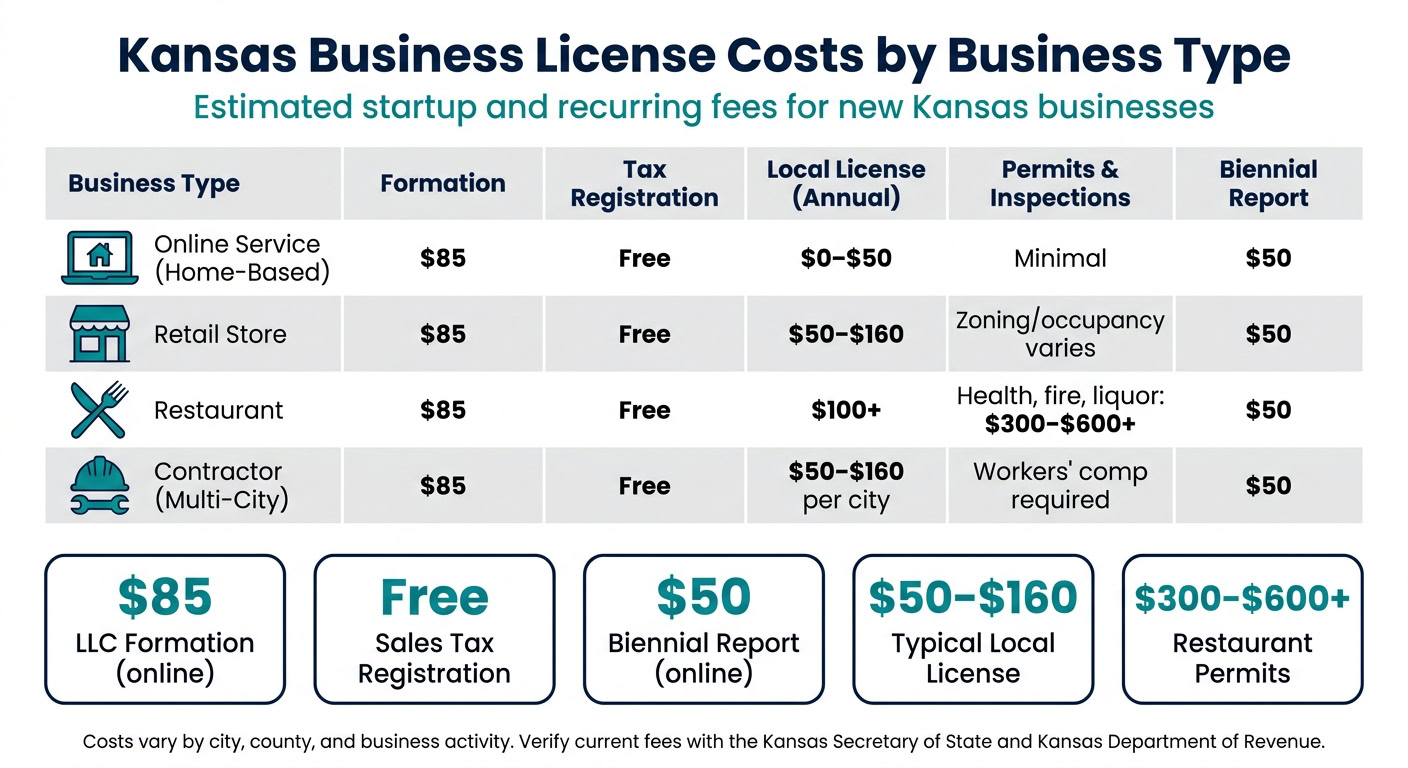
A home-based online service business tends to be the least expensive to start. In some cities, you may pay $0–$50 for a home occupation permit.
A retail store usually needs more than the basics. Along with local licensing, you may need zoning approval or an occupancy permit before opening your doors.
Restaurants usually face the highest upfront fees. A food establishment permit, fire inspection, and, in some cases, a liquor license can push early fees to $300–$600+.
A contractor working across multiple Kansas cities runs into a different issue. Kansas doesn’t have a statewide trade license, so you may need a separate local license in each city where you work. That can mean $50–$160 per jurisdiction. If you’re active in several cities, local licenses alone can cost $300+ before you even get to insurance.
Cost comparison table for new owners
Use this table for a quick side-by-side look at typical startup and repeat fees.
| Business Type | Formation | Tax Registration | Local License (Annual) | Permits and inspections | Biennial Report |
|---|---|---|---|---|---|
| Online service (home-based) | $85 | Free | $0–$50 | Minimal | $50 |
| Retail store | $85 | Free | $50–$160 | Zoning/occupancy varies | $50 |
| Restaurant | $85 | Free | $100+ | Health, fire, liquor: $300–$600+ | $50 |
| Contractor (multi-city) | $85 | Free | $50–$160 per city | Workers’ comp required | $50 |
5. Keep Your Kansas Business Compliant After Licensing
Track renewals, Biennial Information Reports, and local deadlines
Getting licensed is only part of the job. After that, you need to track state, local, and board deadlines on separate renewal timelines for entity filings, tax accounts, local licenses, and industry permits.
Most Kansas entities must file a Biennial Information Report by April 15 every other year. The filing year depends on whether the business was formed in an odd or even year. If you miss the deadline, the entity can be forfeited after the grace period.
Local business licenses often renew once a year, but the due date depends on the city or county. Some use the calendar year. Others use your business anniversary date. A simple move here can save a headache later: set reminders at least 30 days before each renewal so you don’t get hit with late fees. Professional licenses for fields like healthcare, cosmetology, and construction follow the schedule set by the state board that oversees that profession.
Here are a few city renewal examples:
| City | License Renewal Deadline |
|---|---|
| Bonner Springs | December 31 (renew by March 31) |
| Leawood | December 31 |
| Mission Hills | December 31 |
| Shawnee | September 30 |
| Tonganoxie | January 31 |
| Kansas City (Wyandotte) | December 31 |
What remote and out-of-state owners need to know
If you run the business from outside Kansas, your compliance calendar needs one more layer: foreign registration and tax nexus checks. Before operating in Kansas, out-of-state owners must file a Foreign Application with the Kansas Secretary of State to register as a foreign entity. You also need a registered agent with a physical Kansas street address. P.O. boxes don’t count.
If you hire workers in Kansas, register for withholding tax and unemployment insurance through Kansas Business One Stop. Workers’ compensation coverage becomes required once annual payroll goes over $20,000, no matter how few employees you have. And if you sell into Kansas from another state, you may still owe sales tax even without a physical location there if you meet the state’s Kansas sales thresholds.
Conclusion: Getting licensed correctly in Kansas
Kansas compliance comes down to staying current in four places: entity formation, state tax registration, local licensing, and industry-specific permits. Check the latest rules with the Kansas Secretary of State, the Kansas Department of Revenue, and your city or county clerk. Then put every filing and renewal date on a simple calendar so nothing sneaks up on you.
FAQs
Do I need a Kansas business license if I’m a sole proprietor?
No. Kansas does not require a general statewide business license, including for sole proprietors.
You also don’t need to register a sole proprietorship with the Secretary of State.
That said, you may still need local or industry-specific licenses or permits. It depends on where you operate and what kind of work you do.
For example, a city or county may have its own rules for home-based businesses, contractors, food service, or sales activity. That’s why it’s smart to check with your local city or county office before you get started.
How do I know if my city requires a local business license?
Kansas does not have a general statewide business license. Instead, local rules depend on where your business operates.
That means your next step is simple: check your city or county government’s official website or contact the city clerk or local business licensing department.
Some cities require a general business license. Others only license certain industries. And some don’t require a local business license at all.
What licenses do I need to sell online in Kansas?
Kansas does not require a general statewide business license to sell online.
But there’s one thing you need to do before you make taxable sales: register for sales tax with the Kansas Department of Revenue through the Kansas Business One Stop portal.
You may also need local city or county licenses or permits. That depends on where you’re based and what your business does.
And if you work in a regulated industry, Kansas may require a state occupational or industry license for that type of business.