

If I form an LLC in one state, I do not get the right to work in every state. If I start doing business in another state, I may need to register there as a foreign LLC before I open an office, hire a W-2 employee, own property, or do repeat client work.
Here’s the short version:
- “Foreign” usually means out-of-state, not overseas (see domestic vs. foreign LLC differences)
- My LLC stays the same business
- It is domestic in the state where I formed it
- It becomes foreign in another state after I file there
- Many states ask for a Certificate of Good Standing
- Filing fees often run from $50 to $500
- A registered agent often costs about $100 to $300 per year
- Filing may take about 1 to 3 weeks
- If I skip registration, I may face fines, back taxes, and limits on suing in that state
A few acts often trigger filing:
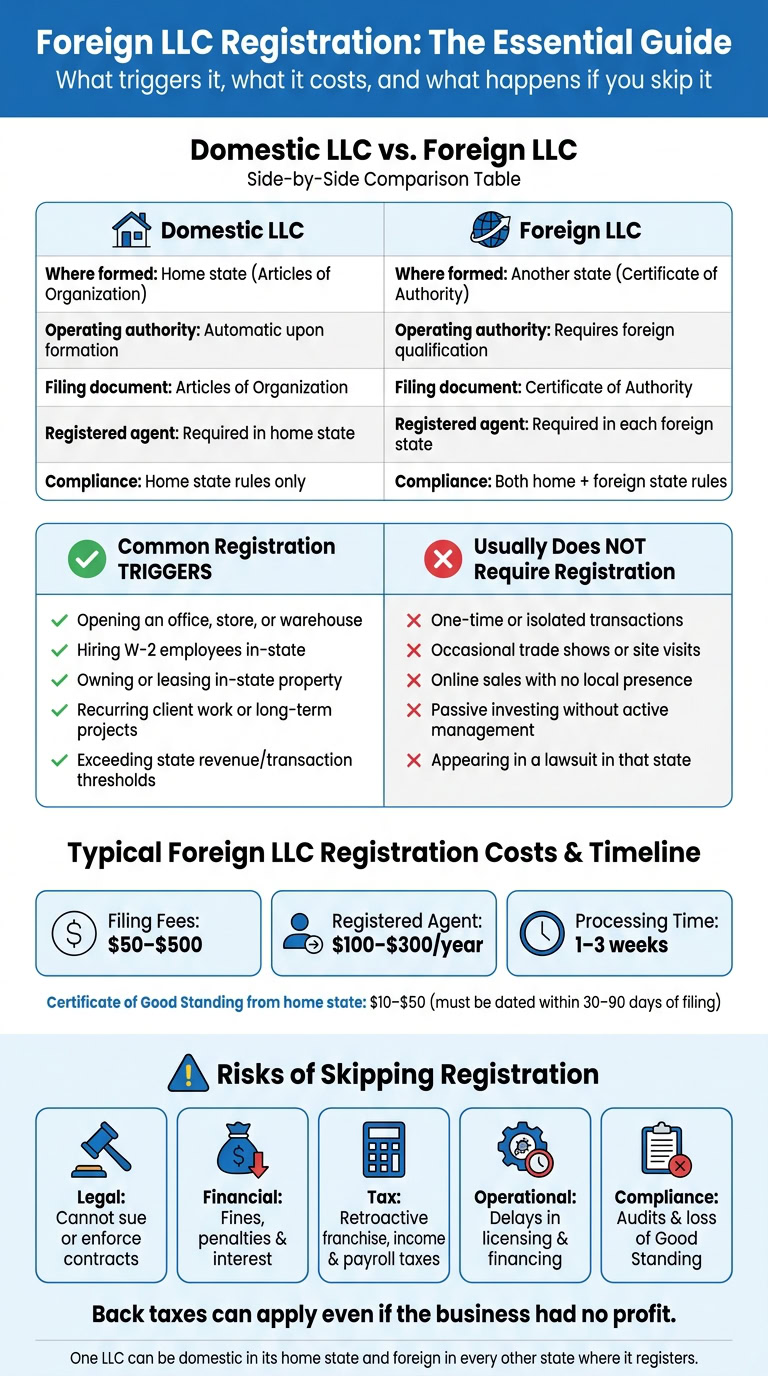
- opening an office, store, or warehouse
- hiring an in-state employee
- buying or leasing rental property
- doing repeat in-state work for clients
A few acts often do not trigger filing:
- one-time deals
- trade shows or short visits
- online sales with no local presence
- passive investing
- showing up in court
| LLC status | What it means | Where it applies |
|---|---|---|
| Domestic LLC | My LLC’s home state status | State where I formed the LLC |
| Foreign LLC | My LLC’s out-of-state registration status | Any other state where I register |
The main point: if my work in another state starts to look regular instead of occasional, I should check that state’s rules and file before problems start.
Foreign LLC vs. Domestic LLC: Key Differences & Registration Triggers
What a foreign LLC is and how it differs from a domestic LLC
Foreign LLC definition in plain English
In U.S. business law, "foreign" means out-of-state, not international.
"The name is misleading since it sounds like you’ll have international operations; however, in reality, it only gives you the right to operate in a different American state." – Rick Mak, Global Entrepreneur and Business Strategist
A foreign LLC is an LLC that was formed in one state and then registered to do business in another. The company itself stays the same. What changes is its status in the new state.
Here’s a simple example. If you form an LLC in Texas, it’s a domestic LLC in Texas. If that same business opens an office in Florida, it must register in Florida. Once it does, it becomes a foreign LLC in Florida while still staying domestic in Texas.
That process is called foreign qualification, and it gives the LLC permission to operate in that state.
This matters because one LLC can hold two statuses at the same time: domestic in the state where it was formed, and foreign in any other state where it has registered to do business.
Domestic LLC vs. foreign LLC: a side-by-side comparison
Here’s the day-to-day difference between the two.
| Feature | Domestic LLC | Foreign LLC |
|---|---|---|
| Where it was formed | The state where Articles of Organization were filed | A state other than where it was formed |
| Operating authority | Granted automatically upon formation | Granted through foreign qualification / a Certificate of Authority |
| Filing document | Articles of Organization | Certificate of Authority |
| Registered agent required | Yes, in the home state | Yes, in each state where it is foreign-qualified |
| Compliance obligations | Home state rules only | Both home state and foreign state rules |
Before most states approve foreign registration, they ask for a Certificate of Good Standing from the home state. This shows the LLC is up to date on taxes and annual filings.
Knowing this difference sets up the next issue: when a business actually has to register.
sbb-itb-ba0a4be
When you need to register a foreign LLC
States define "doing business" in different ways. So these are common triggers, not a one-size-fits-all rule.
Common triggers that require registration
For remote-first companies, the biggest triggers usually come down to people, property, and repeated in-state work.
A physical presence, like an office, storefront, or warehouse, will often trigger foreign registration. The same goes for owning or leasing property in the state.
Hiring employees is another common trigger. As Rick Mak notes:
"If you have W2 employees working in a state where your business is not registered, you will likely need to register as a foreign entity in that state."
Repeated client work can count too. Regular client meetings, long-term local projects, and recurring in-state contracts are all signs to watch. Some states also set revenue or transaction thresholds, even if you don’t have a physical location there.
| Activity Type | Common Registration Trigger |
|---|---|
| Physical | Office, storefront, or warehouse in the state |
| Real estate | Owning or leasing in-state property |
| Personnel | W2 employees or remote workers residing in-state |
| Operational | Recurring client meetings or long-term local projects |
| Financial | Exceeding state revenue or transaction thresholds |
Why does this matter? Because normal business activity can tip into "doing business" once it becomes regular and tied to a state.
A simple test for ongoing business activity
The key issue is whether your activity is ongoing, not just a one-off. Look for repeated, revenue-generating work connected to that state.
If your business has a fixed location, a person on the ground, or steady revenue there, registration is likely the safe assumption. If the answer feels murky, check that state’s filing rules before you begin. Not every in-state activity means you have to register, and the next section covers the common exceptions and what filing looks like when you do need to qualify.
When registration may not be required and how to file when it is
Activities that often do not trigger foreign registration
Start with the same people, property, and activity test from the last section. Then stack that against a few common exceptions.
The big point here is simple: not every out-of-state action means your LLC is "doing business" there.
Work that is isolated or light-touch often does not trigger foreign registration. That can include a one-time contract, an occasional trade show, or online sales into another state when you have no local presence there.
Here are some situations where registration is often not required:
- Isolated transactions
- Occasional site visits or trade shows
- Online sales across state lines with no local presence
- Passive investment without active management
- Appearing in a lawsuit in the state
That said, state rules can differ. One state may treat an activity as minor, while another may not. So before you lean on an exception, check the rules in the state where you plan to operate.
How foreign LLC registration works
If your activity in that state is steady, the next move is to file for authority there. In most cases, that means submitting an Application for Authority – often called a Certificate of Authority – with the state’s filing office.
Most states also ask for a Certificate of Good Standing from your home state. It usually needs to be dated within 30 to 90 days of your filing. You may also need a certified copy of your original Articles of Organization. And you’ll need a registered agent with a physical address in the destination state so legal notices have somewhere to go.
Costs vary by state, but here’s the usual range: filing fees are often $50 to $500, registered agent service runs about $100 to $300 per year, and a Certificate of Good Standing typically costs $10 to $50.
"Foreign registration takes 1-3 weeks." – Rick Mak, Global Entrepreneur and Business Strategist
Once you’re registered, the job isn’t over. You’ll still need to stay on top of multi-state annual reports, keep your registered agent in place, and handle state taxes in each state where the LLC operates.
Compliance risks, ongoing state duties, and key takeaways
What can happen if you do business before registering
Once your LLC starts operating in another state, skipping foreign registration can get expensive fast. You may face fines, tax backcharges, and limits on your right to enforce contracts there.
"Failure to register as a foreign entity can result in penalties, fines, and even restrictions on your ability to enforce contracts in that state." – Rick Mak, Global Entrepreneur and Business Strategist
Here’s what’s usually on the line:
| Risk Category | Potential Consequences |
|---|---|
| Legal | Cannot sue or enforce contracts |
| Financial | State-imposed fines, penalties, and interest on overdue fees |
| Taxation | Liability for retroactive franchise, income, and payroll taxes |
| Operational | Delays in financing, licensing, or expansion |
| Compliance | Risk of audits and loss of Good Standing status |
One point catches many owners off guard: back taxes can apply even if the business had no profit.
File on time, and you can avoid most of these problems. But registration isn’t a one-and-done task. You’ll also need to keep a registered agent with a physical address in the state, file annual or periodic reports by the deadline, and manage state payroll withholding and unemployment tax for employees there.
That last part matters a lot. If you hire an employee in a new state, that move can trigger foreign registration and payroll tax duties at the same time.
Final takeaway: know your triggers and register before problems start
The basic rule is pretty clear. Physical presence, employees, and repeated in-state work are the clearest signs that registration is required. A foreign LLC must register before it does business in another state.
If your LLC is already active in another state, registration helps protect your right to keep operating there. File before you expand. And once your work in that state starts looking regular instead of occasional, don’t wait until the state tells you that you crossed the line.
FAQs
Does a remote employee in another state count as doing business?
Yes – having a remote employee in another state can count as doing business there and can trigger foreign LLC registration.
If you have W-2 employees working in another state, you’ll likely need to register there. States usually look at whether your company has a meaningful presence, including how regular and substantial those in-state ties are.
Can I register the same LLC in multiple states?
Yes. You can operate in more than one state with the same LLC by getting foreign qualification in each new state.
That gives your current LLC the legal right to do business there without setting up a separate company. You’ll still need to follow each state’s rules, which usually include having a registered agent, filing annual reports, and handling state taxes.
What happens if I register late as a foreign LLC?
Registering late as a foreign LLC can create both financial and legal trouble.
On the money side, the business may owe fines, interest, unpaid state fees, and back taxes. Those costs can stack up fast.
The legal side can hurt just as much. An unregistered business may lose the right to use state courts to enforce contracts. That means if a deal goes sideways, the company could have a much harder time getting help through the legal system.
Some states go even further. The business could face:
- Frozen bank accounts
- Revoked permits
- Personal liability for business officers
That’s a rough spot to be in, especially when a late filing can snowball into problems that hit day-to-day operations.