

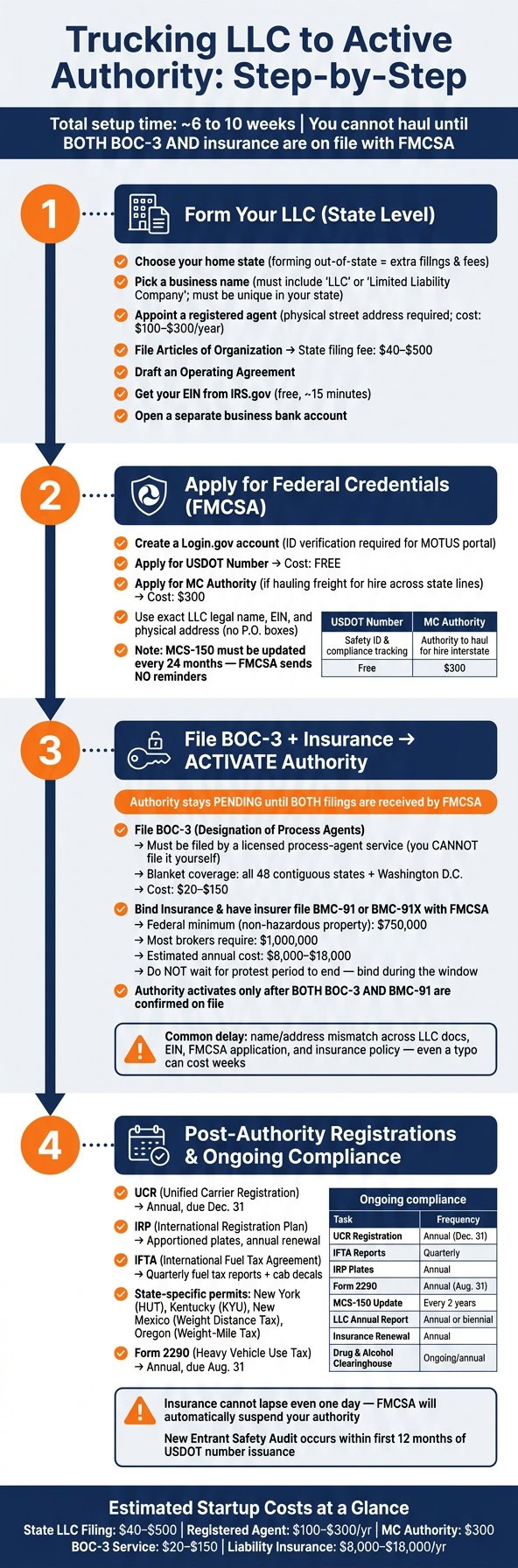
If I want to run under my own authority, I need more than just an LLC. I have to form the LLC with my state, get an EIN, apply for a USDOT number and MC authority, file a BOC-3, add insurance, and finish tax and plate filings like UCR, IRP, IFTA, and Form 2290. In most cases, the whole setup takes about 6 to 10 weeks, and I can’t haul under my own authority until FMCSA has both my BOC-3 and insurance filing on record.
Here’s the short version:
- LLC first: My business name must match across state and FMCSA records.
- Federal filings next: I apply for a USDOT number and, if I haul freight for hire across state lines, MC authority.
- BOC-3 is required: A process-agent service files it for me. I can’t file it myself.
- Insurance turns the key with BOC-3: My authority stays pending until FMCSA gets my insurance filing too.
- Setup doesn’t end at activation: I still need UCR, IRP, IFTA, state permits, Form 2290, MCS-150 updates, and LLC reports.
A few numbers matter right away. State LLC filing fees often range from $40 to $500. MC authority costs $300. A registered agent often costs $100 to $300 per year. BOC-3 service often runs about $20 to $150. New carrier liability insurance can land around $8,000 to $18,000 per year, and many brokers want $1,000,000 in coverage even though the federal minimum for non-hazardous property is $750,000.
The big point: forming the LLC is just the first step. Getting active authority is a sequence, and if my name, address, EIN, insurance, and FMCSA records don’t match exactly, I can lose time fixing errors that were easy to avoid.
That’s what this guide walks through: the full path from state LLC filing to active trucking authority, plus the filings I need to keep the business on the road.
Step 1: Form your trucking LLC at the state level
Your LLC name needs to match every federal filing exactly. Your USDOT number, MC authority, and BOC-3 should all show the precise name on your state paperwork. Start with the entity first. Then move to federal registration.
Choose your state, business name, and registered agent
For most owner-operators, forming in your home state is the simplest route. If you form outside the state where you operate, you’ll still need to register the LLC in that operating state. That means extra filings, annual reports, and fees.
Your business name must include a designator like "LLC" or "Limited Liability Company" and must be different from other entities already registered in your state. After you choose a name, you need a registered agent. This is a person or service with a physical street address, not a P.O. box, in your formation state who can receive legal papers and government notices for you.
If you’re an over-the-road driver, acting as your own registered agent can be a bad bet. You could be halfway across the country when a lawsuit or state notice shows up. A professional registered agent service usually costs $100–$300 per year. It can also keep your home address off public records.
A virtual mailbox can help too. For remote business owners, it lets you get mail scanned and sent to you online wherever you are. One thing to keep straight: a registered agent handles state notices, while a BOC-3 process agent handles federal service of process later. They are not the same thing, and that state address is separate from the federal process-agent filing you’ll deal with later.
File the LLC, create core documents, and get an EIN
Filing your Articles of Organization is what creates the LLC. These articles list the LLC name, registered agent, and management structure. State filing fees can range from $40 to $500, depending on where you form.
Once the state approves your LLC, put together an operating agreement. Even if you have a single-member LLC, this document matters. It helps show that the business is separate from you as an individual.
Next, apply for an EIN (Employer Identification Number) from the IRS. It’s free, takes about 15 minutes online at IRS.gov, and you’ll need it to open a business bank account, file taxes, and apply for carrier authority.
Open a separate business bank account right away. Mixing personal and business money can weaken your liability shield.
With the LLC set up, your EIN in hand, and your finances separate, you’re ready to move to USDOT and MC authority.
Step 2: Apply for USDOT and MC authority under your LLC
With your LLC and EIN in place, the next move is to register with FMCSA for the federal credentials you need to operate. After that, you’ll deal with the filings that turn your authority on: BOC-3, insurance, and the FMCSA activation process.
Determine which FMCSA registrations your operation needs
If you haul freight across state lines for hire, you’ll usually need both a USDOT number and MC authority.
| Registration | Purpose | Cost | Who Needs It |
|---|---|---|---|
| USDOT Number | Federal safety identification and compliance tracking | Free | Interstate commercial carriers |
| MC Authority | Authority to haul freight for hire across state lines | $300 | For-hire interstate carriers |
These two registrations do different jobs, and in many cases, you need them together.
Submit the FMCSA application and track MCS-150 obligations
FMCSA filings now go through MOTUS, and you’ll need a Login.gov account with ID verification to get access.
When you fill out the application, use your LLC’s exact legal name, EIN, and a physical business address, not a P.O. box (though you can use a virtual address for your LLC). For most general freight owner-operators, the right operation type is Carrier – Property. If the name or address on your FMCSA filing doesn’t match your insurance or EIN records, approval can get held up.
The application also includes MCS-150 details. You must update that form every 24 months during your USDOT anniversary month. FMCSA does not send reminders, so you need to track that date yourself. If you miss the update, your USDOT number can be deactivated.
Once those federal filings are moving, the next hurdle is BOC-3 and insurance.
Step 3: File BOC-3, add insurance, and activate your authority
Getting MC authority does not mean you can start hauling right away. Your authority stays in "Pending" status until FMCSA has two filings on record: a BOC-3 and proof of insurance. Both need to be filed before the protest period ends. At this stage, those are the last two items between you and active authority.
| Filing | Who Files It | When It Is Due | What Happens If Missing |
|---|---|---|---|
| BOC-3 | Licensed process agent | After the MC application, before activation | MC authority remains in "Pending" status; you cannot legally haul |
| Insurance (BMC-91/91X) | Insurance company | After the MC application, before activation | MC authority will not activate |
What the BOC-3 filing does and how a process agent handles it
Form BOC-3, the Designation of Process Agents, names a process agent in each state to receive legal papers and lawsuits. You can’t file this form on your own. A licensed process-agent service has to submit it electronically.
Most owner-operators go with a blanket process-agent service. That usually covers all 48 contiguous states plus Washington, D.C., for one fee. In most cases, the price falls between $20 and $150, depending on the provider.
When you’re picking a service, focus on a few basics:
- Nationwide coverage
- Electronic filing
- Dependable document forwarding
That last point matters more than it may seem. If a lawsuit or compliance notice shows up while you’re out on the road, your process agent gets it and passes it along. A service that scans and uploads documents online can save a lot of hassle.
Insurance filings and the sequence for going active
After the BOC-3 is filed, insurance is the last step before activation. Your insurer files the proof of coverage with FMCSA for you. For for-hire interstate motor carriers hauling non-hazardous property, that means Form BMC-91 or BMC-91X for public liability. Household goods movers also need Form BMC-34 for cargo.
The federal liability minimum for non-hazardous property is $750,000, but many brokers want to see $1,000,000 before they’ll give you a load.
Plan your budget with that in mind. New-carrier liability insurance often costs between $8,000 and $18,000 per year. The usual flow is simple: apply for authority, then file the BOC-3 and bind insurance during the protest period. Don’t sit back and wait for that period to end before you start calling insurers. Bind coverage during that window so your insurer can file right away.
Common filing mistakes that delay activation
Most activation delays come down to one issue: details that don’t match. Your LLC’s legal name and address need to be the same across your state formation documents, EIN records, FMCSA application, and insurance policy. Even a small typo can lead to a rejection and cost you weeks.
Another slip-up is thinking the BOC-3 by itself turns your authority on. It doesn’t. FMCSA also needs your insurance filing on record. And if your address changes, update FMCSA right away so everything stays lined up.
sbb-itb-ba0a4be
Step 4: Handle post-authority registrations and ongoing compliance
Once your MC authority is active, you’re not done yet. This is the point where you wrap up the state registrations and renewals that keep your truck legal on the road.
UCR, IRP, IFTA, and state-level permits
After activation, these are the first state and multistate filings to finish.
Unified Carrier Registration (UCR) is an annual fee program for interstate carriers. It’s due by December 31 each year before you operate across state lines.
International Registration Plan (IRP) gives you apportioned plates that are accepted across member jurisdictions. Your fees depend on the share of miles you expect to run in each state and your vehicle’s weight.
International Fuel Tax Agreement (IFTA) covers multi-state fuel tax reporting. You’ll need to display IFTA decals on your cab and file quarterly reports showing fuel purchases and miles driven in each state.
Some states also have their own permits. New York (HUT), Kentucky (KYU), New Mexico (Weight Distance Tax), and Oregon (Weight-Mile Tax) each require separate filings. If those states are part of your regular lanes, get the permits in place before you cross into them. It’s one of those things that’s easy to ignore until it turns into a roadside problem.
Annual LLC, FMCSA, and safety compliance routines
Once the road-use filings are done, the next job is staying on top of renewals that keep your authority active.
| Requirement | Frequency |
|---|---|
| UCR Registration | Annual (due Dec. 31) |
| IFTA Fuel Tax Reports | Quarterly |
| IRP Apportioned Plates | Annual |
| Form 2290 (HVUT) | Annual (due Aug. 31) |
| MCS-150 Update | Every 2 years |
| LLC Annual Report | Annual or biennial |
| Drug & Alcohol Clearinghouse | Ongoing / annual query |
| Insurance Renewal | Annual |
A few of these need close attention.
Insurance can’t lapse for even one day. If your coverage drops, FMCSA will automatically suspend your operating authority right away. Your MCS-150 also needs an update every 24 months, or within 30 days of any major change in your address, fleet size, or business name.
On the LLC side, most states require an annual report with the Secretary of State. California, for example, has a minimum $800 franchise tax each year.
It also helps to keep your registered agent active and easy to reach. If you’re an owner-operator who spends a lot of time out of state, a professional registered agent can make sure legal notices and compliance documents don’t slip through the cracks.
For safety compliance, set up a digital record system from day one. Keep your driver qualification files, hours-of-service logs, vehicle maintenance records, and drug and alcohol testing results organized and easy to pull up. FMCSA’s New Entrant Monitor Program lasts 18 months, and a safety audit takes place within your first 12 months after getting a USDOT number. If your records are already clean and in order, that audit gets a lot less stressful.
Conclusion: A launch checklist from LLC to active authority
Starting a trucking LLC and getting operating authority is a step-by-step process. The main goal at this stage is simple: keep the order tight and don’t leave any gaps between filings.
Use this launch order:
- Form the LLC and appoint a registered agent
- Get an EIN from the IRS
- Apply for USDOT and MC authority through FMCSA
- File BOC-3 through a blanket process agent
- Bind insurance and have your insurer file BMC-91/91X with FMCSA
- Complete UCR, IRP, IFTA, state permits, and Form 2290
One point is worth saying again: BOC-3 is required, but it does not make your authority active on its own. Your authority goes active only after both the BOC-3 and the BMC-91 insurance filing are on file with FMCSA. If you try to operate before that happens, you’re not active yet.
After activation, the focus moves from setup to upkeep. Keep up with renewals, stay organized with driver qualification files and maintenance records, and be ready for the new-entrant safety audit. Clean records from day one make audits and renewals much easier.
FAQs
Can I start hauling with just an LLC?
No. Forming an LLC is an important first step when you set up your business and help shield your personal assets, but it does not give you legal permission to haul freight for hire.
You also need:
- a USDOT number
- active MC authority
- a filed BOC-3
- proof of required commercial insurance
Your authority won’t become active until those items are in place.
How long does it take for authority to become active?
From LLC formation to being legally ready for your first load, the process usually takes 6 to 12 weeks.
For your authority, it only becomes active after the FMCSA’s 10- to 21-day protest period ends and your BOC-3 and proof of insurance are on file.
What filings do I still need after my MC is active?
Once your MC authority is active, the paperwork doesn’t stop. You still need to stay on top of federal and state rules to keep your operation in good standing.
That usually means keeping up with a handful of core items:
- Keep your BOC-3 current
- Complete annual Unified Carrier Registration
- File IRS Form 2290 and meet IFTA fuel tax reporting requirements
- Stay current on IRP apportioned plates and any state weight-distance taxes
- Be ready for the FMCSA New Entrant Safety Audit within your first 12 months
Miss one of these, and small admin issues can turn into a big headache fast.