


Mixing business and personal money can cost you time, tax deductions, and even legal protection. If you run an LLC or corporation, poor separation can help a court argue that your business was not treated as separate. In one court case noted in the article, that helped expose an owner’s personal assets to a $180,000 business debt.
Here’s the short version: I keep business and personal finances apart by using a business bank account, a business card, a set pay method, and clean monthly bookkeeping. That makes taxes easier, gives me a clearer view of cash flow, and leaves a better paper trail if the IRS asks for records from the last 3 years – or up to 6 years in some cases.
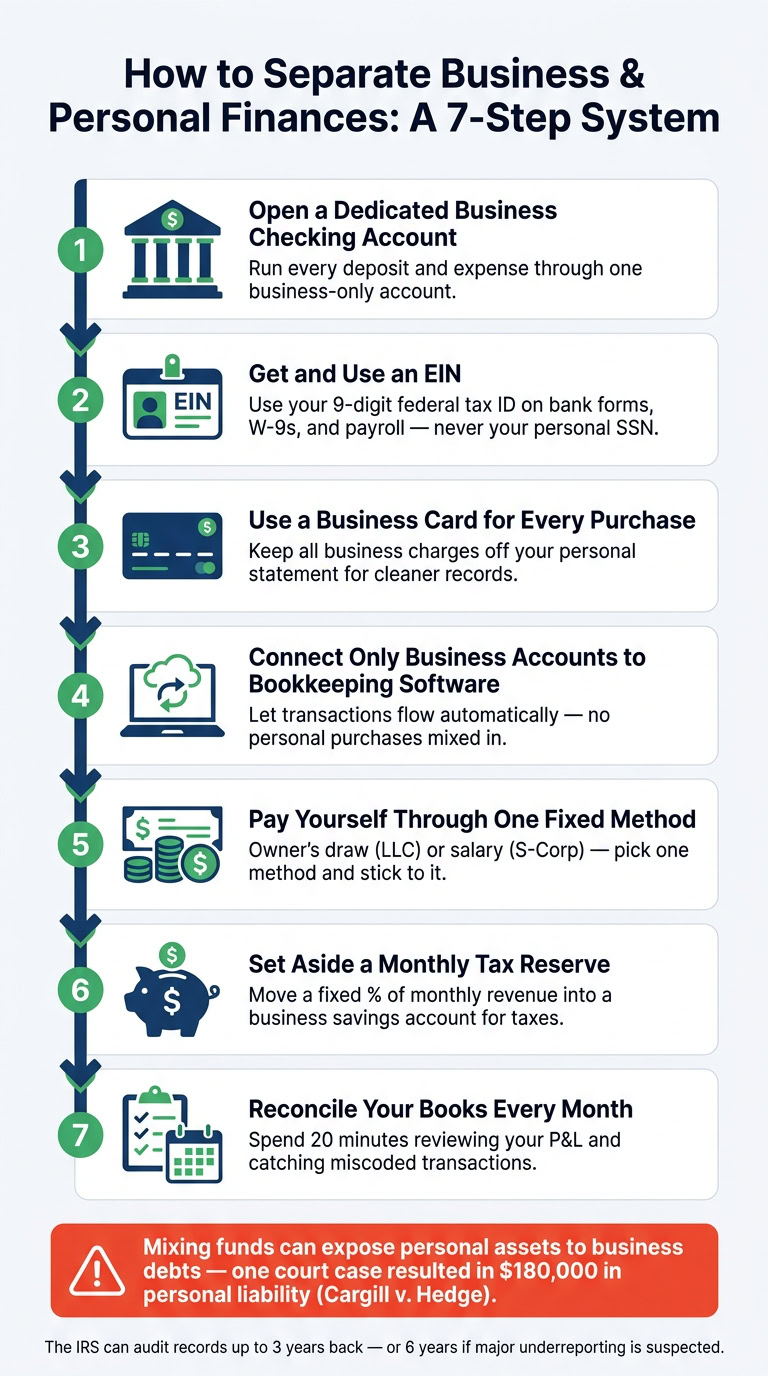
If I wanted the simplest possible system, I’d do this:
- Open a dedicated business checking account
- Get and use an EIN on bank forms, W-9s, and payroll
- Put every business purchase on a business debit or credit card
- Connect only business accounts to accounting software
- Pay myself through a fixed owner draw or salary
- Keep receipts and short notes for reimbursements, mixed-use costs, and startup expenses
- Move part of revenue into a tax reserve every month
A few rules matter most:
- Do not pay personal bills from the business account
- Do not send business income into your personal account
- If I make a mistake, I record it the right way, such as an owner draw or reimbursement
- If I loan money to the business, I put the terms in writing
| Area | What I do | Why it matters |
|---|---|---|
| Banking | Use a business-only checking account | Keeps deposits and spending separate |
| Spending | Use a business-only card | Makes records cleaner |
| Pay | Use one set method for owner pay | Stops random transfers |
| Books | Reconcile each month | Catches mixed charges and missing receipts |
| Taxes | Set aside money for taxes | Helps avoid cash crunches |
Bottom line: if I treat the business like its own money system, my records stay cleaner, tax filing gets easier, and the wall between personal and business funds stays in place.
Why Keeping Finances Separate Protects Your Business
Mixing business and personal money creates more than a messy set of books. It can put your legal protection at risk and make tax time a lot harder than it needs to be.
Liability Protection for LLCs and Corporations
An LLC or corporation helps put a line between your personal assets and your business debts. But that line only holds up if you treat the business like its own legal and financial entity.
Once owners start paying personal bills from business accounts or sending business income into personal accounts, that separation starts to fall apart. And if a dispute ends up in court, a judge may decide the business was never run as a separate entity at all.
That’s where piercing the corporate veil comes in. If that happens, your personal assets may be exposed in a lawsuit or debt claim.
In Cargill v. Hedge, the owner mixed personal rent, personal deposits, and business income, and the court pierced the veil and exposed the owner’s personal assets to a $180,000 business debt.
That’s the first big reason to keep things separate.
Tax Compliance and Audit-Ready Records
Separate accounts also make tax reporting much cleaner. When personal and business transactions are tangled together, it gets much harder to show which expenses were actually for the business. That opens the door to mistakes, missed deductions, and weak backup if the IRS asks questions.
If business income goes into a personal account, expenses are also easier to overlook. A separate business account gives you a cleaner paper trail, which makes year-end reporting much easier.
The IRS can request documentation going back 3 years in a routine audit, and up to 6 years if the IRS suspects major underreporting.
| Risk from mixing funds | Why it matters |
|---|---|
| Liability exposure | Can weaken the LLC/corporation shield and invite veil-piercing arguments |
| Tax/audit problems | Makes deductions harder to substantiate and records harder to defend |
The fix is pretty simple: keep separate accounts, use a dedicated EIN, and set clear spending rules.
sbb-itb-ba0a4be
How to Set Up the Right Financial Accounts and Tax ID
Open a business checking account, get an EIN, and use separate business cards. Those three pieces make it much easier to keep business money apart from personal spending and to track what’s going on. Start with the bank account, then add the EIN and cards so each transaction flows through one system.
Open a Dedicated Business Bank Account
Run every business deposit and expense through the business account.
To open a business checking account, U.S. banks usually ask for a small set of standard documents. The exact list depends on how your business is set up: Entity Type Tax ID Required Formation document Other required documents
You’ll also need a government-issued photo ID for each owner. Some banks ask for a business license based on your industry and location.
One useful tip: check whether the bank offers sub-accounts or “buckets” inside the same account. That can help you set money aside for quarterly taxes or equipment without opening another account.
Apply for an EIN and Use It Consistently
Once the account is open, connect it to the business tax ID.
An EIN is a nine-digit federal tax ID issued by the IRS. Banks need it to open most business accounts, and vendors use it on W-9 forms instead of your personal SSN. You can apply for one at no cost on the IRS website, and the EIN is issued right away. After you get it, use it the same way everywhere – bank applications, W-9 forms, payroll, and any other form that asks for a tax ID.
Use a Separate Business Card for Every Business Purchase
With the account and EIN in place, shift all spending to a separate business card.
Use a business debit or credit card for every business purchase. That keeps charges off your personal statement and makes bookkeeping a lot simpler.
Daily Habits That Keep Business and Personal Finances Apart
Setting up the right accounts is just the start. The part that keeps your books clean is what you do day to day after that.
Connect Bookkeeping Tools Only to Business Accounts
Connect only business bank accounts and business cards to your bookkeeping tool. That way, business transactions flow straight into your books without dragging personal purchases in with them.
Once the feed is live, sort transactions as they come in instead of letting them stack up. It’s a lot easier to deal with a few items each week than a messy backlog later.
If a personal charge lands on the business account by mistake, don’t mark it as a business expense. Record it as an owner draw or distribution so it doesn’t end up lowering business income on paper. Then reconcile your accounts every month and look for:
- mixed charges
- missing receipts
- duplicate entries
Once those accounts are connected, the next move is to control how money goes in and out.
Set Clear Rules for Owner Draws, Salary, and Reimbursements
Paying yourself through one fixed method helps stop business money from turning into everyday personal spending. The setup depends on your entity: single-member LLCs usually take owner’s draws, while S-Corp owners need a reasonable salary run through payroll.
| Pay Method | Best Fit | Key Note |
|---|---|---|
| Owner’s Draw | Owners with variable income | Flexible, but can create year-end tax pressure |
| Salary | Owners who need predictable pay | Requires steady cash flow |
| Combination | Owners who want consistency plus flexibility | Requires strict documentation to distinguish each type |
Whatever method you use, treat it like a paycheck. Pick a fixed transfer schedule and move only that amount from business to personal. That helps you avoid dipping into the business account whenever life throws you a bill.
The same rule applies to reimbursements. If you pay for a business cost with your personal card, use a simple process:
- save the receipt
- add a short note with the vendor name, date, amount, and business purpose
- transfer that exact amount from the business account to your personal account
- record it as a reimbursement in your bookkeeping software
Do it right away. Waiting too long is how details get fuzzy and records fall apart.
"If you would struggle to explain the expense clearly six months from now, write a short note today." – Provident CPAs
Direct Business Spending vs. Out-of-Pocket Reimbursement: A Side-by-Side Look
When a business cost hits your personal card, reimbursement usually creates the cleanest trail back to the business. Still, it’s best used only when needed. Here’s the side-by-side view:
| Feature | Direct Business Spending | Out-of-Pocket Reimbursement |
|---|---|---|
| Separation Clarity | High; transactions never touch personal accounts | Moderate; requires manual untangling of personal statements |
| Administrative Effort | Low; automated via bank feeds and software | High; requires manual entry, receipt submission, and fund transfer |
| Cash-Flow Impact | Immediate; reflected in business balance instantly | Delayed; business cash is only impacted when reimbursement occurs |
| Recordkeeping Strength | Strongest; creates a direct, clean audit trail | Moderate; relies on the quality of manual documentation and receipts |
How to Keep Your Financial System Clean Month After Month
Set Aside a Tax Reserve and Review Monthly Reports
Once your accounts are split, the next job is keeping them that way each month.
Move a fixed share of your monthly revenue into a business savings account for federal, state, and self-employment taxes. That tax reserve is much easier to manage when you pair it with a short month-end check-in. Spend 20 minutes reviewing your profit and loss report and looking for miscoded transactions.
This is where small problems show up early. A charge labeled “Amazon” or “Restaurant” can be hard to sort out in March if it happened back in July. At month-end, it’s still familiar, so fixing it takes far less effort. For each deduction, keep records that show the amount, date, vendor, and business purpose.
Handle Edge Cases Without Breaking Separation
Exceptions happen. The goal isn’t to pretend they won’t. It’s to document them without mixing personal and business spending.
A few cases tend to trip people up:
- Startup expenses paid before your business account was open. Track those pre-launch costs in your personal account, then reimburse yourself once the business account is open.
- Mixed-use costs like a phone plan or home office. Deduct only the business-use share. Write a short note showing how you calculated the split while it’s still clear in your mind. As Provident CPAs put it:
"If you would struggle to explain the expense clearly six months from now, write a short note today."
- Loans between you and the business. Put the terms in writing, including the repayment schedule and interest rate. If you skip that paperwork, the IRS can treat the transaction as a distribution or contribution instead, which changes the tax treatment.
| Transaction Type | Documentation Required | Bookkeeping Entry |
|---|---|---|
| Owner Loan | Written agreement, interest rate, repayment schedule | Liability (Loan Payable) |
| Owner Draw | Transfer record between accounts | Equity (Owner’s Draw) |
| Reimbursement | Original receipt + business purpose note | Expense (e.g., Office Supplies) |
| Capital Contribution | Note in operating agreement or meeting minutes | Equity (Owner’s Contribution) |
| Startup Expense | Receipt from personal account | Reimbursement / Expense |
Conclusion: A Simple System for Cleaner Business Finances
A clean setup usually comes down to a few repeatable habits: open a dedicated business bank account, use a dedicated business debit or credit card for business spending, connect only those accounts to your bookkeeping software, and pay yourself through a fixed draw or regular salary.
When you stick with that system, it helps protect your liability protection by keeping personal and business finances separate. It also makes tax filing easier because your records stay organized and audit-ready, and it gives you a clearer view of cash flow based on separate accounts, steady owner pay, and documented exceptions.
FAQs
Do sole proprietors need a separate business bank account?
Yes. Even though a sole proprietorship isn’t a separate legal entity, a dedicated business bank account is key for clean records, tax compliance, and a clearer view of cash flow.
When you mix personal and business money, bookkeeping gets messy fast. It can also make tax filing harder and put your business deductions at risk. A separate account keeps your finances clear and professional.
What should I do if I accidentally mix personal and business expenses?
Correct the records right away to help protect compliance and limit liability issues. Save the receipt, note the business purpose, and classify the transaction the right way.
If you paid a business expense with personal funds, reimburse yourself from your business account and record it as a reimbursement. If a personal expense was paid from your business account, record it as an owner draw.
A monthly account review helps catch these issues before they pile up. And if things start to get messy, bring in a professional bookkeeper.
How much should I set aside each month for taxes?
Open a dedicated business savings account for tax and payroll reserves. How much you should park there will depend on your income, profit margins, and business structure.
The smart move is simple: keep clean books and reconcile your accounts every month. That gives you a running view of what you may owe in taxes during the year, instead of getting blindsided later.
For the exact percentage to set aside, talk with a licensed tax professional.